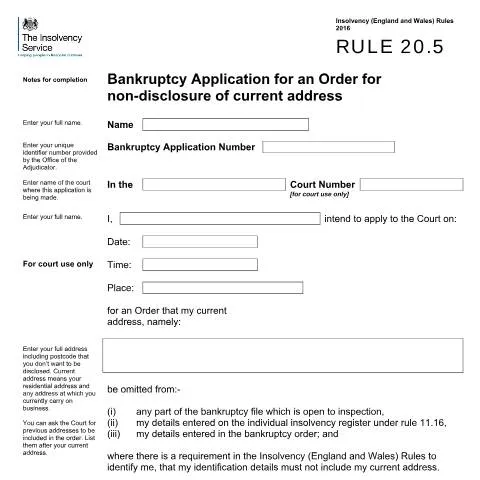
When Personal Safety Meets Financial Ruin: The Hidden Address Protection Application
In the stark reality of bankruptcy proceedings, where financial transparency typically reigns supreme, there exists a crucial exception designed to protect those whose very safety hangs in the balance. The Rule 20.5 bankruptcy application for an order for non-disclosure of current address represents a vital safeguard within England and Wales' insolvency framework, allowing individuals to shield their whereabouts from public scrutiny when disclosure could expose them to genuine threats of violence.
This specialised application operates within the broader bankruptcy process, creating a protective bubble around personal location details whilst maintaining the essential transparency required by insolvency law. Unlike standard bankruptcy procedures where addresses become part of the public record, this mechanism acknowledges that some debtors face circumstances where revealing their location could prove dangerous or even life-threatening.
The application emerges from Rule 20.5 of the Insolvency (England and Wales) Rules 2016, forming part of a comprehensive legal framework that balances public accountability with individual protection. For those caught between financial collapse and personal safety concerns, understanding this process becomes not merely administrative necessity but potentially a matter of survival.
The Vulnerable Applicant Profile: Who Seeks Address Concealment
The typical applicant for Rule 20.5 protection presents a complex profile where financial distress intersects with serious safety concerns. Domestic violence survivors represent a significant proportion of applicants, particularly those whose financial difficulties stem directly from abusive relationships. These individuals often face bankruptcy as a consequence of economic abuse, joint debts accumulated during the relationship, or financial isolation imposed by their abuser.
Business owners who have received creditor threats form another substantial category. When commercial ventures fail, particularly in volatile sectors or contentious circumstances, some creditors may resort to intimidation tactics that extend beyond legitimate debt recovery. Directors of failed companies sometimes find themselves targeted not just legally but personally, with threats extending to family members.
Individuals involved in witness protection schemes or those who have provided evidence in serious criminal cases may also require address concealment during bankruptcy proceedings. Their financial difficulties might be entirely separate from their security concerns, yet the intersection creates a dangerous vulnerability that standard bankruptcy procedures would exacerbate.
Professional and Personal Risk Categories
Healthcare professionals, social workers, and others in public-facing roles occasionally face threats from service users or their families. When these professionals encounter financial difficulties requiring bankruptcy proceedings, their occupational exposure to potentially violent individuals creates additional layers of risk that standard address disclosure would amplify.
Family members of high-profile individuals or those connected to controversial cases may find themselves seeking protection. The ripple effects of public attention can create unexpected vulnerabilities, particularly when financial difficulties become public knowledge through bankruptcy proceedings.
The Court Application Journey: From Initial Concern to Judicial Decision
The process begins with a recognition that standard bankruptcy procedures pose an unacceptable risk. Applicants must first obtain their bankruptcy application number from the Office of the Adjudicator, establishing their position within the formal insolvency process before seeking address protection.
Court selection follows specific jurisdictional rules, typically aligning with either the applicant's location or where the main bankruptcy proceedings will be heard. The application form itself requires careful completion, with particular attention to the comprehensive address details that the applicant wishes to conceal. This includes not only residential addresses but also any business premises where the applicant currently operates.
| Application Stage | Key Requirements | Timeline Considerations |
|---|---|---|
| Initial Preparation | Bankruptcy number from Adjudicator | Must be obtained before Rule 20.5 application |
| Court Filing | Completed form plus witness statement | Should precede main bankruptcy hearing |
| Judicial Review | Evidence of violence risk | Court sets hearing date and time |
| Decision Implementation | Court order integration | Affects all subsequent proceedings |
The court hearing represents the crucial decision point where judicial discretion determines whether protection is warranted. Applicants who fail to attend face the risk of the court making whatever order it deems appropriate, potentially including rejection of the application or partial protection only.
Crafting the Compelling Witness Statement: Evidence That Convinces
The witness statement accompanying the Rule 20.5 application carries the entire weight of the applicant's case. This document must demonstrate that disclosure of address details would reasonably be expected to lead to violence against the applicant or family members residing with them. The standard of evidence required goes beyond mere concern or general anxiety, demanding concrete basis for fear.
Effective witness statements typically include chronological accounts of threatening behaviour, documented evidence of past violence, and clear connections between the applicant's financial situation and the sources of threat. Police reports, restraining orders, medical records of injuries, and witness accounts from neighbours or colleagues can all contribute to building a compelling case.
Structuring Evidence for Maximum Impact
The witness statement must follow specific formatting requirements, with clearly numbered paragraphs on numbered pages. Court name and number must appear prominently, alongside the applicant's full name and address. The evidence should progress logically, establishing the threat source, demonstrating its credibility, and linking it directly to the address disclosure that bankruptcy proceedings would normally require.
Recent incidents carry more weight than historical events, though patterns of behaviour spanning longer periods can demonstrate persistent risk. Specific threats referencing the applicant's financial difficulties or bankruptcy proceedings provide particularly strong evidence, as they directly connect the safety concerns to the insolvency process.
The mandatory concluding paragraph—"I believe that the facts stated in this witness statement are true"—followed by signature and date, carries legal significance. False statements in witness evidence can result in contempt of court proceedings, emphasising the importance of accuracy and honesty throughout.
The Three-Tier Protection: Understanding What Gets Hidden
Rule 20.5 orders create comprehensive address concealment across three distinct areas of the bankruptcy process. Understanding these layers helps applicants appreciate the full scope of protection available and ensures they request appropriate coverage for their circumstances.
The first tier involves bankruptcy file inspection rights. Normally, creditors and members of the public can inspect substantial portions of bankruptcy files, including debtor addresses. A successful Rule 20.5 application removes address details from any part of the file open to inspection, preventing casual discovery by those with access rights.
The second protection layer covers the individual insolvency register maintained under Rule 11.16. This public database typically includes debtor addresses as part of the transparency measures surrounding insolvency proceedings. The non-disclosure order ensures that protected addresses do not appear in these public records, maintaining anonymity even for those conducting specific searches.
The third tier affects the bankruptcy order itself, the formal court document that declares the individual bankrupt. These orders normally include address details as part of the debtor identification process. Rule 20.5 protection extends to ensuring that even this fundamental legal document omits the protected address information.
Extended Protection Scope
Beyond current addresses, applicants can request protection for previous addresses where safety concerns persist. This might include former family homes where relatives still reside, previous business premises that remain connected to the applicant, or temporary addresses used during periods of hiding or relocation.
The protection extends to any requirement within the Insolvency Rules to identify the applicant, creating a comprehensive shield that prevents address disclosure through any procedural requirement. This broad coverage ensures that protective orders cannot be circumvented through technical compliance with other identification requirements.
Strategic Timing and Procedural Coordination
The timing of Rule 20.5 applications requires careful coordination with the broader bankruptcy process. Ideally, applicants should seek address protection before the main bankruptcy proceedings commence, ensuring that protective measures are in place from the outset rather than attempting to retrospectively conceal information that may already have entered the public domain.
However, practical circumstances often prevent perfect timing. Individuals may not recognise the safety implications of address disclosure until after beginning bankruptcy proceedings, or new threats may emerge during the process. The Rules accommodate these situations, though earlier applications generally prove more straightforward to implement.
Court scheduling creates additional timing considerations. The application must specify the intended court appearance date, though the court ultimately determines hearing times and locations. This creates a coordination challenge, particularly for applicants managing multiple legal proceedings or those with restricted mobility due to safety concerns.
Integration with Bankruptcy Timeline
The bankruptcy process follows its own strict timeline, with various disclosure requirements and deadlines that cannot be delayed pending Rule 20.5 decisions. Successful applicants must ensure that their protective orders integrate seamlessly with these existing requirements, avoiding procedural conflicts that could compromise either their bankruptcy or their safety.
Trustees and official receivers must be notified of address protection orders to ensure compliance across all aspects of the bankruptcy administration. This notification process requires careful handling to maintain confidentiality whilst ensuring all relevant parties understand their obligations.
Beyond the Order: Living with Protected Status
Successful Rule 20.5 applicants enter a complex administrative landscape where their protected status must be maintained across all aspects of their bankruptcy proceedings. This extends beyond simple address omission to encompass ongoing correspondence, trustee communications, and creditor interactions throughout the bankruptcy period.
Practical challenges emerge around service of documents and legal communications. Alternative arrangements must be established for receiving important notices, court documents, and trustee correspondence. This might involve solicitor addresses, secure post office boxes, or other arrangements that maintain communication whilst preserving address confidentiality.
The protection order affects creditor meetings and other proceedings where the bankrupt would normally be expected to attend. Special arrangements may be necessary to facilitate participation whilst maintaining address secrecy, potentially including remote attendance options or alternative venues.
Long-term Implications and Review
Address protection orders typically remain in force throughout the bankruptcy period, but circumstances may change requiring review or modification. New threats might emerge requiring extended protection, or original concerns might diminish allowing for relaxation of restrictions.
The discharge process requires careful consideration of whether address protection remains necessary. Some applicants may need ongoing concealment even after bankruptcy discharge, whilst others may feel safe to resume normal address disclosure as their financial situation stabilises and threat sources dissipate.
Record-keeping becomes crucial for protected individuals, who must maintain clear documentation of their circumstances should future review or challenge of their protective status arise. The intersection of insolvency law and personal safety creates ongoing administrative obligations that extend well beyond the initial court application.
Navigating Complex Family and Business Structures
Rule 20.5 applications become particularly intricate when family members or business associates share the same addresses that require protection. The application specifically covers family members who live with the applicant, but determining the scope of this protection requires careful consideration of household arrangements and dependency relationships.
Adult children living in the family home, elderly relatives under the applicant's care, or domestic partners may all benefit from the address protection, but each relationship creates different legal and practical considerations. The court must understand these household dynamics to craft appropriate protective measures that safeguard all vulnerable individuals without creating unnecessary restrictions.
Business premises present additional complexity, particularly where the bankrupt operates from shared commercial spaces or where business partnerships involve other individuals. The application must clearly distinguish between business addresses requiring protection and those where other parties have legitimate interests that might conflict with concealment requirements.
Joint bankruptcy proceedings, where spouses or business partners face insolvency together, require coordinated approach to address protection. One partner's safety concerns may necessitate concealment that affects the other's proceedings, creating potential conflicts that require careful judicial consideration and creative solutions.