Understanding Your Rights as a Respondent in Appeal Proceedings
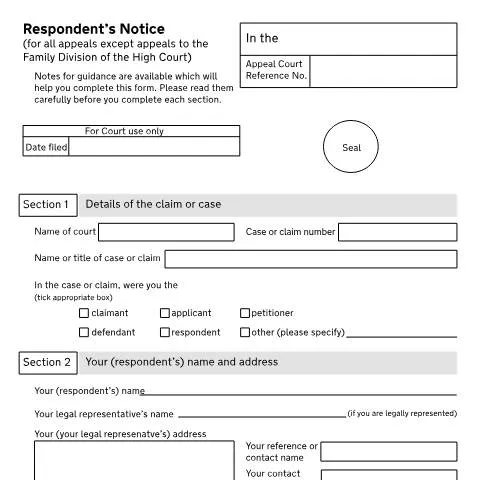
When an appellant challenges a court decision that went in your favour, you may find yourself in the position of respondent – the party defending the original judgment. The Form N162 Respondent's Notice serves as your formal gateway to participate in appeal proceedings, whether you simply wish to support the lower court's decision or pursue your own cross-appeal on different grounds. This document represents more than a mere administrative requirement; it's your strategic platform for shaping how the appeal court will consider the case.
The notice applies to all appeals except those directed to the Family Division of the High Court, covering a vast spectrum of civil proceedings from contract disputes to judicial review cases. Understanding when and how to deploy this notice can mean the difference between passively watching an appeal unfold and actively influencing its outcome.
Navigating the Dual Nature of Respondent Participation
The Form N162 accommodates two fundamentally different approaches to appeal participation. As a respondent, you might simply want to uphold the original order on the same grounds the lower court used, or you may wish to support the same outcome but for different legal reasons. This distinction proves crucial when the appellant's challenge exposes potential weaknesses in the original judgment's reasoning.
Consider a scenario where you won a breach of contract case, but the judge's reasoning relied heavily on one particular legal principle. If the appellant's notice suggests this principle might be vulnerable on appeal, you can use Section 6 of Form N162 to argue that the same outcome should stand based on alternative legal grounds – perhaps statutory interpretation rather than common law principles.
The form also enables you to launch your own respondent's appeal, effectively becoming both respondent and cross-appellant. This proves particularly valuable when you won the case but feel the remedy awarded was insufficient, or when you succeeded on some issues but lost on others that you believe were wrongly decided.
Strategic Considerations for Cross-Appeals
When contemplating a cross-appeal through Form N162, timing becomes critical. You must file within the standard appeal time limits, which typically means 21 days from the date of the order being appealed, though this can vary depending on the type of case and court involved. The form requires you to specify in Section 4 exactly which parts of the original order you're challenging, demanding precision in identifying the discrete elements you wish to overturn or vary.
The permission requirements outlined in Section 5 add another layer of complexity. Some appeals require permission from either the lower court or the appeal court, while others – particularly those involving final orders in certain types of cases – may proceed as of right. The form requires you to declare whether you need permission and, if so, whether you've already obtained it or are seeking it through this notice.
Decoding the Technical Requirements of Section 3
The time estimate section presents a practical challenge that many respondents underestimate. Unlike straightforward case management, appeal hearings involve complex legal arguments, detailed examination of the lower court's reasoning, and often extensive judicial questioning. Your estimate should account for the time needed to present your skeleton argument, respond to the appellant's case, and address any questions from the appeal judges.
| Type of Representation | Typical Time Considerations | Additional Factors |
|---|---|---|
| Self-representation | Allow extra time for explanation of legal points | Appeal courts often provide more assistance to litigants in person |
| Solicitor advocacy | Standard professional presentation time | May need time for consultation during hearing |
| Counsel (barrister) | Efficient legal argument presentation | Specialist knowledge may reduce explanation time |
The form specifically excludes time estimates for Court of Appeal cases, recognising that these higher-level appeals follow different procedural tracks with their own time allocation systems.
Constructing Compelling Grounds and Arguments
Sections 6 and 7 form the intellectual heart of your respondent's notice, where legal theory meets practical advocacy. The grounds for appeal or for upholding the order must demonstrate not just that you disagree with the appellant's position, but that the lower court's decision was legally sound and factually justified.
When defending the original order, your grounds might address procedural compliance, evidential standards, or the correct application of legal principles. If you're seeking to uphold the order on different grounds, you're essentially arguing that even if the appellant succeeds in undermining the original reasoning, the same result should stand for alternative reasons.
The Skeleton Argument Framework
Section 7 addresses the crucial skeleton argument, which serves as your roadmap for the appeal hearing. You have three options: setting out the argument within the form itself, attaching it immediately, or committing to file and serve it within 14 days of filing the respondent's notice. This flexibility accommodates different case complexities and preparation timelines.
A well-structured skeleton argument typically follows a logical progression: identifying the key legal issues, summarising the relevant facts, applying the law to those facts, and addressing the appellant's specific challenges. The argument should be concise yet comprehensive, providing the appeal judges with a clear framework for understanding your position without overwhelming them with excessive detail.
Remedial Requests and Strategic Outcomes
Section 8 requires you to specify exactly what decision you want the appeal court to make, moving beyond abstract legal arguments to concrete relief. The options reflect different strategic approaches: seeking to set aside the order entirely, requesting specific variations, or asking for a new trial when procedural errors may have tainted the original proceedings.
The choice between setting aside and varying an order carries significant implications. Setting aside typically means the matter returns to square one, while variation preserves parts of the original decision while modifying specific elements. When requesting that the appeal court uphold the order for different reasons, you're asking the judges to engage in legal reasoning that goes beyond simply rejecting the appellant's case.
Additional Orders and Case Management
The provision for additional orders recognises that appeals often raise issues beyond the central legal dispute. You might seek orders relating to costs, interim measures, or case management directions that will govern how the appeal proceeds. These applications require careful consideration of proportionality – the time and expense involved should be justified by the potential benefit to your case.
Human Rights Considerations and Legal Aid Implications
The form's specific inquiry about Human Rights Act 1998 issues reflects the particular procedural requirements that apply when Convention rights are in play. Cases involving human rights arguments often require additional case management, including potential involvement of interested parties and extended time estimates for argument.
When human rights issues arise, the appeal court may need to consider not just domestic law but also European Court of Human Rights jurisprudence and the developing interaction between UK law and Convention principles. This complexity affects everything from time estimates to the scope of legal argument you'll need to present.
The Civil Legal Aid Certificate question serves both administrative and strategic purposes. Legal aid availability can influence case management decisions, and the court needs to understand the funding position when considering costs orders and procedural directions.
Procedural Integration with Other Court Documents
Form N162 operates within a broader ecosystem of appeal documentation. The appellant will have filed their notice of appeal, setting out their challenge to the original decision. Your respondent's notice provides the counterpoint, but it must be read alongside the original judgment, any case management orders, and the developing procedural history of the appeal.
The reference to Part 23 applications in Section 9 demonstrates how the respondent's notice integrates with the wider Civil Procedure Rules framework. When you need to make applications that go beyond the standard appeal process – perhaps for permission to adduce fresh evidence or for specific case management orders – these require separate procedural steps while remaining connected to your core respondent's notice.
Statement of Truth Requirements
The concluding Statement of Truth section imposes serious legal obligations, carrying potential contempt of court consequences for false statements made without honest belief in their truth. This applies particularly to any factual assertions in Section 9 applications, where you might be introducing new evidence or making factual claims that go beyond legal argument.
The various signature options accommodate different representation scenarios, from personal litigants to those represented by solicitors or requiring litigation friends due to capacity issues. Each category carries specific responsibilities and procedural implications that affect how the appeal court will interact with your case.
Understanding Form N162 as both a procedural requirement and a strategic document enables you to approach appeal proceedings with confidence, whether you're defending a favourable judgment or pursuing additional relief through cross-appeal. The form's structure reflects the sophisticated balance between protecting successful parties' rights and ensuring that justice can be achieved through the appellate process.
Strategic Considerations for Different Types of Appeals
The approach to completing Form N162 varies significantly depending on the nature of your original case and the grounds for appeal. Understanding these distinctions is crucial for presenting an effective respondent's notice that addresses the specific legal framework governing your matter.
Civil Appeals in County Court and High Court
For civil matters such as contract disputes, personal injury claims, or property litigation, your respondent's notice must demonstrate how the first instance judge correctly applied established legal principles. When the appellant challenges factual findings, focus on highlighting the evidence that supported the original judgment. The Court of Appeal rarely interferes with a trial judge's assessment of witness credibility unless there are compelling reasons to do so.
If you're responding to an appeal concerning procedural matters—such as case management decisions, disclosure orders, or costs assessments—emphasise the judge's discretionary powers and the appropriateness of their exercise. Courts are particularly reluctant to overturn decisions where the first instance judge properly considered relevant factors and reached a reasonable conclusion within their discretion.
For appeals involving summary judgment applications or strike-out orders, your response should reinforce why the case was suitable for determination without a full trial. Detail how the legal test was properly applied and why the appellant's arguments lack sufficient merit to warrant a different outcome.
Administrative and Statutory Appeals
Appeals from administrative bodies—such as planning decisions, licensing matters, or regulatory enforcement—require a different analytical framework. Your respondent's notice should address whether the original decision-maker followed proper procedures, considered relevant factors, and reached a rational conclusion based on available evidence.
When responding to appeals from immigration tribunals, employment tribunals, or other specialist jurisdictions, demonstrate familiarity with the specific statutory framework and any relevant policy guidance. These cases often involve detailed factual matrices where the original tribunal's expertise in their specialist area carries significant weight.
For appeals concerning public law matters, including judicial review decisions that have progressed beyond the Administrative Court, your response must engage with principles of rationality, procedural fairness, and legitimate expectation. Show how the decision under appeal properly balanced competing interests and followed established administrative law principles.
Commercial and Business Appeals
Commercial appeals frequently involve complex contractual interpretation, corporate law issues, or disputes arising from business relationships. Your respondent's notice should demonstrate how the first instance judge correctly applied commercial common sense to contractual interpretation, properly understood industry practices, or appropriately balanced competing commercial interests.
In cases involving directors' duties, corporate governance, or insolvency matters, emphasise how the original decision reflected established legal principles while recognising the specific commercial context. Courts are generally reluctant to substitute their judgment for that of experienced commercial judges who have considered detailed evidence about business practices and market conditions.
Procedural Compliance and Court Expectations
The Court of Appeal maintains strict procedural requirements that extend beyond the basic form completion. Understanding these expectations and demonstrating compliance significantly strengthens your position as a respondent.
Document Preparation and Bundle Requirements
Your respondent's notice forms part of a comprehensive court bundle that must be meticulously organised according to Court of Appeal directions. Ensure your notice cross-references relevant documents in the appeal bundle using consistent numbering systems. When citing authorities, provide complete references including paragraph numbers for judgments and page numbers for textbooks or articles.
The skeleton argument accompanying your respondent's notice should be concise yet comprehensive, typically not exceeding 25 pages unless exceptional circumstances justify greater length. Structure your argument logically, addressing each ground of appeal in sequence while maintaining a coherent narrative that supports your overall position.
Fill in your form directly online
No printing: type your details into the boxes of the official form, tick, then download the PDF ready to send.
- 1Type into the form boxes
- 2Tick in one click
- 3Save and download the PDF
When preparing chronologies or case summaries, maintain strict accuracy and avoid partisan presentation of facts. The Court of Appeal expects professional standards that assist rather than hinder their understanding of the case. Any disagreement about facts should be clearly identified rather than obscured through selective presentation.
Citation of Authorities and Legal Precedent
Your respondent's notice should demonstrate thorough legal research while avoiding unnecessary citation of authorities. Focus on binding precedents from the Court of Appeal and Supreme Court that directly support your position. When citing first instance decisions, explain why they provide persuasive authority relevant to your case's specific circumstances.
Avoid over-citation of authorities that make the same legal point. Instead, select the most authoritative and directly relevant cases, providing proper analysis of how they apply to your facts. The Court of Appeal particularly values responses that engage with recent developments in the law while showing how established principles support the original decision.
When the appellant has cited authorities in their notice, address these directly in your response rather than ignoring them. Distinguish unfavourable cases on their facts or explain why they support rather than undermine the decision under appeal. This demonstrates thorough preparation and helps the court understand why the appellant's legal arguments lack merit.
Costs Considerations and Strategic Implications
Filing a respondent's notice carries costs implications that extend beyond court fees. Consider whether your response strengthens your position sufficiently to justify the additional expense and potential adverse costs exposure if the appeal succeeds on different grounds.
If you're seeking enhanced costs protection or have concerns about your opponent's ability to meet an adverse costs order, address these issues in accompanying applications rather than within the respondent's notice itself. The notice should focus on substantive legal arguments while related procedural applications handle ancillary matters.
When the appeal involves multiple parties with potentially conflicting interests, coordinate your response to avoid duplicating arguments while ensuring your specific position receives adequate attention. This is particularly important in cases involving contribution claims, joint liability, or complex commercial relationships where different respondents may have varying interests in the appeal's outcome.
Common Pitfalls and How to Avoid Them
Experienced practitioners recognise several recurring problems that undermine respondent's notices. Understanding these pitfalls helps ensure your response meets professional standards and effectively serves your client's interests.
Substantive Legal Errors
One frequent mistake involves failing to engage properly with the appellant's legal arguments. Simply asserting that the first instance judge was correct without addressing specific grounds of appeal creates an impression of complacency that may influence the court's perception of your case's merits.
Another common error involves misunderstanding the appellate court's role and function. Appeals are not rehearings of first instance proceedings but reviews of whether the original decision was wrong or unjust due to serious procedural irregularity. Frame your arguments accordingly, focusing on why the decision under appeal was correct rather than re-arguing the entire case from first principles.
Avoid introducing new legal arguments that weren't raised at first instance unless exceptional circumstances justify this approach. The Court of Appeal generally expects parties to have presented their best case at trial, and attempting to improve your position through hindsight rarely succeeds and may attract adverse comment about litigation conduct.
Procedural and Tactical Missteps
Timing errors represent another significant category of problems. While the 14-day deadline for filing appears straightforward, complications arise when considering bank holidays, court closures, or postal delays. Electronic filing through CE-File eliminates some uncertainty, but technical difficulties or system maintenance can create unexpected obstacles.
Failing to serve the respondent's notice on all relevant parties within required timeframes can result in procedural applications that distract from substantive arguments. Maintain comprehensive records of service, including email delivery confirmations and postal tracking information, to demonstrate compliance with court rules.
Some practitioners make tactical errors by over-responding to weak appeals or failing to respond adequately to strong ones. Assess the appeal's realistic prospects carefully, considering not just legal merits but also practical factors such as the appellant's resources, the commercial value at stake, and your client's appetite for continued litigation.
Presentation and Professional Standards
Poor document presentation undermines even strong legal arguments. Ensure your respondent's notice follows prescribed formatting requirements, uses consistent citation methods, and maintains professional standards throughout. Spelling errors, grammatical mistakes, or unclear expression suggest inadequate preparation that may influence judicial perception of your arguments' reliability.
Avoid inflammatory language or personal attacks on opposing parties, their representatives, or the first instance judge. Professional courtesy and measured language are essential, even when responding to appeals you consider wholly without merit. The Court of Appeal expects advocates to maintain high standards of professional conduct that facilitate rather than hinder effective case management.
Finally, ensure your respondent's notice addresses the real issues in dispute rather than peripheral matters that may have attracted attention during first instance proceedings. Appeals require sharp focus on specific legal or procedural errors alleged by the appellant, not comprehensive rehearsal of every argument that might theoretically support your position.