When Court Orders Go Unanswered: The Enforcement Power of Form N344
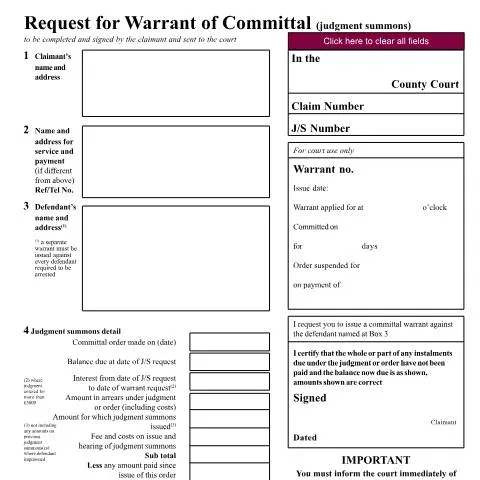
When a defendant fails to comply with a court judgment requiring payment or specific action, the legal system provides enforcement mechanisms that can escalate to imprisonment. Form N344 represents one of the most serious steps in this process – a request for a warrant of committal that can result in the defendant's arrest and detention. This enforcement tool comes into play after a judgment summons has been issued and the defendant continues to ignore their legal obligations, despite having the means to comply.
The warrant of committal stands as the final enforcement measure before actual imprisonment occurs. Unlike standard debt recovery procedures that focus on seizing assets or garnishing wages, this process targets the defendant's liberty directly. It applies specifically to situations where the court has determined that the defendant has wilfully refused to comply with a payment order or other court direction, rather than simply being unable to pay due to genuine financial hardship.
Understanding the Judgment Summons Framework Behind N344
Before a warrant of committal can be requested, the legal process must have progressed through several mandatory stages. The foundation lies in an existing county court judgment that has remained unsatisfied. This could involve unpaid debts, maintenance arrears, or failure to comply with specific court orders requiring action rather than payment.
The judgment summons procedure itself requires the defendant to attend court and explain why they have not complied with the original order. During this hearing, the court examines whether the defendant has the means to pay but has chosen not to do so. Only when the court is satisfied that non-compliance represents wilful defiance rather than genuine inability can it make a committal order – the legal prerequisite for using Form N344.
The Wilful Refusal Test
Courts apply strict criteria when determining wilful refusal. The claimant must demonstrate that the defendant:
- Had sufficient means to comply with the original order
- Understood their legal obligations clearly
- Chose deliberately not to comply despite having reasonable opportunity
- Cannot provide acceptable justification for non-compliance
This high threshold protects defendants facing genuine financial difficulties while ensuring that court orders maintain their authority through enforceable consequences.
Navigating the Critical Details of Form N344
Form N344 requires precise completion across several interconnected sections, each serving specific legal and administrative purposes. The document begins with standard case identification details – the county court name, claim number, and judgment summons (J/S) number that links this warrant request to the underlying case history.
Claimant and Defendant Information Requirements
Sections 1 and 2 capture the claimant's details, with particular attention to service addresses. Where the claimant's address differs from their preferred correspondence address, both must be provided accurately. This ensures that any subsequent court communications reach the appropriate party without delay.
Section 3 requires the defendant's current known address, accompanied by an important restriction: a separate warrant must be issued against every defendant if multiple parties are involved in the same case. This prevents administrative confusion and ensures that each individual faces appropriate enforcement action based on their specific circumstances and level of non-compliance.
Financial Calculations and Judgment Summons Detail
Section 4 presents the most complex part of Form N344, requiring detailed financial calculations that must align precisely with court records. The form breaks down various components:
| Financial Element | Calculation Method | Special Considerations |
|---|---|---|
| Balance due at J/S request date | Original judgment amount minus any payments received | Must match court records exactly |
| Interest calculation | Applied from J/S request to warrant request date | Only applies where judgment exceeds £5,000 |
| Amount in arrears | Outstanding sum including costs | Excludes amounts from previous judgment summons where defendant was imprisoned |
| Judgment summons fees | Court fees and costs for issuing and hearing | Added to total amount due |
The calculation must account for any payments received since the committal order was made, with the final figure representing the sum on payment of which the defendant will be discharged from custody if arrested.
The Claimant's Certification Responsibilities
Completing Form N344 requires the claimant to make several important certifications under their signature. They must confirm that instalments due under the judgment or order remain unpaid, either in whole or in part, and that all financial calculations shown are accurate. This certification carries legal weight – providing false information could constitute contempt of court or perjury.
The form includes a critical ongoing obligation: claimants must inform the court immediately of any payments received after submitting the warrant request. This requirement prevents the inappropriate arrest of defendants who have subsequently satisfied their obligations, protecting both the defendant's liberty and the court's resources.
Additional Information for Bailiff Assistance
The final section allows claimants to provide practical information that might assist court bailiffs in executing the warrant. This includes:
- Alternative addresses where the defendant might be found
- Information about the defendant's routine or whereabouts
- Potential difficulties the bailiff might encounter during arrest attempts
- Security concerns or access issues at the defendant's known addresses
While this information is optional, providing accurate details can significantly improve the warrant's effectiveness and reduce the time and resources required for execution.
Submission Procedures and Court Processing
Form N344 must be submitted to the same county court that issued the original committal order. The court will review the application to ensure it complies with the existing committal order's terms and that all required information has been provided accurately.
Upon approval, the court issues the actual warrant of committal with a unique warrant number and issue date. The warrant includes specific details about when it was applied for and, if executed, records of the defendant's committal period and any suspended terms related to payment arrangements.
Warrant Execution and Defendant Rights
Once issued, the warrant authorises court bailiffs to arrest the defendant and bring them before the court. However, defendants retain important rights throughout this process:
- Right to immediate release upon payment of the specified discharge sum
- Right to apply for variation of the committal order
- Right to legal representation during any court appearances
- Right to appeal the original committal order if grounds exist
The court may suspend the warrant's execution if the defendant demonstrates willingness to comply with a reasonable payment arrangement or can show changed circumstances affecting their ability to pay.
Strategic Considerations for Effective Enforcement
Using Form N344 represents a significant escalation in enforcement proceedings that requires careful consideration of timing and circumstances. Claimants should evaluate whether the defendant's continued non-compliance genuinely reflects wilful refusal rather than changed financial circumstances that might warrant returning to court for variation of the original order.
The proportionality principle applies to committal proceedings – courts expect claimants to have attempted other enforcement methods where appropriate before seeking imprisonment. This might include attempting to garnish wages, seize assets, or negotiate payment arrangements outside the formal court process.
Alternative Enforcement Options
Before pursuing a warrant of committal, claimants might consider whether other enforcement mechanisms could prove more effective:
- Attachment of earnings orders for defendants in regular employment
- Third party debt orders targeting the defendant's bank accounts
- Charging orders against property owned by the defendant
- Bailiff action to seize and sell the defendant's goods
These alternatives may prove more practical for recovering debts while avoiding the significant costs and complications associated with imprisonment proceedings.
Post-Warrant Developments and Resolution Paths
After submitting Form N344, several outcomes remain possible depending on the defendant's response and circumstances. If the defendant makes payment before the warrant's execution, the claimant must immediately notify the court to prevent unnecessary arrest. This notification requirement continues throughout the warrant's validity period.
Should the defendant be arrested and brought before the court, the judge retains discretion over the committal period's length and conditions. Suspended committal orders are common, allowing defendants to avoid imprisonment by complying with specific payment terms within defined timeframes.
Long-term Case Management Implications
The warrant of committal process often catalyses resolution of long-standing disputes. Facing potential imprisonment frequently motivates defendants to engage seriously with payment negotiations or to provide complete disclosure of their financial circumstances for the first time.
However, claimants should recognise that imprisonment rarely improves a defendant's ability to pay – indeed, it often worsens their financial position by disrupting employment or other income sources. The primary value lies in the deterrent effect and the demonstration that court orders carry real consequences.
Successful enforcement through Form N344 requires balancing the legitimate need to uphold court authority with practical considerations about debt recovery effectiveness. Courts increasingly favour solutions that secure compliance while preserving defendants' capacity to meet their ongoing obligations, making genuine engagement with payment proposals often more valuable than pursuing imprisonment to its conclusion.
Understanding the Legal Framework Behind Warrants of Committal
The warrant of committal system operates within a complex legal framework that balances enforcement powers with debtor protection. Under the Administration of Justice Act 1970 and subsequent amendments, committal proceedings represent one of the most serious enforcement mechanisms available to creditors, reserved for cases where standard recovery methods have proven ineffective.
The legal threshold for committal is deliberately high. Courts must be satisfied that the debtor has had the means to pay but has wilfully refused or culpably neglected to do so. This distinction is crucial – mere inability to pay, even if disappointing to creditors, does not constitute grounds for committal. The court will examine the debtor's financial circumstances at the time the order was made and subsequently, looking for evidence of available funds or assets that could reasonably have been used to satisfy the debt.
Wilful refusal typically involves clear evidence that the debtor has deliberately chosen not to pay despite having the means. This might include maintaining a lifestyle inconsistent with claimed poverty, making payments to other creditors while ignoring court orders, or transferring assets to avoid payment. Culpable neglect, whilst less deliberate, still requires evidence of unreasonable failure to take steps to comply with the order, such as refusing employment opportunities or failing to pursue available sources of funds.
The European Convention on Human Rights, incorporated into UK law through the Human Rights Act 1998, provides additional safeguards. Article 5 (right to liberty) and Article 6 (right to fair trial) ensure that committal proceedings meet strict procedural standards. Courts must consider whether imprisonment would be proportionate to the circumstances, taking into account factors such as the debtor's personal situation, the amount owed, and alternative enforcement options.
Fill in your form directly online
No printing: type your details into the boxes of the official form, tick, then download the PDF ready to send.
- 1Type into the form boxes
- 2Tick in one click
- 3Save and download the PDF
Recent case law has emphasised that committal should be seen as a last resort, not a routine collection tool. The Court of Appeal has consistently held that creditors must demonstrate they have exhausted other reasonable enforcement methods before seeking committal. This includes attempting attachment of earnings, third-party debt orders, or charging orders where appropriate to the debtor's circumstances.
Procedural Requirements and Court Hearings
The procedural requirements surrounding Form N344 applications are stringent, reflecting the serious nature of potential imprisonment for civil debt. Once the form is filed, the court will issue a summons requiring the debtor's attendance at a hearing. This summons must be served personally on the debtor – postal service is generally insufficient for committal proceedings due to the liberty implications.
Personal service requirements mean that bailiffs or process servers must physically hand the documents to the debtor, usually at their home or workplace. If the debtor proves elusive, the court may authorise alternative service methods, but these require specific judicial approval and evidence that reasonable attempts at personal service have failed. The serving officer must complete a certificate of service detailing exactly when, where, and how the documents were delivered.
At the committal hearing, the standard of proof required is the criminal standard – beyond reasonable doubt – rather than the civil standard typically applied in other debt proceedings. This elevated threshold recognises that the debtor's liberty is at stake. The applicant must present compelling evidence not just that the order remains unpaid, but that the debtor had the means to pay and deliberately chose not to comply.
Courts will typically require detailed financial evidence covering the period since the original order was made. This might include bank statements, employment records, benefit payments, asset valuations, and evidence of the debtor's lifestyle and expenditure. The debtor has the right to cross-examine witnesses and present their own evidence regarding their financial circumstances and any efforts made to comply with the order.
If the court finds the case proven, it has discretionary powers in determining the appropriate sentence. The maximum term of imprisonment is typically six weeks for most civil debts, though this can vary depending on the type of order and amount involved. Courts often impose suspended sentences, allowing the debtor a final opportunity to pay within a specified timeframe before facing imprisonment.
The judge will also consider whether to make a suspended committal order conditional on future payments. This might involve agreeing to an instalment plan, with the threat of immediate imprisonment if payments fall behind. Such arrangements require careful documentation and regular court reviews to ensure compliance.
Financial Implications and Recovery Strategies
While Form N344 applications can be powerful enforcement tools, applicants must carefully consider the financial implications and realistic prospects of recovery. The costs associated with committal proceedings can be substantial, and there's no guarantee that imprisoning a debtor will ultimately lead to payment of the underlying debt.
Court fees for committal applications vary depending on the type and value of the original order, but applicants should budget for hearing fees, service costs, and potential legal representation expenses. If the application fails, the applicant may face liability for the debtor's legal costs, particularly if the court finds the application was inappropriate or premature.
The practical reality is that many debtors facing committal proceedings genuinely lack the means to pay, regardless of the court's findings on wilful refusal. Imprisonment does not discharge the debt, and a debtor's earning capacity may be further reduced by the employment consequences of a prison sentence. Creditors should therefore view committal primarily as a tool for compelling payment from debtors who have hidden assets or income, rather than as a general debt recovery mechanism.
Alternative enforcement options may prove more cost-effective and productive. Attachment of earnings orders can provide regular payments directly from employment income, while third-party debt orders can freeze and redirect funds held in bank accounts. Charging orders create security over property that may eventually be realised through sale, even if immediate payment is not possible.
For business creditors, the threat of committal proceedings can sometimes encourage negotiated settlements or payment plans that might otherwise be rejected. The serious consequences of potential imprisonment often focus debtors' minds on finding ways to satisfy their obligations, whether through borrowing, asset sales, or assistance from family members.
Creditors should also consider the reputational and relationship implications of pursuing committal, particularly in ongoing commercial relationships or where future business dealings remain possible. The adversarial nature of committal proceedings often makes reconciliation difficult, even if payment is eventually secured.
Record-keeping becomes crucial throughout the process. Detailed documentation of all payment demands, correspondence, and the debtor's responses will be essential evidence in demonstrating both the debt's validity and the debtor's attitude towards compliance. This includes maintaining copies of all formal notices, recorded delivery receipts, and any communications that might indicate the debtor's financial position or willingness to pay.