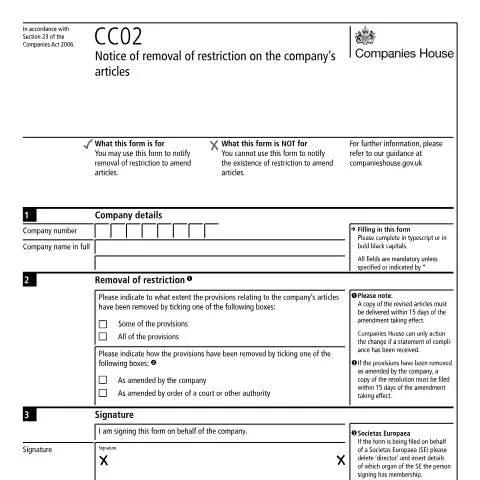
When Company Articles Hit a Restrictive Wall: Understanding the CC02 Liberation Process
Corporate governance can feel like navigating a maze of regulations, particularly when your company's articles of association contain restrictions that once served a purpose but now hinder business operations. The CC02 form represents a crucial administrative gateway for companies seeking to notify Companies House that they've successfully removed restrictive provisions from their constitutional documents. This isn't merely about paperwork compliance—it's about corporate freedom and ensuring the public register accurately reflects your company's current operational capacity.
The removal of article restrictions typically emerges from strategic business decisions: perhaps your company originally included provisions limiting share transfers to maintain family control, or imposed restrictions on director appointments that no longer align with expansion plans. Whatever the original rationale, when these constraints become obstacles rather than safeguards, the CC02 process provides the formal mechanism to signal their elimination to the corporate registry.
Decoding the Anatomy of Article Restrictions and Their Removal
Understanding what constitutes a restriction on articles requires grasping the fundamental nature of a company's constitutional framework. Articles of association serve as the internal rulebook governing how a company operates, covering everything from share transfers and director powers to meeting procedures and dividend distributions. When these articles contain provisions that limit, constrain, or impose conditions on normal corporate activities, they're classified as restrictions.
Common examples include pre-emption rights that give existing shareholders first refusal on new share issues, transfer restrictions requiring board approval for share sales, or director qualification requirements mandating specific professional credentials. These provisions might have seemed prudent at incorporation but can later impede fundraising, succession planning, or strategic partnerships.
The removal process itself operates on two fundamental levels. Companies can eliminate restrictions through internal amendment procedures, typically involving special resolutions passed by shareholders in accordance with the Companies Act 2006. Alternatively, restrictions might be removed by court order or regulatory authority, particularly in circumstances involving disputes, insolvency proceedings, or regulatory interventions.
| Removal Method | Decision Maker | Documentation Required | Typical Circumstances |
|---|---|---|---|
| Company Amendment | Shareholders (special resolution) | Resolution copy + revised articles | Strategic business decisions, modernisation |
| Court/Authority Order | Court or regulatory body | Court order + compliance statement | Disputes, insolvency, regulatory action |
Scope of Removal: Partial Versus Complete Liberation
The CC02 form acknowledges that restriction removal rarely follows an all-or-nothing approach. Companies might eliminate some provisions while retaining others that continue serving legitimate purposes. For instance, a family business might remove transfer restrictions affecting external investors while maintaining provisions protecting family member voting rights.
Conversely, complete removal scenarios typically occur during major corporate restructuring, preparation for public listing, or fundamental business model changes. This comprehensive approach requires careful consideration of potential unintended consequences—removing all restrictions might inadvertently eliminate protective mechanisms that shareholders value.
The Critical 15-Day Window and Documentation Requirements
Timing precision becomes paramount once restrictions are formally removed. The Companies Act 2006 mandates that revised articles must reach Companies House within 15 days of the amendment taking effect. This isn't merely administrative housekeeping—failure to meet this deadline can result in criminal liability for company officers and potential complications for future corporate transactions.
The documentation requirements vary significantly depending on the removal method. When companies amend their own articles, they must file both the CC02 form and a copy of the resolution authorising the changes. The resolution copy serves as evidence that proper procedures were followed and that shareholders legitimately approved the modifications.
For court-ordered removals, the documentation burden shifts toward proving compliance with judicial or regulatory directives. Companies House requires a statement of compliance confirming that the removal has been properly implemented according to the court's instructions. This statement carries significant legal weight—false declarations can trigger serious penalties.
The Statement of Compliance: More Than Administrative Box-Ticking
The statement of compliance requirement deserves particular attention because it represents Companies House's quality control mechanism. This document must confirm that the company has genuinely implemented the restriction removal and that all procedural requirements have been satisfied. It's not merely about confirming that articles have been rewritten—it's about validating that the legal process has been completed correctly.
Companies House cannot action the CC02 notification without this statement, creating a potential bottleneck if documentation is incomplete or unclear. The statement typically requires officer-level authorisation, meaning directors or company secretaries must personally attest to compliance accuracy.
Navigating the Signature Authority Maze
The CC02 form's signature requirements reflect the complex reality of modern corporate structures and circumstances. While standard companies typically rely on director or secretary signatures, the form accommodates various scenarios where different parties might legitimately act on the company's behalf.
Insolvency situations introduce additional complexity, with liquidators, administrators, and receivers potentially holding signature authority. Each role carries specific legal responsibilities and limitations, making it crucial to verify that the signatory has appropriate authority for the particular type of restriction removal being notified.
Societas Europaea structures require special handling, reflecting their unique governance frameworks under European corporate law. The form specifically accommodates SE organ membership variations, recognising that these entities might not follow traditional UK director/secretary models.
- Authorised persons under sections 270 or 274 of the Companies Act 2006 can sign in specific circumstances
- Charity Commission receivers may act for charitable companies under regulatory oversight
- CIC managers can sign for Community Interest Companies subject to special regulatory regimes
- Judicial factors may have authority in Scottish legal proceedings
Strategic Implications Beyond Mere Compliance
Filing a CC02 form creates ripple effects extending far beyond administrative compliance. The notification becomes part of the public record, signalling to potential investors, creditors, and business partners that your company has modified its constitutional constraints. This transparency can enhance corporate attractiveness but also requires careful consideration of competitive implications.
Due diligence processes for mergers, acquisitions, or investment rounds routinely examine Companies House filings for evidence of recent constitutional changes. A properly filed CC02 demonstrates corporate governance maturity and suggests management's proactive approach to removing operational barriers. Conversely, missing or delayed filings can raise red flags about compliance standards and administrative competence.
The Public Record Dimension
Every detail on the CC02 form enters the public domain, creating permanent visibility for the restriction removal. This includes presenter information if provided, though companies aren't obligated to include contact details. The strategic decision about information disclosure should balance transparency benefits against privacy concerns.
Competitor analysis increasingly includes monitoring Companies House filings for intelligence about strategic changes. A CC02 filing might signal expansion plans, ownership restructuring, or preparation for significant transactions—information that competitors could exploit or that might affect market positioning.
Integration with Broader Corporate Governance Strategy
The CC02 process rarely operates in isolation—it typically forms part of broader corporate governance modernisation or strategic repositioning. Companies might simultaneously file multiple forms addressing different constitutional aspects, requiring careful coordination to ensure consistent messaging and timing.
Consider the interaction with annual confirmation statements, director appointment notifications, and share capital changes. A restriction removal that facilitates new share issues might trigger additional filing requirements, while changes affecting director powers could necessitate updated officer information.
The 15-day deadline becomes particularly challenging when restriction removal forms part of complex transaction structures. Corporate lawyers often build buffer time into deal timelines to accommodate potential Companies House processing delays or requests for clarification.
Technology and Submission Methods
Companies House accepts CC02 forms through multiple channels, with electronic submission increasingly preferred for speed and efficiency. However, certain circumstances—particularly those involving court orders or complex corporate structures—might require postal submission with physical supporting documentation.
The choice of submission method can affect processing times and the ability to track progress. Electronic submissions typically generate immediate confirmation receipts, while postal submissions might experience delays during peak periods or when additional verification is required.
Avoiding Common Pitfalls in the Removal Process
Experience reveals several recurring challenges that can derail otherwise straightforward CC02 submissions. Mismatched company details represent the most frequent rejection cause—even minor discrepancies between the form and registered information can trigger returns for correction.
The checkbox selections in section 2 require particular attention because they determine how Companies House processes the notification. Incorrectly indicating whether provisions were removed by company action or external authority can create confusion and delay approval. Similarly, failing to specify whether removal was partial or complete affects how the changes are recorded on the public register.
Timing coordination between restriction removal and CC02 filing creates another common stumbling block. Companies sometimes file the form before actually implementing the changes, or conversely, delay filing beyond the 15-day window. Both scenarios can create compliance issues and potentially invalidate the notification.
Supporting documentation quality significantly affects processing efficiency. Poorly scanned resolution copies, unsigned statements of compliance, or incomplete court orders frequently trigger requests for clarification that extend processing times and create administrative burdens for company officers.
When Restrictions Cannot Be Removed: Common Scenarios and Legal Impediments
Not every restriction placed on a company's articles can be removed through the CC02 process. Understanding the legal boundaries and permanent constraints helps directors avoid unsuccessful applications and potential complications with Companies House.
Court-Imposed Restrictions and Judicial Orders
Restrictions arising from court orders present the most complex removal scenarios. When a court has imposed specific limitations on a company's operations—perhaps following director disqualification proceedings, fraud investigations, or shareholder disputes—these restrictions typically cannot be removed without explicit judicial approval.
The High Court or County Court may have embedded restrictions directly into the company's constitutional documents as part of a settlement or judgment. In such cases, the CC02 form alone proves insufficient. Directors must first return to the originating court to seek variation or discharge of the original order before Companies House can process any restriction removal.
Particularly complex situations arise when restrictions stem from insolvency proceedings. If a company has emerged from administration or a Company Voluntary Arrangement (CVA), certain protective clauses may remain embedded in the articles indefinitely. These safeguards, designed to protect creditors or prevent asset stripping, often require creditor consent or court approval for removal.
Regulatory and Sector-Specific Constraints
Companies operating in regulated sectors face additional layers of complexity when seeking restriction removal. Financial services firms authorised by the Financial Conduct Authority (FCA) or Prudential Regulation Authority (PRA) may have restrictions that interlink with their regulatory permissions.
For instance, investment management companies often carry restrictions on share transfers or director appointments that form part of their regulatory compliance framework. Removing such restrictions could inadvertently breach authorisation conditions, triggering regulatory intervention or licence revocation.
Similarly, companies holding government contracts or security clearances may have restrictions imposed as contractual requirements rather than voluntary corporate decisions. Defence contractors, for example, might face nationality restrictions on shareholders or directors that cannot be removed without jeopardising existing contracts or clearances.
Practical Impediments and Documentation Challenges
Even when legal removal appears straightforward, practical obstacles frequently emerge. Missing documentation represents a common stumbling block, particularly for older companies or those that have changed hands multiple times.
Original restriction agreements may reference specific trigger events, performance milestones, or time periods that prove difficult to verify decades later. If the restriction's removal conditions cannot be definitively established, Companies House may reject the CC02 application pending additional evidence.
Successor liability issues also complicate removal processes. When companies have acquired assets or merged with entities carrying embedded restrictions, the acquiring company may inherit limitations that extend beyond the original transaction scope. These inherited restrictions often require consent from parties who may no longer be readily identifiable or contactable.
Impact Assessment: How Restriction Removal Affects Stakeholder Rights
Successfully removing restrictions through the CC02 process creates ripple effects across the entire stakeholder ecosystem. Directors must carefully evaluate these consequences before proceeding, as removal cannot typically be reversed without implementing entirely new restrictions.
Fill in your form directly online
No printing: type your details into the boxes of the official form, tick, then download the PDF ready to send.
- 1Type into the form boxes
- 2Tick in one click
- 3Save and download the PDF
Shareholder Rights and Investment Protection
Restriction removal fundamentally alters the risk-reward balance for existing shareholders. Pre-emption rights restrictions, when removed, may expose minority shareholders to dilution through new share issues they cannot match proportionally. This shift can dramatically reduce their influence and economic participation in future company growth.
Institutional investors often negotiate specific restrictions as investment protection mechanisms. Venture capital funds, for example, may have secured anti-dilution provisions, board representation rights, or veto powers over major decisions. Removing these restrictions without proper consultation could constitute a breach of investment agreements, potentially triggering legal action or forced buy-out provisions.
The timing of restriction removal relative to funding rounds or exit strategies requires particular attention. Private equity investors approaching exit may view restriction removal as an attempt to reduce their control or economic rights, leading to disputes that could derail planned transactions or IPO preparations.
Creditor and Lender Considerations
Banks and other lenders frequently require specific restrictions as loan conditions, creating a direct link between corporate governance and debt covenants. Restrictions on dividend payments, asset disposals, or additional borrowing serve as early warning mechanisms for lenders monitoring their exposure.
Removing such restrictions without lender consent may constitute an event of default under existing facilities, potentially accelerating repayment obligations or triggering penalty interest rates. Even where loan agreements don't explicitly prohibit restriction removal, the action might breach general covenant requirements around maintaining the company's legal and financial structure.
Trade creditors also benefit indirectly from certain restrictions, particularly those limiting related party transactions or requiring independent director approval for major decisions. These governance safeguards provide confidence that the company operates at arm's length, reducing the risk of asset stripping or preferential treatment of connected parties.
Employee and Pension Scheme Implications
Companies with defined benefit pension schemes or employee share schemes may have embedded restrictions protecting these stakeholder groups. Removing restrictions on share transfers, for instance, could affect employee share ownership plans or alter the company's commitment to pension funding priorities.
Employment law considerations become particularly relevant when restrictions relate to business transfers or restructuring limitations. If restrictions were implemented as part of TUPE (Transfer of Undertakings Protection of Employment) arrangements or redundancy agreements, their removal might affect employee protection rights or consultation obligations.
Strategic Timing and Market Considerations for CC02 Applications
The timing of restriction removal can significantly impact its effectiveness and stakeholder reception. Market conditions, corporate lifecycle stage, and strategic objectives all influence the optimal moment for submitting a CC02 application.
Pre-Transaction Planning and Due Diligence
Potential acquirers or investors frequently conduct extensive due diligence on target companies, scrutinising articles of association for any restrictions that might impede their investment strategy. Companies anticipating M&A activity or funding rounds often benefit from removing unnecessary restrictions well in advance of formal processes.
However, premature restriction removal can signal transaction intentions to competitors or market participants, potentially affecting valuation or triggering unwanted attention. The six-month period between CC02 submission and typical deal completion provides sufficient time for due diligence while maintaining transaction confidentiality.
Private companies considering public listings face particular timing pressures. The Financial Conduct Authority's Listing Rules require specific governance standards that may conflict with existing restrictions. Early restriction removal allows time to implement compliant governance structures without rushing through changes during the IPO process.
Economic Cycle and Industry Dynamics
Broader economic conditions influence the strategic value of maintaining or removing restrictions. During economic uncertainty, restrictions limiting risk-taking or requiring additional approvals may provide valuable protection against poor decision-making under pressure.
Conversely, growth periods may favour restriction removal to enable rapid decision-making and capital deployment. Technology companies, in particular, often find historical restrictions incompatible with the speed required for market opportunities or competitive responses.
Industry consolidation phases present mixed considerations. While restriction removal might facilitate participation in merger opportunities, it simultaneously reduces protection against hostile takeover attempts. Family-owned businesses must balance growth flexibility against maintaining long-term control objectives.
Regulatory Environment and Policy Changes
Evolving regulatory requirements occasionally make existing restrictions obsolete or counterproductive. The implementation of new corporate governance codes or changes to directors' duties may render certain restrictions unnecessary or even problematic for compliance.
Brexit's ongoing impact on UK corporate law continues creating situations where EU-derived restrictions no longer serve their original purpose. Companies with restrictions designed around previous regulatory frameworks may find removal beneficial for operational efficiency and compliance simplification.
Environmental, Social, and Governance (ESG) considerations increasingly influence restriction decisions. Investors and stakeholders now expect companies to demonstrate commitment to sustainable practices and social responsibility. Restrictions that impede ESG initiatives or transparent reporting may require removal to maintain competitive positioning in modern capital markets.
The rise of stakeholder capitalism also affects restriction utility. Traditional shareholder primacy restrictions may conflict with broader stakeholder consideration requirements, creating tension between historical governance structures and contemporary business expectations.