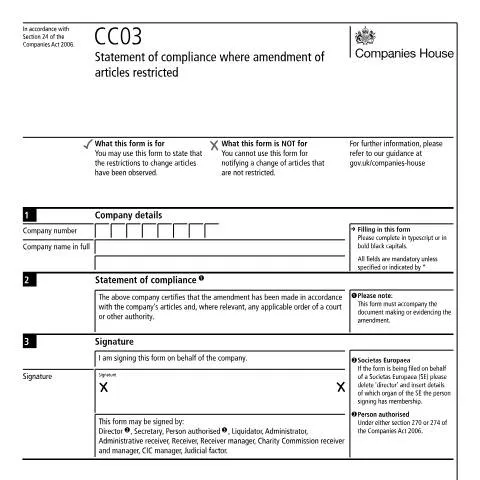
Understanding the CC03 Statement of Compliance for Restricted Article Amendments
When a company's articles of association contain specific restrictions on how they can be amended, directors and company secretaries face a unique challenge. Unlike standard article amendments that follow straightforward procedures, restricted amendments require additional safeguards to ensure compliance with the company's own constitutional framework. The CC03 form serves as a critical compliance certificate, confirming that these internal restrictions have been properly observed during the amendment process.
This statement of compliance becomes particularly relevant for companies whose articles include provisions such as weighted voting requirements, special consent clauses, or court-ordered restrictions. Without proper certification through the CC03, Companies House may reject the proposed amendment, leaving directors in potential breach of their statutory duties under the Companies Act 2006.
The Legal Framework Behind Article Amendment Restrictions
Section 24 of the Companies Act 2006 establishes the foundation for this compliance requirement, recognising that some companies operate under enhanced constitutional protections. These restrictions typically emerge from several scenarios:
- Investor protection clauses inserted during funding rounds, requiring supermajority approval for certain changes
- Court orders imposed following disputes or regulatory interventions
- Regulatory requirements specific to certain industries or company structures
- Shareholder agreements that impose additional procedural hurdles beyond standard company law
The CC03 form specifically addresses situations where these restrictions go beyond the default provisions of the Companies Act. Standard companies can amend their articles through a special resolution requiring 75% shareholder approval, but restricted companies must navigate additional layers of compliance before reaching this threshold.
Distinguishing Restricted from Standard Amendments
The form's guidance explicitly states what it cannot be used for: notifying changes to articles that are not subject to restrictions. This distinction proves crucial for company secretaries who must determine whether their proposed amendment falls within the CC03 remit or follows standard procedures.
Companies operating under Societas Europaea structures face additional complexity, as the form must be adapted to reflect the specific governance organs rather than traditional UK company roles. The form acknowledges this by allowing deletion and insertion of appropriate SE terminology.
Navigating the Compliance Certification Process
The heart of the CC03 lies in its certification statement, where the company formally declares that "the amendment has been made in accordance with the company's articles and, where relevant, any applicable order of a court or other authority." This seemingly simple statement carries significant legal weight and requires careful consideration of multiple compliance layers.
Pre-Certification Requirements
Before completing the CC03, companies must ensure they have satisfied all applicable restrictions. This typically involves:
| Restriction Type | Typical Requirements | Evidence Needed |
|---|---|---|
| Enhanced voting thresholds | Supermajority or unanimous approval | Detailed voting records showing compliance |
| Court orders | Specific procedural compliance | Court approval or confirmation of adherence |
| Regulatory consent | Prior approval from relevant authority | Regulatory clearance documentation |
| Third-party consent clauses | Written agreement from specified parties | Signed consent forms or agreements |
The Mandatory Accompaniment Rule
A critical procedural requirement states that the CC03 must accompany the document making or evidencing the amendment. This means the compliance statement cannot be filed independently or retrospectively – it forms an integral part of the amendment submission package.
This requirement prevents companies from attempting to regularise non-compliant amendments after the fact, ensuring that compliance consideration occurs at the appropriate stage of the process.
Authorised Signatories and Corporate Governance Implications
The CC03 form permits signature by a broad range of corporate officers and authorised persons, reflecting the diverse circumstances under which restricted amendments might occur. Beyond the standard directors and company secretaries, the form accommodates signatures from:
- Liquidators and administrators during insolvency proceedings
- Administrative receivers and receiver managers in secured creditor scenarios
- Charity Commission receivers for charitable companies under regulatory intervention
- CIC managers for Community Interest Companies
- Judicial factors in Scottish legal proceedings
This expansive list recognises that restricted article amendments often occur during periods of corporate distress or regulatory oversight, when normal governance structures may be suspended or modified.
The Section 270 and 274 Authorisation Route
For companies where traditional officers are unavailable or conflicted, the Companies Act provides alternative authorisation routes under sections 270 and 274. These provisions allow specifically authorised persons to act on behalf of the company in limited circumstances, though such authorisation must be properly documented and legally valid.
Practical Considerations for Different Company Structures
The application of CC03 requirements varies significantly depending on the company's structure and the nature of its article restrictions. Private companies with investor protection clauses typically face the most straightforward application, where venture capital or private equity agreements impose additional consent requirements beyond standard company law.
Public Company Complications
Public companies face additional complexity due to their broader shareholder base and potential listing rule requirements. While the CC03 addresses company law compliance, public companies must also consider Financial Conduct Authority regulations and stock exchange requirements that may impose parallel restrictions.
Group Company Scenarios
Subsidiary companies within larger groups often operate under parent company restrictions embedded in their articles. These might include requirements for parent board approval or compliance with group-wide governance policies. The CC03 certification must encompass these restrictions alongside any external requirements.
Documentation Standards and Public Record Implications
Companies House emphasises that all information on the CC03 will appear on the public record, creating transparency obligations that extend beyond simple compliance certification. This public visibility means that the compliance statement becomes part of the company's permanent constitutional history, potentially affecting future transactions or disputes.
Completion Standards and Rejection Risks
The form requires completion in typescript or bold black capitals, reflecting Companies House's emphasis on legible public records. All fields are mandatory unless specifically indicated otherwise, and the accompanying checklist highlights common rejection triggers:
- Mismatched company name and number with public register records
- Missing accompanying amendment documentation
- Unsigned or improperly signed forms
Rejected submissions can delay amendment implementation and potentially expose companies to compliance breaches if time-sensitive restrictions apply.
Integration with Broader Amendment Procedures
The CC03 form operates within a broader ecosystem of company amendment procedures, and understanding its relationship to other filings proves essential for effective compliance management. Companies must often coordinate CC03 submission with special resolution filings, updated articles of association, and potentially regulatory notifications to relevant authorities.
Timing Coordination Challenges
The mandatory accompaniment requirement creates timing challenges for companies with complex approval processes. If court approval is required, for example, companies must ensure that CC03 preparation aligns with court timetables and that all necessary approvals are secured before submission.
For companies with multiple restriction layers, the certification process becomes particularly complex. A company might need to satisfy investor consent requirements, regulatory approval, and enhanced voting thresholds before completing the CC03, requiring careful project management to ensure all elements align appropriately.
Post-Submission Considerations
Once filed, the CC03 creates a permanent record of compliance that may be referenced in future legal proceedings or transaction due diligence. Companies should maintain comprehensive supporting documentation to substantiate their compliance certification, as challenges to the validity of restricted amendments can emerge years after filing.
The public nature of the filing also means that stakeholders, including minority shareholders, creditors, and regulatory authorities, gain visibility of the company's compliance with its constitutional restrictions. This transparency can enhance corporate governance but also exposes companies to scrutiny if compliance shortcuts have been taken.
Strategic Implications for Corporate Constitutional Management
The CC03 requirement highlights the importance of proactive constitutional management for companies operating under article restrictions. Rather than viewing compliance as a mere procedural hurdle, sophisticated companies integrate restriction management into their broader governance framework.
This involves regular review of existing restrictions to assess their continued relevance, particularly as companies evolve through funding rounds, acquisitions, or strategic pivots. Some restrictions that made sense at incorporation may become impediments to efficient governance, warranting consideration of whether amendment or removal might be appropriate.
Companies should also consider the cumulative effect of multiple restrictions, as layered constitutional protections can create governance paralysis in fast-moving commercial situations. The CC03 process provides an opportunity to audit these restrictions and consider rationalisation where appropriate.
For companies contemplating future fundraising or M&A activity, understanding existing article restrictions and their CC03 implications becomes crucial for transaction planning. Buyers and investors increasingly focus on constitutional flexibility as a key due diligence consideration, making restriction management a strategic as well as compliance issue.
Alternative Notification Methods and Digital Submission Procedures
While Companies House strongly encourages online submission of Form CC03 through their WebFiling service, understanding the full range of submission methods ensures compliance regardless of your circumstances or technical capabilities.
WebFiling Service Requirements and Process
The WebFiling system requires an authentication code, typically found on your company's annual confirmation statement or incorporation documents. If you've misplaced this code, you'll need to request a new one from Companies House, which can add 5-10 working days to your timeline. The system accepts PDF uploads of supporting documents up to 10MB per file, though complex restriction agreements may exceed this limit.
When using WebFiling, the system performs real-time validation checks on company numbers, director details, and form completion. However, it cannot verify the legal validity of your restriction compliance, meaning technical acceptance doesn't guarantee regulatory approval. The system generates an immediate receipt with a unique submission reference, but the formal processing timeline remains the same as postal submissions.
Postal Submission Considerations
For postal submissions to Companies House, Crown Way, Cardiff CF14 3UZ, ensure you use recorded delivery or special delivery services. Standard first-class post carries risk of non-delivery without proof, potentially causing compliance issues if deadlines are missed. Include a covering letter clearly stating the nature of your submission and requesting written acknowledgement.
Postal submissions require original signatures on Form CC03, unlike digital submissions where electronic authentication suffices. If your company has multiple directors or shareholders involved in the restriction compliance, coordinate signature collection well before your deadline to avoid last-minute complications.
Same-Day Filing Services
Companies House offers same-day processing for urgent filings submitted before 3pm on working days, though this service incurs additional fees. This option proves particularly valuable when restriction compliance deadlines coincide with other corporate events or when late-discovered compliance requirements emerge. However, same-day service doesn't guarantee same-day approval—it only ensures same-day processing begins.
Impact on Corporate Governance and Board Responsibilities
Filing Form CC03 creates significant implications for ongoing corporate governance, establishing precedents and responsibilities that extend well beyond the immediate compliance requirement.
Director Duties and Liability Considerations
Directors submitting CC03 notifications assume personal responsibility for the accuracy and completeness of the compliance statement. Under the Companies Act 2006, directors who knowingly provide false information face potential criminal liability, including fines up to £5,000 and potential disqualification from holding directorships.
The notification creates a permanent public record of the company's approach to article restrictions, potentially influencing future legal interpretations of similar restrictions. Courts may reference previous CC03 filings when determining whether companies have established patterns of compliance or non-compliance with constitutional restrictions.
Fill in your form directly online
No printing: type your details into the boxes of the official form, tick, then download the PDF ready to send.
- 1Type into the form boxes
- 2Tick in one click
- 3Save and download the PDF
Directors must also consider whether the restriction compliance affects their duties under sections 171-177 of the Companies Act 2006. For instance, if compliance with share transfer restrictions involves related party transactions, additional disclosure obligations may arise under the substantial property transactions provisions.
Shareholder Rights and Information Access
The CC03 filing becomes part of the public record accessible through Companies House searches, meaning shareholders—and potential investors—can review your company's restriction compliance history. This transparency requirement serves legitimate interests but may also reveal sensitive information about internal corporate arrangements or disputes.
Shareholders retain rights to inspect the underlying documents referenced in CC03 filings, though companies can resist disclosure if commercially sensitive information is involved. The balance between transparency obligations and confidentiality protection often requires legal guidance, particularly in companies with complex ownership structures or ongoing commercial negotiations.
Impact on Future Corporate Actions
CC03 filings establish precedents for how your company interprets and applies article restrictions, potentially constraining future flexibility. For example, if you notify compliance with share transfer restrictions by applying a particular valuation methodology, shareholders may expect consistent application in future transfers.
The filing may also trigger review obligations under loan agreements, insurance policies, or other contracts containing corporate governance covenants. Some commercial agreements require notification when companies file certain forms with Companies House, making CC03 submission a potential trigger event for broader contractual obligations.
Sector-Specific Compliance Considerations and Regulatory Intersection
Different industry sectors face unique challenges when managing article restrictions and CC03 compliance, with additional regulatory frameworks creating layered obligations that require careful coordination.
Financial Services and FCA Oversight
Companies operating under Financial Conduct Authority (FCA) authorization face additional complexity when managing share transfer restrictions. FCA rules regarding "significant influence" and "control" may conflict with or override standard article restrictions, particularly where transfers could affect regulatory capital requirements or fit-and-proper assessments.
The Senior Managers and Certification Regime (SMCR) creates additional notification obligations when article restrictions affect persons holding senior management functions. Changes in effective control—even if technically compliant with article restrictions—may require separate FCA notifications within specific timeframes that don't align with Companies House filing deadlines.
Investment firms must also consider Market Abuse Regulation (MAR) implications when article restrictions affect trading in company shares. What appears as routine compliance with constitutional restrictions might constitute inside information requiring market disclosure under MAR provisions.
Healthcare and Professional Service Restrictions
Healthcare companies often face statutory restrictions on ownership by non-qualified persons, creating intersection points between article restrictions and professional regulatory requirements. For example, dental practices incorporated as limited companies must ensure share transfers comply with General Dental Council requirements alongside any article restrictions.
Professional service companies—legal practices, accounting firms, architectural practices—frequently have article restrictions designed to maintain professional compliance. CC03 filings in these sectors may trigger review by professional bodies, particularly where ownership changes could affect practicing certificate requirements or professional indemnity insurance coverage.
Care home operators face additional scrutiny from the Care Quality Commission (CQC) regarding ownership changes, even when technically compliant with article restrictions. The CQC's fitness test for registered providers may require separate notification processes that CC03 filing alone doesn't satisfy.
Technology and Intellectual Property Considerations
Technology companies often have complex article restrictions related to intellectual property ownership, export control compliance, or foreign investment screening. The National Security and Investment Act 2021 creates mandatory notification requirements for certain technology transfers that may override standard article restrictions.
Where article restrictions relate to IP licensing or technology transfer rights, CC03 compliance notification may trigger obligations under existing licensing agreements or joint venture arrangements. International licensing agreements may require separate notifications to foreign partners or regulatory authorities when ownership structures change, even if domestic article restrictions are satisfied.
Companies involved in government contracts or defense-related activities face additional security clearance requirements that intersect with share transfer restrictions. Security vetting processes may require disclosure of CC03 filings and underlying compliance documentation, potentially creating timing pressures where clearance renewal deadlines approach.
Cross-Border Implications and International Reporting
Companies with international operations or foreign shareholders must consider whether CC03 filings trigger reporting obligations in other jurisdictions. EU subsidiaries may face disclosure requirements under local company law, while US operations might trigger Securities and Exchange Commission (SEC) reporting obligations for publicly traded parent companies.
Tax implications of restriction compliance often extend beyond UK borders, particularly where article restrictions affect profit-sharing arrangements or dividend distribution rights. Double taxation treaty provisions may apply differently depending on how restriction compliance affects beneficial ownership determinations for treaty purposes.
Immigration implications can arise where article restrictions affect employment rights or sponsor license obligations. Companies sponsoring international employees under the points-based immigration system must consider whether ownership changes evidenced by CC03 filings affect their sponsor duties or require separate Home Office notifications.