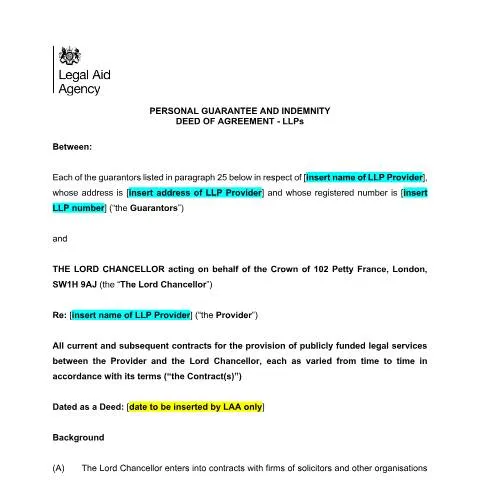
When Legal Aid Meets Limited Liability: Understanding Personal Guarantees for LLP Providers
The shift from traditional partnerships to Limited Liability Partnerships has fundamentally altered the landscape of legal aid provision in England and Wales. While LLPs offer practitioners protection from personal liability in most circumstances, they create a significant challenge for the Legal Aid Agency when it comes to recovering overpayments and ensuring contract performance. The Personal Guarantee and Indemnity deed represents the Crown's response to this challenge, requiring individual members to personally guarantee their LLP's obligations under legal aid contracts.
This arrangement stems from a practical reality: when solicitors operate as traditional partnerships, each partner bears unlimited personal liability for the firm's debts and obligations. If the Legal Aid Agency advances funds that subsequently need to be recovered, it can pursue individual partners directly. However, LLP members enjoy limited liability protection, potentially leaving the Agency unable to recover public funds if the LLP itself becomes insolvent or defaults on its obligations.
The guarantee mechanism ensures the Lord Chancellor remains in "no worse a position when contracting with providers which are LLPs than he would have been had the provider been a partnership or sole principal." This principle underpins the entire framework and explains why individual guarantees become necessary despite the limited liability structure that practitioners specifically chose to adopt.
The Dual Nature of Financial Responsibility Under This Deed
The Personal Guarantee and Indemnity creates two distinct but complementary forms of personal liability for LLP members. Understanding this dual structure is crucial for practitioners considering LLP conversion or joining an existing LLP with legal aid contracts.
Primary Guarantee Obligations
Under the guarantee provisions, each signatory becomes personally liable for the LLP's performance of all obligations under legal aid contracts. This encompasses not merely financial obligations but the entire spectrum of contractual duties, including service delivery standards, reporting requirements, and compliance obligations. The guarantee operates on a joint and several basis, meaning the Legal Aid Agency can pursue any individual guarantor for the full extent of any breach, regardless of that person's actual involvement in the specific default.
The guarantee specifically covers two critical areas: punctual performance of all contractual obligations and payment of all monies due to the Lord Chancellor. This broad scope means guarantors cannot limit their exposure to particular types of breach or specific contract provisions.
Independent Indemnity Commitment
Beyond the guarantee, each signatory provides a separate indemnity undertaking. This operates as a "separate and primary obligation" rather than merely secondary liability that depends on the LLP's default. The indemnity covers all losses, costs, claims, expenses, damages, demands, or liabilities suffered by the Lord Chancellor arising from the Provider's failure to comply with contract obligations.
This dual structure ensures comprehensive protection regardless of how legal proceedings might develop. Even if technical defences might apply to the guarantee, the indemnity provides an independent basis for recovery. The arrangement also covers situations involving receivers, administrators, or similar insolvency practitioners appointed to the LLP.
Navigating Membership Changes and Ongoing Obligations
LLP membership naturally evolves over time, with partners joining and leaving the practice. The guarantee framework includes specific provisions governing these transitions, creating both opportunities and obligations for existing and prospective members.
Advance Notification Requirements
Current guarantors must inform the Legal Aid Agency at least 15 business days prior to any change in the Provider's membership. This advance notice requirement serves multiple purposes: it allows the Agency to assess the impact of membership changes on contract security, provides time to arrange new guarantee documentation, and ensures continuity of protection throughout transitions.
The notification obligation extends beyond simple additions or departures. Any structural changes affecting the membership composition trigger the requirement, including situations where existing members alter their own corporate structure or liability status.
New Member Integration Process
When new members join the LLP, existing guarantors undertake to ensure appropriate guarantee arrangements are established within 28 days of the membership change. This responsibility extends to complex membership structures where new members might themselves be companies or LLPs.
| New Member Type | Guarantee Requirements | Timeframe |
|---|---|---|
| Individual practitioner | Personal guarantee signature required | Within 28 days of joining |
| Corporate member | Directors and shareholders must sign | Within 28 days of joining |
| LLP member | All LLP members must sign | Within 28 days of joining |
The complexity increases significantly when corporate entities or other LLPs become members. In these situations, the guarantee requirement cascades through the ownership structure, potentially requiring signatures from multiple individuals who may have limited direct involvement in legal aid work.
Departure Protocols and Liability Limitation
One of the most practically significant provisions addresses what happens when guarantors leave the LLP or cease their qualifying relationship with a corporate member. The deed provides clear protection for departing members while maintaining security for ongoing obligations.
Under clause 5, departing guarantors cease liability "for any liabilities incurred after the date of his/her departure." This cut-off applies whether someone stops being an LLP member directly, or ceases to be a director or shareholder of a corporate member, or leaves an LLP that is itself a member of the provider LLP.
However, this protection only applies to future liabilities. Departing members remain fully liable for any breaches, overpayments, or other obligations that arose during their period as guarantors. This continuing liability can extend well beyond the departure date, particularly for complex cases or investigations that may take years to resolve.
The practical implications are significant for retirement planning and career transitions. Practitioners considering departure should carefully review all outstanding legal aid matters and potential exposure before finalising their exit arrangements. The Legal Aid Agency's internal processes for determining when liabilities "arise" may not align with practitioners' assumptions about timing.
Contractual Protections and Variation Safeguards
The deed includes extensive provisions preventing guarantors from claiming discharge or reduction of liability based on subsequent changes to the underlying contracts or the Legal Aid Agency's enforcement approach. These protections ensure that the guarantee remains effective regardless of how the contractual relationship evolves.
Immunity from Contract Modifications
Clause 8 establishes that guarantor liability cannot be reduced by contract terminations, amendments, novations, replacements, supplements, or variations. This includes changes to "the extent or nature of the work performed under the Contract(s)." Even if the LLP's legal aid contract undergoes substantial modification, existing guarantees remain fully effective.
This protection addresses a common legal principle where guarantees can be discharged if the underlying obligation changes materially without the guarantor's consent. By contracting out of this protection, guarantors accept that their liability continues regardless of how the legal aid arrangements develop.
Enforcement and Collection Flexibility
The deed also prevents guarantors from claiming discharge based on the Legal Aid Agency's enforcement approach. Whether the Agency grants time, makes concessions, shows indulgence, or delays enforcement action cannot be used to escape guarantee obligations. This ensures that reasonable administrative flexibility in contract management does not inadvertently undermine security arrangements.
Similarly, the Agency's dealings with third parties or any acts or omissions that might otherwise discharge guarantee liability are specifically excluded from providing such relief. This comprehensive approach prevents technical legal arguments from undermining the fundamental protection the guarantee is designed to provide.
Execution Requirements and Documentary Formalities
The Personal Guarantee and Indemnity must be executed as a deed, reflecting the serious nature of the commitments involved and ensuring maximum legal enforceability. The deed structure provides greater protection than simple contract arrangements and typically allows longer limitation periods for enforcement.
Each guarantor executes the deed individually, creating separate legal relationships with the Lord Chancellor rather than a single collective arrangement. This individual execution ensures that one person's potential legal challenges cannot affect others' obligations and provides maximum flexibility for enforcement.
Dating and Commencement Procedures
The Legal Aid Agency retains control over the deed's effective date, with the document stating "Dated as a Deed: [date to be inserted by LAA only]." This administrative control ensures proper coordination with contract commencement and avoids gaps in guarantee coverage during transition periods.
The deed commences on its stated date and continues until the later of two events: completion of all Provider obligations under the legal aid contracts, or full discharge of all guarantee obligations. This structure ensures coverage extends beyond contract completion to address any lingering liability or recovery proceedings.
Modification and Discharge Considerations
While the deed creates substantial obligations, it includes provisions for potential modification or discharge in appropriate circumstances. The Lord Chancellor commits not to "unreasonably refuse to discharge this Deed, or to modify its terms, in respect of one or more of the Guarantors."
However, any such discharge or modification may be "subject to reasonable conditions." This might include alternative security arrangements, settlement of outstanding liabilities, or other protections ensuring the Legal Aid Agency's position remains secure.
The reasonableness standard provides some protection for guarantors while maintaining necessary flexibility for the Agency. Practitioners seeking discharge should present compelling reasons and be prepared to discuss alternative arrangements that maintain appropriate security for public funds.
This balanced approach recognises that circumstances change and that permanent guarantee obligations may become inappropriate in some situations, while ensuring that any modifications properly protect the public interest in legal aid contract security.
Enforcement Mechanisms and Recovery Procedures
When a personal guarantee is called upon, creditors have several enforcement routes available under English law, each with distinct procedures and implications for guarantors. Understanding these mechanisms is crucial for anyone considering signing a guarantee, as the consequences can be far-reaching and immediate.
The most straightforward enforcement method is direct demand for payment. Once the principal debtor defaults, the creditor can serve a formal demand on the guarantor, typically requiring payment within 7 to 21 days. This demand must clearly specify the amount owed, the basis for the claim, and reference the guarantee document. Guarantors should scrutinise such demands carefully, as they have the right to dispute the claim if they believe it's unfounded or exceeds the guarantee's scope.
If the guarantor fails to respond to the demand, creditors may initiate court proceedings. For debts under £100,000, this typically involves the County Court, while higher amounts proceed through the High Court. The creditor must demonstrate that the principal debt exists, the guarantee covers the specific obligation, and proper demand has been made. Guarantors can defend such actions by challenging the validity of the guarantee, arguing that conditions precedent haven't been met, or raising defences such as misrepresentation or undue influence.
Judgment creditors possess powerful enforcement tools once they obtain a court order. These include charging orders against the guarantor's property, which effectively secure the debt against real estate or other assets. Third party debt orders can freeze bank accounts, while attachment of earnings orders direct employers to deduct amounts from the guarantor's salary. In extreme cases, creditors may petition for the guarantor's bankruptcy, though this is typically a last resort given the costs and complexity involved.
Asset tracing becomes particularly relevant where guarantors attempt to dissipate assets to avoid liability. Creditors may seek freezing injunctions (formerly Mareva injunctions) to preserve assets pending judgment. These orders can be granted without notice to the guarantor where there's a risk of asset dissipation, and breach can constitute contempt of court with potential imprisonment consequences.
The limitation period for guarantee claims is generally six years from the date the cause of action accrued, typically when demand for payment was first made. However, acknowledgment of the debt or part payment can restart this period, and continuing guarantees may have different limitation considerations depending on when specific defaults occurred.
Director Guarantees and Corporate Insolvency Implications
Director guarantees represent one of the most common and consequential forms of personal guarantee in UK commercial practice. These arrangements typically arise when company directors provide personal security for corporate borrowing, rental agreements, or trade credit facilities. The intersection between director guarantees and corporate insolvency creates particularly complex legal and practical considerations.
When directors sign personal guarantees, they're effectively stepping outside the protection of limited liability that incorporation normally provides. This decision should never be taken lightly, as it can result in personal assets being exposed to corporate debts that may be many times the director's personal wealth. Standard director guarantees often include "all monies" clauses, meaning the guarantee covers not just the original facility but any additional borrowing or liability the company may incur with the creditor.
The timing of guarantee enforcement in relation to corporate insolvency proceedings is crucial. Creditors holding director guarantees may choose to pursue the company through normal insolvency procedures while simultaneously enforcing against the director personally. Alternatively, they might focus primarily on the guarantee if they believe the director has better realisable assets than the company. This strategic choice can significantly impact recovery prospects and costs.
Directors should be aware that certain guarantee clauses may survive corporate insolvency in ways that seem counterintuitive. For instance, "principal debtor" clauses can make the guarantor liable as if they were the primary debtor, preventing them from claiming in the company's insolvency for any amounts paid under the guarantee. Similarly, clauses excluding set-off rights mean guarantors cannot offset amounts the company might owe them against guarantee liabilities.
The Insolvency Act 1986 contains specific provisions affecting director guarantees, particularly around preferences and transactions at undervalue. If a company grants security or makes payments to reduce a director's guarantee liability shortly before insolvency, these transactions may be challenged and reversed. Directors should also consider their duties under sections 172 and 174 of the Companies Act 2006 when deciding whether to provide guarantees, as these must be in the company's best interests and made with reasonable skill and care.
Administration and Company Voluntary Arrangement (CVA) procedures can complicate guarantee enforcement. While these insolvency procedures may provide breathing space for the company, they don't automatically affect creditor rights against guarantors. However, practical enforcement may be delayed while the company's position is clarified, and successful restructuring might reduce the ultimate guarantee liability if the company resumes payments.
Director loan accounts create additional complexity in guarantee scenarios. Where directors have lent money to their companies, they become creditors in any insolvency. However, guarantee liabilities typically rank as unsecured claims, meaning directors may face the prospect of paying guarantee debts while receiving minimal recovery on their loans to the company. Subordination agreements can worsen this position by requiring director loans to rank behind other creditors.
Cross-Border Guarantees and International Enforcement
Cross-border personal guarantees present unique challenges and opportunities, particularly relevant given the UK's position as an international financial centre and the global nature of modern commerce. These arrangements involve guarantors or creditors in different jurisdictions, creating complex questions around applicable law, enforcement mechanisms, and practical recovery strategies.
The choice of governing law clause in international guarantees is fundamental to determining rights and obligations. English law remains popular for international guarantees due to its commercial sophistication and predictable court system. However, guarantors should understand that choosing English law doesn't automatically mean English courts will have jurisdiction, and separate jurisdiction clauses are essential. The Brussels Regulation (retained in UK law post-Brexit) and other international conventions may affect where proceedings can be brought and how judgments are recognised.
Enforcement of English guarantee judgments abroad varies significantly between jurisdictions. European countries generally offer reciprocal enforcement arrangements, though Brexit has complicated some procedures. The Hague Convention on Choice of Court Agreements may provide enforcement routes in contracting states, while common law countries often have established procedures for recognising English judgments. However, some jurisdictions refuse to enforce foreign judgments or require re-litigation of the underlying claim.
Currency considerations add another layer of complexity to international guarantees. Multi-currency guarantees may specify different currencies for different obligations, while exchange rate fluctuations can significantly impact liability amounts. English courts generally award judgment in the currency of the underlying obligation, but practical recovery may require conversion at rates that have moved significantly since the guarantee was given. Some guarantees include currency hedging provisions or caps to manage this risk.
Tax implications of cross-border guarantees can be substantial and often overlooked. UK resident guarantors may face income tax or capital gains tax consequences depending on the guarantee structure and enforcement method. Double taxation treaties may provide relief, but professional tax advice is essential. Additionally, some jurisdictions impose stamp duty or registration fees on guarantee documents, and failure to comply can affect enforceability.
Regulatory considerations are increasingly important for international guarantees, particularly those involving financial institutions or regulated entities. Anti-money laundering rules may require enhanced due diligence on foreign guarantors, while economic sanctions can make certain guarantee arrangements prohibited. The UK's financial services regulations may also apply where guarantees relate to regulated activities, even if other elements are overseas.
Practical enforcement challenges in cross-border scenarios often exceed the legal complexities. Asset location and valuation across multiple jurisdictions requires specialist expertise and can be extremely costly. Political and economic instability in some jurisdictions may make enforcement impossible or uneconomic. Cultural and language differences can complicate negotiations and settlement discussions, while time zone differences may delay urgent applications for interim relief.
The impact of insolvency proceedings becomes particularly complex in international contexts. While the EU Insolvency Regulation provided a framework for recognising insolvency proceedings across member states, Brexit has created uncertainty about UK participation in these arrangements. Guarantors may find themselves subject to multiple insolvency regimes with conflicting requirements, while creditors must navigate different priority rules and recovery procedures in each relevant jurisdiction.