When Trade Mark Disputes Require a Higher Authority's Intervention
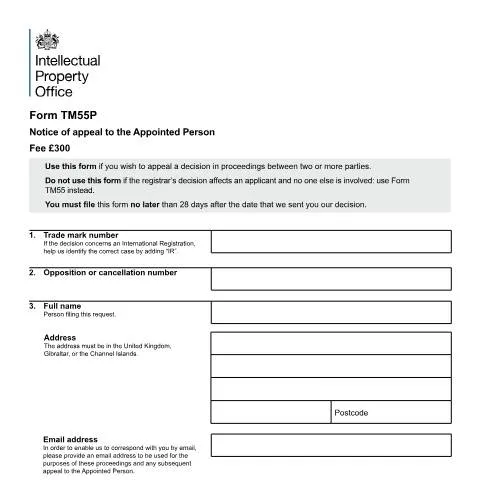
Trade mark disputes between opposing parties can become complex legal battlegrounds where initial decisions by the Intellectual Property Office may not satisfy all stakeholders. When a registrar's decision in contested proceedings leaves one party believing justice has not been served, the Notice of appeal to the appointed person (inter parte) document becomes their pathway to challenge that outcome. This specialised form, designated as TM55P, serves exclusively for appeals in multi-party trade mark disputes where the stakes often involve significant commercial interests and brand protection strategies.
Unlike straightforward application rejections that affect only the applicant, inter parte proceedings involve adversarial situations where registered owners, opponents, and their representatives battle over trade mark rights. The appointed person system represents the UK's intermediate appellate tier, positioned between the IPO's initial decisions and the High Court's jurisdiction, offering a more cost-effective route for challenging determinations in opposition and cancellation proceedings.
Understanding the Inter Parte Appeal Framework
The distinction between TM55 and TM55P forms reflects a fundamental difference in trade mark dispute structures. Form TM55P specifically addresses situations where multiple parties have contested rights or interests, creating a more complex procedural landscape than single-party applications. This inter parte framework typically emerges from:
- Opposition proceedings where third parties challenge pending applications
- Cancellation actions seeking to remove existing registrations
- Revocation proceedings based on non-use or other grounds
- Invalidity declarations challenging registration validity
The appointed person, typically a senior legal practitioner with extensive intellectual property expertise, operates independently from the IPO's examination structure. Their role encompasses reviewing both substantive decisions on trade mark merits and procedural determinations affecting case management, costs, or evidence handling.
Temporal Constraints and Strategic Considerations
The 28-day deadline from the IPO's decision notification creates immediate pressure for dissatisfied parties. This timeframe cannot be extended retrospectively, making prompt legal assessment crucial. Parties must evaluate whether appealing serves their broader commercial strategy, considering that unsuccessful appeals may result in additional costs being awarded against them.
The £300 fee, while modest compared to High Court proceedings, represents just the initial investment. Appointed person hearings can involve substantial legal costs, expert witness fees, and potential adverse cost orders, making the decision to appeal a significant strategic choice rather than an automatic response to unfavourable outcomes.
Navigating the Technical Requirements and Party Classifications
Form TM55P's structure reflects the complexity of multi-party intellectual property disputes. The party identification section requires careful completion, as incorrect categorisation can affect procedural rights and cost liabilities. The available classifications encompass:
| Party Type | Typical Circumstances | Procedural Implications |
|---|---|---|
| Recorded owner/holder | Defending existing registration | May claim costs if successful |
| Owner's representative | Acting for registered proprietor | Must demonstrate proper authority |
| Opponent | Challenging application/registration | Bears burden of proving grounds |
| Opponent's representative | Acting for challenging party | Requires clear mandate documentation |
| Other interested party | Third-party intervener | Must establish legitimate interest |
The address requirement limiting locations to the United Kingdom, Gibraltar, or the Channel Islands reflects post-Brexit intellectual property arrangements. This restriction affects international businesses, potentially requiring them to appoint UK-based representatives or establish qualifying addresses for appeal purposes.
International Registration Complexities
When appeals concern International Registrations under the Madrid Protocol, the form requires adding "IR" to the trade mark number. This seemingly minor detail becomes crucial for IPO case identification, as International Registrations follow different procedural tracks and may involve coordination with the World Intellectual Property Organization.
Crafting Compelling Appeal Grounds Within Legal Parameters
The "Reasons for appeal" section represents the document's most critical component, where legal strategy meets practical advocacy. Successful appeals typically challenge either the registrar's legal reasoning or factual findings, requiring appellants to demonstrate specific errors rather than merely expressing dissatisfaction with outcomes.
Substantive decision appeals often focus on trademark distinctiveness assessments, likelihood of confusion analyses, or the application of exclusions under the Trade Marks Act 1994. These appeals require detailed legal argument supported by case law precedents and evidence challenging the registrar's conclusions.
Procedural decision appeals may address case management directions, evidence admission rulings, or cost determinations. While seemingly less significant, procedural errors can fundamentally affect case outcomes, making them legitimate grounds for appellate intervention.
Strategic Presentation Techniques
Effective appeal grounds typically follow structured approaches that appointed persons expect from experienced practitioners:
- Clear identification of the specific decision elements being challenged
- Detailed explanation of alleged legal or factual errors
- Reference to relevant statutory provisions or case law authorities
- Demonstration of how errors materially affected the outcome
- Indication of the relief sought from the appointed person
The provision for continuation sheets acknowledges that complex trade mark disputes often require extensive legal argument. However, concise, well-structured presentations generally prove more effective than lengthy submissions that may obscure key points.
Payment Mechanisms and Administrative Processing Considerations
The IPO's multiple payment options reflect modern administrative flexibility while maintaining security standards. The online card payment system through fees.ipo.gov.uk provides immediate processing confirmation through unique 10-character reference codes, enabling rapid form submission and processing initiation.
IPO deposit accounts offer convenience for regular users, particularly law firms and corporate intellectual property departments handling multiple cases. These accounts streamline payment processing and provide clear audit trails for professional billing purposes.
Bank transfer options accommodate international parties and those preferring traditional payment methods. The provided SWIFT and IBAN details facilitate overseas transfers, though parties should consider currency conversion timing and potential delays in international banking processes.
Processing Timeline Implications
The IPO's preference for electronic submission to [email protected] reflects efficiency priorities and environmental considerations. Email submissions enable immediate acknowledgment and faster case file creation, potentially reducing overall appeal processing times.
Postal submissions to the Newport office, while still accepted, face longer processing periods that could affect subsequent procedural deadlines. Given the time-sensitive nature of intellectual property disputes, electronic submission represents the preferred approach for maintaining procedural momentum.
Appointed Person Jurisdiction and Procedural Expectations
The appointed person system operates under specific jurisdictional constraints that appellants must understand before initiating proceedings. Unlike High Court judges, appointed persons cannot award damages or grant injunctive relief, limiting their remedial powers to overturning, varying, or confirming IPO decisions.
Appointed person procedures typically involve written submissions rather than oral hearings, though complex cases may warrant face-to-face proceedings. The appointed person may request additional evidence or legal argument, particularly where the original IPO decision raised novel legal questions or involved incomplete factual development.
Interaction with Broader Dispute Resolution Strategies
Appeals to the appointed person often form part of broader intellectual property enforcement or defence strategies. Successful appeals may strengthen positions in related proceedings, including domain name disputes, passing off actions, or international trade mark portfolio management.
The appointed person's decision creates binding precedent within the IPO system, potentially affecting similar cases and influencing future examination practices. This precedential value may justify appeals even where immediate commercial benefits appear limited.
Post-Appeal Pathways and Strategic Outcomes
Appointed person decisions themselves remain appealable to the High Court on points of law, creating a three-tier system for trade mark dispute resolution. However, High Court appeals involve significantly higher costs and stricter procedural requirements, making appointed person proceedings often the practical final stage for many disputes.
The appointed person may award costs against unsuccessful appellants, though such awards typically remain modest compared to High Court proceedings. Cost considerations often influence settlement discussions, as parties evaluate litigation risks against potential commercial outcomes.
Successful appeals may result in cases being remitted to the IPO for reconsideration under revised legal frameworks, potentially extending overall dispute timelines while providing opportunities for alternative resolutions. The interplay between appellate success and practical case resolution requires careful strategic planning throughout the process.
Understanding the TM55P framework enables parties to make informed decisions about challenging adverse trade mark decisions, balancing legal prospects against commercial realities in the complex landscape of intellectual property dispute resolution.
Understanding the Grounds for Appeal and Building Your Case
The strength of your appeal to the appointed person hinges on identifying solid legal grounds and presenting compelling evidence. Unlike the initial opposition or invalidity proceedings, you cannot introduce entirely new grounds at the appeal stage – you're bound by the scope of issues raised in the original proceedings before the hearing officer.
The most common grounds for appeal include procedural errors by the hearing officer, misapplication of relevant trademark law, or failure to properly consider evidence submitted during the inter partes proceedings. For instance, if the hearing officer incorrectly assessed the likelihood of confusion under Section 5(2)(b) of the Trade Marks Act 1994, or failed to apply the proper legal test established in cases such as Sabel v Puma or Canon v MGM, this could form the basis of your appeal.
Evidential issues frequently arise where the hearing officer has allegedly given insufficient weight to survey evidence, market research, or witness statements. If you submitted consumer confusion surveys or evidence of actual use in the marketplace that the hearing officer dismissed without adequate reasoning, this may constitute appealable error. Similarly, if coexistence agreements or licensing arrangements were overlooked, or if the hearing officer failed to properly consider the impact of earlier coexistence in the marketplace, these omissions could strengthen your appeal case.
When drafting your notice of appeal, focus on specific legal errors rather than merely disagreeing with the hearing officer's conclusions. The appointed person will not simply substitute their view for that of the hearing officer – there must be demonstrable legal error. Quote specific paragraphs from the hearing officer's decision and explain precisely why the reasoning is flawed, citing relevant case law and statutory provisions.
Consider whether the hearing officer properly applied the "global appreciation" test for likelihood of confusion, correctly assessed the degree of attention of the average consumer, or adequately considered the interdependence between similarity of marks and similarity of goods/services. These technical aspects of trademark law are frequently misapplied and can provide strong grounds for appeal.
The Role of Evidence and Documentation in Inter Partes Appeals
Evidence management becomes particularly crucial in inter partes appeals, as you must work within the evidentiary record established during the original proceedings. The appointed person will generally not admit fresh evidence unless there are exceptional circumstances, such as evidence that was not available at the time of the original hearing or evidence that goes to a pure point of law.
Your evidence bundle should be meticulously organised and cross-referenced to specific paragraphs in the hearing officer's decision. If challenging the assessment of likelihood of confusion, ensure your evidence clearly demonstrates how consumers actually encounter and distinguish between the marks in question. This might include point-of-sale evidence, packaging samples, advertising materials, or documentation showing the channels of trade for the respective goods or services.
For appeals involving absolute grounds for refusal, such as distinctiveness under Section 3(1)(b) or descriptiveness under Section 3(1)(c), compile evidence showing how the mark functions as a trademark in practice. This could include evidence of substantial use, advertising spend figures, market recognition surveys, or third-party references to the mark as a brand identifier rather than a descriptive term.
Pay particular attention to any evidence that the hearing officer specifically mentioned but allegedly misinterpreted. If witness statements were given little weight, identify whether this was due to procedural deficiencies in their preparation or substantive concerns about their content. Professional witnesses, such as trademark attorneys or industry experts, should have their qualifications and experience clearly established in their statements.
Documentation of the opponent's or applicant's trademark portfolio can be highly relevant, particularly where arguments about family of marks, reputation, or filing patterns arise. Compile comprehensive searches showing the scope and geographical extent of trademark registrations, paying attention to classification differences and filing dates that might affect priority claims.
Consider whether the hearing officer properly evaluated evidence of reputation and distinctiveness acquired through use. Under Section 3(3) of the Trade Marks Act 1994, marks that are initially descriptive or non-distinctive can become registrable through acquired distinctiveness. Evidence supporting such claims must be substantial and typically includes market share data, advertising expenditure, consumer recognition surveys, and evidence of exclusive use over a significant period.
Strategic Considerations for Different Types of Inter Partes Proceedings
The strategic approach to your appeal will vary significantly depending on whether you're appealing from opposition proceedings, invalidity actions, or revocation proceedings. Each type of proceeding has distinct legal frameworks and evidential requirements that influence how you should structure your appeal arguments.
In opposition appeal cases, focus on whether the hearing officer correctly applied the relative grounds for refusal under Sections 5(1), 5(2), 5(3), or 5(4) of the Trade Marks Act 1994. Section 5(2)(b) appeals often turn on the proper application of the likelihood of confusion test, including assessment of the degree of similarity between marks, similarity of goods/services, and the likelihood that consumers would be confused or associate the marks. The hearing officer's reasoning on each limb of this test should be scrutinised for legal error.
For Section 5(3) appeals involving marks with a reputation, examine whether the hearing officer properly established the reputation threshold, correctly identified the relevant public, and adequately assessed whether the use complained of would take unfair advantage of or be detrimental to the distinctive character or repute of the earlier mark. The Intel criteria must be properly applied, and failure to consider all relevant factors could constitute appealable error.
Invalidity appeals present different challenges, as the applicant seeks to remove an existing registration from the register. Here, examine whether the hearing officer correctly assessed the evidence available at the filing date of the contested registration. Evidence of subsequent use or changes in the marketplace may be irrelevant to the validity assessment, and the hearing officer's treatment of such evidence should be scrutinised.
Revocation proceedings focus on whether the mark has been genuinely used or whether it has become generic or deceptive. Appeals in revocation cases often centre on the definition of "genuine use" and whether the hearing officer properly applied the guidance in cases such as Ansul and La Mer. Evidence of token use, minimal sales, or use solely to maintain the registration may be insufficient, and the hearing officer's assessment of the quality, quantity, and nature of use should be carefully reviewed.
Consider the burden of proof applicable to your type of proceeding. In opposition cases, the opponent must prove their case, whilst in revocation proceedings for non-use, the applicant for revocation must establish a prima facie case before the burden shifts to the proprietor to prove use. Misapplication of evidential burdens can provide strong grounds for appeal.
Timing considerations may also affect your strategic approach. If the hearing officer failed to properly consider the relevant dates for assessing conflicts (application date, priority date, or date of use), this could significantly impact the outcome and provide grounds for appeal. Similarly, in cases involving Madrid Protocol applications or Convention priority claims, ensure the hearing officer correctly applied the relevant international treaty provisions.