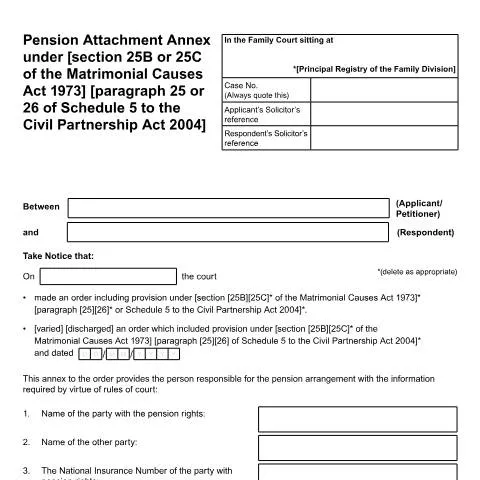
Navigating the Pension Attachment Annex: Form P2
Understanding the intricacies of Form P2, or the Pension Attachment Annex, is essential for individuals navigating the complex waters of divorce or civil partnership dissolution. This document plays a pivotal role in the allocation of pension rights following the breakdown of a relationship, as determined by the Family Court. With pensions often being a significant financial asset, ensuring a thorough comprehension of this form is vital for both parties involved.
The Profile of the Parties Involved
When dealing with Form P2, it's crucial to identify the parties directly involved. Typically, this includes:
- The Applicant: This individual is seeking the pension attachment as part of the court's financial provision order during divorce or civil partnership dissolution proceedings.
- The Respondent: The person against whom the pension attachment is sought, who possesses the pension rights in question.
Both parties must ensure that the information provided is accurate, as discrepancies can lead to complications or delays in proceedings.
Why Accurate Information Matters
Inaccuracies in the Pension Attachment Annex can have serious implications:
- Legal delays, extending the time required to reach a final settlement.
- Potential financial losses if pension rights are not correctly allocated.
- Increased legal fees due to necessary corrections or additional court appearances.
Thus, parties should take great care when filling out Form P2 to avoid any pitfalls.
How Form P2 Fits into the Bigger Picture
Form P2 is not merely a standalone document; it is closely intertwined with the legal framework governing matrimonial and civil partnership law in the UK. Specifically, it operates under sections 25B and 25C of the Matrimonial Causes Act 1973, as well as paragraphs 25 and 26 of Schedule 5 to the Civil Partnership Act 2004.
This form is required when a court has ordered a pension attachment as part of a financial settlement. It serves to inform the pension provider of the court's decision, detailing the required actions that need to be taken regarding the pension rights of the parties involved.
The Role of the Family Court
The Family Court is responsible for interpreting and enforcing the orders that arise from divorce or civil partnership dissolution. The court's role includes:
- Assessing the financial needs and obligations of both parties.
- Determining the fair distribution of assets, including pensions.
- Issuing orders that ensure compliance with the rulings made.
Form P2 thus serves as an essential tool in communicating these orders to pension providers, ensuring that individuals receive their rightful entitlements.
Completion of Form P2: Step by Step
Filling out Form P2 requires careful attention to detail to ensure compliance with court orders. The information needed generally includes:
- Name of the party with pension rights: Clearly state the name as per legal documents.
- Name of the other party: Ensure this is the correct and full name as recognized by the court.
- National Insurance Number: This is a key identifier and must be accurate.
- Pension Arrangement Details: This includes the name of the pension scheme and the address of the pension provider.
- Specified Percentage Allocations: This section requires careful calculations to determine the percentage of the pension that is to be divided, including any lump sums.
Each section of the form must be completed meticulously to avoid any future disputes or complications.
Commonly Required Information
The following details are typically needed:
| Detail | Description |
|---|---|
| Name of Pension Arrangement | The official name of the pension scheme. |
| Responsible Person | Name and contact details of the individual managing the pension scheme. |
| Reference Number | Any reference numbers associated with the pension scheme. |
| Percentage of Payments | The agreed percentages of payments due to either party. |
Submission Channels: Your Options
Once Form P2 is completed, the next step involves submission. Here are the primary methods for submission:
- Online Submission: Some courts may allow online submission via their official platforms, streamlining the process.
- Postal Submission: You can mail the completed form directly to the Family Court handling your case. This method requires adequate postage and may take longer.
- In-Person Submission: For those preferring face-to-face interaction, submitting the form at the court can provide immediate confirmation of receipt.
Choosing the correct submission channel is critical, as each has its own processing times and protocols.
Understanding Court Protocols
Each Family Court may have specific protocols for processing submissions:
- Check the court's website for any specific forms or electronic submission requirements.
- Retain a copy of the submitted form for your records, regardless of the submission method.
Familiarizing yourself with these protocols can prevent administrative mishaps that might delay your case.
After Submission: Anticipating the Next Steps
Once Form P2 has been submitted, various outcomes may arise:
- Order Confirmation: If the form is accepted and processed correctly, you will receive confirmation of the court order, which may outline specific actions for both parties.
- Further Court Interaction: You may be required to attend additional court hearings if there are disputes regarding the pension attachment or if new evidence surfaces.
- Challenges and Appeals: If either party feels that the order is unjust, they may have the option to appeal the decision, necessitating further use of court resources.
Being prepared for these possibilities ensures that you are equipped to handle the outcome of your submission. Adequate preparation and understanding of your rights are crucial as you navigate this process.
Responding to Court Decisions: Options Available
In the event of a court decision that is not favorable, parties have several options:
- Seek Legal Advice: Consulting with a solicitor can clarify the implications of the court’s order and any available avenues for appeal.
- File an Appeal: If there are legitimate grounds, parties may file an appeal against the ruling, provided they adhere to set legal timelines.
- Consider Mediation: Before taking further legal action, mediation may serve as a less confrontational means of resolving outstanding issues.
Each of these options provides an avenue for addressing grievances, but they also require careful consideration and often legal expertise.
Dealing with Errors or Missing Information
Errors in Form P2 can range from minor typos to significant omissions, all of which can impact the legal proceedings:
- Correcting Errors: If you realize an error after submission, it’s essential to notify the court immediately. Depending on the severity, you may need to submit an amended form.
- Missing Information: If relevant information was not provided, the court may request that you supply it. Failure to comply may delay proceedings or affect the outcome.
Staying proactive in addressing any discrepancies is crucial to ensuring that the process runs smoothly.
Documentation to Keep Handy
Maintaining a comprehensive record of all documents related to Form P2 and your case is advisable:
- Copies of the completed Form P2.
- Any correspondence with the court or pension provider.
- Notes from court hearings or consultations with legal professionals.
Having these documents organized can expedite any necessary corrections and provide clarity in future proceedings.
Specific Scenarios: Tailoring the Approach
Different circumstances may require unique considerations when dealing with Form P2:
- International Parties: If one party is residing outside the UK, legal advice may be necessary to navigate international pension laws and agreements.
- Minors Involved: When children are part of the equation, considerations regarding child support and other financial obligations must be evaluated alongside pension rights.
- Urgent Situations: In cases of financial hardship or urgency, one may seek a provisional order for immediate pension access while awaiting a full court review.
Understanding these nuances is crucial for adapting your approach to the specifics of your situation.
Recommendations for Specific Profiles
Here are practical recommendations tailored to varying profiles:
- For Applicants: Ensure all financial disclosures are accurate and comprehensive to strengthen your position.
- For Respondents: Engage with legal representation early to safeguard your rights and ensure a fair assessment of your pension rights.
- For Those with Complex Assets: Consider engaging financial analysts familiar with pension law to provide clarity on complex financial arrangements.
Embracing Transparency in Financial Disclosures
Ultimately, the key to navigating Form P2 successfully lies in transparency. Both parties must be forthcoming about their financial situations, which not only fosters trust but also allows the court to make informed decisions that reflect the true financial landscape following a divorce or civil partnership dissolution.
By keeping open lines of communication and being diligent about providing accurate information, both parties can work towards a resolution that respects each individual's rights and entitlements.
Understanding and completing Form P2 is a critical step in the process of dividing pension rights upon the dissolution of a marriage or civil partnership. By following the procedures outlined and addressing all necessary aspects diligently, individuals can ensure that their rights are protected and that the financial aspects of their separation are handled with care and precision.
Understanding Pension Attachment Orders
Pension attachment orders are a key mechanism in the context of divorce and separation proceedings within the UK. They allow an ex-spouse to claim a portion of their partner’s pension benefits as part of the financial settlement. When a court issues a pension attachment order, it directs the pension scheme administrator to pay a specified amount of the member's pension benefits directly to the other party. This order can apply to various types of pension schemes, including defined benefit and defined contribution schemes.
It is crucial to understand that a pension attachment does not give the recipient ownership of the pension fund; rather, it entitles them to receive payments from the scheme when the member takes their benefits, typically upon retirement. This distinction is essential because it means that the pension attachment will not affect the fund's value until the member retires, at which point the agreed-upon portion will be deducted.
One significant factor in pension attachment orders is the timing of the application. The application for a pension attachment can be made during divorce proceedings or afterwards, but it must be included in the financial settlement. If financial orders have already been made, obtaining a pension attachment may require additional court applications, which may complicate matters.
Another essential aspect of pension attachment orders is that they must be clearly defined. The order should specify the percentage or amount to be attached, as well as any conditions surrounding the payments, including what happens in the event of the member’s early death or if they choose to transfer their pension to another scheme.
Before pursuing a pension attachment order, individuals should seek legal advice to assess whether it is the best route for their financial settlement. Legal professionals can help navigate the complexities of pension law and ensure that all necessary steps are taken to secure the order. Furthermore, understanding the tax implications associated with pension attachments is crucial for both parties involved.
The Role of Form P2 in Pension Attachment Orders
Form P2, officially known as the "Pension Attachment Order Application Form," plays a vital role in the process of obtaining a pension attachment order in the UK. This form is essential for both applicants and respondents, as it facilitates the legal process and ensures that all relevant information is captured accurately. Understanding how to complete this form correctly is critical to avoid delays or complications in the court process.
When completing Form P2, it is important to gather all necessary information beforehand. This includes details about the pension scheme, such as the scheme manager's contact information, the member’s National Insurance number, and the projected pension benefits. The form also requires the applicant to provide details of their relationship with the member, which includes the dates of marriage or civil partnership, any prior court orders, and the financial circumstances surrounding the separation.
Furthermore, when filling out Form P2, applicants must clearly articulate the reasons for seeking a pension attachment order. Providing comprehensive evidence to support the claims made on the application is also recommended. This may involve submitting spreadsheets or documents that outline the financial position of both parties, including income, assets, and liabilities, to give the court a clearer picture of why a pension attachment is necessary.
Once Form P2 is completed, it must be submitted to the relevant family court along with the appropriate fee. It's important to note that fee exemptions or reductions may be available for those on a low income, which can be applied for concurrently with the submission of Form P2.
After submission, the court will review the application and, if necessary, schedule a hearing to discuss the pension attachment order. During this hearing, both parties can present their case, and the court will make a decision based on the evidence provided. Should the court grant the order, it will subsequently be sent to the pension scheme administrator for implementation.
Challenges and Considerations in Sealing a Pension Attachment Order
Obtaining a pension attachment order is not without its challenges. One of the most significant hurdles can be the complexity of pension schemes themselves. Different pension funds follow varied rules and regulations, which may not be easily understood by laypersons. Therefore, it is often advisable for applicants to consult with financial experts or solicitors who specialize in pensions to navigate this complexity effectively.
Additionally, there may be disputes over the specifics of what constitutes “fair” when determining the amount to be attached. The ex-spouse may have different expectations regarding the percentage of the pension, which can lead to negotiations and, potentially, litigation. This underscores the importance of thorough preparation and possibly mediation, where both parties can negotiate terms before the court hearing.
Another consideration is the tax implications associated with receiving pension payments. Any pension income received as a result of a pension attachment order will generally be subject to income tax, which can significantly impact the overall financial benefit of the attachment. Recipients must factor this into their financial planning to avoid surprises at tax time.
Moreover, pension attachment orders can also be affected by changes in personal circumstances such as remarriage, cohabitation, or changes in income. These factors may necessitate a re-evaluation of the original order. It is essential for individuals to stay informed about their legal rights and obligations regarding their pension attachment order and to seek legal advice if their circumstances change significantly.
Lastly, recipients of pension attachment orders should also keep abreast of any changes to pension schemes, particularly those that may result from legislative reforms or changes in the financial sector. Being proactive about understanding these changes can help ensure that the financial benefits of the attachment remain secure and relevant.