Navigating Divorce Settlements: When Pension Rights Become Central to Financial Arrangements
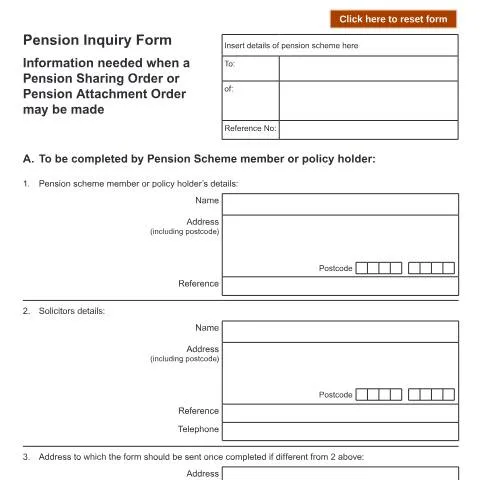
When marriages or civil partnerships reach their end through divorce proceedings, the division of assets extends far beyond joint bank accounts and property ownership. Pension rights, often representing decades of accumulated retirement savings, frequently constitute one of the most valuable marital assets requiring careful evaluation and potential redistribution. The Form P Pension Inquiry Form, administered by HM Courts & Tribunals Service, serves as the essential gateway for gathering comprehensive information about pension arrangements when the court may issue either a Pension Sharing Order or Pension Attachment Order.
This multi-section document creates a structured dialogue between divorcing parties, their legal representatives, and pension scheme administrators. Unlike straightforward financial disclosure forms, Form P operates within the complex intersection of family law and pensions regulation, requiring precise coordination between multiple parties to ensure courts receive accurate valuations and implementation details before making binding orders affecting retirement provision.
The form's significance extends beyond mere information gathering. It establishes the legal framework for pension scheme administrators to release confidential member data, creates statutory timeframes for responses, and ensures compliance with both the Pensions on Divorce etc (Provision of Information) Regulations 2000 and relevant sections of the Family Procedure Rules 2010.
The Legal Architecture: Understanding Pension Orders in Divorce Proceedings
Two distinct types of court orders can affect pension rights during divorce proceedings, each requiring different information from pension schemes. Pension Sharing Orders create an immediate transfer of pension rights from one spouse to another, effectively splitting the pension pot and creating independent retirement provision for both parties. The receiving spouse becomes entitled to a pension credit, which may be transferred to their own pension arrangement or retained within the original scheme if membership is offered.
Pension Attachment Orders, by contrast, maintain the original pension holder's ownership whilst directing that specific benefits or portions thereof be paid to the former spouse when they become due. These orders can apply to pension income, lump sum payments, or death benefits, but do not create immediate ownership transfer.
Form P addresses both scenarios by requiring pension administrators to disclose charging policies, implementation procedures, and potential restrictions that might affect either type of order. The distinction matters significantly for both legal strategy and financial planning, as sharing orders create clean breaks whilst attachment orders maintain ongoing financial connections between former spouses.
Regulatory Framework and Statutory Timeframes
The form operates under strict statutory deadlines established by regulations. When Cash Equivalent Value (CEV) calculations are requested, pension schemes must respond within three months for general inquiries or six weeks when notified the information relates to matrimonial or civil partnership proceedings. Other information requests require responses within one month, though courts may specify shorter deadlines.
These timeframes reflect the balance between ensuring adequate time for accurate valuations whilst preventing unnecessary delays in divorce proceedings. Pension administrators cannot simply ignore Form P requests, as they carry the force of statutory obligation under the Pensions on Divorce regulations.
Completing Section A: The Member's Authorization Gateway
Section A serves as both identification and authorization mechanism, requiring completion by the pension scheme member or policy holder themselves. This section cannot be completed by solicitors or other representatives, reflecting the personal nature of pension data disclosure and the need for explicit member consent.
The member's signature acts as legal authorization for pension scheme administrators to release confidential information that would otherwise be protected under data protection legislation. Without this signature, pension schemes can only provide information if presented with a specific court order compelling disclosure.
Solicitor details in this section establish the primary communication channel for ongoing correspondence. Many pension schemes prefer dealing directly with legal representatives rather than individual members, particularly during emotionally charged divorce proceedings where clear professional communication channels help prevent misunderstandings.
Alternative Delivery Arrangements
The form accommodates situations where completed forms should be sent to addresses different from the solicitor's office. This proves particularly useful when specialist pension advisers are involved, when one party has relocated during proceedings, or where specific counsel requires direct receipt of pension information for court preparation purposes.
Section B Deep Dive: Current Pension Position and Future Implementation
Section B requires pension administrators to provide detailed information about existing valuations and their calculation methods. The requirement that CEV valuations must have been made not more than 12 months before the date fixed for the first appointment ensures courts work with current rather than historical values, reflecting market changes and benefit accruals.
Question 1(a) addresses whether recent valuations already exist, potentially accelerating proceedings where up-to-date information is readily available. When existing valuations are absent, administrators must attach CEV quotations with calculation dates, ensuring transparency about the timing of pension assessments.
| Information Required | Purpose | Impact on Proceedings |
|---|---|---|
| CEV calculation method | Understanding valuation basis | Enables challenge of inappropriate assumptions |
| Benefits included in valuation | Scope clarification | Identifies excluded elements requiring separate consideration |
| Scheme membership availability | Implementation planning | Determines whether pension credits remain in-scheme |
| Charging policy disclosure | Cost assessment | Influences order structure and payment arrangements |
Pension Credit Membership and Trustee Approval Requirements
Questions 4(a) and 4(b) address whether pension schemes offer membership to pension credit recipients and whether such membership requires employer or trustee approval. This information proves crucial for determining whether the receiving spouse can maintain their pension within the existing scheme arrangement or must transfer their credit elsewhere.
Some occupational pension schemes restrict membership to employees of the sponsoring employer, effectively requiring pension credits to be transferred to personal pension arrangements. Others welcome pension credit holders but subject membership to trustee discretion, potentially creating uncertainty about implementation procedures.
Section C: Pre-Order Implementation Intelligence
Section C addresses information specifically required when pension sharing orders may be made, requiring responses within 21 days of notification. This section recognizes that courts need comprehensive implementation information before issuing orders, rather than discovering potential complications afterwards.
The winding-up provisions in questions 2 and 3 address scheme viability concerns. When occupational pension schemes are winding up, CEV calculations may be reduced to reflect the scheme's financial position, potentially affecting the value available for sharing. Courts need this information to make informed decisions about order timing and structure.
Question 4 creates a comprehensive audit of existing charges against pension rights. Previous pension sharing orders, attachment orders from earlier relationships, forfeiture orders, or bankruptcy restrictions can all affect the pension rights available for division. Each type of charge operates differently:
- Previous pension sharing orders have already reduced the available pension pot
- Pension attachment orders create ongoing payment obligations that may affect scheme viability
- Forfeiture orders may have eliminated certain benefits entirely
- Bankruptcy orders could vest pension rights in trustee control
Non-Shareable Rights and Additional Charges
Question 5 identifies pension rights that cannot be shared under the Pension Sharing (Valuation) Regulations 2000. These typically include certain protected rights, guaranteed minimum pensions in specific circumstances, or rights that have already been subject to sharing orders. Understanding non-shareable elements helps courts structure orders appropriately and avoid implementation problems.
The additional charges inquiry in question 6 references the Pensions on Divorce (Charging) Regulations 2000, which permit schemes to levy specific charges for implementing pension sharing orders. These charges can be substantial, potentially affecting the net value received by pension credit holders.
Implementation Practicalities: Health Information and Additional Requirements
Questions 8 and 9 in Section C address practical implementation requirements that could affect order execution. Some pension arrangements require health information before implementing pension sharing orders, particularly where the receiving spouse's benefits might be calculated differently based on their medical circumstances.
Personal pension plans and insurance-based arrangements sometimes apply different charging structures or investment options based on the pension credit holder's age, health status, or other personal circumstances. Courts need advance warning of such requirements to ensure orders can be implemented smoothly without subsequent complications.
Question 9's inquiry about additional information requirements beyond statutory minimums helps identify schemes with complex implementation procedures. Some arrangements may require additional forms, medical evidence, or trustee approvals that could delay implementation unless anticipated in the original court order.
Strategic Timing and Professional Coordination
Form P's effectiveness depends heavily on timing and coordination between multiple professionals. Solicitors typically initiate the process by obtaining member signatures and forwarding forms to pension administrators, but the quality of information received depends on clear communication about the urgency and context of requests.
The form works most effectively when issued early in divorce proceedings, allowing sufficient time for pension administrators to provide comprehensive responses without delaying court timetables. Late-stage requests often receive incomplete responses or trigger requests for deadline extensions that can disrupt settlement negotiations.
Pension scheme administrators vary significantly in their responsiveness and expertise regarding divorce-related inquiries. Large occupational schemes often have dedicated teams familiar with Form P requirements, whilst smaller arrangements or overseas schemes may require additional explanation and follow-up to ensure complete responses.
Cross-Border and Complex Scheme Considerations
International pension arrangements present particular challenges for Form P completion. Schemes based outside the UK may not be familiar with English divorce procedures, requiring additional explanation of legal requirements and deadlines. Some overseas arrangements cannot provide CEV calculations in the format expected by English courts, necessitating expert evidence to translate foreign pension valuations into comparable UK terms.
Multi-employer schemes, group personal pension arrangements, and hybrid pension structures each present unique information challenges that may require supplementary documentation beyond Form P's standard requirements. Professional advisers must be prepared to supplement Form P responses with additional technical explanations when dealing with complex pension structures.
Quality Control and Response Verification
Receiving comprehensive Form P responses represents only the first step in pension-related divorce proceedings. Legal representatives must carefully review responses for completeness, accuracy, and consistency with other financial disclosure. Pension administrators may misunderstand questions, provide outdated information, or fail to address all aspects of complex pension arrangements.
Common response deficiencies include failure to specify calculation dates for CEV quotations, incomplete charging information, or ambiguous answers about implementation requirements. Such deficiencies often require follow-up correspondence that can delay proceedings unless identified and addressed promptly.
The statutory timeframes for Form P responses create pressure for quick turnaround, but recipients should verify that responses actually answer the questions asked rather than providing generic pension information. Quality verification proves particularly important for occupational pension schemes where benefits may include multiple elements requiring separate consideration for divorce purposes.
When Form P responses reveal complex implementation requirements, additional charges, or restrictions on pension sharing, legal teams must factor these elements into settlement negotiations and court applications. The form serves not merely as information gathering but as essential groundwork for structuring workable pension orders that achieve intended outcomes without subsequent implementation problems.
Understanding the Legal Framework Behind Pension Orders
The authority to issue Pension Sharing Orders and Pension Attachment Orders stems from the Welfare Reform and Pensions Act 1999 and the Matrimonial Causes Act 1973, which provide the legal foundation for pension division during divorce proceedings. These orders represent a significant shift from earlier divorce settlements where pension rights were often overlooked or inadequately addressed.
A Pension Sharing Order creates an immediate, clean break by transferring a percentage of one party's pension rights to the other spouse. This percentage is calculated based on the Cash Equivalent Transfer Value (CETV) at the time of the order. The receiving spouse becomes entitled to their own separate pension arrangement, effectively severing financial ties with their former partner's retirement provision.
Conversely, a Pension Attachment Order (previously known as pension earmarking) maintains a connection between former spouses. Under this arrangement, when the pension scheme member begins receiving benefits, a specified portion must be redirected to their former spouse. This could include regular pension payments, tax-free lump sums, or death benefits, depending on the court's specific directions.
The distinction between these orders is crucial when completing Form P. Pension scheme administrators require different information depending on which type of order the court is considering. For Pension Sharing Orders, detailed CETV calculations and transfer value projections become paramount. For Pension Attachment Orders, the focus shifts to benefit structures, payment frequencies, and the scheme's capacity to make split payments.
Form P serves as the critical information bridge between pension scheme administrators and the family court system. The Pension Advisory Service estimates that over 40,000 pension orders are processed annually across UK courts, making accurate completion of this form essential for timely divorce proceedings. Incomplete or inaccurate information can delay proceedings by several months while additional details are sought.
The form must address specific legal requirements established by the Pension Sharing (Implementation and Discharge of Liability) Regulations 2000. These regulations stipulate that pension scheme administrators must provide comprehensive information about the scheme's rules, the member's accrued rights, and any restrictions that might affect the implementation of a court order.
Particular attention must be paid to schemes with guaranteed minimum pensions (GMPs) or protected rights, as these elements are subject to special rules under pension sharing arrangements. The form should clearly identify any such complications, as they may influence the court's decision on the most appropriate type of order to make.
Navigating Complex Pension Arrangements and Multi-Scheme Scenarios
Modern divorce proceedings often involve individuals with multiple pension arrangements, creating layers of complexity that Form P must address comprehensively. A typical case might involve a combination of workplace defined benefit schemes, personal pension plans, stakeholder pensions, and Self-Invested Personal Pensions (SIPPs), each requiring distinct information gathering approaches.
Defined benefit schemes, particularly those in the public sector such as the Teachers' Pension Scheme or NHS Pension Scheme, present unique challenges. These schemes often have complex benefit calculations based on final salary or career average earnings, with built-in inflation protection and survivor benefits. Form P must capture not only the current CETV but also explain how benefits are calculated, when they become payable, and what options exist for early or late retirement.
The situation becomes more intricate with unfunded public sector schemes, where pension promises are backed by government guarantees rather than investment funds. The Crown Guarantee underpinning schemes like the Civil Service Pension Scheme means that traditional transfer value concepts don't apply in the same way as funded schemes. Form P submissions for these arrangements must clearly explain the funding mechanism and any restrictions on pension sharing.
Defined contribution schemes require a different information approach entirely. Here, the focus shifts to current fund values, investment performance, annual management charges, and projected retirement benefits under various scenarios. The volatile nature of investment-based pensions means that CETV figures can fluctuate significantly, and Form P should indicate the valuation date and methodology used.
Executive pension schemes and director's pensions often incorporate additional complications such as employer loan arrangements, unapproved benefit structures, or connections to company share option schemes. These elements may not be directly divisible through standard pension orders, requiring careful explanation in Form P to help courts understand the full picture of retirement provision.
International pension arrangements add another dimension of complexity. Expatriate workers may have accumulated pension rights in multiple jurisdictions, each with different legal frameworks for pension division. Form P must address questions of jurisdiction, enforceability, and currency considerations when overseas pensions form part of the matrimonial assets.
QROPS (Qualifying Recognised Overseas Pension Schemes) transfers present particular challenges, as these arrangements are designed to provide pension benefits to UK residents who move abroad. The form must clarify whether QROPS transfers have already occurred and how this affects the pension rights available for division.
Small self-administered schemes (SSAS) and other occupational money purchase schemes may hold unusual investments such as commercial property, unlisted shares, or loan arrangements with sponsoring employers. These illiquid assets can significantly complicate both valuation and the practical implementation of pension orders, requiring detailed explanation in Form P submissions.
Timing Considerations and Strategic Planning Around Form P Submissions
The timing of Form P submission can significantly impact both the information provided and the ultimate outcome of pension order applications. Strategic consideration of when to request pension information can influence valuations, particularly in volatile market conditions or when dealing with schemes that calculate transfer values using different methodologies.
Most defined benefit schemes calculate CETV figures using factors that are reviewed periodically, often annually or when significant market movements occur. These factor changes can result in substantial variations in transfer values for identical benefit entitlements. Form P should ideally be completed when factors are most favourable, though this requires careful monitoring of scheme announcements and factor review schedules.
The three-month validity period for CETV quotations creates additional timing pressures. If divorce proceedings extend beyond this timeframe, fresh valuations may be required, potentially at less favourable rates. Form P submissions should therefore be coordinated with the overall litigation timetable to ensure that pension information remains current and usable throughout the court process.
Tax year considerations also influence optimal timing for Form P completion. Annual allowance calculations, lifetime allowance assessments, and the availability of protection certificates can all affect the net value of pension rights and the tax implications of different order types. Submissions made close to the 5 April tax year end should account for potential changes in tax treatment that might affect pension values.
Scheme-specific considerations may dictate alternative timing strategies. Some employer-sponsored schemes calculate transfer values more generously during specific windows, such as when moving between different pension arrangements or during corporate restructuring. Form P should capture information about any such opportunities that might influence the court's decision-making process.
The interaction between pension orders and other financial remedy claims requires careful coordination. Where spousal maintenance claims are being pursued alongside pension sharing applications, the timing of Form P submission should align with income evidence gathering to present a coherent picture of both parties' financial positions.
Consideration must also be given to the scheme's operational capabilities and processing timeframes. Some older pension schemes have limited administrative systems that may struggle with complex pension sharing calculations or unusual order structures. Form P should realistically assess implementation timescales and highlight any potential operational challenges that might affect the court's choice between different order types.
The proximity of the pension scheme member's retirement can significantly influence both the information required in Form P and the court's approach to pension orders. Where retirement is imminent, attachment orders may be more practical than sharing orders, given the reduced timeframe for separate pension arrangement establishment. Conversely, younger scheme members may benefit more from clean-break sharing arrangements that eliminate ongoing financial connections.