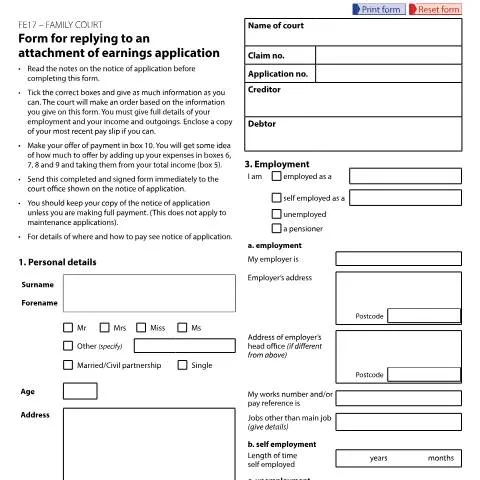
Understanding Form FE17: A Crucial Step in Family Court Proceedings
In the intricate realm of family law, where financial responsibilities are often at the forefront, the Form FE17 stands as a crucial document for those facing attachment of earnings applications in the Family Court. This form is not merely a bureaucratic requirement; it embodies the rights and obligations of individuals navigating their financial commitments post-separation or divorce. By delving into the specifics of this form, users can better understand its implications and the procedural landscape surrounding it.
Deciphering the Components of Form FE17
Filling out Form FE17 is a responsibility that demands attention to detail. Each section invites individuals to reflect on their circumstances, ensuring the court receives a comprehensive view of their financial situation. Below is a breakdown of the key components of the form:
Personal Identification
At the outset, the form requires personal details. Here, applicants must accurately provide their name, marital status, age, and address. These details, while seemingly straightforward, are fundamental as they help the court verify identities and establish jurisdiction. Any errors could lead to delays or complications in case processing.
Dependants Information
The second section prompts users to disclose information about dependants. This includes children under the age of 19 whom the applicant financially supports. Proper documentation here is essential, as it provides the court with an understanding of the applicant’s financial commitments to family members. Detailing dependants can influence the court's assessment of the applicant's financial obligations.
Employment Status Reporting
Securely navigating one’s employment status is vital. The form differentiates between various situations, including employment, self-employment, unemployment, or pension status. A common pitfall is neglecting to detail any secondary jobs or work situations, which can skew the court's understanding of one's total income. Including employer contact information and job specifics will aid in establishing the accuracy of reported income.
Financial Insights: Bank Accounts and Savings
Transparency about bank accounts and savings is critical. Users must report any overdrafts or positive balances, as these figures contribute to the court’s comprehensive view of financial stability. Omitting this information can lead to misunderstandings regarding an individual’s financial capability to meet payment arrangements.
Income Breakdown
One of the most significant sections pertains to income. The FE17 form requires a detailed breakdown of all income sources, from wages and bonuses to state benefits and pensions. It’s crucial to provide accurate figures here, as the total income will directly influence the court's decisions regarding payment abilities. Individuals should compile their income documentation, including recent payslips, to support their claims effectively.
Identifying and Calculating Expenses
A comprehensive assessment of expenses helps illustrate the financial landscape of the applicant. Users are prompted to list all regular expenses, including housing costs, utilities, and living expenses. A common misstep is underestimating these costs or neglecting to account for irregular expenses that could impact financial stability. Thorough documentation will allow the court to make a more informed decision.
Understanding Priority Debts and Financial Obligations
Priority debts, such as rent or mortgage arrears, require careful attention. This section helps differentiate between regular expenses and obligations that hold legal weight. Accurately reporting these debts is essential, as they can significantly affect the court's view on the payment capability and urgency of addressing these arrears.
Articulating Payment Offers
The concluding section allows applicants to propose a payment offer derived from their income and expenses. This is a pivotal moment in the form, as it gives individuals agency in suggesting how much they can afford to pay. It’s advisable to calculate this figure carefully, taking into account all reported expenses, to ensure it is realistic and acceptable to the court.
The Journey: From Submission to Court Decision
The process does not end with filling out Form FE17. Once completed, it is imperative to submit the document to the designated court office without delay. Here’s a chronological overview of what happens next:
Submission: Ensure that the completed form is signed and submitted to the relevant court office as indicated on the notice of application. Retaining a copy is vital for personal records.
Court Review: The court will review the submitted form to evaluate the details provided. This stage may involve cross-referencing with other documentation or even requesting additional information if necessary.
Hearing Notification: Following the review, the court may schedule a hearing. Participants will be notified of the date, time, and venue where they may need to elaborate on their financial situation in person.
Judicial Decision: At the hearing, the court will consider all submitted forms, evidence, and oral testimony to arrive at a decision regarding the attachment of earnings and any payment arrangements. Understanding how to present oneself during this hearing can influence outcomes significantly.
Implementation of Orders: After deliberation, the court will issue its ruling, which may include directives on payment amounts and timings. It’s essential to comply with these orders promptly to avoid further legal complications.
Recognising Implications: Rights and Responsibilities
Filing Form FE17 carries with it a range of rights and responsibilities. Understanding these can empower individuals in their financial dealings post-court proceedings:
Right to Fair Assessment: Individuals have the right to present their financial circumstances comprehensively and seek a fair assessment based on factual information.
Obligation to Report Truthfully: There is a legal obligation to provide accurate information. Misrepresentation can lead to severe consequences, including contempt of court.
Impact of Non-Compliance: Failure to follow through with payments set by the court can result in further legal actions, including enforcement measures such as deductions from wages.
Opportunity for Review: Courts may allow for the review of payment arrangements should circumstances change significantly, such as loss of employment or substantial changes in financial situations.
Distinguishing Form FE17 from Other Court Documents
While Form FE17 is specific to attachment of earnings applications, it is important to understand how it differs from other related forms:
| Form | Purpose | Context |
|---|---|---|
| Form FE17 | Reply to an attachment of earnings application | Family Court, responding to financial obligations |
| Form N39 | Application for enforcement of a family financial order | Enforcement of court orders regarding money |
| Form D50B | Disclosure of income and expenditure | General financial disclosures in court |
Each form serves a distinct purpose within family law procedures, and recognizing these differences aids in appropriate usage.
Supporting Documentation: What to Prepare
Preparing to submit Form FE17 involves more than just filling out the form; it also requires gathering supporting documentation to substantiate claims. The following items may be necessary:
- Recent payslips or income statements
- Bank statements providing proof of account balances and transactions
- Evidence of any dependants, such as birth certificates
- Documentation supporting claims for expenses, such as bills or rental agreements
- Any relevant court orders related to previous financial obligations
Being thorough in assembling these documents not only strengthens one’s case but also prepares individuals for any potential court inquiries.
Final Thoughts: The Importance of an Accurate Representation
Navigating the journey through the Family Court system can be daunting, particularly when addressing financial matters. Form FE17 is a significant step in this process, and understanding its nuances is crucial for ensuring that one's financial circumstances are accurately represented. By approaching the form thoughtfully and meticulously, individuals can effectively communicate their circumstances to the court and advocate for fair consideration of their financial obligations.
In the labyrinthine pathways of family law, being informed and prepared is the best strategy to safeguard one’s rights and responsibilities. Thus, the completion and submission of Form FE17 is not just a bureaucratic exercise; it is a vital component of ensuring a fair and just outcome in the family legal arena.
Understanding the Attachment of Earnings Order Process
When faced with an attachment of earnings application, it’s crucial to grasp the overall process before you respond using Form FE17. An Attachment of Earnings Order (AEO) is a legal procedure that enables the enforcement of a financial order by deducting payments directly from a debtor's salary or wages. This method is frequently employed in family court cases for unpaid maintenance or child support.
The process typically begins when a creditor applies to the court for an AEO, which can be initiated after a financial order has been granted in a family law matter. The court will then assess the application and may issue an order requiring the debtor's employer to make deductions from the debtor’s earnings. It’s essential to understand that the employer has a legal duty to comply with the AEO, although the debtor has the right to dispute the order by submitting Form FE17.
Responding to this application means that you will need to provide comprehensive details about your financial situation, including your income, expenses, and any other relevant financial commitments. You may also need to include your National Insurance number, as this helps in identifying records that the court and your employer can reference during the deduction process.
Fill in your form directly online
No printing: type your details into the boxes of the official form, tick, then download the PDF ready to send.
- 1Type into the form boxes
- 2Tick in one click
- 3Save and download the PDF
Additionally, if you believe that the AEO unduly impacts your ability to meet your living expenses, you can present arguments to the court. It’s advisable to gather evidence, such as pay slips, bank statements, and documentation of any other obligations, to substantiate your claims. This evidence becomes vital in showcasing your financial circumstances and potentially reducing the order's impact.
Completing Form FE17: Key Considerations
Completion of Form FE17 is a critical step in responding to an attachment of earnings application. The form is segmented into multiple sections, each requiring specific information that can influence the court's decision regarding the AEO. Here are key aspects to consider when filling out the form:
Personal Information: Ensure that your details, including your full name, address, and National Insurance number, are accurately entered. Mistakes here can delay processing and create complications in your case.
Employment Details: You will need to provide information about your current employer, including their name and address. If you have multiple jobs, you must declare all sources of income. Additionally, specifying whether you are on a fixed-term contract or a permanent position helps the court understand your job stability.
Income and Expenditure: This section is crucial as it outlines your financial landscape. Detail your monthly income, including salary, bonuses, and any other sources of revenue. Equally important is the disclosure of your monthly expenses, such as rent or mortgage payments, utilities, and any other financial obligations. This comprehensive snapshot allows the court to evaluate your financial capacity and the fairness of the AEO.
Supporting Documents: Accompanying the completed Form FE17 with supporting documents enhances your submission. These documents may include recent payslips, a P60 certificate, bank statements, or any other relevant financial records. The more thorough your submission, the better the court can assess your circumstances.
Filing and Submission: Once completed, you must file Form FE17 with the appropriate family court and ensure that all parties involved receive a copy. It's essential to adhere to the deadlines specified by the court to avoid penalties or further complications.
Legal Guidance: Consider seeking legal advice if you are uncertain about any aspect of completing the form or the implications of submitting it. A solicitor with experience in family law can provide invaluable insight into how best to approach your situation and may help in mitigating the financial burden imposed by the AEO.
The Impact of AEO on Child Support and Maintenance Payments
One commonly discussed aspect of Attachment of Earnings Orders is their impact on child support and maintenance payments. When a parent fails to make timely payments as ordered by the court, the custodial parent often resorts to applying for an AEO to ensure that financial obligations are met. Understanding the implications of such orders, as well as their enforcement, is vital for both non-custodial and custodial parents.
Firstly, it's essential to clarify that an AEO does not change the original maintenance order; it merely assists in enforcing it. The AEO requires the non-custodial parent’s employer to deduct a specified amount directly from their earnings to pay towards child support. This ensures that the custodial parent receives the funds necessary to support the child, thus reinforcing the primary purpose of child maintenance.
However, the deduction can significantly affect the non-custodial parent's disposable income. The amount deducted is calculated based on the non-custodial parent's earnings, so fluctuations in their salary can lead to changes in the amount deducted. If the non-custodial parent faces a change in employment status, such as job loss or reduced hours, it is imperative they inform the court immediately. They may need to apply for a variation of the AEO to reflect their new financial circumstances, which involves submitting a new application to the court, potentially using Form FE17 again.
Additionally, if the non-custodial parent believes that the AEO is causing undue hardship, they can file a complaint with the court. Demonstrating that the deductions are impacting their ability to cover basic living expenses will be critical in persuading the court to adjust the order.
Lastly, it’s important for custodial parents to understand that an AEO is not a permanent solution. It’s a tool for enforcement, and continuous dialogue regarding financial responsibilities can often lead to more amicable arrangements. Regularly reviewing child maintenance agreements and being open to communication can help both parties navigate their responsibilities effectively, reducing the likelihood of AEO applications in the future.