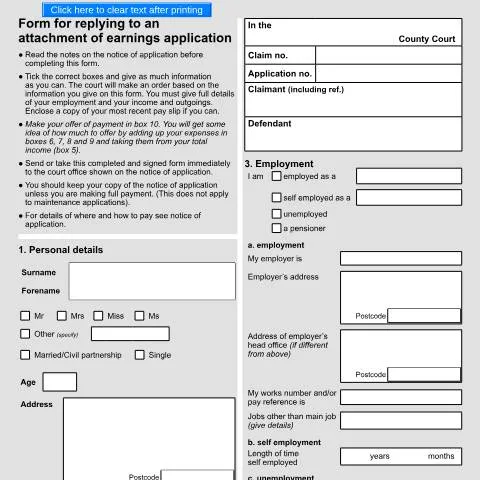
When Your Employer Receives Notice of Attachment: Understanding the N56 Response Process
When a creditor successfully applies for an attachment of earnings order through the County Court, your employer receives formal notification requiring them to deduct money directly from your wages. However, the process doesn't end there. As the debtor, you retain the right to respond with your own financial circumstances through Form N56, a crucial document that can significantly influence the court's final decision on how much should be deducted from your pay packet.
This response mechanism exists because the original attachment application may not have included your current financial position. Perhaps your circumstances have changed since the debt was incurred, or you have dependants and essential expenses that weren't considered. The N56 form serves as your opportunity to present a complete picture of your financial reality to the court, potentially resulting in reduced deduction amounts or even a suspended order that allows you to pay voluntarily.
The Strategic Timing of Your Response
The N56 form must be submitted immediately upon receiving the notice of application. This isn't merely administrative guidance—it's a practical necessity. Once the court processes the original attachment application without your input, enforcement action begins swiftly. Your employer will start making deductions based solely on the creditor's application and standard statutory calculations.
Unlike many court procedures that allow weeks for response, attachment of earnings applications move rapidly through the system. The court typically processes these applications within days of receipt, particularly when the debtor fails to respond. This means your window for influence is narrow but critical.
However, timing works differently depending on your payment proposal. If you're offering full immediate payment to settle the debt entirely, you needn't retain your copy of the notice of application. The court will halt the attachment process once full settlement is confirmed. For partial payments or instalment arrangements, you must keep all documentation until the debt is fully satisfied.
Maintenance Cases: Special Timing Considerations
Maintenance attachments operate under different rules. The standard advice about retaining notices doesn't apply because maintenance payments are ongoing obligations rather than fixed debt amounts. Your response timing remains equally crucial, but the court's approach to calculating deductions follows different statutory guidelines that prioritise the maintenance recipient's needs.
Dissecting Your Financial Disclosure Requirements
The N56 form demands comprehensive financial transparency across multiple categories, each serving a specific purpose in the court's calculation matrix. Understanding why each section matters helps you provide information that genuinely influences the outcome.
Employment Status and Its Implications
Your employment classification fundamentally affects how attachment orders operate. Employees face direct payroll deductions through PAYE systems, making enforcement straightforward for courts and creditors. Self-employed individuals present more complex scenarios—while technically subject to attachment orders, practical enforcement becomes significantly more challenging.
For unemployed respondents, attachment applications typically remain dormant until employment resumes. However, declaring unemployment doesn't eliminate the underlying debt or prevent future attachment attempts. The court may instead consider alternative enforcement methods or suspend the order pending employment changes.
| Employment Status | Attachment Feasibility | Court's Typical Response |
|---|---|---|
| PAYE Employee | Highly effective | Standard deduction calculation |
| Self-employed | Problematic | May consider alternatives |
| Unemployed | Not applicable | Suspended pending employment |
| Pensioner | Limited (state pensions protected) | Reduced deductions or suspension |
The Critical Income Calculation
Box 5 requires meticulous attention because it establishes your total disposable income baseline. The court uses this figure to determine what constitutes reasonable deduction amounts under statutory guidelines. Crucially, the form specifically excludes tax credits from your main take-home pay calculation, then adds them separately.
This distinction matters because different income types receive varying levels of protection under attachment legislation. Child benefit and tax credits enjoy stronger statutory protection than regular wages, influencing how much the court can reasonably order for deduction.
Priority Debts and the Court's Hierarchy
Section 7 of the N56 form addresses priority debts—a legal concept that significantly impacts attachment calculations. Courts must consider your existing priority debt obligations when determining how much additional income can be attached for other creditors.
Priority debts include rent arrears, mortgage shortfalls, Council Tax arrears, and utility debts. These receive preferential treatment because they can result in loss of accommodation or essential services. When completing this section, distinguish carefully between current regular payments (listed in expenses) and actual arrears requiring separate attention.
Understanding the Court's Balancing Act
Courts must balance multiple competing interests: the creditor's legitimate right to recover debts, your need to maintain reasonable living standards, and society's interest in keeping families housed and fed. Priority debts tip this balance because they represent immediate threats to basic welfare.
If your priority debt obligations consume most of your disposable income, the court may conclude that additional attachments would create undue hardship, potentially resulting in reduced deduction amounts or suspended orders.
Crafting Your Payment Offer Strategy
Box 10 represents your most important strategic decision on the N56 form. Your payment offer directly influences the court's final order, but it requires careful calculation based on your disclosed financial position.
The form provides basic guidance: subtract your total expenses (boxes 6-9) from your total income (box 5) to identify disposable income. However, this simple arithmetic doesn't account for statutory protected amounts that courts must consider under attachment legislation.
Weekly Versus Monthly Payment Structures
Your payment frequency choice affects both practical enforcement and psychological perception. Weekly payments often appear more manageable to debtors but may seem insufficient to creditors and courts. Monthly payments align better with most people's budgeting cycles and major expense patterns.
Consider your actual pay frequency when making this choice. If you're paid monthly, offering weekly payments creates unnecessary complexity for your employer's payroll system and may increase the likelihood of calculation errors.
The Suspended Order Option
Requesting a suspended order represents a significant strategic choice that requires compelling justification. Suspended orders allow you to make voluntary payments without employer involvement, preserving employment relationships and maintaining privacy about your financial difficulties.
Courts grant suspended orders when convinced that voluntary compliance will occur reliably. Strong justifications include:
- Employment contracts or professional requirements that make wage attachments problematic
- Demonstrated history of voluntary payment compliance
- Temporary financial difficulties with clear resolution timelines
- Complex income patterns that make payroll deductions impractical
Navigating Complex Financial Situations
Certain financial circumstances require careful handling on the N56 form to ensure accurate court assessment and appropriate outcome.
Irregular Income Patterns
Commission-based workers, seasonal employees, and those with fluctuating overtime face particular challenges in completing income declarations. The form asks for "usual" take-home pay, but what constitutes usual when income varies significantly?
Consider providing average figures over a representative period—typically three to six months—and include explanatory notes about income variability. Courts can accommodate irregular income through variable deduction orders or seasonal adjustment provisions.
Multiple Employment Situations
Working multiple jobs creates complexity for both disclosure and enforcement. List all employment sources with corresponding income amounts, as courts need complete income pictures for accurate calculations.
However, attachment orders typically apply to your main employer only. Secondary employment income may remain unaffected by the attachment, though creditors can pursue separate attachments against other employers if warranted.
Shared Household Finances
When household members contribute to shared expenses, accurately reflecting your personal financial obligations becomes crucial. The form requires your personal expenses only, not contributions made by other household members from their own income.
This distinction affects calculations significantly. If your partner pays the mortgage from their income, you shouldn't include mortgage payments in your expense calculations, even if you live in the property.
Post-Submission Procedures and Outcomes
After submitting your N56 response, the court reviews all available information—the creditor's original application, your financial disclosure, and any additional evidence provided—to determine the final attachment order terms.
The court may:
- Grant the attachment as requested if your financial position supports the original application amounts
- Reduce the deduction amount based on your disclosed circumstances and competing financial obligations
- Issue a suspended order if you've requested this option with adequate justification
- Dismiss the application if your financial position demonstrates that attachment would cause undue hardship
When Orders Don't Match Your Circumstances
If the court's final order doesn't adequately reflect your financial reality, you retain options for reconsideration. Significant changes in circumstances—job loss, reduced hours, new dependants, or increased essential expenses—can justify applications to vary existing attachment orders.
However, minor variations or temporary financial pressures rarely warrant order modifications. Courts expect reasonable fluctuations in personal finances and structure orders to accommodate normal variability.
Documentation and Evidence Requirements
While the N56 form requests comprehensive financial information, supporting evidence strengthens your position significantly. The form specifically mentions enclosing recent pay slips, but additional documentation can support your financial disclosure.
Relevant supporting documents include:
- Bank statements showing actual account balances and transaction patterns
- Benefit award letters confirming state benefit entitlements
- Tenancy agreements or mortgage statements supporting housing cost claims
- Utility bills demonstrating actual household expense levels
- Court orders for existing maintenance or debt payment obligations
However, avoid overwhelming the court with excessive documentation. Focus on evidence that directly supports significant claims or unusual circumstances that might not be apparent from the form alone.
The Importance of Accuracy and Honesty
The N56 form concludes with a declaration requiring you to confirm the accuracy of all provided information. This isn't merely administrative formality—providing false information to courts constitutes contempt of court, potentially resulting in fines or imprisonment.
Moreover, creditors often possess independent information about your financial circumstances through credit files, bank records, or previous court proceedings. Inconsistencies between your declared position and available evidence undermine your credibility and may result in less favourable outcomes.
If you're uncertain about specific figures, it's better to provide reasonable estimates with explanatory notes than to guess wildly or omit information entirely. Courts appreciate honesty about financial uncertainty more than apparent precision that later proves inaccurate.
Fill in your form directly online
No printing: type your details into the boxes of the official form, tick, then download the PDF ready to send.
- 1Type into the form boxes
- 2Tick in one click
- 3Save and download the PDF
Strategic Considerations When Challenging an Attachment
Challenging an attachment of earnings through Form N56 requires careful strategic planning, as your response can significantly impact both the immediate outcome and your long-term financial situation. The timing of your challenge is particularly crucial—whilst you have the right to object at any point during the attachment process, early intervention typically yields better results.
When formulating your challenge strategy, consider whether a partial attachment might be more realistic than seeking complete dismissal. Courts often view reasonable compromise proposals favourably, particularly when they demonstrate genuine engagement with your financial obligations. For instance, if the proposed attachment would leave you below the protected earnings threshold, you might propose an alternative payment arrangement that satisfies the creditor whilst preserving your essential living costs.
The strength of your challenge often depends on the quality of evidence you can provide. Bank statements showing regular essential expenditure, medical certificates documenting health conditions affecting your earning capacity, or correspondence with other creditors demonstrating existing payment arrangements all carry significant weight. However, ensure any documentation is recent—courts typically expect evidence dated within the previous three months for financial information.
Consider the broader implications of your challenge beyond the immediate case. An unsuccessful challenge might result in additional court costs being added to your debt, whilst a successful one could establish precedent for dealing with other creditors. If you're facing multiple enforcement actions, coordinating your response across all cases can prevent contradictory positions that might undermine your credibility.
Your employment status significantly influences challenge strategies. Employees with stable contracts face different considerations than those on zero-hours contracts or with variable income. Self-employed individuals must navigate additional complexities, as attachment orders against the self-employed require different legal mechanisms and may not follow standard attachment of earnings procedures.
Technical Compliance and Documentation Requirements
Form N56 submissions must meet strict technical requirements to be considered valid by the court. The form itself must be completed in its entirety—partially completed forms may be rejected without consideration, potentially prejudicing your position. Each section requires specific types of information, and understanding these requirements can mean the difference between a successful challenge and administrative rejection.
When documenting your financial circumstances, precision is essential. Round figures or estimates may be viewed suspiciously by courts, which expect detailed, accurate financial information. Your income declaration should include all sources—salary, benefits, pension income, rental income, or irregular payments. Similarly, expenditure must be comprehensively documented, including both fixed costs like rent and mortgage payments, and variable expenses such as food, clothing, and transport.
The court requires evidence to support your declarations, but not all evidence carries equal weight. Original bank statements are preferred over printed online statements, whilst official letters from creditors are more persuasive than handwritten payment records. If you're claiming exceptional circumstances, medical evidence must come from qualified practitioners—GP letters carry more weight than physiotherapy reports, whilst consultant reports are given greatest consideration.
Timing your submission correctly involves more than meeting deadlines. Courts operate on specific administrative cycles, and understanding these can improve your chances of timely consideration. Forms submitted just before court holidays may face delays, whilst those submitted early in the court's administrative cycle typically receive prompter attention. However, don't delay submission simply to time it optimally—meeting deadlines takes absolute priority.
Digital submission requirements have evolved significantly, particularly following increased court digitisation. Whilst paper submissions remain valid, electronic submissions through approved portals often receive faster processing. However, ensure you retain proof of submission—system-generated confirmation emails or reference numbers provide essential evidence of timely filing.
Cross-referencing your N56 submission with other court documents is crucial for consistency. Any discrepancies between your financial information on Form N56 and previous court submissions may be highlighted by the creditor's legal representatives. Courts expect explanations for any changes in circumstances, and unexplained inconsistencies can undermine your credibility significantly.
Post-Submission Procedures and Ongoing Obligations
Once you've submitted Form N56, several procedural steps follow that require active engagement on your part. The court will typically acknowledge receipt within a specified timeframe, though this varies by court jurisdiction and current administrative pressures. This acknowledgement doesn't indicate acceptance of your challenge—it merely confirms the court has received your documentation and will consider it according to standard procedures.
Following submission, you acquire ongoing disclosure obligations that continue throughout the attachment process. Any material changes to your financial circumstances must be reported promptly to the court. This includes changes in employment, significant alterations to income or expenditure, or new debts that might affect your ability to sustain proposed payment arrangements. Failure to disclose material changes can result in your challenge being dismissed and may prejudice future applications.
The creditor has rights to respond to your challenge, and understanding their likely response strategy helps you prepare for subsequent proceedings. Creditors typically focus on challenging your claimed expenditure levels, questioning the necessity of certain costs, or disputing your income declarations. They may request additional documentation or seek court orders requiring you to provide further evidence of your financial position.
Court hearings, when required, follow specific procedural rules that differ from standard civil proceedings. These hearings are typically shorter and more focused on financial evidence than legal argument. Preparation should focus on being able to explain and justify every aspect of your financial position clearly and concisely. Bringing organised documentation to support your oral evidence is essential—courts appreciate well-prepared parties who can respond quickly to questions about their circumstances.
If your challenge is successful, this doesn't necessarily end your obligations. The court may impose alternative payment arrangements, require regular financial reviews, or set conditions for maintaining the suspension of attachment. Compliance with these alternative arrangements is strictly monitored, and any defaults may result in the original attachment being reinstated without further hearing.
Unsuccessful challenges trigger different consequences depending on the grounds for rejection. Technical failures—such as incomplete forms or missing evidence—may allow for resubmission with corrections, though this isn't guaranteed. Substantive rejections, where the court considers your financial circumstances but concludes attachment is appropriate, are more difficult to appeal and may result in additional costs being imposed.
Throughout this process, maintaining detailed records of all communications, submissions, and court correspondence is essential. These records may be required for appeals, future applications, or dealings with other creditors. They also provide valuable evidence of your compliance with court procedures, which can be beneficial if your circumstances change and you need to make further applications to the court.