When Articles of Association Override Special Resolutions: The NM04 Alternative Route
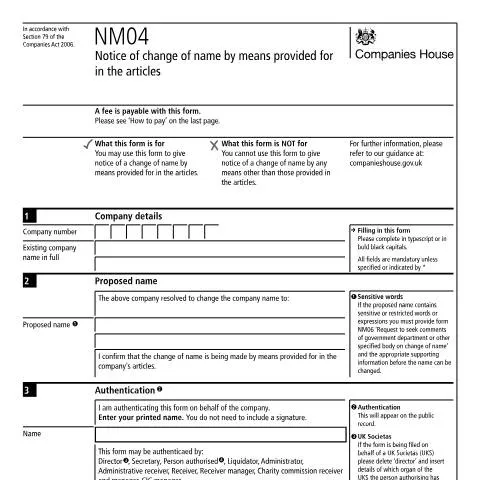
Most company directors assume that changing a company name requires the formal process of a special resolution followed by form NM01. However, the Companies Act 2006 recognises an alternative pathway that many overlook: name changes executed through provisions already embedded within the company's articles of association. Form NM04 serves this specific purpose, allowing companies to notify Companies House of name changes that have been implemented using mechanisms built into their constitutional documents rather than through the standard resolution process.
This distinction matters considerably in practice. Where a company's articles contain specific clauses permitting name changes through particular procedures—perhaps board resolutions, member votes with different thresholds, or other governance mechanisms—form NM04 becomes the appropriate notification tool. The process acknowledges that the change has already occurred according to the company's own rules, and Companies House simply needs formal notification to update the public register.
Understanding when and how to use form NM04 requires careful examination of your company's articles, the procedural requirements they establish, and the practical implications of this alternative route for name changes.
Constitutional Foundations: When Your Articles Provide the Framework
The legal basis for form NM04 lies in Section 79 of the Companies Act 2006, which explicitly recognises that companies may change their names "by means provided for in the articles." This provision acknowledges the principle that companies should have flexibility in their internal governance arrangements, provided they operate within the broader statutory framework.
Not all companies will have relevant provisions in their articles. Standard model articles typically do not include alternative name change procedures, meaning most companies will rely on the special resolution route. However, companies that have adopted bespoke articles—particularly those with complex ownership structures, specific governance arrangements, or particular commercial requirements—may have incorporated alternative mechanisms.
Common scenarios where articles might provide alternative name change procedures include:
- Management companies where operational flexibility requires streamlined governance procedures
- Joint venture entities where partner agreements necessitate specific approval mechanisms
- Holding companies within corporate groups where centralised decision-making processes apply
- Investment vehicles where fund management arrangements dictate particular procedural requirements
The key requirement is that the articles must clearly establish the mechanism by which name changes can be implemented. Vague or ambiguous provisions will not suffice, and Companies House may reject notifications where the constitutional basis appears uncertain.
Interpreting Article Provisions
When examining whether your articles provide appropriate mechanisms, consider both explicit and implicit powers. Some articles contain specific clauses addressing name changes, while others may grant broad powers to directors or members that could encompass name change authority. However, implicit powers require careful legal analysis to ensure they genuinely support the proposed action.
The interpretation must also consider any restrictions or conditions within the articles. For instance, articles might permit name changes by board resolution but only in specific circumstances, or might require particular notice periods or consultation processes.
Procedural Requirements and Internal Compliance
Before completing form NM04, companies must ensure they have properly followed the procedures established in their articles. This internal compliance step is crucial because form NM04 is a notification of a change that has already taken place, not an application for permission to make a change.
The procedural requirements will vary depending on the specific provisions in your articles, but common elements include:
| Typical Requirement | Documentation Needed | Timing Considerations |
|---|---|---|
| Board resolution | Signed board minutes or written resolution | Must follow any notice requirements in articles |
| Member approval | Member resolution or written consent | Consider any cooling-off periods specified |
| Third party consent | Written consent from specified parties | May require advance notification periods |
| Conditional approvals | Evidence that conditions have been met | All conditions must be satisfied before notification |
Companies must maintain comprehensive records of the internal procedures followed. While Companies House does not require submission of internal documentation with form NM04, maintaining proper records is essential for regulatory compliance and potential future scrutiny.
Timing and Effective Dates
The effective date of the name change depends on the specific provisions in the articles. Some may specify that changes take effect immediately upon the relevant resolution or approval, while others might establish different effective dates. Companies House will register the change based on the notification date, but the actual change date should reflect when the internal procedures were completed.
This timing distinction can have practical implications for contracts, banking arrangements, and other commercial relationships. Companies should coordinate their internal procedures with practical implementation requirements to avoid complications.
Completing Form NM04: Section-by-Section Analysis
Form NM04 follows a straightforward structure, but each section requires careful attention to ensure accurate completion and avoid delays in processing.
Section 1: Company Identification
The company details section requires the existing company name in full and the company number. These must match exactly with the information held on the public register at Companies House. Even minor discrepancies in punctuation, spacing, or capitalisation can result in form rejection.
For companies that have recently filed other changes, ensure you use the most current registered name. If there is any uncertainty about the current registered details, check the company information service on the Companies House website before completing the form.
Section 2: Proposed Name Declaration
This section requires entry of the complete new company name and includes a crucial declaration: "I confirm that the change of name is being made by means provided for in the company's articles." This declaration carries legal significance as it represents a formal statement that the internal procedures have been properly followed.
The proposed name must comply with all standard company naming requirements, including appropriate company type indicators (Limited, Ltd, PLC, etc.). The name must also be available for use—Companies House will still conduct availability checks even though this is a notification rather than an application.
Section 3: Authentication Requirements
Authentication of form NM04 can be provided by various categories of authorised persons, including directors, company secretaries, persons authorised under sections 270 or 274 of the Companies Act 2006, and various types of insolvency practitioners.
The authentication section requires the printed name of the person authenticating the form. Unlike some other Companies House forms, no signature is required, but the person authenticating must have appropriate authority to act on behalf of the company.
For UK Societas (UKS), specific provisions apply, and the standard "director" designation should be modified to reflect the appropriate organ of the UKS structure.
Fee Structure and Sensitive Name Considerations
Form NM04 attracts a fee of £30 payable to Companies House. This fee applies regardless of the method of submission and must accompany the form when filed. Payment can be made by cheque or postal order when submitting by post, with electronic payment options available for online submissions.
The fee structure for NM04 differs from some other company name change procedures, and companies should factor this cost into their planning. While £30 may seem modest, it represents part of the overall cost of implementing name changes when combined with other practical expenses such as updating stationery, signage, and digital assets.
Sensitive Words and Additional Requirements
If the proposed company name contains sensitive or restricted words or expressions, additional procedures apply before the name change can be registered. Companies must submit form NM06 ("Request to seek comments of government department or other specified body on change of name") along with appropriate supporting information.
Sensitive words include terms that might suggest government affiliation, professional regulation, or particular business activities that require authorisation. Common examples include words such as "Royal," "National," "Institute," "Association," or terms relating to specific regulated sectors like banking, insurance, or healthcare.
The NM06 process involves consultation with relevant government departments or regulatory bodies, which can extend the overall timeline for name change registration significantly. Companies should identify potential sensitive word issues early in their planning process to avoid delays.
Submission Methods and Processing Timelines
Companies House accepts form NM04 submissions through multiple channels, with different processing timelines and practical considerations for each method.
Electronic Submission Options
Online submission through the Companies House WebFiling service typically offers the fastest processing times. Electronic submissions can be processed within 24 hours during normal business days, though complex cases or those requiring additional verification may take longer.
Fill in your form directly online
No printing: type your details into the boxes of the official form, tick, then download the PDF ready to send.
- 1Type into the form boxes
- 2Tick in one click
- 3Save and download the PDF
Electronic submission also provides immediate confirmation of receipt and allows real-time tracking of application status. Payment can be made electronically, streamlining the entire process and reducing the risk of delays associated with postal submissions.
Postal Submission Procedures
Postal submissions must be sent to the appropriate Companies House office based on the company's registered address. Form NM04 submissions for companies registered in England and Wales should be sent to the Cardiff office, while Scottish companies use the Edinburgh office.
Postal processing typically takes 5-7 working days from receipt, assuming all documentation is complete and correct. However, this timeline excludes postal delivery times and any delays associated with payment processing for cheques or postal orders.
Post-Registration Implications and Ongoing Obligations
Once Companies House registers the name change notification, several important consequences follow that companies must manage carefully.
The certificate of incorporation on change of name becomes the primary evidence of the company's new identity. This document should be retained safely as it may be required for various commercial and regulatory purposes. Companies often need multiple certified copies for banking, contractual, and regulatory compliance purposes.
All statutory documents and correspondence must immediately reflect the new company name. This includes updating registered office signage, statutory books, share certificates, and official correspondence. Failure to use the correct company name in legal documents can create complications and potential liabilities.
Third-Party Notification Requirements
Beyond the Companies House registration, companies must systematically notify various third parties of the name change:
- HMRC for corporation tax, PAYE, and VAT purposes
- Banks and financial institutions for account updates and new mandate arrangements
- Contractual counterparties where name changes might affect legal obligations
- Insurance providers to ensure continued coverage under updated company details
- Regulatory bodies relevant to the company's business activities
The timing and method of these notifications can affect business continuity, so companies should develop comprehensive implementation plans that coordinate the Companies House registration with broader operational requirements.
Strategic Considerations and Alternative Approaches
Choosing between form NM04 and the standard special resolution route involves several strategic considerations beyond mere procedural differences.
The NM04 route may offer advantages in terms of speed and flexibility where the articles provide streamlined procedures. However, it also places greater emphasis on ensuring internal compliance and maintaining proper documentation of the decision-making process.
Companies should also consider the transparency and governance implications of their chosen route. Special resolutions create clear public records of member approval, while article-based changes may rely more heavily on internal governance records that are not publicly available.
For companies with complex ownership structures or specific governance requirements, the article-based route may provide better alignment with existing decision-making processes and commercial arrangements. However, companies should ensure that all stakeholders understand and accept the chosen approach to avoid potential disputes or complications.
The choice of procedure may also affect the timing and coordination of broader corporate restructuring activities, merger and acquisition processes, or regulatory compliance initiatives. Companies should evaluate form NM04 within the context of their broader strategic objectives and operational requirements rather than as an isolated administrative procedure.