Understanding the AM12 Document: A Vital Tool in Company Administration
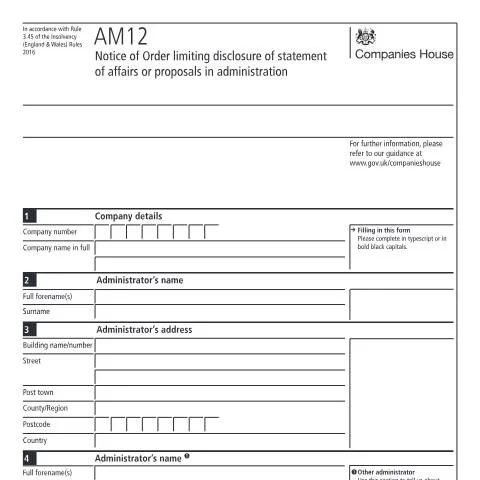
The AM12 document, formally known as the Notice of Order Limiting Disclosure of Statement of Affairs or Proposals in Administration, serves as an essential part of the administration process for businesses in the UK. It reflects a court order designed to protect sensitive information about a company's financial affairs. This document can significantly impact how administrators manage stakeholder communications and protect confidentiality during insolvency proceedings. Understanding the nuances of the AM12 is crucial for administrators and stakeholders alike.
Key Components of the AM12 Document
The AM12 includes specific fields that need to be accurately completed to ensure compliance with legal requirements. Here are its primary components:
- Company Details: The full name and company number, essential for proper identification in the public registry.
- Administrator's Information: Names and addresses of the appointed administrator(s) responsible for managing the company's affairs.
- Date of Court Order: The effective date when the order limiting disclosure was issued.
- Attachments: This section must confirm the inclusion of essential documents such as the court order itself, the statement of affairs, and any proposals.
- Signature: The administrator must sign and date the document, affirming its accuracy and completeness.
Situations Necessitating the AM12 Document
The AM12 document is pivotal in specific scenarios within company administration. Administrators may find themselves needing to file this notice under the following circumstances:
- Insolvency Proceedings: When a company enters administration, it often requires protection from creditors, making the AM12 essential for limiting the disclosure of sensitive financial information.
- Confidential Proposals: If the administrator has proposals that include sensitive information, the AM12 helps to restrict access to this data while still fulfilling legal requirements.
- Stakeholder Protection: It plays a critical role in protecting the interests of various stakeholders, including employees and creditors, during challenging financial times.
The Legal Framework Surrounding the AM12
The AM12 is governed by the Insolvency (England & Wales) Rules 2016, specifically Rule 3.45. This legal framework outlines the conditions under which administrators can limit disclosure to ensure confidentiality in an administration process. Understanding these legal stipulations is vital to execute the AM12 correctly. Here’s a summary of its critical legal points:
| Aspect | Description |
|---|---|
| Purpose | To limit the disclosure of sensitive information in statements of affairs or proposals. |
| Applicability | Applies during company administration to protect stakeholders involved. |
| Compliance | Documents must be filed correctly to avoid delays or rejections. |
Common Misinterpretations of the AM12 Document
Despite its clear purpose, several common misinterpretations surround the AM12. Addressing these misunderstandings can prevent unnecessary complications:
- Assuming Automatic Confidentiality: Many administrators believe that filing the AM12 automatically makes all related documents confidential. However, the court order must explicitly state the limitations on disclosure.
- Neglecting Completeness: Incomplete submissions can lead to rejection. Administrators often overlook the need to attach supporting documents like the statement of affairs.
- Misunderstanding the Role of the Administrator: Some believe that the AM12 relieves the administrator of their duties to communicate with stakeholders. On the contrary, it primarily governs the type of information that can be disclosed.
Practical Steps for Using the AM12 Document
Effectively utilizing the AM12 requires careful attention to detail. Here’s a step-by-step guide:
- Gather Required Information: Ensure all details regarding the company and administrator(s) are accurate and up-to-date.
- Prepare Supporting Documents: Collect the court order, statement of affairs, and any relevant proposals that need to be attached.
- Complete the AM12: Fill in the document clearly in typescript or bold black capitals to prevent any misinterpretation.
- Sign and Date: The administrator must affirm their commitment by signing and dating the document.
- Submit to Companies House: While submissions can be made to any Companies House address, for efficiency, sending it to the Cardiff office is recommended.
The Role of Companies House in the AM12 Process
Companies House plays a pivotal role in the administration process by maintaining a public register of all companies in the UK. When it comes to the AM12, Companies House is responsible for:
- Receiving Filings: They process the AM12 and any attached documents, ensuring they are recorded accurately.
- Public Disclosure: Information submitted becomes part of the public record, which can be accessed by interested parties.
- Guidance and Support: Companies House offers resources and guidance notes to help administrators navigate the requirements surrounding the AM12.
Strategic Considerations for Administrators
In managing any administration process, especially under the constraints of the AM12, administrators should consider the following strategic points:
- Communication Strategy: While the AM12 limits disclosure, maintaining transparency with key stakeholders is essential for trust.
- Legal Counsel: Involving legal experts in the process can help navigate the complexities associated with court orders and disclosures.
- Timeliness: Prompt submission of the AM12 and supporting documents can prevent delays and potential penalties.
Understanding the Context of AM12 Notices
The AM12 form is crucial in the realm of family law and privacy protection within the UK legal framework. Understanding the context in which an AM12 notice operates is vital for individuals seeking to limit the disclosure of sensitive information during legal proceedings. Typically, these notices are applicable in cases involving children, where the best interests of the child are paramount. Legal representatives often advise clients to submit an AM12 notice to protect sensitive data from being disclosed publicly, particularly in court hearings.
When initiating a case that may involve sensitive personal information, it is essential to consider the potential ramifications of disclosing such data. The AM12 notice serves as a protective measure that upholds the confidentiality of involved parties, ensuring that sensitive information is only shared on a 'need-to-know' basis. This is particularly relevant when handling cases of domestic violence, sensitive medical history, or situations that may expose the parties to further trauma.
Moreover, it’s important to acknowledge that the use of AM12 notices can also serve to streamline proceedings. By limiting the amount of unnecessary disclosure, courts can focus on the pertinent issues at hand without getting bogged down by extraneous details that do not serve the interests of justice.
Fill in your form directly online
No printing: type your details into the boxes of the official form, tick, then download the PDF ready to send.
- 1Type into the form boxes
- 2Tick in one click
- 3Save and download the PDF
Steps to Prepare for Submitting an AM12 Notice
Preparing to submit an AM12 notice requires careful attention to detail and an understanding of the legal requirements. Here are the essential steps to ensure that your submission is effective and compliant with legal standards:
- Consult Legal Counsel: Prior to submitting an AM12 notice, it is advisable to engage with legal counsel who specializes in family law or the specific area relevant to your case. They can provide ample guidance tailored to your unique circumstances, ensuring that your notice is appropriately justified.
- Gather Necessary Information: Collect all pertinent details that support the need for limiting disclosure. This may include sensitive personal information, reasons for confidentiality, and any documentation that reinforces your claim. The more robust your supporting evidence, the stronger your case for limiting disclosure.
- Complete the AM12 Form Accurately: When filling out the AM12 form, ensure that all sections are completed with precision. Any inaccuracies or omissions could lead to delays in processing or even rejection of your notice. Pay close attention to the specific requirements outlined on the form and double-check your entries.
- File Timely: Be mindful of any deadlines that may apply to your case. Submitting the AM12 notice promptly at the onset of your legal proceedings is crucial. Delays in filing could compromise the effectiveness of your disclosure limitations.
- Follow Up: After submitting your AM12 notice, it is advisable to follow up with the court to confirm receipt and ascertain whether any further information is required. This ensures that your request is being processed and that you can address any potential issues proactively.
The Role of the Court in Assessing AM12 Notices
The court plays a pivotal role in evaluating the validity of AM12 notices. Upon receipt, the court is tasked with determining whether the application for limited disclosure aligns with the principles of justice and privacy as dictated by the Data Protection Act 2018 and UK GDPR. Courts must carefully balance the rights of the parties involved against the public interest and the transparency of judicial proceedings.
During the assessment process, the court will consider several factors:
- Nature of the Information: The court will scrutinize the type of information being protected. Sensitive personal data, such as medical records or information related to children, typically warrant more stringent protection.
- Potential Harm: Courts will evaluate the potential harm that may arise from the disclosure of the information. If revealing certain details could lead to emotional distress or physical danger, the likelihood of granting the AM12 notice increases.
- Public Interest: Courts must also consider the public interest in maintaining transparency in legal proceedings. If the information in question significantly impacts public understanding of the case or legal principles at stake, this may weigh against limiting disclosure.
Ultimately, the decision to grant an AM12 notice rests with the judges, who will issue an order that reflects the court’s ruling on the matter. This order may specify the extent of disclosure permitted, and any limitations imposed will be binding for all parties involved. Following the court's order, it is critical that the involved parties adhere to the stipulations outlined, as failure to comply can lead to legal repercussions.