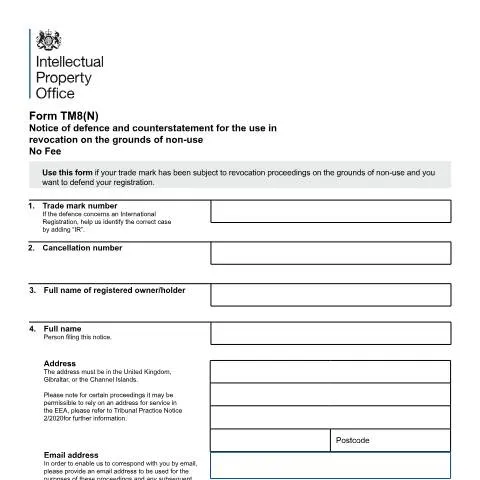
Understanding the Strategic Defence Against Trade Mark Revocation Proceedings
When your registered trade mark faces revocation proceedings on the grounds of non-use, the clock starts ticking immediately. The TM8(N) Notice of Defence and Counterstatement represents your primary weapon in protecting intellectual property rights that may have taken years to establish and considerable investment to develop. This comprehensive defence document serves as both your formal response to revocation challenges and your opportunity to present compelling evidence of genuine commercial use.
The form emerges at a critical juncture in trade mark law where use it or lose it principles apply with particular force. Under UK trade mark legislation, any interested party can challenge your registration if they believe your mark has remained unused for a continuous period of five years following completion of the registration process. The TM8(N) form transforms what could be a devastating loss of intellectual property rights into a structured legal battleground where evidence, timing, and strategic presentation determine the outcome.
Navigating the Critical Components of Your Defence Strategy
The TM8(N) form demands precision across eleven distinct sections, each serving a specific function in building your defence case. The opening sections establish fundamental case parameters that the Intellectual Property Office uses to track and process your response effectively.
Trade mark identification requires absolute accuracy, particularly for International Registrations where the "IR" prefix becomes essential for proper case matching. The cancellation number, typically provided in the original revocation notice, creates the vital link between the challenge and your response, ensuring your defence reaches the correct proceedings file.
Address requirements reflect post-Brexit adjustments in UK intellectual property law. Your correspondence address must fall within the United Kingdom, Gibraltar, or the Channel Islands, though Tribunal Practice Notice 2/2020 may permit EEA addresses in specific circumstances. This geographical restriction ensures the IPO can serve documents effectively and maintain proper procedural control over domestic proceedings.
Establishing Standing and Interest in the Proceedings
Section 5 addresses a frequently overlooked but legally significant aspect: demonstrating your right to defend the registration. The form accommodates three distinct categories of defendants, each carrying different procedural implications and evidence requirements.
| Status Category | Authority to Defend | Required Documentation |
|---|---|---|
| Recorded Owner/Holder | Automatic right | Registration records sufficient |
| Recorded Representative | Based on formal appointment | Power of attorney or agency agreement |
| Other Interested Party | Must demonstrate legitimate interest | Licensing agreements, exclusive distribution rights |
The "Other" category proves particularly complex, encompassing exclusive licensees, distributors with territorial rights, or companies that have acquired use rights through corporate restructuring. These scenarios require careful documentation to establish standing before the substantive defence can proceed.
Crafting the Counterstatement: Your Substantive Defence Foundation
Section 8 represents the intellectual and legal heart of your defence, where strategic thinking meets practical evidence presentation. The counterstatement must address two fundamental questions: which goods and services have genuinely been used in commerce, and what circumstances explain any apparent periods of non-use.
The scope of your defence significantly impacts both the complexity of your evidence gathering and the potential outcomes. Defending all goods and services listed in your registration creates the broadest protection but demands comprehensive evidence across every category. Alternatively, focusing on specific goods and services allows concentrated evidence presentation but results in partial revocation for undefended categories.
Developing Proper Reasons for Non-Use
When periods of non-use exist, the counterstatement becomes your opportunity to present proper reasons for non-use that UK trade mark law recognises as legitimate defences. These circumstances extend beyond mere business difficulties to encompass specific situations that courts and the IPO accept as justifying temporary cessation of commercial activity.
Regulatory obstacles frequently provide compelling proper reasons, particularly where government approvals, licensing requirements, or safety certifications create unavoidable delays in bringing products to market. Similarly, supply chain disruptions, manufacturing problems, or force majeure events may constitute proper reasons if documented appropriately and linked directly to the non-use period.
Import restrictions, customs delays, or third-party intellectual property disputes can also support proper reasons defences, provided the circumstances were beyond your reasonable control and you maintained genuine intention to resume use once obstacles cleared.
Evidence Strategy and Timeline Management
Section 9 presents a crucial strategic decision that impacts your entire defence approach. The form permits filing evidence immediately with your counterstatement or within the subsequent two-month period, each approach carrying distinct advantages and risks.
Immediate evidence filing demonstrates confidence in your position and may discourage the applicant from pursuing the revocation vigorously. However, this approach provides less time for comprehensive evidence gathering and may result in weaker documentation than a more deliberate preparation period allows.
The two-month evidence window offers valuable time for thorough preparation, including gathering international evidence, obtaining witness statements from customers or suppliers, and preparing detailed chronologies of use. This extended timeline proves particularly beneficial for complex commercial arrangements or where evidence exists in multiple jurisdictions or languages.
Evidence Categories and Strength Assessment
Effective evidence strategy recognises that different types of proof carry varying persuasive weight in revocation proceedings. Primary evidence of actual commercial use typically includes invoices, delivery receipts, advertising materials, and customer correspondence showing genuine transactions in the ordinary course of business.
- Commercial invoices bearing trade mark usage and showing genuine sales transactions
- Marketing materials demonstrating public-facing use in advertising, brochures, or promotional campaigns
- Distribution agreements evidencing third-party commercial relationships and territorial use
- Customs documentation proving import/export activities under the registered mark
- Website analytics showing customer engagement and commercial activity online
Secondary evidence supports your primary case by demonstrating consistent business conduct and genuine commercial intention. This category encompasses trademark renewal payments, domain name registrations, business registration documents, and strategic planning materials referencing continued mark usage.
Procedural Integration with Broader Intellectual Property Strategy
The TM8(N) defence form operates within a complex procedural framework that often involves multiple concurrent proceedings across different jurisdictions. Section 6 requires disclosure of related proceedings, acknowledging that trade mark disputes rarely exist in isolation.
Parallel proceedings in UK courts, EUIPO opposition or cancellation actions, or international disputes can significantly impact your defence strategy and available arguments. Consistency across jurisdictions becomes essential, as contradictory positions in different proceedings may undermine your credibility and legal standing.
The IPO Registry proceedings category encompasses other opposition, invalidation, or administrative actions that may share common facts or legal issues with your revocation defence. Similarly, UK court proceedings might involve infringement disputes, passing off claims, or contractual disagreements that relate directly to the use evidence you present in your TM8(N) defence.
International Coordination Considerations
For businesses operating across multiple markets, the revocation defence must align with broader intellectual property portfolio management. Evidence of use in the UK may support similar defences in other jurisdictions, while maintaining consistent positions across territories prevents opponents from exploiting contradictory statements in subsequent proceedings.
EUIPO proceedings deserve particular attention given the continuing commercial relationships between UK and EU markets. Although Brexit has separated the legal systems, business activities often span both jurisdictions, creating opportunities for coordinated defence strategies or risks of conflicting outcomes.
Technical Compliance and Submission Protocols
The TM8(N) form demands strict adherence to technical requirements that, while seemingly administrative, can determine whether your defence proceeds or faces procedural rejection. The IPO's emphasis on digital submission through [email protected] reflects both efficiency considerations and the need for reliable document tracking in contested proceedings.
Email submission offers significant advantages beyond mere convenience. Digital filing provides immediate confirmation of receipt, reduces processing times from the standard four-week period for postal submissions, and creates electronic records that facilitate subsequent case management and evidence filing.
However, postal submission to the Newport office remains available for circumstances where digital submission proves impossible or inappropriate. Large evidence bundles, exhibits requiring special formatting, or situations involving confidential materials may necessitate physical delivery despite the extended processing timeline.
Quality Control and Error Prevention
The form's built-in checklist serves as more than administrative convenience—it reflects common submission errors that can delay or derail defence proceedings. Missing trade mark numbers, incorrect cancellation references, or unsigned declarations represent frequent problems that the IPO encounters in revocation defences.
Signature requirements accommodate both digital and handwritten approaches, recognising modern business practices while maintaining legal formality. Whether typed or handwritten, the signature represents a formal declaration that the stated facts are true, carrying potential consequences for knowingly false statements in official proceedings.
Reference numbering systems help manage complex cases involving multiple trade marks, related proceedings, or ongoing correspondence with the IPO. While optional, consistent reference usage facilitates efficient communication and reduces the risk of misfiled documents or confused case management.
Long-term Strategic Implications and Rights Preservation
Successfully defending against revocation proceedings extends far beyond the immediate case outcome. Your TM8(N) defence establishes precedents for future challenges, creates documented evidence of commercial use that strengthens your intellectual property position, and demonstrates to competitors your commitment to protecting registered rights.
The counterstatement and supporting evidence become part of the permanent IPO record, potentially influencing subsequent opposition proceedings, licensing negotiations, or enforcement actions. Strong defence documentation can deter future challenges by demonstrating both the strength of your position and your willingness to invest resources in protection.
Moreover, the defence process often reveals valuable insights into your trade mark usage patterns, commercial relationships, and evidence-gathering capabilities that inform broader intellectual property strategy. Understanding which evidence sources prove most persuasive, which business activities generate the strongest proof of use, and which procedural approaches work most effectively creates lasting value beyond the immediate proceedings.
The two-decade timeframe for maintaining trade mark registrations through renewal means that today's successful defence establishes foundations for long-term brand protection and commercial exploitation. In competitive markets where intellectual property rights provide crucial advantages, the TM8(N) defence represents not merely a reactive legal response but a proactive investment in sustained commercial success.
Strategic Considerations for Filing Your Notice of Defence
When facing a revocation challenge based on non-use, your strategic approach to the Notice of Defence can significantly influence the outcome. The Intellectual Property Office examines each case on its merits, but certain tactical considerations can strengthen your position from the outset.
Timing plays a crucial role in your defence strategy. Whilst you have the mandatory two-month period to file your Notice of Defence, submitting earlier rather than later demonstrates proactive engagement with the proceedings. This approach allows additional time to gather supporting evidence and can create a positive impression with the hearing officer reviewing your case.
The scope of your defence requires careful consideration, particularly when dealing with trade marks registered for multiple goods or services. You may choose to defend the entire registration or acknowledge that certain items lack sufficient use evidence. Strategic partial surrender of goods or services—formally abandoning protection for items you cannot defend—can focus resources on defending your core business areas whilst potentially reducing costs.
Evidence gathering should commence immediately upon receiving the revocation application, even before filing your Notice of Defence. The IPO's approach to evidence evaluation follows established precedents, including the requirement that use must be "genuine" rather than merely token. Consider what constitutes genuine use in your specific market context: a luxury goods manufacturer selling fifty items annually might demonstrate genuine use, whilst a mass-market consumer product would require substantially higher volumes.
Fill in your form directly online
No printing: type your details into the boxes of the official form, tick, then download the PDF ready to send.
- 1Type into the form boxes
- 2Tick in one click
- 3Save and download the PDF
Geographic considerations within the UK market deserve particular attention. Your trade mark registration covers England, Wales, Scotland, and Northern Ireland, but use in one territory may suffice for the entire registration. However, the nature and extent of that use must align with the character of your goods or services. Online sales accessible throughout the UK can constitute use across all territories, provided you can demonstrate actual consumer access and engagement.
Documentation strategies should extend beyond basic sales records. Consider maintaining comprehensive records including advertising materials, social media engagement metrics, customer testimonials, and industry recognition. The IPO increasingly values evidence demonstrating consumer perception and market presence, not merely transactional data.
Procedural Variations and Special Circumstances
The revocation process accommodates various special circumstances that may affect your Notice of Defence approach. Understanding these variations ensures you neither overlook opportunities nor miss procedural requirements specific to your situation.
Multiple proprietor scenarios require coordinated responses when a trade mark has several registered owners. Each proprietor must file their own Notice of Defence or formally authorise one party to represent all interests. The IPO will not accept a single defence covering multiple proprietors without explicit written consent from all parties. This coordination becomes particularly complex in licensing arrangements where exclusive licensees may have standing to defend independently of the proprietor.
International priority claims and Madrid Protocol registrations present unique considerations. Where your UK registration derives from an international registration, evidence of use in other territories may support your UK defence, particularly if you can demonstrate intention to use in the UK market. However, foreign use alone cannot substitute for UK use requirements, though it may support arguments regarding proper reasons for non-use.
Collective and certification marks face distinct challenges in revocation proceedings. These registrations serve different functions than individual trade marks, and the use requirements reflect this distinction. For collective marks, use by authorised members of the collective constitutes use by the proprietor. Your Notice of Defence should clearly identify the collective's structure and how member use satisfies the registration requirements.
Series marks—where multiple variations are registered under a single application—require careful analysis of which specific marks face revocation challenges. The applicant may target only certain marks within the series, allowing you to focus your defence on those specific variations whilst potentially abandoning others that lack sufficient use evidence.
Priority date complications arise when dealing with applications filed during the relevant five-year period. If your registration includes priority claims from earlier applications, the IPO may need to determine which date governs the non-use period. These technical issues can significantly affect your defence strategy and should be addressed explicitly in your Notice of Defence if relevant to your circumstances.
Conversion scenarios from EU trade marks following Brexit present ongoing complexities. Where your registration resulted from converting an EU trade mark, evidence of use within the UK during the EU registration period may support your defence. However, post-Brexit use requirements follow standard UK principles, and you cannot rely indefinitely on pre-conversion EU use patterns.
Evidence Standards and Burden of Proof Dynamics
Understanding the evidential standards applied in UK revocation proceedings enables more effective preparation of your defence case. The Intellectual Property Office applies established legal principles, but practical application varies considerably depending on your specific circumstances and the nature of evidence presented.
The burden of proof operates in distinct phases throughout revocation proceedings. Initially, the applicant must establish a prima facie case for non-use, typically achieved by stating they are unaware of any use and challenging you to prove otherwise. Once this threshold is met, the burden shifts to you as trade mark proprietor to demonstrate genuine use during the relevant period.
Genuine use assessment involves both quantitative and qualitative considerations. The IPO examines not merely whether use occurred, but whether that use maintains or creates market share, demonstrates commercial exploitation, or maintains the trade mark's function as an indicator of commercial origin. Token use—minimal activity designed purely to maintain registration rights—will not satisfy these requirements.
Market context significantly influences evidence evaluation. What constitutes sufficient use varies dramatically between sectors, geographic markets, and business models. Specialist industrial equipment sold to a limited customer base may demonstrate genuine use through relatively few transactions, whilst consumer goods typically require broader market presence. Your evidence should contextualise your use within relevant market parameters.
Temporal distribution of use affects strength of evidence considerably. Continuous use throughout the five-year period provides stronger evidence than concentrated use in a brief period, even if the total volume appears substantial. The IPO examines patterns of use to assess whether commercial activity represents genuine market engagement rather than artificial maintenance of rights.
Third-party evidence carries particular weight in revocation proceedings. Independent confirmation of your trade mark use—through customer statements, industry publications, competitor acknowledgment, or regulatory filings—often proves more persuasive than internal company records alone. Consider obtaining statutory declarations from key customers or business partners who can attest to your market presence during the relevant period.
Digital evidence presents both opportunities and challenges in modern revocation proceedings. Website analytics, social media engagement, and online marketplace activity can demonstrate use, but you must ensure such evidence clearly links to UK consumers and the specific goods or services under challenge. Screenshots and digital records require proper authentication to meet IPO evidence standards.
Expert evidence may prove valuable in complex cases involving technical goods, specialised markets, or industry-specific practices. Independent experts can explain market dynamics, industry standards, or technical requirements that contextualise your use evidence. However, expert testimony supplements rather than replaces direct evidence of actual use in commerce.