Understanding the ADM16: A Crucial Step in Limiting Liability
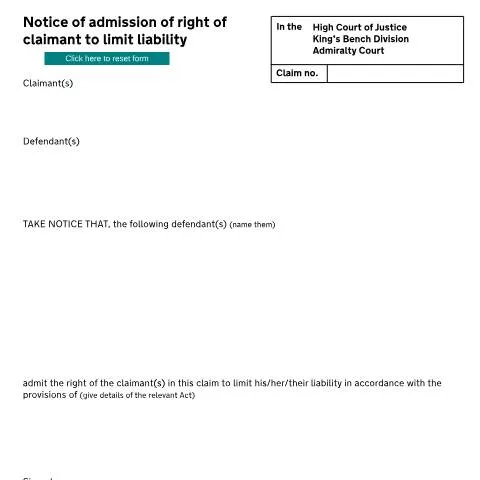
In the complex world of maritime and admiralty law, the Notice of Admission of Right of Claimant to Limit Liability (Form ADM16) stands as a pivotal document for defendants seeking to affirm their right to limit liability in claims brought against them. This notice, issued within the High Court of Justice, King’s Bench Division, specifically the Admiralty Court, plays a critical role for various parties involved in maritime disputes, often determining the course of action in legal proceedings.
Who Should Use the ADM16?
The ADM16 is primarily relevant for defendants in maritime cases who anticipate that their liability may be limited under applicable legislation. This might include:
- Shipowners
- Charterers
- Freight forwarders
- Marine insurers
Understanding when to use this notice is essential. For example, if a vessel is involved in an incident causing damage or injury, the responsible party may invoke their right to limit liability under legislation such as the Merchant Shipping Act 1995 or similar related statutes. Recognizing the timing and conditions under which to submit the ADM16 is crucial for protecting one's legal interests.
Key Components of the ADM16
The ADM16 incorporates several critical elements that must be accurately completed. First and foremost, the notice requires details of the claim, including:
- Claim Number: A unique identifier for the case, essential for tracking and referencing.
- Claimants and Defendants: Names and details of all parties involved, ensuring clarity in legal proceedings.
- Relevant Statutes: Specific references to the Acts under which the right to limit liability is being claimed, reflecting the legal basis for the application.
To effectively utilize the ADM16, all parties must pay close attention to these details to avoid potential pitfalls that could jeopardize their claim to limit liability.
The Procedural Pathway: Steps to Submitting the ADM16
Submitting the ADM16 is not merely a matter of filling out a form; it is a procedural step that interacts with various legal processes. Here’s a step-by-step breakdown:
- Evaluate the Circumstances: Determine whether the conditions for limiting liability apply to your situation.
- Gather Necessary Information: Collect details pertinent to the case, including the claim number and relevant statutes.
- Draft the ADM16: Ensure that all required fields are filled out with precise and accurate information.
- File with the Court: Submit the completed ADM16 to the appropriate court, ensuring compliance with any additional procedural requirements.
- Serve the Notice: Provide copies of the ADM16 to all claimants involved in the case.
Proper adherence to these steps is essential for ensuring that your right to limit liability is recognized and protected by the court.
Interrelation with Other Legal Documents
The ADM16 does not exist in isolation; it interacts with numerous other legal documents and proceedings. These may include:
- Claim Forms: Such as the Claim Form (N1), which initiates the legal proceedings.
- Defence Statements: Necessary for outlining the defendant's position in relation to the claim and the decision to limit liability.
- Witness Statements: These may provide context or evidence relating to the incident in question and support the assertion of limited liability.
Understanding how the ADM16 fits into the broader context of legal proceedings is critical. For instance, while the ADM16 asserts the right to limit liability, the accompanying defence statement must comprehensively address the specifics of the claim, potentially influencing the court's decision.
Scope and Limitations of the ADM16
While the ADM16 is a powerful tool in limiting liability, it is essential to understand its scope and limitations. This notice:
- Does not automatically absolve a defendant from all liability; it merely limits the extent of that liability as defined by law.
- Is subject to court review, meaning that the court must accept the right to limit liability based on the provided information and evidence.
- Must be filed within specific timeframes set by court rules or relevant legislation to remain valid.
Failure to acknowledge these limitations could lead to misunderstandings about the protections offered by the ADM16 and potentially detrimental legal consequences.
Common Misinterpretations to Avoid
In navigating the intricacies of admiralty law, there are several common misinterpretations of the ADM16 that can lead to complications. Notably:
- Assuming Automatic Liability Limitation: Many defendants mistakenly believe that submitting the ADM16 guarantees a limitation of liability. In reality, the court must affirm this right.
- Inadequate Legal References: Failing to cite relevant statutes accurately can undermine the effectiveness of the notice.
- Neglecting Time Limits: Some parties may overlook the urgency of submitting the ADM16 within the stipulated timeframes, risking their right to limit liability.
To mitigate these risks, defendants are encouraged to seek legal advice early in the process to clarify their understanding and obligations regarding the ADM16.
Navigating Legislative Frameworks: Key Terms and Concepts
Grasping the legislative framework surrounding the ADM16 is vital for any party involved in maritime law. Key terms and concepts include:
- Limitation of Liability: A legal principle that allows a party to limit their financial liability to a predetermined amount, often related to the value of the vessel or cargo.
- Relevant Acts: Legislation such as the Merchant Shipping Act outlines the conditions under which liability can be limited and must be referenced in the ADM16.
- Admiralty Jurisdiction: The legal authority of the court to hear cases related to maritime matters, which is intrinsic to the submission of the ADM16.
By developing a clear understanding of these foundational concepts, defendants can better navigate the complexities associated with their claims in admiralty court.
Final Thoughts on the ADM16 Process
Using the Notice of Admission of Right of Claimant to Limit Liability (Form ADM16) is a crucial process that requires careful consideration and adherence to legal protocols. Engaging with maritime law necessitates a thorough understanding of not only the ADM16 but also its interconnectedness with broader legal frameworks. Whether you are a shipowner, charterer, or stakeholder in maritime commerce, being well-prepared to utilize the ADM16 effectively can safeguard your interests and help ensure that your legal rights are upheld in the face of potential claims.
Understanding the Purpose of Form ADM16
Form ADM16, known as the "Notice of Admission of Right of Claimant to Limit Liability," is a specific legal document in the UK that allows for the admission of a claimant's right to limit liability in certain maritime and shipping contexts. This form is particularly relevant for those involved in shipping disputes or issues surrounding maritime claims, often under the purview of the Limitation of Liability for Maritime Claims Act 1989.
The primary purpose of this form is to facilitate the legal process by officially acknowledging the claimant's right to limit liability. This admission can significantly impact how the claim is handled, as it outlines the extent to which a party may be liable under maritime law, allowing for a more structured resolution to disputes. It is essential for claimants to understand the implications of submitting an ADM16, as this can affect the outcome of their case and their potential compensation.
This document typically needs to be completed and submitted to the High Court in England and Wales, or the relevant court in Scotland or Northern Ireland, depending on where the claim arises. It is crucial for the claimant to provide accurate and detailed information about the incident leading to the claim, including any supporting evidence, as this will influence the court's assessment of the liability limit.
Common Scenarios Leading to the Use of Form ADM16
There are several common scenarios where parties might find Form ADM16 applicable. Understanding these contexts can help claimants and defendants navigate the complexities of maritime claims more effectively.
Shipping Incidents: One of the most frequent situations requiring the use of Form ADM16 involves accidents or incidents during the shipping process. This can include collisions between vessels, damages caused to cargo, or environmental damages resulting from maritime operations. In such cases, the shipping company may wish to limit its liability based on the specific legal frameworks governing maritime law.
Charter Agreements: In arrangements where vessels are chartered, disputes can arise over damages or losses incurred during the charter period. The charterers or shipowners might use Form ADM16 to assert their right to limit liability, particularly if the terms of the charter agreement allow for liability limitations.
Personal Injury Cases: Maritime workers or passengers may suffer injuries while on board a vessel. Claims resulting from personal injury can be complex due to the interplay of various laws, including both maritime and personal injury law. In these cases, the vessel owner might file Form ADM16 to limit their liability, arguing that compensation should be constrained within the limits established by the applicable maritime laws.
Environmental Claims: Increasingly, incidents leading to environmental damage, such as oil spills or other hazardous material releases, necessitate the filing of Form ADM16. Here, the party responsible for the vessel may seek to limit its liability for the costs associated with environmental remediation and penalties imposed by regulatory authorities.
Fill in your form directly online
No printing: type your details into the boxes of the official form, tick, then download the PDF ready to send.
- 1Type into the form boxes
- 2Tick in one click
- 3Save and download the PDF
Each of these scenarios underscores the importance of understanding not only the procedural aspects of Form ADM16 but also the substantive law that governs maritime liability. Claimants and defendants alike would benefit from consulting with legal professionals who specialize in maritime law to navigate their specific circumstances effectively.
Filing Form ADM16: Step-by-Step Guidance
Filing Form ADM16 can be a detailed process, and understanding each step can help ensure that claimants and defendants present their cases efficiently and effectively. Below is a step-by-step guide to assist in the completion and filing of this critical form.
Gather Necessary Information: Before starting the form, collect all relevant information pertaining to the claim. This includes details of the incident, the parties involved, and any documentation that supports the claim. Evidence may include witness statements, photographs, reports, and any prior correspondence related to the dispute.
Complete the Form: Fill out Form ADM16 carefully. Each section of the form must be completed accurately, providing necessary details such as the claimant’s and defendant's names, contact information, and specifics about the claim being limited. Be sure to clarify the basis for limiting liability, referencing the relevant legal provisions.
Review for Accuracy: Once the form is completed, it is essential to review it thoroughly for accuracy and completeness. Errors or omissions could lead to delays or complications in the processing of your claim. Ensuring that all required documentation is attached will facilitate a smoother review process.
Submit the Form: Form ADM16 must be filed with the appropriate court. This will typically involve paying a filing fee, which varies depending on the court's jurisdiction. It is vital to submit the form before any statutory deadlines to avoid jeopardizing the claim.
Await Court Acknowledgment: After filing, the court will review the form and acknowledge receipt. Depending on the circumstances, the court may schedule a hearing or issue a ruling based on the submission. Be prepared for potential follow-up requests for additional information from the court.
Legal Representation: Consider securing legal representation, particularly if the case involves substantial claims or complex legal questions. A solicitor experienced in maritime law can provide critical guidance and increase the likelihood of a favorable outcome.
Respond to Court Directions: If the court requires further clarification, evidence, or a hearing, it is crucial to respond promptly and comprehensively. Following court directions accurately can influence how the claim progresses.
By following these steps, claimants and defendants can effectively manage the filing process for Form ADM16, thus ensuring that their rights and interests are adequately represented in maritime disputes.