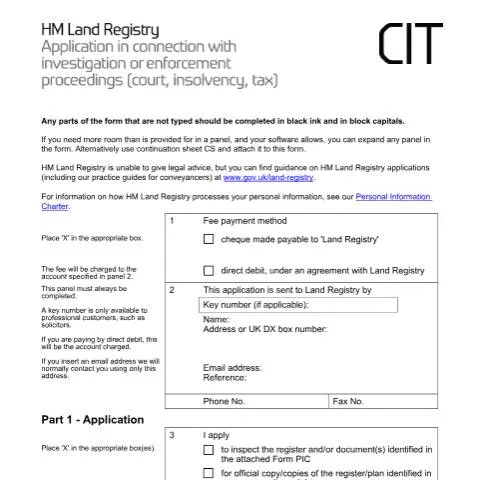
When Land Registry Records Meet Law Enforcement: Understanding the CIT Application
Property ownership data sits at the heart of countless criminal investigations, insolvency proceedings, and tax enforcement actions across England and Wales. When police forces investigate fraud, when HMRC pursues tax evasion cases, or when courts need to trace assets in complex financial crimes, they turn to HM Land Registry's confidential records through a specialised gateway: the Investigation or Enforcement Proceedings (CIT) form.
This isn't your typical property search. While members of the public can access basic register information for a small fee, the CIT process unlocks far more sensitive data for qualified law enforcement agencies. The form serves as both an application tool and a legal safeguard, ensuring that confidential property information reaches only those with legitimate investigative powers whilst maintaining proper oversight of these exceptional disclosures.
The CIT form represents a careful balance between transparency in property ownership and protection of personal data. Under normal circumstances, HM Land Registry operates an open register system where anyone can discover who owns a property. However, certain investigations require access to historical records, detailed document copies, or information about properties where the owners have opted for privacy restrictions. This is where the CIT process becomes essential.
The Investigative Gateway: Who Can Apply and Under What Circumstances
The CIT form isn't available to private investigators, journalists, or curious members of the public. Access is strictly controlled and limited to specific categories of authorised applicants who must certify their legal authority to request the information.
Police and Prosecution Authorities
Chief Officers of Police hold primary authority to make CIT applications, though this power is routinely delegated to authorised officers within their forces. The Crown Prosecution Service can apply through members authorised by the Director of Public Prosecutions, whilst the Serious Fraud Office operates under similar delegation arrangements from its Director.
These applications typically arise during complex fraud investigations where property transactions may conceal criminal proceeds, or where establishing ownership patterns helps prove conspiracy or money laundering charges. The investigating officer must certify that a criminal offence has been committed or is reasonably suspected, and that Land Registry records may provide relevant evidence.
Government Departments and Regulatory Bodies
Several government departments hold CIT application rights, reflecting the diverse nature of investigations that may require property data. HMRC officers frequently use the process when investigating tax evasion, particularly cases involving undeclared rental income or capital gains tax avoidance through complex property structures.
The Department for Work and Pensions may seek property information when investigating benefit fraud, especially cases where claimants fail to declare significant assets. Similarly, the Department for Business and Trade can access records during investigations into corporate misconduct or insolvency-related offences.
| Authorised Body | Typical Investigation Focus | Certificate Type Used |
|---|---|---|
| Police Forces | Fraud, money laundering, proceeds of crime | Certificate A or B |
| HMRC | Tax evasion, undeclared assets | Certificate A |
| Financial Conduct Authority | Financial services fraud | Certificate A |
| NHS Counter Fraud Authority | Healthcare-related fraud | Certificate A |
Specialist Investigation Units
The Financial Conduct Authority can apply through Heads of Department in its Enforcement and Financial Crime Division, typically when investigating unauthorised financial activities or market manipulation where property assets may be involved. The NHS Counter Fraud Authority has similar powers for healthcare fraud cases, whilst the Royal Military Police can access records through officers in the Force Intelligence & Investigation Unit.
Navigating the Certificate Framework: Four Pathways to Property Data
The CIT form employs a sophisticated certificate system that categorises different types of investigations and ensures appropriate legal standards are met. Each certificate type reflects distinct investigative circumstances and carries specific evidential requirements.
Certificate A: General Criminal Investigations
This represents the most commonly used pathway, covering the broad spectrum of criminal investigations where property data may prove relevant. The applicant must identify the suspected offence and the relevant legislation, demonstrating reasonable grounds for believing that Land Registry information will assist the investigation or subsequent prosecution.
Certificate A applications often arise in fraud cases where suspects may have concealed assets through complex property transactions, or in money laundering investigations where legitimate property purchases mask criminal proceeds. The certificate requires specific details about the suspected offence, including the relevant statutory provisions and the connection between the investigation and the requested property information.
Certificate B: Recovery of Criminal Proceeds
This pathway specifically addresses post-conviction proceedings where authorities seek to recover assets or distribute compensation to victims. The applicant must provide court details, conviction information, and demonstrate how the requested property data relates to proceeds recovery or victim compensation efforts.
Certificate B applications typically follow successful prosecutions under the Proceeds of Crime Act 2002, where confiscation orders require detailed asset tracing. The certificate demands precise conviction details, including any offences taken into consideration, and clear justification for why property records are needed for the recovery process.
Certificates C and D: Drug Trafficking Investigations
These certificates address the specific requirements of drug trafficking investigations under the Drug Trafficking Act 1994. Certificate C covers ongoing investigations where there are reasonable grounds for suspecting that property information will provide substantial value to a drug trafficking inquiry.
Certificate D focuses on post-investigation phases, examining whether individuals have benefited from drug trafficking or facilitating the recovery of trafficking proceeds. These applications require demonstration of reasonable suspicion that the subject has committed drug trafficking offences and that property records will substantially assist the recovery process.
Completing the Application: Technical Requirements and Common Challenges
The CIT form demands meticulous attention to detail, as errors can delay investigations or compromise legal proceedings. Unlike standard Land Registry applications, CIT submissions carry additional evidential weight and must meet stringent accuracy standards.
Payment and Account Details
Professional applicants typically use direct debit arrangements under existing Land Registry accounts, streamlining the payment process for regular users. Key numbers, available only to professional customers such as solicitors acting for law enforcement agencies, facilitate faster processing and account management.
For agencies without existing accounts, cheque payments made payable to 'Land Registry' remain acceptable, though this may extend processing times. The form requires complete applicant details, including official addresses and contact information, as Land Registry may need to verify authority or seek clarification during processing.
Defining Information Requirements
The application section allows investigators to specify exactly what information they require, from basic register inspections to comprehensive document copies. Each type of search requires completion of additional forms: Form PIC for register inspections, Form OC1 for official register copies, or Form OC2 for document copies.
Historical searches using Form HC1 prove particularly valuable in long-term investigations, revealing ownership patterns over time that may demonstrate systematic asset concealment or money laundering activities. Index searches through Forms SIM, SIF, or PN1 help investigators identify all properties connected to specific individuals or areas.
Certificate Completion Requirements
Each certificate demands specific information tailored to the investigation type. Certificate A applications must identify the suspected offence with reference to relevant legislation, whilst Certificate B submissions require court details and conviction specifics. The applicant must also identify their authority to make the application, selecting from the prescribed list of authorised positions.
Drug trafficking certificates carry additional complexity, requiring demonstration of reasonable grounds for suspicion and substantial value assessments. The applicant must articulate how the requested information connects to drug trafficking investigations or proceeds recovery efforts under the 1994 Act.
Processing Timelines and Administrative Procedures
CIT applications receive priority processing within HM Land Registry, reflecting the urgent nature of many investigations. However, processing times vary significantly depending on the complexity of the request and the current workload of the specialist investigation team.
Initial Assessment and Verification
Upon receipt, Land Registry conducts initial verification of the applicant's authority and the completeness of the submission. This may involve contacting the applying agency to confirm the officer's authorisation or seek clarification about the investigation requirements. Incomplete applications face immediate rejection, potentially causing significant delays in time-sensitive investigations.
The verification process extends to examining the certificate details, ensuring that the stated grounds for the application align with the requested information. Land Registry maintains strict oversight of these exceptional disclosures, as improper release of confidential information could compromise both investigations and individual privacy rights.
Information Compilation and Delivery
Once approved, Land Registry compiles the requested information using its comprehensive database systems. This may involve accessing current registers, historical records, or document archives depending on the investigation requirements. Complex requests spanning multiple properties or extended time periods naturally require longer processing times.
Delivery methods vary according to the sensitivity and urgency of the investigation. Standard postal delivery suffices for most applications, whilst urgent cases may warrant secure electronic transmission or priority postal services. The investigating agency can specify preferred delivery methods during the application process.
Safeguards, Oversight, and Data Protection Compliance
The CIT process operates within a robust framework of legal safeguards designed to prevent misuse whilst facilitating legitimate investigations. These protections reflect the sensitive nature of property ownership data and the potential impact on individual privacy rights.
Legal Framework and Statutory Authority
The Data Protection Act 2018 and UK GDPR provide the overarching framework for CIT processing, establishing lawful bases for exceptional disclosures to law enforcement agencies. Land Registry processing relies on the law enforcement exemptions within data protection legislation, whilst maintaining detailed records of all disclosures for audit purposes.
The Land Registration Act 2002 provides specific authority for these disclosures, balancing the open register principle with legitimate investigation needs. This statutory framework ensures that CIT applications operate within clear legal parameters whilst maintaining appropriate oversight mechanisms.
Fraud Warnings and Criminal Sanctions
The CIT form carries prominent fraud warnings, reflecting the serious criminal penalties for dishonest applications. Under the Fraud Act 2006, false or misleading statements intended to secure unauthorised access to property information can result in up to ten years' imprisonment or unlimited fines.
These warnings serve multiple purposes: deterring inappropriate applications, emphasising the serious nature of the process, and providing clear legal notice of the consequences of misuse. The warnings apply equally to all applicants, regardless of their official position or investigative authority.
Audit Trails and Accountability Measures
Land Registry maintains comprehensive audit trails for all CIT applications, recording applicant details, justification grounds, and information disclosed. These records enable retrospective review of the process and provide accountability mechanisms for both Land Registry and the applying agencies.
Regular audits examine CIT usage patterns, identifying any unusual activity or potential misuse. This oversight extends to monitoring the effectiveness of the process in supporting legitimate investigations whilst ensuring appropriate protection of confidential information.
Strategic Considerations for Investigating Agencies
Successful CIT applications require careful planning and strategic consideration of information requirements. Investigating agencies must balance the scope of their requests against processing times and the evidential value of different types of property data.
Timing and Investigation Coordination
The timing of CIT applications can significantly impact investigation outcomes. Early applications may help identify additional suspects or assets, whilst delayed submissions risk missing time-sensitive opportunities for asset recovery or evidence preservation.
Coordination with other investigation activities proves crucial, particularly in complex multi-agency operations. Property data often provides the missing link between suspects, assets, and criminal activities, making CIT information valuable for developing investigation strategies and securing additional evidence sources.
Scope and Proportionality Assessments
Investigators must carefully consider the scope of their CIT requests, balancing comprehensive coverage against proportionality requirements. Overly broad applications may face challenges from Land Registry or create unnecessary processing delays, whilst narrow requests might miss crucial connections or evidence.
The proportionality assessment extends to considering alternative information sources and the specific evidential requirements of the investigation. Property data may provide crucial evidence in some cases whilst offering only marginal value in others, requiring careful evaluation of the cost-benefit balance.