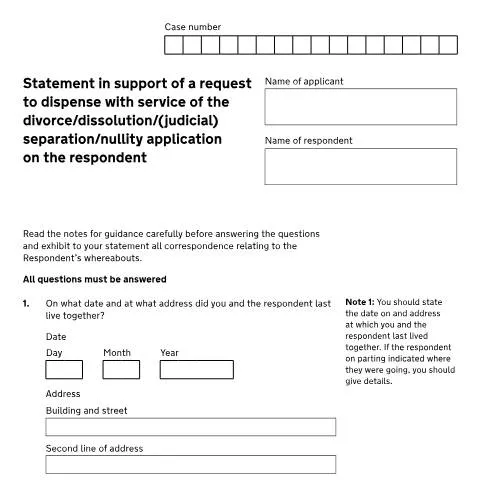
When Your Former Partner Cannot Be Found: Understanding the D13B Dispensation Process
Divorce proceedings reach an unexpected impasse when the respondent—your former spouse or civil partner—has vanished without trace. The Family Court requires proper service of divorce papers to ensure procedural fairness, yet what happens when exhaustive searches yield nothing? Form D13B provides the legal mechanism to request the court's permission to proceed without serving documents on an untraceable respondent, but success hinges on demonstrating genuinely comprehensive efforts to locate them.
This statement form accompanies applications for dispensation with service in divorce, dissolution, nullity, or judicial separation proceedings. Unlike standard divorce paperwork, the D13B demands detailed evidence of investigative work—from checking with former employers to contacting the Child Support Agency. The court scrutinises each entry to determine whether service should be waived, making thorough preparation essential for applicants facing this challenging situation.
Establishing Your Investigative Trail: Core Requirements and Documentation
The D13B operates on a fundamental principle: dispensation with service represents an exceptional remedy granted only when genuine attempts at location have failed. Courts expect applicants to demonstrate systematic enquiries across multiple channels, with documentary evidence supporting each claim of unsuccessful contact attempts.
The form's ten detailed questions create a chronological investigation map, beginning with the last known cohabitation address and extending through employment history, family networks, and financial institutions. Each section requires specific information about enquiries made and results obtained, transforming what might seem like straightforward questions into complex evidential challenges.
Essential Documentation Requirements
Successful D13B applications rely heavily on exhibited correspondence demonstrating failed contact attempts. This includes:
- Returned mail marked "not known at this address" or "gone away"
- Written responses from employers, relatives, or friends confirming no current contact
- Records of enquiries made to banks, building societies, or professional organisations
- Documentation from Child Support Agency or magistrates' court maintenance enquiries
- Any other relevant correspondence relating to tracing efforts
The court guidance emphasises that all correspondence relating to the respondent's whereabouts must be exhibited to the statement. This comprehensive approach ensures judges can assess both the scope and quality of investigative efforts undertaken.
Navigating the Ten Critical Questions: A Section-by-Section Analysis
Each D13B question serves a specific investigative purpose, building a comprehensive picture of attempts to locate the missing respondent. Understanding the underlying rationale helps applicants provide complete, compelling responses that demonstrate genuine effort rather than superficial enquiries.
Questions 1-2: Establishing the Starting Point
The opening questions establish the last known cohabitation address and subsequent living arrangements. Courts need precise dates and locations to understand the timeframe since separation and assess whether enough time has elapsed to justify dispensation. If the respondent indicated their intended destination upon parting, this information becomes crucial for demonstrating initial attempts at contact.
Question 2 requires detailed results of enquiries made at known subsequent addresses, including specific steps taken to verify the respondent's departure. Neighbour enquiries, landlord contacts, and returned correspondence all contribute to building the evidential picture courts require.
Questions 3-5: Personal Networks and Family Connections
These questions probe the respondent's personal connections, recognising that family members and close friends often maintain contact even when formal addresses change. Question 4 demands comprehensive details about all known relatives and friends, including their responses to enquiries and the specific nature of contact attempts made.
The children question (Question 5) carries particular weight, as parental contact often continues despite relationship breakdown. Courts expect detailed information about any ongoing contact arrangements, as these may provide alternative service routes or indicate the respondent's continued presence in the local area.
Questions 6-9: Financial and Institutional Connections
| Question Focus | Key Information Required | Documentation Expected |
|---|---|---|
| Employment (Q6) | Last known employer details, occupation, enquiry results | Employer correspondence, forwarding attempts |
| Financial institutions (Q7a) | Bank/building society account details, enquiry outcomes | Institution responses to trace requests |
| Professional organisations (Q7b) | Trade union/professional body membership, contact results | Organisation correspondence regarding member status |
| Maintenance orders (Q8-9) | Court orders, CSA calculations, agency enquiry results | Court/agency responses to location requests |
These institutional enquiries often prove most fruitful, as employers, banks, and maintenance agencies maintain current contact information for operational purposes. The notes emphasise that enquiries should request assistance with forwarding correspondence, providing opportunities for indirect service even when direct addresses remain unknown.
Strategic Approaches to Comprehensive Tracing Efforts
Effective D13B preparation requires strategic thinking about tracing methodologies, moving beyond obvious enquiries to demonstrate genuine investigative thoroughness. Courts distinguish between perfunctory efforts and comprehensive searches, with success often depending on creative approaches to locating missing respondents.
Employment-Based Investigations
The employer enquiry provisions (Question 6) offer sophisticated options beyond simple address requests. The guidance suggests requesting forwarding services where employers agree to pass on sealed envelopes without disclosure. This approach can achieve effective service while respecting privacy concerns, potentially avoiding the need for dispensation altogether.
When pursuing employer contacts, applicants should explain the legal requirement for service rather than simply requesting personal information. Most employers will assist with forwarding arrangements while maintaining confidentiality, providing a practical solution that courts view favourably.
Financial Institution Strategies
Banks and building societies maintain sophisticated tracking systems, but data protection regulations limit information sharing. Effective enquiries focus on forwarding services rather than address disclosure, asking institutions to pass on correspondence rather than reveal account details.
Professional organisations, trade unions, and membership bodies often prove more cooperative than financial institutions, particularly when approached with clear explanations of legal requirements. Many maintain current contact information for members and may assist with forwarding divorce papers or confirming membership status changes.
Advanced Tracing Considerations
Question 10 invites disclosure of additional investigative efforts, providing opportunities to demonstrate exceptional thoroughness. For cases involving lengthy disappearances (typically two years or more), the guidance specifically recommends searching the decree absolute/final order index maintained at the Principal Registry to ensure the respondent hasn't already divorced the applicant elsewhere.
This requirement reflects the court's concern about preventing fraudulent or duplicative proceedings, ensuring that dispensation applications don't circumvent legitimate legal processes already concluded through alternative channels.
Timing Considerations and Procedural Integration
The D13B doesn't exist in isolation but forms part of the broader divorce application process, with specific timing requirements affecting both preparation and submission strategies. Understanding when to pursue dispensation—and when alternative approaches might prove more effective—requires careful consideration of procedural timelines and court expectations.
Pre-Application Timing
Courts expect applicants to undertake comprehensive tracing efforts before submitting dispensation requests, rather than treating the D13B as a shortcut around service difficulties. The depth of investigation required typically demands several weeks or months of systematic enquiries, with documented attempts spanning multiple channels and contact methods.
Premature dispensation applications often fail because insufficient time has elapsed to demonstrate genuine investigation efforts. Courts look for evidence of sustained, systematic attempts over reasonable periods, rather than brief, superficial enquiries conducted immediately after initial service difficulties.
Integration with Main Proceedings
The D13B accompanies the primary divorce application but requires separate consideration by the court. Judges evaluate dispensation requests independently from the underlying divorce merits, focusing specifically on service-related evidence rather than relationship breakdown factors.
This separation means that strong divorce grounds don't compensate for weak tracing evidence, while comprehensive investigation efforts can secure dispensation even in complex or contested cases. The form's success depends entirely on demonstrating exhaustive attempts to locate the respondent.
Addressing Complex Circumstances and Exceptional Cases
Certain situations present particular challenges for D13B applications, requiring adapted approaches that address specific complications while maintaining the comprehensive investigation standards courts demand.
International Complications
When respondents have potential international connections, tracing efforts must extend beyond UK-based enquiries to demonstrate genuine attempts at location. This might involve contacting overseas relatives, international employers, or foreign professional bodies, depending on the respondent's known background and connections.
Immigration status considerations add complexity, particularly where respondents face potential deportation or have uncertain legal status. Courts may expect enquiries directed to relevant government departments or immigration authorities, though success rates often prove limited due to confidentiality restrictions.
Vulnerable Respondents
Cases involving potentially vulnerable respondents—those with mental health difficulties, substance abuse issues, or domestic violence histories—require sensitive handling that balances comprehensive investigation with appropriate protection considerations. Courts may accept modified investigation approaches where full enquiries might create safety risks.
The guidance doesn't specifically address vulnerability issues, but family court practice recognises that standard tracing methods may prove inappropriate or counterproductive in certain circumstances. Applicants should clearly explain any limitations on investigation efforts arising from genuine protection concerns.
Historic Disappearances
Long-term disappearances (typically exceeding two years) benefit from the specific guidance regarding decree absolute index searches, but may also require enhanced investigation efforts to address the extended timeframe. Courts expect applicants to demonstrate recent attempts at contact rather than relying solely on historical enquiries.
The passage of time can strengthen dispensation applications by demonstrating sustained absence, but may also raise questions about the adequacy of ongoing investigation efforts. Regular renewal of enquiries helps maintain the currency of evidence presented to the court.
Court Assessment Criteria and Decision-Making Processes
Understanding how courts evaluate D13B applications helps applicants structure their evidence effectively and anticipate potential areas of judicial scrutiny. The assessment process focuses on proportionality—balancing the need for proper service against the practical realities of untraceable respondents.
Judicial Evaluation Standards
Courts apply a reasonableness test when assessing dispensation requests, asking whether a reasonable person in the applicant's position could be expected to undertake further investigative efforts. This subjective element means that identical factual situations might receive different judicial treatment depending on specific circumstances and presentation quality.
The exhibited correspondence plays a crucial role in this assessment, providing tangible evidence of investigation efforts rather than mere assertions about attempts made. Courts scrutinise both the breadth and depth of enquiries, looking for systematic approaches rather than scattergun attempts at contact.
Common Refusal Grounds
Dispensation applications typically fail when courts identify obvious investigative gaps or question the thoroughness of efforts described. Insufficient time periods, limited enquiry scope, or missing documentation frequently lead to refusal, requiring applicants to undertake additional investigations before resubmission.
The court may suggest specific additional enquiries rather than simply refusing the application, providing guidance for strengthening subsequent submissions. This iterative approach recognises that comprehensive tracing often requires multiple attempts and creative investigation strategies.
Post-Submission Procedures and Alternative Service Options
Successful D13B applications don't automatically conclude service requirements but may lead to alternative service orders requiring substitute methods of bringing proceedings to the respondent's attention. Understanding these potential outcomes helps applicants prepare for subsequent procedural requirements.
Alternative service might involve newspaper advertisements, notice posting at last known addresses, or service on known relatives or friends. These methods aim to maximise the likelihood of the respondent becoming aware of proceedings while acknowledging that direct personal service remains impossible.
Where dispensation is granted without alternative service requirements, proceedings may continue in the respondent's absence, but courts retain discretion to set aside subsequent orders if the respondent later appears with evidence of inadequate investigation efforts or procedural irregularities in the original dispensation process.
When Courts Typically Grant Dispensation Applications
Understanding when courts are likely to approve your Form D13B application helps you present the strongest possible case. District judges consider several key factors when evaluating dispensation requests, with the overriding principle being whether it would be just and proportionate to proceed without serving the respondent.
Length and nature of attempts to trace: Courts expect to see systematic efforts over a reasonable period. A single internet search or one letter to a last known address rarely suffices. You'll need to demonstrate sustained efforts, typically spanning several months. For instance, if your former spouse disappeared two years ago, showing monthly attempts to contact them through various channels carries more weight than sporadic efforts over the same period.
Fill in your form directly online
No printing: type your details into the boxes of the official form, tick, then download the PDF ready to send.
- 1Type into the form boxes
- 2Tick in one click
- 3Save and download the PDF
Urgency of circumstances: Some situations create compelling reasons for expedited proceedings. If you're facing financial hardship due to inability to access joint assets, or if you need to remarry for immigration purposes, courts may be more receptive to dispensation applications. Similarly, cases involving domestic violence where the applicant fears renewed contact with the respondent receive careful consideration.
Quality of evidence provided: Courts distinguish between thorough investigations and perfunctory attempts. Strong applications include screenshots of social media searches, correspondence with the last known employer, and evidence of enquiries with mutual acquaintances. Weak applications typically rely on assumptions or hearsay without documented proof of investigation.
Respondent's known circumstances: If evidence suggests the respondent deliberately avoids service—perhaps due to previous court orders or known financial difficulties—judges may be more willing to grant dispensation. Conversely, if the respondent has a stable lifestyle and strong community ties, courts expect more comprehensive tracing efforts.
Public interest considerations: Courts balance individual circumstances against broader policy objectives. While they recognise that some relationships irretrievably break down with one party disappearing, they also uphold the principle that people shouldn't lose important legal rights without proper notice. This tension influences decision-making, particularly in cases involving significant financial assets or children.
Alternative Service Methods: When D13B Isn't Your Only Option
Before pursuing dispensation through Form D13B, consider whether alternative service methods might resolve your difficulty more straightforwardly. Courts often prefer attempts at alternative service before considering complete dispensation, as these methods still provide the respondent with actual notice of proceedings.
Service by advertisement: If you know the respondent's general location but not their precise address, you might apply for service by advertisement in local newspapers. This method works particularly well when the respondent has connections to a specific town or region. The court requires evidence that the respondent is likely to see the advertisement, so you'll need to demonstrate their ongoing ties to the area.
Service through social media platforms: With court permission, you may serve divorce papers through established social media accounts where you can prove the respondent's identity. This requires showing that the account is genuinely theirs and that they actively use it. Screenshots of recent activity, mutual connections, and personal information that matches your knowledge of the respondent strengthen such applications.
Service via email: If you have a current email address and can demonstrate the respondent regularly uses it, courts may permit electronic service. You'll need evidence such as recent email exchanges or confirmation that the respondent conducts business through that address. Simply having an old email address isn't sufficient—you must show it remains active and monitored.
Service through relatives or friends: Sometimes serving papers on someone likely to inform the respondent provides an acceptable alternative. This works when family members or close friends maintain regular contact with the respondent, even if you don't know the respondent's current address. The court needs assurance that the intermediary will genuinely pass on the documents rather than simply accepting service without forwarding them.
Service through professional representatives: If the respondent has a known solicitor, accountant, or other professional representative, the court might permit service through them. This method requires evidence of an ongoing professional relationship and the representative's willingness to accept service on their client's behalf.
Each alternative service method requires a separate court application with supporting evidence. While this adds time and complexity to your case, successfully serving the respondent through alternative means generally provides a more robust legal foundation than proceeding with dispensed service.
Protecting Your Position: Strategic Considerations and Risk Management
Applying for dispensation of service creates both opportunities and vulnerabilities in divorce proceedings. Understanding these implications helps you make informed decisions and protect your interests throughout the process.
Financial disclosure obligations: Even when service is dispensed, you remain under strict duties regarding financial disclosure. Courts require comprehensive Form E financial statements in financial remedy proceedings, regardless of whether the respondent participates. Attempting to conceal assets or provide misleading information carries serious consequences, including potential criminal charges for contempt of court.
Future enforceability of orders: Orders made without the respondent's knowledge may face challenges if they later emerge and claim inadequate notice. While dispensed service provides legal protection when properly obtained, you should document your tracing efforts meticulously to defend against future applications to set aside orders. Keep detailed records of all attempts to locate the respondent, including dates, methods used, and outcomes.
Children arrangements considerations: If you have children with the missing respondent, dispensed service creates particular complexities. The court retains ongoing jurisdiction over child arrangements, and the absent parent may later seek contact or residence orders. Consider how proceeding without their input affects your children's interests and whether you should seek specific directions about their future involvement.
International complications: If the respondent may be overseas, dispensed service can create enforcement difficulties in foreign jurisdictions. Some countries don't recognise divorces granted without proper service on their nationals or residents. If you anticipate needing to enforce orders internationally or if you plan to remarry in another country, seek specialist advice about potential recognition problems.
Insurance and indemnity considerations: Some practitioners recommend considering after-the-event insurance to cover potential costs if the respondent later successfully challenges proceedings. While not mandatory, such protection may provide peace of mind in high-value cases where significant assets are at stake.
Ongoing monitoring obligations: After obtaining dispensed service, maintain reasonable efforts to monitor the respondent's whereabouts. If you later discover their location during proceedings, you may need to inform the court and consider whether to attempt actual service at that point. Courts expect honesty about material changes in circumstances.
Documentation standards: Maintain comprehensive records of all steps taken, decisions made, and advice received throughout the process. This documentation serves multiple purposes: supporting your initial application, defending against future challenges, and demonstrating good faith if questions arise about your conduct. Store physical and electronic copies securely, as you may need them years later.
Remember that dispensed service represents an exceptional remedy rather than a routine procedure. Courts grant such applications reluctantly and expect applicants to demonstrate compelling reasons why normal service methods cannot succeed. Approaching the process with appropriate seriousness and thorough preparation significantly improves your prospects of success while minimising future complications.