When Charities Need Professional Scrutiny: The Independent Examiner's Critical Assessment
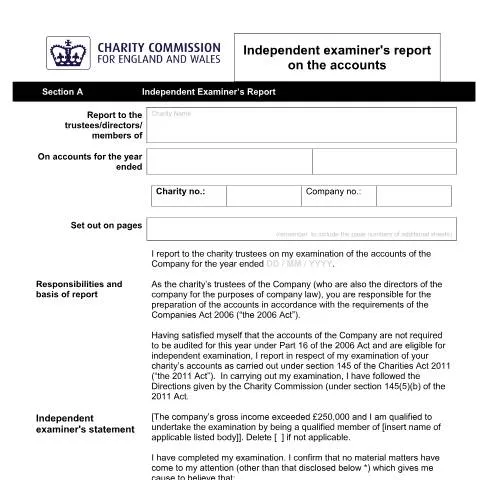
Every year, thousands of charitable companies across England and Wales face a pivotal moment in their governance cycle. As trustees prepare their annual accounts, many discover they require neither a full audit nor simple self-certification, but something in between: an independent examination. This middle ground, governed by specific income thresholds and regulatory requirements, demands completion of The Charity Commission's Independent Examiner's Report template for SORP FRS 102 charitable companies.
This statutory document represents more than administrative compliance—it serves as the professional gateway between basic accountability and full audit scrutiny. For charitable companies with gross income between £25,000 and £1 million, the independent examiner's report becomes the cornerstone of financial transparency, bridging the gap between trustee responsibility and public accountability.
Qualifying Thresholds and Professional Requirements
The independent examination pathway applies to charitable companies operating within carefully defined parameters. Understanding these boundaries determines whether your charity requires this specific reporting mechanism or must pursue alternative routes.
Income-Based Qualification Criteria
Charitable companies qualify for independent examination when their gross income falls between £25,000 and £1 million in the relevant financial year. This threshold calculation includes all incoming resources before deductions—donations, grants, investment income, trading receipts, and any other revenue streams. Companies below £25,000 may prepare receipts and payments accounts without examination, whilst those exceeding £1 million typically require statutory audit.
However, gross income exceeding £250,000 triggers additional examiner qualification requirements. Beyond this threshold, only professionally qualified individuals may conduct the examination—specifically members of recognised accountancy bodies or other organisations approved by The Charity Commission.
Asset and Activity Considerations
Total assets exceeding £3.26 million automatically disqualify charitable companies from independent examination, regardless of income levels. Similarly, companies engaged in significant trading activities through subsidiary undertakings may find themselves subject to statutory audit requirements, even within standard income parameters.
| Income Range | Examiner Requirements | Additional Conditions |
|---|---|---|
| £25,000 - £250,000 | Competent person with relevant experience | Assets under £3.26m |
| £250,001 - £1,000,000 | Professionally qualified member of listed body | Assets under £3.26m |
| Over £1,000,000 | Statutory audit required | Independent examination not permitted |
Navigating the Template's Structural Framework
The SORP FRS 102 template divides into two distinct sections, each serving specific regulatory and professional purposes. Understanding this structure prevents common completion errors and ensures comprehensive compliance with both charity law and company legislation.
Section A: Core Independent Examiner's Statement
Section A constitutes the primary examination report, beginning with fundamental identification details. The examiner must specify the charity name exactly as registered with both The Charity Commission and Companies House, including charity number and company registration number. Financial year-end dates require particular attention—these must correspond precisely with the accounting period covered by the examined accounts.
The template incorporates standardised language acknowledging trustees' responsibilities under the Companies Act 2006, specifically their duty to prepare accounts meeting statutory requirements. This acknowledgement establishes the legal framework within which the examination operates, distinguishing independent examination from statutory audit processes.
Critical examination confirmations address four key compliance areas: maintenance of proper accounting records under section 386 of the Companies Act 2006; accordance between accounts and underlying records; compliance with relevant accounting requirements under section 396; and adherence to the Charities SORP (FRS102) framework.
Professional Qualification Declaration
For charities exceeding £250,000 gross income, examiners must complete the bracketed professional qualification statement, identifying their relevant professional body membership. This requirement reflects heightened scrutiny expectations for larger charitable operations, ensuring examiner competence matches organisational complexity.
Section B: Material Concerns and Disclosure Requirements
Section B activation occurs only when examiners identify material matters requiring disclosure—situations demanding transparency beyond standard examination parameters. The Charity Commission's guidance document CC32 provides detailed direction on circumstances triggering Section B completion.
Identifying Disclosure-Worthy Issues
Material matters warranting disclosure typically involve significant accounting irregularities, governance concerns affecting financial management, or circumstances preventing complete examination scope. Examples include inadequate accounting records, unexplained transactions, or trustee conflicts of interest materially affecting financial reporting.
Examiners must exercise professional judgement in determining disclosure necessity, balancing transparency requirements against proportionality considerations. Minor administrative deficiencies rarely justify Section B completion, whilst systemic issues or potential regulatory breaches typically demand explicit disclosure.
Timing and Submission Protocols
Independent examination timing aligns with charitable company annual reporting obligations, creating interconnected deadlines affecting multiple regulatory submissions.
Annual Return Integration
Charitable companies must submit their annual return to The Charity Commission within 10 months of their financial year-end, incorporating the completed independent examiner's report alongside audited or examined accounts. This deadline synchronises with Companies House filing requirements, though specific submission dates may vary.
The examination itself should commence only after trustees finalise their accounts preparation, ensuring examiners review complete and approved financial statements. However, early engagement between trustees and examiners facilitates smoother examination processes and reduces deadline pressure.
Filing Coordination Challenges
Dual regulatory requirements—both Charity Commission and Companies House submissions—create coordination complexities. The independent examiner's report accompanies Charity Commission filings, whilst Companies House receives the examined accounts with examiner details but not necessarily the full template format.
Late filing penalties apply to both regulatory submissions, emphasising the importance of coordinated preparation and submission scheduling. Charitable companies should establish clear timelines accommodating both examination completion and dual filing requirements.
Common Completion Pitfalls and Professional Standards
Template completion demands attention to specific formatting requirements and professional standards, with common errors potentially invalidating the examination process or triggering regulatory queries.
Signature and Dating Precision
Examiner signatures must be contemporaneous with examination completion, with dating reflecting actual examination conclusion rather than account preparation or submission dates. Post-dated signatures or inconsistent dating between examination completion and formal reporting can raise regulatory concerns about examination integrity.
Professional qualification details require complete accuracy, including full professional body names and membership numbers where applicable. Generic references to "accounting qualifications" or incomplete professional body identification may prompt Charity Commission follow-up enquiries.
Address and Contact Information
Examiner address details must facilitate potential regulatory contact, requiring current business or professional addresses rather than convenience locations. This requirement supports The Charity Commission's ability to verify examination quality or seek clarification on reported matters.
Regulatory Consequences and Follow-Up Procedures
Submission of the independent examiner's report triggers various regulatory processes, from routine filing acceptance to potential investigation procedures when concerns arise.
Standard Processing Outcomes
Most independent examiner reports receive routine processing, with The Charity Commission updating charity records to reflect annual return completion and examination status. Clean examinations—those without Section B disclosures—typically generate minimal regulatory follow-up beyond standard compliance monitoring.
However, Section B disclosures may prompt Charity Commission engagement, ranging from informal clarification requests to formal investigation procedures. The Commission's response depends on disclosure severity and potential regulatory implications, with serious concerns potentially triggering statutory inquiry powers.
Trustee Responsibilities Post-Examination
Following examination completion, trustees retain ongoing responsibilities for addressing any identified concerns and maintaining proper accounting systems. The independent examiner's report does not absolve trustees of their continuing fiduciary duties or governance responsibilities.
Where examiners highlight areas for improvement—either within the formal report or through separate management letters—trustees should demonstrate responsive action and systematic improvement. The Charity Commission expects evidence of trustee engagement with examination recommendations during subsequent regulatory interactions.
Professional Development and Examiner Competence
The independent examination framework relies heavily on examiner competence and professional integrity, creating ongoing development expectations for individuals conducting charitable company examinations.
For professionally qualified examiners, continuing professional development requirements of their respective bodies typically encompass charity examination competence. However, individuals examining smaller charities (under £250,000 income) must maintain relevant knowledge through alternative development routes, including Charity Commission guidance updates and sector-specific training programmes.
The Commission's CC32 guidance document provides essential direction for all examiners, regardless of professional background, establishing minimum examination standards and reporting expectations. Regular guidance updates reflect evolving regulatory expectations and emerging best practices within the charity examination sector.
Examiner independence remains fundamental throughout the process, requiring clear separation between examination functions and any advisory or bookkeeping services provided to the charity. This independence requirement extends beyond financial relationships to encompass family connections, trustee relationships, and other potential conflicts affecting professional objectivity.
Sector-Specific SORP Adaptations and Industry Variations
The Charities SORP (FRS 102) recognises that charitable companies operate across vastly different sectors, each with unique accounting challenges that influence the independent examiner's approach. Healthcare charities, for instance, must navigate complex funding arrangements involving NHS contracts, clinical commissioning groups, and patient outcome metrics that directly impact revenue recognition. An independent examiner reviewing a hospice charity's accounts will scrutinise how care quality premiums are accounted for and whether restricted donations for specific medical equipment are properly ring-fenced.
Educational charitable companies present their own complexities, particularly those operating academies or supplementary schools. Fee income recognition becomes critical when examining term-based payments, bursary schemes, and government per-pupil funding. The examiner must verify that tuition fee income is properly matched to the academic periods delivered, and that any advance payments for future terms are correctly treated as deferred income rather than immediate revenue.
Religious charitable companies often handle unique income streams including regular congregational giving, special collections, and property rental from halls or ancillary buildings. The SORP requires careful treatment of planned giving schemes, where donors commit to regular payments over extended periods. Independent examiners must assess whether such commitments qualify as enforceable debts or remain as contingent income until actually received.
Environmental and conservation charities frequently deal with long-term project funding spanning multiple accounting periods. A charity working on habitat restoration might receive a three-year grant requiring specific milestones and outcomes. The independent examiner must evaluate whether the charity's revenue recognition policy properly reflects the substance of such arrangements, particularly where funding is conditional upon achieving measurable environmental targets.
Arts and cultural charitable companies often blend commercial and charitable activities through venue hire, ticket sales, and merchandising alongside grant-funded community programmes. The SORP's requirements for distinguishing between charitable and non-charitable trading become paramount. An examiner reviewing a community theatre's accounts must verify that commercial bar sales are properly allocated to subsidiary trading companies where turnover exceeds £8,000 annually, and that any Gift Aid claims on ticket sales meet HMRC's stringent benefit rules.
Navigating Complex Funding Arrangements and Multi-Year Commitments
Modern charitable companies increasingly operate within sophisticated funding ecosystems that challenge traditional accounting boundaries. The Charities SORP (FRS 102) provides detailed guidance on recognising income from performance-related grants, but practical application requires careful analysis of each funding agreement's specific terms and conditions.
Outcome-based funding presents particular challenges for independent examiners. Social impact bonds, payment-by-results contracts, and outcome funds typically structure payments around achieving predetermined social outcomes rather than simply delivering activities. A charity working with homeless individuals might receive funding based on the number of people successfully housed for six months or longer. The independent examiner must assess whether the charity's income recognition policy appropriately reflects the uncertainty inherent in such arrangements, potentially requiring income to be recognised only when outcomes are verified by independent evaluators.
Multi-year grant agreements require sophisticated treatment under the SORP, particularly where funding is subject to annual review or performance milestones. A charitable company delivering a five-year youth programme might secure initial funding for years one and two, with subsequent years dependent on satisfactory progress reports and continued funder commitment. The examiner must evaluate whether the charity appropriately treats only confirmed funding as recognised income, while ensuring adequate disclosure of contingent future funding in the notes to the accounts.
Collaborative funding arrangements, where multiple charitable companies partner to deliver shared outcomes, create additional complexity. Joint ventures and consortium arrangements must be carefully structured to ensure each charity's accounts properly reflect their proportionate share of income, expenditure, and any shared assets or liabilities. The independent examiner must verify that partnership agreements clearly define financial responsibilities and that accounting treatments across partner organisations remain consistent.
European Union funding, despite Brexit complications, continues to influence many charitable companies through legacy programmes and replacement schemes. The examiner must understand how currency fluctuations affect multi-year EUR-denominated grants, and whether the charity maintains appropriate hedging arrangements or provisions for exchange rate movements. Additionally, any clawback provisions within EU funding agreements require careful assessment to ensure adequate contingent liability provisions.
Corporate partnership arrangements increasingly blur the lines between donations, sponsorship, and commercial relationships. A charity partnering with a major retailer might receive percentage-based donations from customer purchases, branded product licensing fees, and employee volunteering support. The SORP requires clear distinction between these different income streams, with the independent examiner verifying that commercial elements are properly valued at fair value and that any non-monetary benefits are appropriately quantified and disclosed.
Digital Transformation and Modern Fundraising Challenges
The digital revolution has fundamentally transformed how charitable companies engage with supporters, creating new accounting challenges that the Charities SORP (FRS 102) must address through evolving interpretation and guidance. Online fundraising platforms, cryptocurrency donations, and digital asset management now feature prominently in many charitable companies' financial landscapes.
Crowdfunding campaigns present unique recognition challenges, particularly where platforms operate "all-or-nothing" funding models. A charity launching a £50,000 campaign for new equipment must carefully consider when pledged donations become enforceable debts. The independent examiner must assess whether the charity's accounting policy appropriately recognises income only when campaign targets are met and funds become available, rather than when initial pledges are made. Platform fees, payment processing charges, and potential refund obligations further complicate the accounting treatment.
Cryptocurrency donations require specialist understanding of volatile asset valuation and regulatory compliance. Bitcoin, Ethereum, and other digital currencies donated to charitable companies must be valued at the point of receipt, with subsequent movements treated as investment gains or losses. The independent examiner must verify that the charity maintains adequate systems for tracking digital wallet addresses, transaction histories, and compliance with HMRC's cryptoasset taxation guidance. Where charities hold significant cryptocurrency balances, additional considerations around custody arrangements, insurance coverage, and board oversight become critical.
Social media fundraising through platforms like Facebook, Instagram, and TikTok creates complex income recognition scenarios. Micro-donations, viral challenges, and influencer partnerships generate income streams that may not follow traditional donation patterns. The examiner must assess whether the charity's systems adequately capture and record these diverse income sources, particularly where platform-specific fees and delayed settlement periods affect cash flow timing.
Digital legacy giving represents a growing income stream requiring careful accounting treatment. Online will-writing services, digital estate planning tools, and cryptocurrency inheritance create new categories of legacy income that may not fit traditional probate timelines. The independent examiner must evaluate whether the charity's legacy recognition policy adequately addresses these modern giving methods while maintaining conservative recognition principles for uncertain income streams.
Data protection compliance under UK GDPR adds another layer of complexity to digital fundraising operations. Charitable companies must demonstrate lawful bases for processing supporter data, maintain appropriate retention policies, and provide clear opt-out mechanisms. The independent examiner should consider whether GDPR compliance costs are appropriately categorised and whether any potential regulatory penalties are adequately provided for in the charity's risk management processes.
Artificial intelligence and automated fundraising systems increasingly support donor relationship management, predictive analytics, and personalised communication strategies. While these technologies can enhance fundraising efficiency, they also create new risks around data accuracy, algorithmic bias, and donor privacy. The independent examiner must assess whether the charity maintains appropriate oversight of automated systems and whether technology-related risks are adequately disclosed and managed within the governance framework.