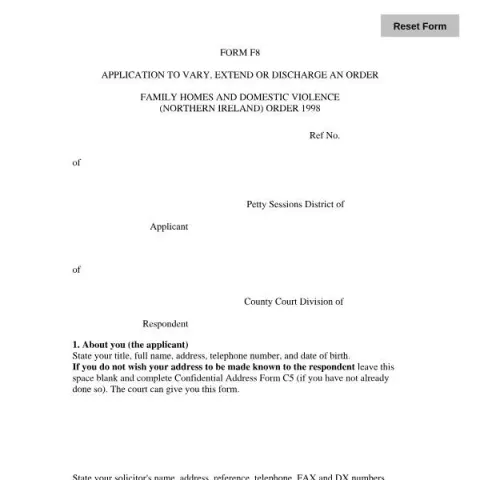
Understanding the F8 Form: Application to Vary, Extend or Discharge an Order in Northern Ireland
The Form F8 is an official document issued by the Department of Justice Northern Ireland designed for individuals seeking to modify, prolong, or cancel an existing legal order under the Family Homes and Domestic Violence (Northern Ireland) Order 1998. This form plays a crucial role in family law proceedings, especially in cases involving domestic violence or related family matters, by providing a formal process to request changes to court orders.
Purpose and Scope of the Form
The primary purpose of the Form F8 is to enable parties involved in a family law case to request alterations to an existing court order. Whether circumstances have changed or the original order needs adjustment, this form allows applicants to formally petition the court for:
- Variation — to modify the terms of an existing order
- Extension — to prolong the duration of an order beyond its original expiry
- Discharge — to cancel or end an existing order
The form is applicable specifically within the context of family law cases involving domestic violence, ensuring that the court can respond flexibly to the evolving needs of families and individuals in Northern Ireland.
Who Should Use the F8 Form?
This form is intended for individuals who are parties to a family court case under the relevant legislation. Typically, applicants include:
- Persons subject to a court order seeking to modify or end it
- Legal representatives acting on behalf of clients
- Respondents who wish to oppose or respond to the application
It is essential that applicants are aware of their role in the case and have the relevant details, such as the case reference number and the specific order they wish to vary, extend, or discharge.
Step-by-Step Procedure for Completing the Form
1. Filling in Your Details
Start by providing your full name, address, date of birth, and contact information. If you prefer to keep your address confidential from the respondent, you should leave this section blank and complete a Confidential Address Form C5. Additionally, include your solicitor's details if you have legal representation.
2. Identifying the Order
Specify whether you are applying to vary, extend, or discharge an order. Include the date of the original order and, if available, attach a copy of it to your application. Clearly describe the specific changes you are requesting, such as the new terms or duration.
3. Stating Your Reasons
Briefly explain why you are seeking the change. This section should succinctly outline the circumstances that have changed or the reasons why the original order no longer serves its purpose.
4. Serving the Application
Identify the respondent(s) by providing their full names and addresses. This ensures that all parties involved are formally notified of the application and can respond accordingly.
Important Considerations and Deadlines
When submitting the Form F8, it is vital to adhere to any deadlines set by the court or specified in the original order. Typically, applications should be made promptly to ensure the court can consider the change in a timely manner. The court may request additional documentation or evidence supporting your reasons for the application.
Fill in your form directly online
No printing: type your details into the boxes of the official form, tick, then download the PDF ready to send.
- 1Type into the form boxes
- 2Tick in one click
- 3Save and download the PDF
After Submission: What Happens Next?
Once the application is filed, the court will review the request and may schedule a hearing to consider the matter further. Both parties will be notified and given the opportunity to present their case. The court's decision will be based on the best interests of the involved parties, especially where children or vulnerable individuals are concerned.
It is advisable to seek legal advice or assistance from a solicitor experienced in family law to ensure that your application is properly completed and that your rights are protected throughout the process.
Conclusion
The F8 Form serves as a vital legal tool for those seeking to modify family court orders under the Family Homes and Domestic Violence (Northern Ireland) Order 1998. By understanding its purpose, proper completion, and procedural requirements, applicants can effectively navigate the process to achieve a fair and appropriate outcome in their family law case.