When Legal Aid Budgets Hit Reality: Understanding the CW3A Extension Process
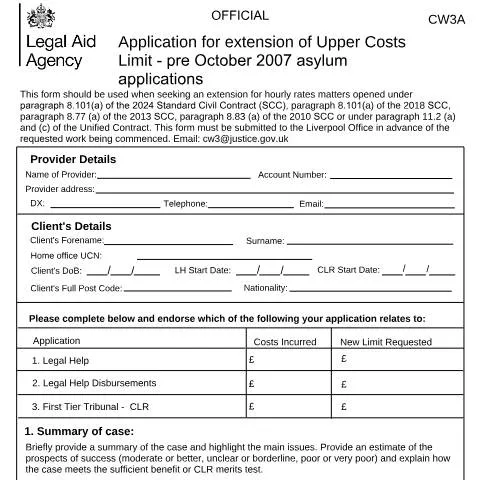
Immigration cases rarely follow neat financial boundaries. A straightforward asylum application can spiral into complex appeals, requiring expert medical reports, country-specific evidence, or extensive tribunal preparation that far exceeds the standard legal aid allocation. The CW3A form (Controlled Work 3A Immigration) serves as the formal mechanism for solicitors to request additional funding when their immigration cases demand resources beyond the upper cost limits set by the Legal Aid Agency.
This extension process acknowledges a fundamental truth about immigration law: cases involving vulnerable clients, complex medical conditions, or politically sensitive country situations cannot always be resolved within predetermined cost brackets. The form bridges the gap between rigid budget controls and the practical realities of delivering effective legal representation in immigration matters.
The Architecture of Cost Control: Where CW3A Fits in Legal Aid Funding
The Legal Aid Agency operates under the Standard Civil Contract framework, which sets upper cost limits for different types of controlled work. For immigration cases, these limits vary depending on the complexity and stage of proceedings. Legal Help typically covers initial advice and assistance, while Controlled Legal Representation (CLR) extends to tribunal representation.
The CW3A form specifically addresses cases where providers need to exceed these predetermined thresholds. It applies to matters opened under various contract specifications, including the 2024, 2018, 2013, and 2010 Standard Civil Contracts, as well as the earlier Unified Contract. This broad applicability reflects the form's evolution alongside changing legal aid arrangements.
| Contract Period | Relevant Paragraph | Application Scope |
|---|---|---|
| 2024 SCC | 8.101(a) | Hourly rates matters requiring extension |
| 2018 SCC | 8.101(a) | Hourly rates matters requiring extension |
| 2013 SCC | 8.77(a) | Hourly rates matters requiring extension |
| 2010 SCC | 8.83(a) | Hourly rates matters requiring extension |
| Unified Contract | 11.2(a) and (c) | Extended scope applications |
The form must be submitted to the Liverpool Office before commencing the additional work. This pre-approval requirement prevents providers from incurring costs speculatively and ensures the Legal Aid Agency maintains budgetary control while supporting genuine cases of need.
Dissecting the Application: Core Components and Strategic Considerations
The CW3A form demands both administrative precision and strategic advocacy. Providers must present their case not merely as a request for more money, but as a justified extension necessary for effective representation. The form's structure reflects this dual requirement, combining factual reporting with persuasive case-making.
Provider and Client Fundamentals
The opening sections establish the basic framework: provider details including Legal Aid Agency account number, client information with Home Office UCN (Unique Case Number), and case commencement dates. These seemingly routine details serve crucial administrative functions, linking the application to existing case management systems and enabling proper tracking.
The client's nationality field carries particular significance in immigration cases, as it may indicate specific country expertise requirements or heightened complexity factors that justify additional resources. The Legal Help start date establishes the timeline for assessing whether the case has progressed at reasonable pace or encountered unforeseen complications.
The Heart of the Matter: Case Summary and Merits Assessment
Section 1 requires providers to summarise the case and highlight main issues while providing a prospects of success assessment. This isn't mere bureaucratic box-ticking; it's a critical evaluation that must demonstrate the case meets either the "sufficient benefit" test or CLR merits criteria.
The prospects categories—moderate or better, unclear or borderline, poor or very poor—directly impact funding decisions. Cases with poor prospects face higher scrutiny, requiring compelling explanations of why continued funding serves the client's interests and represents value for public money.
Navigating Complex Cost Breakdowns: Work Completed and Future Requirements
The form's middle sections demand meticulous accounting of past and future work. Section 2 requires chronological detail of completed work, including counsel costs, while Sections 3 and 4 address disbursements incurred and future requirements respectively.
Chronological Work Documentation
Providers must demonstrate logical case progression, showing how each step built toward the current position. This chronological approach serves multiple purposes: it evidences diligent case management, justifies time spent, and establishes the foundation for future work requests.
Effective documentation might trace a path from initial client interview through evidence gathering, Home Office submissions, refusal responses, and appeal preparation. Each stage should show time invested and outcomes achieved, building a narrative of necessary progression rather than inefficient duplication.
Disbursement Categorisation and Justification
The form separates different disbursement types—interpreters, medical reports, travel costs—recognising that each serves distinct functions and requires different justification approaches. Interpreter costs might be essential for client communication, while medical reports address specific health conditions affecting the immigration claim.
- Interpreter services: Hourly rates for attendance, travel, and waiting time
- Translation work: Rates per 1000 words or A4 page
- Expert reports: Specialist hourly rates and estimated time requirements
- Travel expenses: Regional variations and necessity justification
Expert Evidence Strategy: Medical Reports and Country Expertise
Section 5 addresses expert reports with particular sophistication, recognising their critical role in many immigration cases. The form requires specific justification for different report types, acknowledging that expert evidence often determines case outcomes but represents significant cost.
Medical Report Justification Framework
For medical reports, providers must demonstrate whether their client has been diagnosed with relevant conditions and whether reports from treating doctors have been obtained and presented to the Home Office. This graduated approach prevents unnecessary duplication while ensuring comprehensive medical evidence where needed.
The framework recognises that initial GP reports might suffice for straightforward medical issues, while complex mental health conditions or torture-related trauma may require specialist psychiatric assessment. The key lies in demonstrating proportionality between the medical evidence and its potential impact on the immigration claim.
Country Expert Evidence Considerations
Country reports require demonstration that objective evidence has been considered and identification of specific aspects requiring expert commentary. This prevents generic country reports that add little value while supporting targeted expertise that addresses specific case vulnerabilities.
Effective country expert applications typically identify particular regions, ethnic groups, political affiliations, or social circumstances that require specialist analysis beyond standard country guidance. The expert's role should complement rather than duplicate existing objective evidence.
Pre-Approval Protocols and Liverpool Office Engagement
The requirement for advance submission to the Liverpool Office creates both opportunities and constraints. Providers must plan ahead, anticipating resource needs before commencing work, but gain certainty about funding before investing time and effort.
The dedicated email address—[email protected]—provides a direct channel to the decision-making team. However, providers should understand that applications undergo scrutiny by legal aid assessors familiar with immigration case patterns and funding precedents.
Timing Considerations and Case Management
The pre-approval requirement demands careful case management. Providers must identify potential cost overruns early enough to submit applications without delaying urgent work. This might mean submitting applications during initial case assessment rather than waiting until standard limits are exhausted.
Emergency situations present particular challenges. While the form doesn't explicitly address urgent applications, providers facing imminent deadlines should contact the Liverpool Office directly to discuss expedited processing options.
Decision Outcomes and Administrative Follow-Up
The form's final section provides space for Legal Aid Agency decisions, including amounts requested, amounts allowed, decision-maker identification, and PA reference numbers. These administrative details enable proper case tracking and financial reconciliation.
Decisions may approve full amounts, partial amounts, or reject applications entirely. Partial approvals often reflect assessor judgements about proportionality or alternative approaches that might achieve similar outcomes more cost-effectively.
Managing Rejected or Reduced Applications
When applications receive less than requested amounts, providers face strategic decisions about case progression. They might proceed with reduced resources, seek alternative funding sources, or discuss case limitations with clients.
The Legal Aid Agency's feedback often provides insight into decision rationale, helping providers understand which elements were accepted and which required stronger justification. This information proves valuable for future applications and case management approaches.
Integration with Broader Immigration Legal Aid Landscape
The CW3A form operates within a complex legal aid ecosystem that includes various funding streams, contract requirements, and regulatory obligations. Understanding these connections helps providers maximise available resources while maintaining compliance.
The form specifically addresses "pre-October 2007 asylum applications," reflecting the continuing impact of legacy cases under previous funding arrangements. These cases often involve particularly vulnerable clients with complex needs that justify extended resource allocation.
Providers must balance CW3A applications with other funding mechanisms, including Exceptional Case Funding for cases outside legal aid scope entirely. Strategic funding decisions might involve combining different sources to achieve comprehensive client representation while maintaining cost-effectiveness.
The declaration section requires providers to confirm information accuracy and contract compliance, creating legal obligations that extend beyond simple form completion. This accountability framework ensures public funding serves legitimate purposes while protecting provider interests through clear procedural requirements.
Effective CW3A applications demonstrate not just financial need but strategic case management that maximises client outcomes within available resources. Success depends on combining administrative precision with persuasive advocacy, showing how additional funding serves both individual client interests and broader public policy objectives in maintaining access to justice for immigration cases.
Case Study Scenarios: When Upper Cost Limits May Be Extended
Understanding the practical application of CW3 extensions requires examining realistic scenarios where controlled work cases exceed standard cost limits. These examples illustrate the decision-making process and evidence requirements that legal aid practitioners encounter regularly.
Consider a housing possession case where initial advice appears straightforward—a tenant facing eviction due to rent arrears. The standard upper cost limit might seem adequate for basic representation. However, complications emerge during case development: the landlord has failed to follow proper procedures, there are potential human rights implications due to the tenant's disability, and expert evidence is required regarding reasonable adjustments. The solicitor discovers that defending the case properly requires extensive correspondence with the local authority about housing benefit delays, obtaining medical evidence, and potentially instructing a housing expert. Each element adds legitimate costs that push beyond the original limit.
In immigration cases, complexity often becomes apparent only after initial client interviews. A seemingly routine asylum application may reveal trafficking indicators requiring specialist psychological assessments, country expert reports, and extensive documentary evidence gathering. The solicitor might need to trace family members abroad, obtain foreign legal documents with certified translations, and coordinate with specialist trauma counsellors. Such cases frequently justify cost limit extensions, particularly where the client's safety depends on thorough case preparation.
Family law scenarios present another category where extensions prove essential. A straightforward divorce case can evolve into complex financial remedy proceedings when hidden assets emerge, requiring forensic accounting, business valuations, and international asset tracing. Similarly, children cases may require multiple expert assessments—psychological, psychiatric, or medical—particularly where allegations of abuse surface during proceedings.
The Legal Aid Agency evaluates these scenarios against established criteria. They consider whether the additional work directly relates to the legal issues, whether alternative approaches could achieve the same outcome more cost-effectively, and whether the proposed expenditure is proportionate to the likely benefit for the client. Practitioners must demonstrate that they have considered all options before seeking extensions, including whether certain work could be undertaken by less senior fee earners or whether expert evidence is truly necessary rather than merely helpful.
Documentation Standards and Evidence Requirements for CW3 Applications
The success of a CW3 application depends heavily on the quality and comprehensiveness of supporting documentation. The Legal Aid Agency requires specific evidence demonstrating both the necessity for additional costs and the reasonableness of the proposed expenditure. This documentation serves multiple purposes: justifying the extension to case workers, providing audit trails for compliance reviews, and protecting practitioners against later challenges to their billing.
Essential documentation begins with a detailed case chronology showing how complexity emerged beyond initial expectations. This chronology should highlight key turning points where additional work became necessary, linking each development to specific legal requirements or client circumstances. For instance, if new evidence emerges requiring expert analysis, the chronology should document when this evidence appeared, why it was unexpected, and how it relates to the legal issues in dispute.
Cost estimates form another crucial component of CW3 applications. These estimates must be realistic and detailed, breaking down anticipated work into specific tasks with time allocations. The Legal Aid Agency expects practitioners to demonstrate they have considered the most cost-effective approach to each task. This might involve using junior staff for routine work, limiting expert instruction to essential issues, or exploring whether existing evidence could serve multiple purposes.
When expert evidence is required, practitioners must justify both the need for expertise and the selection of particular experts. The application should explain why the expert's specific qualifications are necessary, why their evidence cannot be obtained through less expensive means, and how their contribution will materially assist the case. Letters of instruction to experts should be included, demonstrating that the scope of work is appropriately limited and focused on relevant legal issues.
Client impact statements provide important context for extension requests. These statements should explain how inadequate representation might affect the client's circumstances, particularly in cases involving vulnerable individuals or serious consequences. However, such statements must be proportionate—the Legal Aid Agency will not approve unlimited expenditure simply because stakes are high for the client.
Previous case management decisions should also be documented, showing how the case has been conducted efficiently to date. This includes evidence of attempts to resolve issues through negotiation, early identification of key legal points, and appropriate case planning. Practitioners who can demonstrate proactive case management are more likely to receive approval for necessary extensions.
The application should address potential challenges to the extension request. This might involve explaining why certain work could not have been anticipated earlier, why alternative approaches are not viable, or how the proposed work relates to statutory requirements or court directions. Anticipating and addressing these concerns strengthens the application and demonstrates thorough case analysis.
Post-Extension Obligations and Ongoing Cost Management
Securing a CW3 extension creates ongoing obligations for legal aid practitioners that extend well beyond the initial approval. These responsibilities encompass detailed record-keeping, regular progress monitoring, and potential further applications if circumstances continue to evolve. Understanding these post-extension requirements is essential for maintaining compliance and ensuring continued legal aid funding.
Once an extension is granted, practitioners must maintain meticulous records of how the additional costs are utilised. This involves detailed time recording that links specific activities to the justified reasons for extension. If an extension was granted for expert evidence, time spent on expert instruction, liaison, and evidence review must be clearly documented and distinguished from general case preparation. The Legal Aid Agency may request detailed breakdowns of expenditure during compliance reviews, and practitioners must be able to demonstrate that extended costs were used for their intended purposes.
Regular case review becomes more critical following cost limit extensions. Practitioners should establish milestone reviews to assess whether the case is progressing as anticipated when the extension was granted. If circumstances change significantly—either making additional work unnecessary or revealing further complexity—practitioners have obligations to notify the Legal Aid Agency promptly. Failing to report relevant developments can result in retrospective cost disallowances or compliance sanctions.
Communication with clients about extended cost limits requires particular care. Clients should understand that extensions do not guarantee unlimited funding and that their case remains subject to legal aid eligibility criteria. If the case evolves beyond the extended limits, further applications may be necessary, and there is no guarantee these will be approved. Practitioners should maintain records of client discussions about cost implications and ensure clients understand their potential financial exposure if legal aid is withdrawn or limited.
The relationship with experts and other third parties requires careful management following cost extensions. Instructions to experts should specify the approved cost limits and ensure that work remains within authorised parameters. If experts identify additional issues requiring investigation, practitioners must assess whether this falls within existing authority or requires further extension applications. Regular liaison with experts helps prevent cost overruns and ensures work remains focused on legally relevant issues.
Preparation for potential compliance reviews should begin immediately following extension approval. This involves organising files to demonstrate clear linkage between extended costs and approved activities, maintaining correspondence that shows appropriate case management, and ensuring all decisions are properly documented with reasoning. The Legal Aid Agency's compliance teams may review extended cases more closely, particularly where significant additional costs have been approved.
If cases settle or conclude before extended costs are fully utilised, practitioners must report this to the Legal Aid Agency. Unused extensions cannot be transferred to other cases or retained for future use. Similarly, if cases are lost or abandoned, practitioners must ensure that extended costs claimed relate only to work that was reasonably undertaken and necessary at the time it was performed.
Planning for potential further extensions should be ongoing throughout cases subject to existing extensions. If additional complexity emerges, early identification and prompt application processes are essential. Practitioners who wait until extended limits are exhausted before applying for further extensions may face funding gaps that compromise case conduct. The Legal Aid Agency expects proactive case management, including forward planning of likely resource requirements.