Immigration Legal Aid: Navigating the CW2(IMM) Application Maze
When facing immigration proceedings in the UK, securing legal representation can make the difference between success and deportation. The CW2(IMM) form serves as the gateway to Controlled Legal Representation for immigration matters through the Legal Aid Agency, yet its complexity often leaves applicants and their solicitors grappling with intricate financial assessments and procedural requirements that can determine whether vulnerable individuals receive the legal support they desperately need.
This comprehensive application encompasses not only the initial request for representation but also provisions for disbursement limit extensions (CW3C) and review of refusal procedures (CW4), creating a multi-layered system that requires careful navigation. Understanding its nuances becomes crucial when dealing with asylum seekers, immigration detainees, and other vulnerable migrants whose cases often hang in the balance.
Understanding the Three-Pronged Application System
The CW2(IMM) operates as part of a trinity of interconnected procedures within immigration legal aid. The primary form establishes eligibility for Controlled Legal Representation, whilst the embedded CW3C provisions allow for extending financial limits when complex cases demand additional resources. Meanwhile, the CW4 review mechanism provides a crucial safety net when initial applications face rejection.
This integrated approach reflects the Legal Aid Agency's recognition that immigration cases rarely follow predictable patterns. A straightforward asylum claim might escalate into a complex human rights challenge, requiring additional expert witnesses or extensive documentary evidence that pushes costs beyond initial estimates.
Exceptional Case Funding Integration
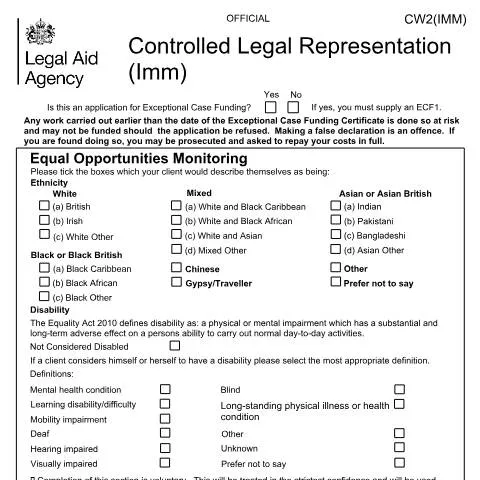
The form explicitly addresses Exceptional Case Funding (ECF) scenarios, requiring practitioners to complete an ECF1 form alongside the CW2(IMM) when cases fall outside standard legal aid scope. This dual-track approach acknowledges that some immigration matters—particularly those involving complex human rights arguments or vulnerable clients—demand funding even when they don't meet conventional criteria.
Crucially, the form warns that any work undertaken before ECF approval carries financial risk, potentially leaving solicitors uncompensated if applications fail. This creates a delicate balance between providing immediate assistance to clients in urgent situations and protecting legal practices from unsustainable losses.
Client Profiling and Financial Assessment Complexities
The financial eligibility assessment within CW2(IMM) recognises the unique circumstances facing immigration clients. Unlike domestic legal aid applications, this form acknowledges that many applicants receive NASS (National Asylum Support Service) payments or have irregular immigration status that complicates traditional income verification.
| Client Category | Assessment Requirements | Special Considerations |
|---|---|---|
| Children under 18 | No financial assessment required | Proceed directly to case details and merits |
| NASS recipients | Simplified assessment process | Immigration-specific payment recognition |
| Benefit recipients | Streamlined eligibility | Automatic qualification for certain benefits |
| Standard applicants | Full income and capital assessment | Partner aggregation may apply |
Capital Assessment Intricacies
The capital assessment section reveals sophisticated understanding of immigrant financial circumstances. The £100,000 equity disregard for main homes acknowledges that property ownership doesn't necessarily indicate liquid wealth—particularly relevant for asylum seekers who may own property abroad but cannot access its value due to persecution or country conditions.
The form distinguishes between different property interests, requiring percentage calculations for shared ownership arrangements. This granular approach proves essential when dealing with clients from cultures where extended family property ownership is common, or where political circumstances have complicated property rights.
Partner Aggregation and Household Composition Challenges
The question of whose means require assessment often proves more complex in immigration contexts than domestic legal aid scenarios. Cultural differences in family structures, polygamous marriages not recognised under UK law, and uncertain relationship statuses due to separation by immigration enforcement create assessment challenges that require careful consideration.
The form's approach to partner aggregation must account for situations where spouses remain in countries of origin, where relationships have been disrupted by persecution, or where cultural marriage practices don't align with UK legal definitions. Practitioners must navigate these sensitivities whilst ensuring accurate financial disclosure.
Dependent Children Considerations
The allowances structure recognises different needs for dependents aged under and over 15, reflecting varying support costs and potential earning capacity. For immigration clients, this becomes particularly complex when children remain abroad, when family reunification proceedings are ongoing, or when unaccompanied minors are involved in care arrangements.
Housing cost caps for clients without dependents acknowledge the Legal Aid Agency's focus on supporting family units whilst controlling costs for single applicants. However, this approach requires careful interpretation when dealing with clients whose family circumstances are complicated by immigration restrictions or ongoing separation.
Equal Opportunities Monitoring and Cultural Sensitivity
The comprehensive equality monitoring section demonstrates awareness of the diverse client base requiring immigration legal aid. The voluntary nature of this information reflects sensitivity to clients who may fear that personal details could be used against them in immigration proceedings, despite assurances of confidentiality.
The inclusion of specific categories like "Gypsy/Traveller" and detailed ethnic breakdowns acknowledges the particular vulnerabilities and discrimination patterns affecting different communities in immigration contexts. The disability assessment framework, based on the Equality Act 2010, provides crucial data for understanding barriers faced by disabled migrants in accessing legal services.
Trauma-Informed Approach
The form's structure implicitly recognises that many immigration clients have experienced trauma, persecution, or significant stress. The "prefer not to say" options throughout the equality monitoring section provide escape routes for clients uncomfortable with detailed personal disclosure, whilst still gathering statistical data necessary for service planning and equality monitoring.
Evidence Requirements and Documentation Challenges
The evidence section acknowledges the unique documentation challenges facing immigration clients. Unlike domestic legal aid applicants who typically have established UK financial histories, immigration clients often lack conventional proof of income, assets, or expenses. The form's flexibility in accepting alternative evidence becomes crucial for asylum seekers, undocumented migrants, or those whose financial arrangements don't follow UK norms.
The requirement to justify exceptional circumstances when standard evidence isn't available provides a framework for practitioners to explain why conventional documentation may be unavailable. This might include situations where bank statements are inaccessible due to persecution, where informal employment arrangements lack standard payslips, or where cultural practices mean financial arrangements aren't documented in ways UK authorities typically expect.
Provider Responsibility and Risk Management
The provider details section places significant responsibility on legal practitioners to ensure accurate completion and submission. The warning about false declarations carries serious consequences, including prosecution and full cost recovery, creating strong incentives for thorough verification of client circumstances.
For immigration practitioners, this responsibility is complicated by clients' potentially limited English, unfamiliarity with UK financial systems, and possible reluctance to disclose information due to past persecution or mistrust of authorities. Balancing thorough assessment with cultural sensitivity requires considerable skill and patience.
Case Merit Considerations and Strategic Planning
The merits criteria section, whilst only partially visible in the source document, represents the crucial bridge between financial eligibility and substantive legal assessment. For immigration cases, merit assessment must consider not only legal prospects but also the severe consequences of failure—including deportation to persecution or family separation.
The "one grant of CLR per matter" principle requires careful case definition and strategic thinking. Practitioners must consider whether to frame applications broadly to encompass potential complications or narrowly to focus on immediate issues, knowing that subsequent related matters might require separate applications through the CW3C extension process.
Timing and Procedural Coordination
Immigration cases often operate under tight deadlines imposed by tribunals, Home Office decisions, or detention time limits. The CW2(IMM) process must align with these external pressures whilst maintaining thorough assessment standards. This creates tension between the need for comprehensive evaluation and the urgency often characterising immigration matters.
The integration with ECF procedures adds another layer of timing complexity, particularly when cases straddle the boundary between standard and exceptional funding criteria. Practitioners must often make rapid decisions about which route to pursue, knowing that delays could prejudice their clients' substantive cases.
Post-Application Procedures and Review Mechanisms
The CW4 review process embedded within the CW2(IMM) framework provides essential protection for clients whose initial applications face rejection. This mechanism acknowledges that immigration legal aid decisions often involve complex judgements about vulnerability, case merit, and exceptional circumstances that may not be immediately apparent from initial applications.
The review process becomes particularly important given the high stakes involved in immigration cases. A wrongly refused legal aid application could leave a vulnerable asylum seeker facing deportation proceedings without representation, with potentially catastrophic consequences for their safety and human rights.
Understanding the interplay between initial applications, extension requests, and review procedures enables practitioners to develop comprehensive strategies that protect both their clients' interests and their practices' financial sustainability. This holistic approach to the CW2(IMM) system ensures that immigration legal aid serves its intended purpose of providing access to justice for some of society's most vulnerable individuals whilst maintaining appropriate controls on public expenditure.
When Your Case Crosses Multiple Immigration Categories: Managing Form Transitions
Immigration cases rarely follow a straightforward path, and practitioners frequently encounter situations where initial applications evolve or where clients' circumstances change mid-process. Understanding how to navigate form transitions between CW2, CW3C, and CW4 becomes crucial when dealing with complex multi-stage cases.
Consider a scenario where you initially submit a CW2 form for a family reunion case under the Immigration Rules, but during the process, the client's circumstances change—perhaps their sponsor's employment status shifts, or new evidence emerges that strengthens their asylum claim. The Legal Aid Agency expects practitioners to assess whether the case now falls under different funding categories, which may require transitioning between different CW forms.
When a case evolves from standard representation to requiring disbursement limit extensions, timing becomes critical. You cannot retrospectively apply for increased disbursement limits through CW3C for expenses already incurred without prior approval. The LAA's guidance emphasises that exceptional circumstances must be demonstrated at the time of application, not after costs have been exceeded. This means maintaining ongoing case review processes to identify when standard limits may prove insufficient.
For cases involving potential judicial review challenges, practitioners must consider whether their initial CW2 application adequately covers the scope of work required. Judicial review proceedings often demand extensive document review, expert witness preparation, and complex legal research that may exceed standard case limits. The transition from CW2 to CW3C should occur before these intensive phases begin, not after costs spiral beyond control.
Mental health cases present particular challenges for form transitions. Initial representation under CW2 may seem straightforward, but clients with complex psychological conditions often require additional support services, interpreter costs for specialist sessions, or expert psychiatric evaluations. These cases frequently require CW3C applications for disbursement extensions, particularly when dealing with trauma-related evidence or capacity assessments that demand specialist input.
Documentation continuity becomes essential when transitioning between forms. The LAA expects practitioners to demonstrate clear links between initial case assessments and subsequent applications for extensions or reviews. This means maintaining detailed contemporaneous notes that justify why circumstances have changed or why initial assessments proved insufficient. Simply stating that a case has become more complex will not satisfy LAA requirements for additional funding.
Regional Variations and Local Implementation Challenges
The implementation of CW2, CW3C, and CW4 procedures varies significantly across different regions of England and Wales, creating practical challenges for practitioners operating in multiple jurisdictions. These variations stem from differing local Legal Aid Agency office practices, regional caseload pressures, and varying interpretation of central guidance by local decision-makers.
Northern regions, particularly areas with significant refugee populations such as Greater Manchester and West Yorkshire, often experience longer processing times for CW2 applications due to higher volumes of complex asylum cases. Local LAA offices in these areas have developed informal triage systems that prioritise urgent cases—those involving detention, imminent removal, or unaccompanied minors—but this can result in routine family reunion or settlement applications experiencing delays of several weeks beyond standard processing times.
London-based practitioners face different challenges, with the high cost of living affecting disbursement calculations for CW3C applications. Expert witness fees, interpreter costs, and document translation services command premium rates in the capital, yet LAA standard rates remain nationally uniform. This creates particular difficulties when seeking approval for disbursement limit extensions, as local LAA decision-makers may not fully appreciate the cost differentials involved.
Welsh practitioners encounter additional complexity due to bilingual requirements. Cases involving Welsh-speaking clients may require specialist interpreters or translated documents, costs that standard CW2 allocations rarely anticipate. The Legal Aid Agency has acknowledged these additional costs in principle, but securing approval through CW3C applications often requires detailed justification of why standard English-language services prove inadequate.
Border regions, particularly areas near major ports and airports, see high volumes of urgent cases requiring immediate legal intervention. Practitioners in Kent, Essex, and other coastal areas frequently encounter clients detained immediately upon arrival, creating time pressures that standard CW2 processing timelines cannot accommodate. Local LAA offices in these regions have developed expedited procedures for emergency applications, but these informal arrangements lack consistency and can vary depending on individual caseworker interpretation.
Rural practitioners face unique challenges in accessing specialist services covered by CW3C applications. Expert witnesses, specialist interpreters, and medical professionals may be located significant distances away, creating additional travel costs and coordination difficulties. The LAA's standard disbursement rates often fail to account for these geographical challenges, requiring detailed justification in CW3C applications to secure adequate funding.
Some regional variations have emerged around CW4 review procedures, with certain LAA offices demonstrating more receptive approaches to challenges based on procedural irregularities, while others focus primarily on merit-based grounds for review. Understanding these local tendencies can inform strategic decisions about whether to pursue internal reviews or proceed directly to judicial review proceedings.
Technology Integration and Digital Case Management
The Legal Aid Agency's ongoing digital transformation significantly impacts how practitioners handle CW2, CW3C, and CW4 applications, though the transition from paper-based to digital systems has created both opportunities and complications for immigration practitioners.
The Client and Cost Management System (CCMS) now handles most CW2 applications electronically, but immigration cases often involve complex documentation that doesn't fit neatly into standardised digital forms. Practitioners frequently encounter difficulties uploading supporting documents that exceed file size limits, particularly when dealing with extensive country condition evidence or medical reports. The system's inability to handle certain file formats can delay applications, especially when expert reports come in formats not recognised by LAA systems.
Digital submission of CW3C applications has streamlined some aspects of the disbursement extension process, allowing practitioners to track application status and receive automated updates. However, the system's rigid formatting requirements can prove problematic when justifying exceptional circumstances that don't fit predetermined categories. The digital forms often lack sufficient space for detailed explanations of complex case developments, forcing practitioners to use workarounds that may not effectively communicate the urgency or complexity of their situations.
Document management becomes particularly complex in multi-form cases where initial CW2 applications evolve into CW3C extensions and potentially CW4 reviews. The CCMS requires practitioners to maintain clear document trails linking all related applications, but the system's search and cross-referencing functions often prove inadequate for complex cases spanning multiple forms and time periods. This creates administrative burdens that can divert practitioner time from direct client service.
The digital system's audit trails provide detailed records of application processing, which can prove valuable when preparing CW4 review applications. Electronic timestamps, decision-maker identifications, and processing notes create comprehensive records that can support challenges to LAA decisions. However, practitioners must understand how to access and interpret these digital records effectively, skills that weren't required under previous paper-based systems.
Integration with other government systems remains incomplete, creating particular challenges for immigration practitioners. While CCMS can verify client eligibility for legal aid, it cannot directly access Home Office immigration status information, HMRC employment records, or DWP benefit entitlements. This lack of integration means practitioners must continue gathering paper documentation to support applications, undermining some potential efficiency gains from digitalisation.
Mobile access to CCMS allows practitioners to update case information and submit urgent applications remotely, which proves particularly valuable when dealing with detained clients or attending court hearings away from the office. However, the mobile interface lacks full functionality, particularly for complex applications requiring extensive documentation or detailed justifications.
Data protection considerations under UK GDPR create additional complexity in digital case management. Practitioners must ensure that client information shared through CCMS meets data protection requirements, particularly when cases involve sensitive personal information about asylum claims, domestic violence, or trafficking situations. The system's security measures provide protection, but practitioners retain responsibility for ensuring appropriate data handling throughout the application process.