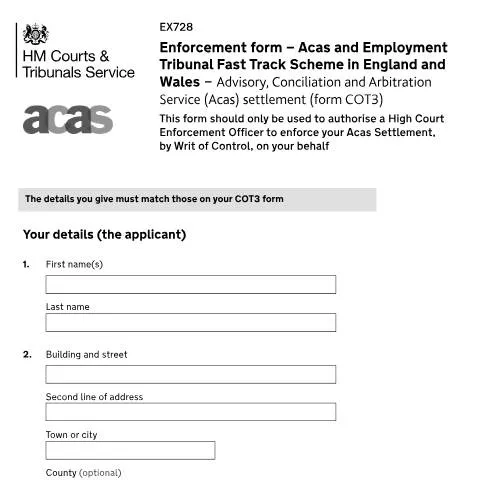
When Employment Settlements Hit a Wall: The EX728 Fast Track Route to Recovery
Securing an Acas COT3 settlement should mark the end of your employment dispute, but what happens when your former employer simply ignores their obligation to pay? The EX728 form represents a streamlined enforcement mechanism specifically designed for England and Wales, allowing successful claimants to bypass lengthy court procedures and engage High Court Enforcement Officers directly. This fast track scheme transforms your Acas settlement into an enforceable court order through a Writ of Control, giving you real teeth when dealing with non-compliant respondents.
Unlike traditional enforcement routes that can take months to navigate through the county court system, the EX728 process leverages the existing infrastructure of Registry Trust Limited to assign your case directly to specialist enforcement officers. This represents a significant shift in how employment settlements are enforced, recognising that delayed justice often amounts to denied justice for workers who may be facing financial hardship following workplace disputes.
The Regulatory Framework Behind Fast Track Enforcement
The EX728 scheme operates under the broader framework of the Tribunals, Courts and Enforcement Act 2007 and subsequent regulations governing High Court enforcement procedures. This legislative foundation allows Acas settlements recorded on COT3 forms to be treated as equivalent to court judgments for enforcement purposes, eliminating the traditional requirement for claimants to first obtain a county court judgment.
The scheme specifically applies to England and Wales only, reflecting the jurisdictional boundaries of the High Court system. Scottish employment settlements follow different enforcement procedures through the Sheriff Court system, whilst Northern Ireland maintains its own distinct processes. This geographical limitation is crucial when determining eligibility, particularly for companies with operations across multiple UK jurisdictions.
Registry Trust Limited's role as the central coordinating body stems from their existing responsibilities in maintaining the Register of Judgments, Orders and Fines. Their involvement ensures that enforcement actions are properly recorded and tracked, providing transparency whilst maintaining the efficiency that makes the fast track scheme attractive to claimants.
Navigating the Distinction Between EX728 and Alternative Enforcement Routes
The EX728 fast track scheme sits alongside several other enforcement mechanisms, each with distinct advantages and limitations. Understanding these differences is crucial for making informed decisions about recovery strategies.
| Enforcement Method | Timeline | Cost Implications | Suitable For |
|---|---|---|---|
| EX728 Fast Track | 2-4 weeks from submission | Court order fee plus HCEO costs | COT3 settlements with clear monetary awards |
| County Court Judgment | 8-12 weeks minimum | Court fees plus potential legal costs | Complex settlements or disputed amounts |
| Employment Tribunal Enforcement | Variable, often 6+ months | Tribunal fees plus enforcement costs | Tribunal awards rather than settlements |
| Statutory Demand | 21 days notice period | Minimal upfront costs | Companies with assets over £750 threshold |
The key advantage of EX728 lies in its streamlined authorisation process. Rather than proving your case afresh in county court, you're leveraging the existing COT3 agreement that both parties have already accepted. This eliminates the risk of respondents raising spurious defences or technical objections that could delay traditional enforcement proceedings.
Completing the EX728: Critical Details That Make or Break Your Application
The EX728 form's apparent simplicity can be deceptive. Each section requires precise alignment with your original COT3 settlement to avoid delays or rejection. The opening instruction that "details you give must match those on your COT3 form" isn't merely advisory—Registry Trust Limited will cross-reference every detail before authorising enforcement action.
Personal details in sections 1-4 must reflect exactly how you're identified in the COT3, including any middle names or initials. Variations in spelling or formatting can trigger verification delays, particularly where names contain hyphens, apostrophes, or non-standard characters. Your contact information becomes crucial once enforcement begins, as High Court Enforcement Officers need reliable communication channels to coordinate recovery activities.
The solicitor/representative section (5-9) requires completion even if you're acting in person but received initial legal advice. If your original COT3 was negotiated through a trade union representative or employment law specialist, their details should be included here with appropriate reference numbers. This ensures continuity of professional communication throughout the enforcement process.
Section 15's request for "information concerning the respondent that may be useful in the enforcement" represents perhaps the most strategic element of the form. Effective completion requires thinking like an enforcement officer: what assets, locations, or business patterns might facilitate recovery? Trading stock details, vehicle registrations, property interests, or knowledge of peak trading periods can significantly enhance enforcement prospects.
Strategic Asset Intelligence for Enhanced Recovery
High Court Enforcement Officers operate most effectively when equipped with current intelligence about respondent assets and business operations. Consider including:
- Business premises details: Multiple trading addresses, warehouse locations, or retail outlets where stock might be seized
- Vehicle information: Company cars, delivery vehicles, or plant machinery that could be subject to control
- Trading patterns: Peak business hours, seasonal variations, or market day schedules that might affect enforcement timing
- Bank account indicators: Knowledge of primary banking relationships or regular payment patterns
- Third-party debts: Major customers or clients who might owe money to the respondent
The Certificate and Authorisation: Understanding Your Legal Commitments
The certification section on page 4 contains two distinct legal commitments that require careful consideration. The first certificate confirms that no declaration regarding unrecoverable sums has been made under general contract law, whilst the second provides explicit authorisation for Registry Trust Limited and subsequent High Court Enforcement Officers to act on your behalf.
This dual certification serves important protective functions. The first element prevents abuse of the fast track system where respondents might have legitimate contractual defences, ensuring that only genuine settlement breaches proceed to enforcement. The second authorisation is legally significant because it grants enforcement officers the power to sign form N471A and obtain Writs of Control without further reference to you.
Understanding the scope of this authorisation is crucial. Once granted, the assigned High Court Enforcement Officer can take various enforcement actions including visiting business premises, seizing goods, and negotiating payment arrangements. Whilst officers operate under professional supervision and regulatory oversight, the initial authorisation is broadly drafted to ensure enforcement effectiveness.
Submission Logistics and Fee Structures in the Fast Track System
The EX728 submission process involves coordination between multiple parties, each with distinct roles and responsibilities. Registry Trust Limited acts as the central processing hub, receiving applications and assigning cases to appropriate High Court Enforcement Officers across England and Wales.
Submission can occur through two primary channels: postal delivery to the Carthusian Street address or electronic transmission via the dedicated tribunal enforcement email address. Electronic submissions require all attachments in PDF format, with particular attention to ensuring your COT3 form is clearly legible when converted from its original format.
The fee structure operates on a deferred payment basis, with the assigned High Court Enforcement Officer contacting you directly to arrange payment of the court order fee. This approach recognises that many claimants may be experiencing financial difficulties following employment disputes, allowing enforcement to commence before fee payment whilst ensuring costs are ultimately recovered.
Fee Remission Eligibility and the EX160 Process
Claimants experiencing financial hardship can apply for fee remission using form EX160, which must be submitted alongside the EX728 application. Fee remission eligibility depends on various factors including:
- Income thresholds: Monthly gross income below specified limits based on household composition
- Capital limits: Savings and investments below prescribed amounts excluding primary residence
- Benefit receipt: Certain qualifying benefits including Universal Credit, Income Support, or Pension Credit
- Exceptional hardship: Circumstances where paying fees would cause undue financial distress
The EX160 assessment process operates independently of the EX728 review, but both must be completed before enforcement can commence. This parallel processing helps minimise delays whilst ensuring appropriate financial protection for eligible claimants.
Post-Submission Procedures: What Happens After Registry Trust Takes Control
Once Registry Trust Limited receives your complete EX728 application, a structured assignment process begins. The organisation maintains a network of approved High Court Enforcement Officers across England and Wales, with assignments typically based on geographical proximity to the respondent's location and officer availability.
The assigned enforcement officer will contact you within 5-10 working days to acknowledge receipt and discuss enforcement strategy. This initial contact serves multiple purposes: confirming your contact details, clarifying any aspects of the settlement terms, and gathering additional intelligence that might assist with recovery efforts.
Communication protocols during enforcement vary between officers, but most provide regular updates on significant developments. These might include initial contact attempts with the respondent, scheduled enforcement visits, or negotiated payment arrangements. Understanding that enforcement can be an iterative process helps manage expectations about timelines and outcomes.
Tracking Progress and Managing Expectations
High Court Enforcement Officers operate under statutory powers that provide significant leverage, but successful recovery depends on various factors beyond their direct control. These include:
- Respondent solvency: The fundamental ability to pay based on available assets and income
- Asset accessibility: Whether valuable items are physically accessible and legally seizable
- Business cooperation: The respondent's willingness to engage constructively with enforcement officers
- Third-party complications: Other creditors, secured interests, or insolvency proceedings that might affect recovery
Enforcement officers maintain detailed records of all activities, providing transparency about efforts undertaken and obstacles encountered. This documentation becomes valuable if alternative enforcement methods need to be considered or if the matter requires escalation through other legal channels.
Special Circumstances and Complex Enforcement Scenarios
The EX728 fast track scheme handles most straightforward COT3 settlements efficiently, but certain circumstances require additional consideration or alternative approaches. Multi-jurisdictional respondents present particular challenges where enforcement might need to occur outside England and Wales, requiring coordination with different legal systems and enforcement mechanisms.
Corporate restructuring or insolvency proceedings can significantly complicate enforcement efforts. Where respondent companies enter administration or liquidation after COT3 agreement but before payment, the EX728 process may need to be suspended whilst insolvency practitioners assess company assets and liabilities. Early identification of such proceedings helps preserve your position as a creditor whilst avoiding abortive enforcement costs.
Individual respondents facing personal financial difficulties may be subject to different enforcement considerations. High Court Enforcement Officers have discretion to negotiate reasonable payment arrangements, particularly where immediate full payment would cause exceptional hardship whilst longer-term recovery remains viable.
International elements add further complexity, particularly where respondent companies have moved assets offshore or ceased UK trading activities. The EX728 scheme's effectiveness diminishes significantly in such scenarios, often requiring specialist legal advice about cross-border enforcement mechanisms or alternative recovery strategies.
The fast track system represents a significant advancement in employment settlement enforcement, providing claimants with streamlined access to High Court powers whilst maintaining appropriate safeguards against abuse. Success depends heavily on thorough preparation, accurate documentation, and realistic expectations about enforcement outcomes in your specific circumstances.
Understanding the Fast Track Enforcement Process Step-by-Step
The fast track enforcement mechanism for Acas settlement agreements operates through a streamlined judicial process that bypasses many traditional enforcement hurdles. When you submit Form EX728, you're essentially asking the Employment Tribunal to convert your Acas settlement agreement into an enforceable court order without requiring a full hearing.
The process begins when HM Courts & Tribunals Service receives your completed EX728 form along with the required documentation. A tribunal judge will review your application on the papers—meaning they'll assess whether your settlement agreement meets the statutory criteria for fast track enforcement without convening a formal hearing. This initial review typically focuses on three key areas: whether the agreement was properly concluded under Acas procedures, whether the terms are sufficiently clear and certain, and whether enforcement would serve the interests of justice.
If the judge determines that your application meets the threshold requirements, they'll issue what's known as a "consent order" or "enforcement order." This order carries the same legal weight as any other tribunal judgment and can be enforced through the standard civil enforcement mechanisms available in England, Wales, and Scotland. However, if the judge identifies deficiencies in your application—such as ambiguous settlement terms or procedural irregularities—they may request additional information or, in some cases, direct that the matter proceed to a full hearing.
Fill in your form directly online
No printing: type your details into the boxes of the official form, tick, then download the PDF ready to send.
- 1Type into the form boxes
- 2Tick in one click
- 3Save and download the PDF
The timeframe for this process can vary significantly depending on the tribunal's current workload and the complexity of your settlement agreement. While HM Courts & Tribunals Service doesn't publish specific performance targets for EX728 applications, practitioners generally expect a response within 4-8 weeks of submission. However, this timeline can extend considerably during peak periods or if the judge requires clarification on particular aspects of your settlement.
One crucial aspect that many applicants overlook is the tribunal's discretion to refuse fast track enforcement even when technical requirements are met. Judges may decline to make an enforcement order if they believe the settlement terms are manifestly unfair, if there's evidence of duress or misrepresentation, or if circumstances have changed substantially since the agreement was concluded. This discretionary element means that having a technically compliant settlement agreement doesn't guarantee automatic enforcement through the fast track route.
Common Pitfalls and How to Avoid Them When Completing Form EX728
Experience from employment law practitioners reveals several recurring issues that can derail fast track enforcement applications, many of which stem from seemingly minor oversights in completing Form EX728 or preparing the supporting documentation.
One of the most frequent problems involves inadequate identification of the settling parties. The form requires precise details about both the claimant and respondent, including full legal names, addresses, and any relevant company registration numbers. Where the original employment tribunal claim involved multiple respondents—such as both an employer company and individual directors—failing to specify exactly which parties are bound by the settlement agreement can lead to enforcement complications. Similarly, if a company has changed its name or been acquired since the settlement was reached, you'll need to provide evidence of the corporate succession to establish the current legal entity responsible for compliance.
Another significant pitfall involves the description of settlement terms on the EX728 form itself. While the form provides limited space for summarising the agreement, many applicants make the mistake of oversimplifying complex provisions or omitting crucial details about payment schedules, performance obligations, or conditional terms. This can create ambiguity about exactly what the tribunal is being asked to enforce. Best practice involves providing a comprehensive but concise summary that captures all material obligations, with clear cross-references to the specific clauses in the attached settlement agreement.
Documentation issues also frequently derail applications. The most common problem occurs when applicants submit draft settlement agreements rather than the final executed version, or when they fail to include all relevant schedules and appendices that form part of the settlement terms. If your settlement agreement incorporates terms by reference to other documents—such as employment contracts, policies, or previous correspondence—you may need to include these materials to give the tribunal a complete picture of the parties' obligations.
Timing considerations present another area where applications frequently encounter difficulties. If significant time has elapsed between the settlement agreement and your enforcement application, you may need to address why enforcement is being sought at this particular point and whether any limitation periods might affect the tribunal's willingness to make an enforcement order. Additionally, if the respondent has made partial payments or taken some steps towards compliance since the settlement was concluded, this should be clearly documented to avoid confusion about what remains outstanding.
Jurisdictional issues can also create unexpected complications, particularly where the settlement agreement covers matters that extend beyond the Employment Tribunal's original jurisdiction. For example, if your settlement includes provisions about intellectual property rights, restrictive covenants, or claims that could have been brought in other courts, the tribunal may need to consider whether the fast track enforcement process is appropriate for the entire agreement or only specific elements of it.
Alternative Enforcement Routes and Strategic Considerations
While the EX728 fast track process offers significant advantages in terms of speed and cost-effectiveness, it's not always the most appropriate enforcement mechanism for every Acas settlement agreement. Understanding the alternative routes available can help you make an informed strategic decision about how to proceed when a respondent fails to comply with their settlement obligations.
The most straightforward alternative is pursuing enforcement through the County Court or High Court, depending on the value and nature of your claim. This route may be preferable where your settlement agreement includes complex commercial terms that fall outside the Employment Tribunal's usual expertise, or where you need to seek interim relief such as freezing orders or search orders to protect your position. County Court proceedings also offer more extensive disclosure and evidence-gathering powers, which can be valuable if you suspect the respondent is deliberately concealing assets or information relevant to their ability to comply with the settlement.
For settlement agreements that include ongoing obligations rather than simple monetary payments, enforcement through the civil courts may provide more flexible remedies. Employment Tribunals are generally limited to making monetary awards and basic compliance orders, whereas the civil courts can grant specific performance orders, mandatory injunctions, and other equitable remedies that may be more appropriate for complex performance obligations.
In cases involving corporate respondents, you may also need to consider whether insolvency proceedings affect your enforcement options. If the respondent company has entered administration, liquidation, or any form of insolvency procedure since the settlement was concluded, this will likely impact both the fast track process and alternative enforcement routes. The Insolvency Act 1986 provides specific protections for companies in formal insolvency procedures, and you may need to seek permission from the insolvency court or prove your claim in the insolvency proceedings rather than pursuing enforcement through the Employment Tribunal.
Cross-border enforcement considerations also become relevant where the respondent is based outside England and Wales or has assets in other jurisdictions. While the EX728 process is designed for domestic enforcement, the resulting tribunal order may be capable of recognition and enforcement in other countries under various international agreements. However, this can be a complex area requiring specialist advice, particularly where the respondent is based in Scotland (which has its own distinct legal system) or in EU countries where post-Brexit arrangements may apply.
Strategic timing considerations also influence the choice of enforcement route. The fast track process through EX728 is generally most effective when sought relatively promptly after a clear breach of the settlement agreement. If you delay enforcement action for an extended period, you may face questions about whether you've waived your right to enforce particular terms or whether the respondent's conduct has been accepted as performance. In such circumstances, the more formal procedures available in the civil courts may provide better opportunities to address these defences comprehensively.
Cost considerations represent another crucial factor in choosing your enforcement strategy. While the EX728 process involves minimal court fees and can often be handled without legal representation, more complex civil enforcement proceedings typically require substantial upfront costs and carry greater financial risks if unsuccessful. However, the civil courts also offer more extensive cost recovery mechanisms, including the possibility of recovering legal costs from the respondent if your enforcement action succeeds.