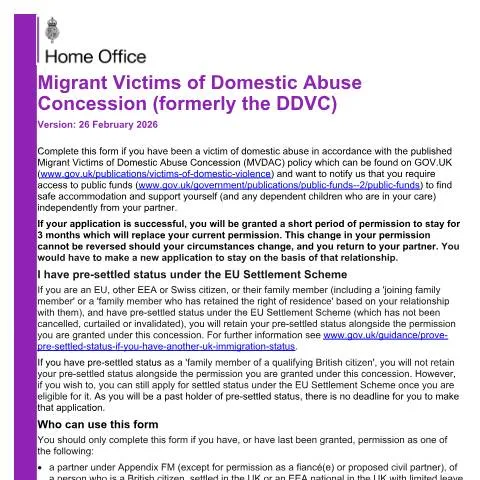
When Domestic Violence Disrupts Your Immigration Status: Understanding the MVDAC Emergency Pathway
Domestic abuse can trap victims not only through physical and emotional violence, but also through complex immigration dependencies that make escape seem impossible. For migrants whose legal status in the UK depends on their relationship with an abusive partner, the Migrant Victims of Domestic Abuse Concession (MVDAC) represents a crucial emergency lifeline that can break this cycle of control.
This concession, formerly known as the Destitute Domestic Violence Concession (DDVC), provides immediate access to public funds for three months, enabling victims to secure safe accommodation and essential support whilst they plan their next steps. However, the application carries irreversible consequences for your current immigration status, making it essential to understand exactly what this pathway involves before proceeding.
Unlike standard immigration applications that extend or vary existing permissions, the MVDAC fundamentally replaces your current status with temporary permission outside the Immigration Rules. This change cannot be undone, even if circumstances with your partner appear to improve, making this application a decisive step towards independence.
The Strict Eligibility Framework: Who Qualifies for Emergency Protection
The MVDAC operates within carefully defined parameters, restricting access to specific categories of migrants whose immigration status directly depends on their relationship with their abuser. You must currently hold, or have last been granted, permission in one of these precise categories:
| Immigration Route | Partner's Status Required | Specific Exclusions |
|---|---|---|
| Appendix FM Partner | British citizen, settled person, or EEA national with limited leave under Appendix EU | Fiancé(e) or proposed civil partner status |
| Appendix EU Family Member | Relevant EEA citizen or qualifying British citizen | None specified |
| Refugee Family Reunion | Person with refugee protection status | None specified |
| HM Armed Forces Appendix | Current or former Armed Forces member | Fiancé(e) or proposed civil partner status |
Notably absent from this list are partners of individuals on work visas, student routes, or most other temporary immigration categories. These groups face a particularly challenging situation, as they may qualify for the three-month emergency support but will likely find no onward immigration pathway available to them afterwards.
The EU Settlement Scheme Complexity
If you hold pre-settled status under the EU Settlement Scheme, the interaction with MVDAC creates a unique dual-status situation. Most applicants will retain their pre-settled status alongside the new three-month permission, providing crucial continuity for future settlement applications.
However, there's a critical exception: those who obtained pre-settled status as "family members of qualifying British citizens" will lose this status when granted MVDAC permission. Whilst they can still apply for settled status later without deadline restrictions, this loss of pre-settled status may affect their immediate access to certain services.
The Application's Immediate Impact: What Changes From Day One
Submitting an MVDAC application triggers immediate and irreversible changes to your immigration position. Your existing permission—whether as a spouse under Appendix FM, a family member under Appendix EU, or any other qualifying route—will be replaced entirely by new permission granted outside the Immigration Rules.
This replacement occurs regardless of how much time remained on your previous permission. If you held a two-year partner visa with eighteen months remaining, or pre-settled status valid for several more years, all of this is surrendered in favour of the three-month emergency permission.
Access to Public Funds: The Primary Benefit
The core advantage of MVDAC permission is immediate eligibility for public funds, breaking the financial control often exercised by abusive partners. This access enables you to:
- Secure emergency accommodation through local authority housing support
- Claim Universal Credit for basic living expenses
- Access council tax support and housing benefit where applicable
- Receive child benefit and tax credits for dependent children in your care
Local authorities have specific duties under homelessness legislation to assist those fleeing domestic violence, and MVDAC permission ensures you meet the eligibility criteria for this support without the "no recourse to public funds" restriction that typically applies to migrants.
Strategic Timing: When to Apply and What Happens Next
The decision to apply for MVDAC requires careful consideration of timing, as the three-month permission period begins immediately upon approval. This is not a holding pattern—it's an active period during which you must either prepare to leave the UK safely or submit a further immigration application.
For many applicants, the optimal strategy involves preparing a subsequent application before submitting the MVDAC form. If you submit a new application within the three-month period, your permission automatically extends until that application is decided, preventing any gap in legal status.
The Appendix VDA Pathway
Certain MVDAC beneficiaries may be eligible for immediate settlement under Appendix Victim of Domestic Abuse (Appendix VDA), which provides indefinite leave to remain for qualifying domestic abuse survivors. This route requires:
- Evidence of domestic abuse from your partner who was a British citizen or settled person
- Previous relationship-based permission under Appendix FM or similar routes
- Meeting specific evidential requirements about the abuse suffered
If eligible, you should complete form SET(DV) rather than pursuing MVDAC, as immediate settlement provides far greater security than temporary permission followed by uncertainty.
Critical Limitations: Understanding What MVDAC Cannot Provide
Whilst MVDAC offers crucial emergency support, it's essential to understand its limitations. This concession does not guarantee any future immigration success, and for some applicants, it may represent the end of their legal pathway to remain in the UK.
Partners of individuals on temporary work visas, student routes, or certain other categories face particular challenges. Whilst they receive the same three months of emergency support, they typically have no qualifying onward route available within UK immigration law.
The Ukraine Scheme Exception
A specific cohort requiring careful consideration includes partners under the Ukraine Scheme who were granted permission based on their relationship with a Ukrainian national. These applicants can access MVDAC support but should understand that no clear onward immigration pathway currently exists for them once the three-month period expires.
This limitation reflects the emergency nature of the Ukraine Scheme and the complexity of providing long-term solutions for domestic abuse survivors within that framework.
Completing Your Application: Essential Documentation and Evidence Requirements
The MVDAC application requires comprehensive evidence both of your qualifying immigration status and of the domestic abuse you've experienced. UK Visas and Immigration must be satisfied that you meet both the technical eligibility criteria and the substantive requirements regarding domestic violence.
Your evidence package should establish:
- Your current or most recent immigration permission and its basis on your relationship with your partner
- The domestic abuse you've suffered through police reports, medical evidence, support worker statements, or court documents
- Your need for public funds to secure safe accommodation and support independent from your partner
- Details of any dependent children in your care who would benefit from the concession
The application form itself guides you through providing personal details, immigration history, and circumstances of the domestic abuse. However, the quality and comprehensiveness of your supporting evidence often determines the success of your application.
Alternative Evidence Sources
Recognising that domestic abuse often occurs in private and that victims may have limited access to official documentation, UK Visas and Immigration accepts evidence from various sources including:
- Multi-agency risk assessment conference (MARAC) records
- Independent domestic violence adviser (IDVA) statements
- Medical professionals' reports documenting injuries or mental health impacts
- Social services records regarding safeguarding concerns
Post-Decision Planning: Preparing for Life After the Three-Month Window
Receiving MVDAC permission marks the beginning, not the end, of your journey towards independence and security. The three-month period requires active planning to secure your long-term position, whether that involves preparing a further UK immigration application or making arrangements to return safely to your country of origin.
During this period, you should prioritise:
- Securing stable accommodation through local authority support or other means
- Accessing specialist domestic violence support services for ongoing safety planning and emotional support
- Obtaining legal advice about potential onward immigration routes or return options
- Establishing financial independence through employment (if permitted) or benefits claims
If you hold retained pre-settled status, you maintain the option to apply for settled status under the EU Settlement Scheme once you meet the residence requirements, providing a potential pathway to permanent residence.
Employment Rights and Restrictions
MVDAC permission typically includes the right to work, enabling you to pursue employment during the three-month period. This can be crucial for establishing financial independence and demonstrating self-sufficiency for any future immigration applications.
However, certain employment restrictions may apply, and you should check the specific conditions attached to your grant of permission. The ability to work legally also supports your access to employment-related benefits and tax credits through the universal credit system.
Navigating Uncertainty: When Standard Immigration Routes Remain Closed
For applicants whose partners held temporary immigration status themselves—such as work visa holders or students—the period following MVDAC permission can involve difficult decisions about their future in the UK. No automatic onward route exists for these individuals, despite their successful escape from domestic abuse.
In such circumstances, you may need to explore:
- Human rights applications based on your established private life in the UK or the best interests of any British children
- Fresh applications under other immigration routes for which you may have become eligible
- Voluntary return programmes that provide support for safe reintegration in your country of origin
The Home Office recognises this gap in provision but has not yet established comprehensive onward routes for all MVDAC beneficiaries. This reality makes pre-application legal advice particularly valuable for understanding your realistic options.
Should you decide to discontinue your MVDAC application at any stage before a decision is made, you must contact UK Visas and Immigration immediately via email at [email protected]. However, once permission is granted under the concession, the change to your immigration status cannot be reversed, even if your relationship circumstances change.
Special Circumstances and Complex Cases
The migrant victims of domestic abuse concession recognises that survivors often face particularly complex circumstances that require careful consideration during the application process. Understanding these nuances can be crucial for a successful application.
Multiple Perpetrators and Relationship Patterns
Some applicants may have experienced abuse from multiple partners or sponsors throughout their immigration journey. The Home Office acknowledges that patterns of coercive control can span different relationships, particularly where perpetrators specifically target individuals based on their vulnerable immigration status. When documenting such cases, it's essential to provide a chronological account that clearly links each abusive relationship to your immigration circumstances.
If you've experienced abuse from a previous sponsor before your current relationship, this history can strengthen your application by demonstrating a pattern of exploitation. However, you must show that your current immigration status or recent status was directly connected to an abusive relationship. Historical abuse alone, whilst relevant context, may not satisfy the specific eligibility criteria unless it directly impacts your present circumstances.
Children and Dependent Considerations
Applications involving children require additional documentation and consideration of their best interests. If you're applying as a parent or guardian, you must demonstrate how the domestic abuse has affected both you and any dependent children. This includes providing evidence of how the abuse impacted the children's welfare, education, or development.
Children born in the UK to parents on spousal or partner visas may have different immigration statuses that need careful consideration. The Home Office will assess whether granting the concession serves the best interests of any British citizen or settled children involved. School records, medical records, or statements from children's services can provide valuable supporting evidence in such cases.
Mental Health and Capacity Issues
Survivors of domestic abuse often experience significant mental health impacts that can affect their ability to navigate the application process. Post-traumatic stress disorder, depression, anxiety, and other conditions may impair memory, concentration, or the ability to provide detailed statements about traumatic events.
If mental health issues affect your ability to complete the application independently, you may request reasonable adjustments from the Home Office. This could include accepting applications in alternative formats, allowing additional time for responses, or accepting third-party assistance with form completion. Medical evidence from NHS mental health services, your GP, or specialist trauma counsellors can support such requests.
Financial Implications and Practical Considerations
The financial aspects of applying for the migrant victims of domestic abuse concession extend beyond the application fee itself, encompassing broader economic considerations that affect many survivors.
Fee Waiver Eligibility and Process
The Home Office operates a fee waiver scheme for applicants who cannot afford immigration fees due to exceptional circumstances. Survivors of domestic abuse may qualify for fee waivers if they can demonstrate financial hardship directly resulting from their abusive situation.
To apply for a fee waiver, you must complete form FWF and provide detailed financial information, including bank statements, evidence of benefits received, and documentation of any debts or financial obligations. The assessment considers your income, essential expenditure, and any assets you may have. Importantly, the Home Office recognises that abusers often exercise financial control, so evidence of restricted access to funds or economic abuse can support your waiver application.
If your fee waiver is refused, you have the right to request an administrative review within 14 days. This review will reconsider your financial circumstances and may result in a full or partial fee waiver if additional evidence is provided.
Legal Aid and Representation
Whilst legal aid for immigration matters is limited, survivors of domestic abuse may be eligible for exceptional case funding or legal aid under specific circumstances. The Legal Aid Agency can provide funding for immigration advice where there are compelling reasons, such as the complexity of your case or significant vulnerabilities.
Many law centres and charitable organisations provide free or low-cost immigration advice specifically for domestic abuse survivors. These services often have specialist knowledge of the concession and can help ensure your application addresses all relevant criteria. When seeking legal representation, ensure any advisor is regulated by the Office of the Immigration Services Commissioner or is a qualified solicitor.
Employment and Benefits Entitlements
Your immigration status whilst your application is pending affects your ability to work and claim benefits. Most applicants under the domestic abuse concession will have 'no recourse to public funds' conditions attached to their current or most recent visa. However, the Home Office may lift these restrictions in exceptional circumstances where there are particularly compelling factors.
If you're destitute or at risk of destitution due to your circumstances, you may be eligible for support under Section 95 or Section 4 of the Immigration and Asylum Act 1999. This support is administered by the Home Office and provides basic accommodation and subsistence allowance. Applications for such support require separate forms and evidence of destitution.
Long-term Outcomes and Path to Settlement
Understanding the potential outcomes of a successful application and the pathway to permanent residence is crucial for planning your future in the UK.
Types of Leave Granted
Successful applicants under the domestic abuse concession typically receive 30 months of limited leave to remain with permission to work and study. This leave is usually granted with a condition stating 'no recourse to public funds', though this restriction may be lifted in cases of particular hardship or where there are dependent children.
The 30-month period is designed to provide sufficient time for survivors to establish independence, rebuild their lives, and prepare for the next stage of their immigration journey. During this period, you're expected to demonstrate that you're taking steps towards self-sufficiency and integration into UK society.
Progression to Indefinite Leave to Remain
After completing the 30-month period, successful applicants may be eligible to apply for indefinite leave to remain (settlement) under specific provisions for domestic abuse survivors. This pathway recognises the particular circumstances that led to your initial application and provides a route to permanent residence without requiring you to return to the standard partner visa route.
To qualify for settlement, you must demonstrate that you've been living continuously in the UK, have not breached immigration laws, and meet the English language and Life in the UK test requirements. The Home Office also considers your conduct during the 30-month period, including any criminal convictions or immigration breaches.
Preparing for the Settlement Application
The period following a successful concession application should be used strategically to prepare for your settlement application. This includes maintaining comprehensive records of your residence in the UK, pursuing English language qualifications if needed, and building evidence of your integration into British society.
Community involvement, employment history, volunteering, or educational achievements can all support your settlement application by demonstrating your commitment to life in the UK. Healthcare records, council tax payments, and utility bills provide evidence of continuous residence, whilst references from employers, community leaders, or support organisations can attest to your character and contributions to society.
It's worth noting that the settlement route for domestic abuse survivors may have different requirements compared to standard settlement applications, particularly regarding the relationship requirement and financial thresholds. However, you must still satisfy the general requirements around English language, knowledge of life in the UK, and the absence of criminality or immigration breaches.