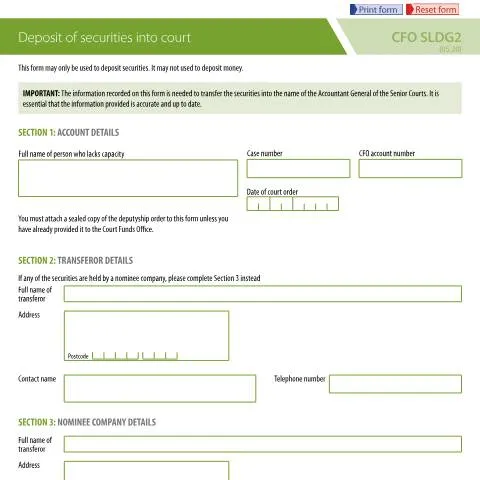
Navigating the Court Funds: Understanding the Deposit of Securities Form
When engaging with the judicial system in the UK, various forms and protocols come into play, particularly when it involves financial matters such as deposit of securities. The Deposit of Securities into Court form, officially identified by the code CFO SLDG2, plays a critical role in ensuring that assets are properly managed and recorded under the jurisdiction of the courts. This document is used solely for the purpose of depositing securities, not cash, into a designated court funds account.
Whom Does This Form Affect?
This form primarily concerns individuals who may lack the capacity to manage their financial affairs independently, including minors, those with mental incapacities, and other vulnerable individuals. In practice, it is often the appointed deputies or trustees responsible for these individuals who will be completing and submitting the form. Understanding the nuances of who qualifies and the circumstances surrounding their capacity is essential in navigating this process.
Specific Categories of Individuals
- Minors: Minors (individuals under 18 years) cannot manage their financial affairs directly, necessitating the involvement of a parent or guardian.
- Individuals with Mental Capacity Issues: This includes persons who have been assigned a deputyship order, where a court has determined the individual is unable to make specific decisions.
- Corporate Entities: Sometimes, companies may deposit securities on behalf of clients or stakeholders, requiring understanding of the nominee company details.
Special Circumstances and Exceptions
Unique situations may arise during the process of filling out this form. For instance, if securities are held by a nominee company, it is essential to complete the section designated for nominee companies, ensuring accurate representation of the transferor’s details. Additionally, emergencies may arise where the swift deposition of securities is necessary; in such cases, understanding the expedited processes within the court system can be beneficial.
Decoding the Form Sections: A Step-by-Step Breakdown
Completing the CFO SLDG2 form requires attention to detail as each section must be meticulously filled to avoid delays. Let’s explore each section in depth.
Section 1: Account Details
This section requires the full name of the individual who lacks capacity. It is crucial that the information provided here is accurate, as it will facilitate the transfer of securities into the account under the name of the Accountant General of the Senior Courts.
Section 2: Transferor Details
Here, the details of the individual or entity transferring the securities must be explicitly stated. Mistakes in this section, such as incorrect names or addresses, could result in significant delays or complications in processing the deposit.
Section 3: Nominee Company Details
Should the securities in question be held by a nominee company, this section must be completed instead of Section 2. The need for clarity in the nominee’s identification cannot be overstated, as this ensures that the court accurately processes the deposit.
Section 4: Details of Securities to be Deposited
| ISIN Number | Description of Security | Quantity |
|---|---|---|
| GB00B1234567 | Example Security Description | 100 |
| GB00C7654321 | Another Security Description | 200 |
This section demands precise information regarding each security being deposited. The ISIN number and the quantity need to be provided accurately to avoid issues in the transfer process.
Section 5: Deputy’s Details
For those appointed to act on behalf of the individual lacking capacity, the deputy's details must be entered here. This section is vital in establishing the legal authority of the individual completing the form and ensuring all parties are appropriately represented.
Significance of Accuracy: The Legal Framework
The importance of providing accurate and up-to-date information on this form cannot be overstated. Under the Data Protection Act 2018 and the UK GDPR, individuals have rights concerning their personal information. Misinformation or omissions could lead to serious legal ramifications and hinder the court's ability to act on behalf of those who require support.
Understanding the Deputyship Order
For individuals who have a deputy appointed, the submission of a sealed copy of the deputyship order alongside this form is a requirement. This document serves as legal proof that the deputy has been granted authority to act on behalf of the individual lacking capacity. Thus, familiarity with the implications of this order is essential for all parties involved.
Common Pitfalls and How to Avoid Them
When dealing with the CFO SLDG2 form, several common errors can lead to complications. Awareness of these pitfalls can save time and streamline the process.
Filling Incomplete Information
Often, individuals may rush through forms or omit crucial details without realising. Every section must be fully complete to prevent unnecessary delays.
Misidentification of Securities
Ensuring the correct ISIN numbers and security descriptions is vital; inaccuracies can lead to securities not being deposited correctly, potentially complicating future transactions.
Ignoring Communication Protocols
Lastly, maintaining open lines of communication with the Court Funds Office is essential. Should any uncertainties arise, contacting them directly via their helpline or email is encouraged for clarification.
After Submission: What Happens Next?
Upon submission of the CFO SLDG2 form, the Court Funds Office will process the information provided. This may take several weeks, during which it’s wise to keep track of the case number provided at the time of submission.
Once the securities are successfully transferred into the name of the Accountant General of the Senior Courts, a confirmation will be sent to the contact details provided in the form. This confirmation is crucial for record-keeping and can serve as proof of the transaction for all relevant parties.
Contacting the Court Funds Office
For any inquiries or follow-ups regarding the submission, you can reach the Court Funds Office at the following:
Fill in your form directly online
No printing: type your details into the boxes of the official form, tick, then download the PDF ready to send.
- 1Type into the form boxes
- 2Tick in one click
- 3Save and download the PDF
- Phone: 0300 0200 199
- Email: [email protected]
- Postal Address: Court Funds Office, Sunderland, SR43 3AB
Final Notes: Enhancing Your Understanding
Engaging with the legal and financial systems can be overwhelming, especially when dealing with sensitive matters such as deposits on behalf of individuals who cannot manage their affairs. By understanding the Deposit of Securities into Court form and its importance, individuals can navigate their responsibilities with confidence. For further learning, consider reaching out to legal advisors or financial professionals familiar with these processes.
Understanding Court Funds: The Basics
In the UK, court funds refer to money held by the Court Funds Office (CFO) on behalf of individuals. This can often arise from claims made in court cases, including personal injury settlements, inheritance, or compensation awards. When the court determines that an individual is entitled to funds but lacks the capacity to manage these funds, the CFO ensures that the money is securely deposited and managed on their behalf. The CFO operates under the jurisdiction of the Ministry of Justice and is responsible for safeguarding these funds until the rightful owner can withdraw them.
When depositing funds into a court account, it’s essential to understand the type of account that will be used. The Court Funds Office offers several accounts tailored to different needs, including interest-bearing accounts which accumulate interest over time. This interest can be beneficial for the funds held, especially if the money is anticipated to be held for an extended period. Additionally, the process involves strict adherence to legal protocols, ensuring that deposits are made in accordance with court orders and regulations.
Eligibility Criteria for Depositing Funds
Not everyone can deposit funds into a court account; eligibility is often determined by the court's ruling. Generally, you must have a relevant court order or judgement that specifies the amount to be deposited.
Eligibility can vary based on several factors:
- Age: Individuals under the age of 18 may have funds deposited on their behalf by a parent or guardian. The court must approve such arrangements.
- Capacity: Individuals deemed unable to manage their finances due to mental incapacity may have their funds managed by the CFO. This involves a formal process of determining capacity and may require medical assessments or reports.
- Type of Case: Only certain types of legal cases lead to court funds being established. It is essential to review the specific details of your case or consult legal counsel to ensure eligibility.
Additionally, the specific procedures for deposits may differ depending on the type of case and amount of funds involved. For larger sums, additional documentation may be required to verify the source of the funds, ensuring compliance with anti-money laundering regulations.
Steps to Deposit Securities Into a Court Funds Account
The process of depositing funds into a court account is structured to ensure compliance with legal standards and to protect the interests of individuals involved. Here are the steps you need to follow:
- Obtain a Court Order: Before you can deposit any funds, you need to secure a court order that explicitly authorizes the deposit. This may involve submitting a request for a hearing.
- Complete the Required Paperwork: The CFO provides specific forms that must be filled out, detailing information about the case, the amount to be deposited, and the name of the account holder. Ensure that all information is accurate and complete.
- Provide Supporting Documentation: Depending on the circumstances, you may need to submit additional documents such as proof of identity, verification of the court order, or financial statements.
- Submit the Deposit: Once all forms are completed and documentation is gathered, submit them to the Court Funds Office. You may be required to send the funds via bank transfer or cheque, depending on the amount.
- Confirmation of Deposit: After processing your deposit, the CFO will issue a confirmation. This confirmation is essential for future reference and may be needed for withdrawals or inquiries.
Each of these steps can involve specific timelines, and it is crucial to stay within any deadlines specified by the court to avoid delays in accessing the funds. If any issues arise, contact the CFO directly, as they can provide guidance and support during the deposit process.