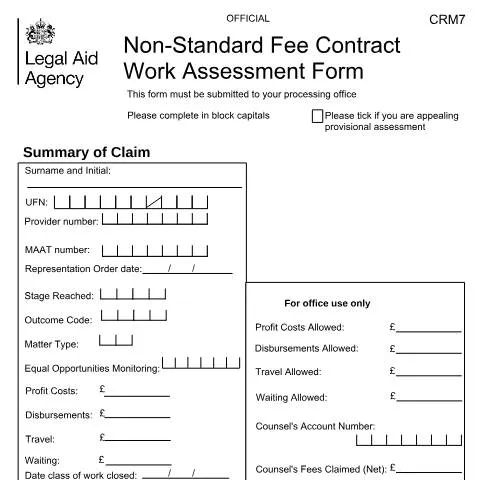
Maximising Solicitor Remuneration Beyond Standard Legal Aid Rates
When magistrates' court proceedings demand exceptional preparation time, involve complex multi-defendant cases, or require enhanced advocacy skills, the standard legal aid fees may fall woefully short of covering legitimate costs. The CRM7 form serves as the gateway for solicitors to claim non-standard fees that reflect the true complexity of their criminal defence work, moving beyond the rigid constraints of fixed-fee arrangements.
This Legal Aid Agency assessment form enables practitioners to demonstrate why their case merits additional remuneration, whether through enhanced hourly rates, extended preparation time, or circumstances that push core costs beyond the higher limits. Unlike routine legal aid claims processed automatically, CRM7 submissions undergo detailed scrutiny by LAA case workers who evaluate each element against strict criteria outlined in the 2025 Crime Contract Specification.
The form's significance extends beyond mere fee recovery—it represents a crucial mechanism for maintaining quality criminal defence representation in an increasingly stretched legal aid system. Solicitors who master its complexities can ensure sustainable practice whilst delivering thorough representation to clients facing serious charges.
Identifying Cases That Merit Non-Standard Fee Applications
The CRM7 form addresses specific scenarios where standard magistrates' court fees prove inadequate. Core costs exceeding higher limits represent the most common trigger, occurring when preparation time, court attendances, or case complexity substantially surpass typical matters within the same category.
Enhanced rates become claimable when cases demand specialist knowledge or exceptional advocacy skills. Youth court matters involving vulnerable defendants, complex fraud allegations requiring financial expertise, or cases with extensive unused material reviews often justify enhanced remuneration. The form specifically accommodates Category 1A, 1B, 2A, and 2B classifications, each carrying distinct thresholds for standard fee limits.
Counsel assignment automatically triggers non-standard fee consideration, particularly in either-way matters where the complexity or gravity warrants senior advocacy. The form captures both assigned and unassigned counsel scenarios, with the maximum fee principle applying to unassigned cases where solicitors retain discretion over counsel selection.
| Case Type | Standard Fee Trigger | Non-Standard Indicators |
|---|---|---|
| Category 1A (Summary Only) | Basic preparation up to 3 hours | Extensive unused material, multiple witnesses |
| Category 1B (Either Way - Guilty Plea) | Standard plea preparation | Complex mitigation, pre-sentence reports |
| Category 2A (Either Way - Trial) | Fixed trial preparation allowance | Expert evidence, extensive cross-examination |
| Category 2B (Indictable Only) | Sending hearing only | Bail applications, preliminary hearings |
Pre-Order Work and Representation Challenges
Cases frequently require substantial preparation before representation orders are granted, particularly where defendants face police station interviews, early court appearances, or urgent bail applications. The CRM7 form specifically accommodates pre-order work claims, requiring practitioners to demonstrate the application date and justify work undertaken before formal legal aid authorization.
Multiple defendant scenarios present particular complexity, especially when co-defendants' interests conflict or when costs cannot be split equally between represented parties. The form demands precise percentage allocations against each named defendant, ensuring accurate cost attribution across complex multi-handed matters.
Navigating the Enhanced Rates Framework
Enhanced rates represent a significant departure from standard legal aid remuneration, requiring compelling justification based on case complexity, practitioner expertise, or exceptional circumstances. The Legal Aid Agency applies rigorous criteria when assessing enhancement claims, examining both the nature of legal issues involved and the specific skills required for effective representation.
Specialist knowledge requirements often justify enhanced rates in areas such as proceeds of crime legislation, complex fraud allegations, or cases involving vulnerable defendants with mental health complications. Practitioners must demonstrate that standard rates inadequately compensate for the specialist expertise required, supported by detailed case information explaining the complexity encountered.
The form's time recording schedule allows for percentage uplifts across different work categories—preparation, advocacy, attendance, travel, and waiting time. However, enhancements apply selectively; practitioners can highlight specific work items meriting enhanced rates rather than claiming blanket percentage increases across all activities.
Chronological Time Recording Requirements
Accurate time recording proves essential for successful non-standard fee claims. The CRM7 schedule demands chronological entries showing date, fee earner initials, and precise time allocation across five categories. Hearing type codes and person codes must correspond to LAA specifications, ensuring consistency with agency processing systems.
Travel and waiting time attract particular scrutiny, especially where court locations or hearing schedules create inefficiencies. Practitioners must justify travel claims based on designated or undesignated area classifications, with mileage details required for car travel and receipts necessary for public transport disbursements.
Disbursements and VAT Considerations in Complex Cases
Magistrates' court proceedings increasingly involve substantial disbursements, from expert witness fees to forensic analysis costs. The CRM7 form distinguishes between VAT-liable and VAT-exempt disbursements, requiring practitioners to calculate VAT obligations accurately and provide supporting documentation for all claimed expenses.
Expert witness costs represent the most significant disbursement category, particularly in cases involving medical evidence, forensic analysis, or specialist technical testimony. Prior authority requirements apply to disbursements exceeding specified thresholds, though emergency situations may permit retrospective approval where immediate expert instruction proves essential for effective defence.
Prosecution evidence volume significantly impacts preparation time and associated costs. Cases involving thousands of pages of unused material, extensive CCTV footage, or multiple witness statements require proportionate preparation time that standard fees rarely accommodate adequately.
Audio-Visual Evidence and Technology Challenges
Modern criminal cases frequently involve extensive audio-visual evidence requiring detailed analysis. The CRM7 form specifically captures time spent watching or listening to taped evidence, recognizing that real-time review often proves essential for effective cross-examination preparation. Practitioners must record total running time in hours and minutes, demonstrating the proportionate impact on case preparation.
Body-worn camera footage, CCTV evidence, and recorded interviews can generate hundreds of hours of material in serious cases. The form accommodates these technological challenges by allowing separate time recording for evidence review, distinct from traditional document-based preparation work.
Youth Court Complexities and Additional Fee Entitlements
Youth court matters carry distinct challenges that warrant specific fee recognition under recent Legal Aid Agency reforms. The Additional Fee for Youth Court Matters applies to representation orders granted from 6th December 2024, providing supplementary remuneration for Category 1A and 2A youth cases beyond standard core costs.
Young defendants often require additional preparation time for effective communication, liaison with youth offending teams, and coordination with parents or guardians. Court processes adapt to accommodate young people's needs, frequently extending hearing duration and requiring specialist advocacy approaches that justify enhanced remuneration.
The CRM7 form captures youth-specific factors including vulnerability assessments, education disruption considerations, and family conference requirements. These elements contribute to legitimate cost increases that standard youth court fees may inadequately address, particularly in complex cases involving serious charges or multiple co-defendants.
Prescribed Proceedings and Low-Value Shoplifting
Recent legislative changes have introduced prescribed proceedings categories, including specific provisions for low-value shoplifting under Section 22A(3) of the Magistrates Court Act 1980. These cases follow streamlined procedures but may still generate non-standard fee claims where defendants contest charges or where underlying circumstances reveal greater complexity than initially apparent.
The form accommodates these procedural variations whilst maintaining consistency with broader Legal Aid Agency assessment criteria, ensuring appropriate remuneration regardless of case categorization.
Wasted Costs Orders and Professional Risk Management
The CRM7 form includes specific provisions for cases where wasted costs orders have been made, recognizing the significant impact such orders can have on practitioner remuneration and professional standing. Wasted costs orders arise where legal representatives' conduct causes unnecessary expense through improper, unreasonable, or negligent acts or omissions.
When completing the form, practitioners must disclose any wasted costs orders and provide detailed explanations on page seven. This transparency requirement enables the Legal Aid Agency to assess claims appropriately whilst considering any impact on legitimate cost recovery. Cases involving wasted costs orders may still merit non-standard fees where complexity or exceptional circumstances justify additional remuneration beyond standard rates.
Professional indemnity considerations become particularly relevant in complex cases where non-standard fee claims intersect with potential wasted costs exposure. Practitioners must balance thorough representation with cost-effective case management, documenting decisions that justify additional time or expense to support subsequent fee claims.
Crown Court Remittals and Jurisdictional Transfers
Cases remitted from Crown Court back to magistrates' courts present unique billing challenges that the CRM7 form specifically addresses. When Crown Court proceedings conclude with remittal for sentence or other disposal, practitioners may claim additional fees for magistrates' court work while ensuring no duplication with previous Crown Court claims.
The form requires copies of related Crown Court claims and any provisional assessment notices, enabling LAA processors to verify cost allocation between jurisdictions. This documentation prevents double-billing whilst ensuring practitioners receive appropriate remuneration for work undertaken across different court levels.
Strategic Completion and Supporting Documentation
Successful CRM7 submissions require strategic completion that anticipates LAA scrutiny whilst maximizing legitimate cost recovery. The relevant case information section provides crucial opportunity to explain exceptional circumstances, complex legal issues, or procedural complications that justify non-standard fees.
Practitioners should provide compelling narratives that connect case complexity to time expenditure and cost increases. Generic explanations rarely succeed; specific examples of unusual legal research, complex witness handling, or exceptional procedural requirements prove far more persuasive to LAA assessors.
Supporting documentation requirements vary by claim type but typically include representation orders, court listings, correspondence demonstrating case complexity, and expert reports where relevant. Time recording contemporaneously throughout case progression provides essential foundation for successful claims, as retrospective reconstruction rarely satisfies LAA evidential standards.
Processing Timescales and Payment Expectations
Non-standard fee claims undergo detailed assessment that extends beyond routine legal aid processing timescales. LAA case workers examine each element against contract specifications, often requesting additional information or clarification before determining appropriate remuneration levels.
Practitioners should anticipate assessment periods of several weeks for straightforward claims, extending to months where complex issues require senior management review or external expert input. Provisional assessments may be issued where partial approval seems appropriate, with appeal rights available against adverse decisions through the CRM7 appeal mechanism.
The form's design reflects this detailed assessment process, requiring comprehensive information that enables informed decision-making whilst minimizing subsequent correspondence that delays final determination. Accurate initial completion proves essential for timely resolution and optimal cost recovery outcomes.
Understanding Fee Structures and Payment Methods for CRM7 Applications
The financial aspects of CRM7 claims require careful consideration, as non-standard fee applications often involve complex calculations that differ significantly from standard magistrates' court rates. Legal practitioners must understand that the Legal Aid Agency applies specific criteria when assessing whether enhanced remuneration is justified, and the burden of proof lies squarely with the applicant.
Fill in your form directly online
No printing: type your details into the boxes of the official form, tick, then download the PDF ready to send.
- 1Type into the form boxes
- 2Tick in one click
- 3Save and download the PDF
When preparing fee calculations, solicitors should document every aspect that contributes to the non-standard nature of their case. This includes unusual travel requirements—perhaps representing a client detained in a facility hundreds of miles from the court—or cases requiring specialist expertise not typically expected in summary proceedings. For instance, a seemingly straightforward assault charge that develops into a complex matter involving expert medical testimony about brain injuries would warrant detailed justification of additional preparation time.
The Legal Aid Agency expects practitioners to provide granular breakdowns of time spent on different activities. A general claim stating "extensive preparation required" will almost certainly face rejection. Instead, applicants must specify hours dedicated to reviewing voluminous prosecution evidence, consulting with multiple witnesses, or researching novel points of law that arose unexpectedly during proceedings.
Payment processing for approved CRM7 claims follows the Agency's standard procedures, but practitioners should be aware that non-standard fee payments often take longer to process than routine claims. The additional scrutiny applied to these applications, combined with the need for senior caseworker approval, can extend payment timelines beyond the usual 20 working days. Firms experiencing cash flow pressures should factor these delays into their financial planning.
VAT considerations also apply differently to CRM7 claims compared to standard legal aid payments. While most legal aid payments are exempt from VAT, certain disbursements claimed through the non-standard fee route may attract VAT charges. Practitioners should maintain detailed records of all expenses and consult current HMRC guidance when completing their applications.
Common Rejection Reasons and How to Avoid Them
Analysis of Legal Aid Agency decision data reveals recurring patterns in CRM7 application rejections, providing valuable insights for practitioners seeking to maximise their success rates. Understanding these common pitfalls enables solicitors to address potential weaknesses before submission, significantly improving their chances of approval.
The most frequent rejection reason relates to insufficient justification of the non-standard nature of the work. Applications that merely assert exceptional circumstances without providing concrete evidence face almost certain refusal. The Agency expects detailed explanations of why standard fee rates prove inadequate, supported by specific examples from the case file. A successful application might document how a routine shoplifting case became complex when the defendant's mental health issues required extensive liaison with psychiatric services, multiple court adjournments, and preparation for a fitness-to-plead hearing.
Timing issues represent another significant rejection category. Applications submitted after the prescribed deadlines face rejection unless exceptional circumstances can be demonstrated. However, even within the deadline, applications submitted too early—before the true scope of additional work becomes apparent—may be deemed premature. The optimal timing involves submitting the CRM7 once the full extent of non-standard work is known but before the statutory deadline expires.
Inadequate supporting documentation consistently undermines applications. The Agency requires contemporaneous records demonstrating the work undertaken, not retrospective summaries prepared solely for the application. Practitioners should maintain detailed time records throughout the case, noting not just hours worked but the specific activities undertaken and their necessity to the case progression.
Mathematical errors and inconsistencies in fee calculations provide easy grounds for rejection. Applications should be thoroughly checked to ensure all figures align with the Agency's current fee scales and that calculations follow the prescribed methodology. Discrepancies between narrative descriptions of work undertaken and the hours claimed for different activities often trigger detailed scrutiny and potential rejection.
Another common weakness involves failing to demonstrate that alternative, less expensive approaches were considered and found inadequate. The Agency expects practitioners to show they have explored all reasonable options before seeking enhanced remuneration. This might involve explaining why telephone conferences proved insufficient, necessitating face-to-face meetings, or why standard expert reports required supplementation with specialist opinions.
Strategic Considerations for Appeal Procedures
The CRM7 appeal process requires a fundamentally different approach from the initial application, focusing on procedural compliance and substantive legal arguments rather than simply expanding on the original justification. Successful appeals typically identify specific errors in the Agency's decision-making process or present new evidence that was unavailable during the initial assessment.
Appellants must understand that the Legal Aid Agency's appeal panel applies strict procedural requirements, and technical non-compliance can result in summary dismissal regardless of the merits. The appeal must clearly identify the specific grounds being challenged, referencing the relevant paragraphs of the original decision letter. Generic appeals citing "unfair treatment" or "inadequate consideration" without specific focus rarely succeed.
Timing remains critical in the appeal process, with the 21-day deadline being strictly enforced. However, practitioners should also consider whether immediate appeal represents the best strategy. In some cases, submitting a fresh CRM7 application addressing the identified deficiencies may prove more effective than appealing the original decision, particularly where the rejection highlighted correctable weaknesses in the application.
The appeal submission should include a comprehensive response to each point raised in the rejection letter, demonstrating either that the Agency misunderstood the submitted evidence or that additional information addresses their concerns. Successful appeals often provide contemporaneous documentation that was overlooked in the original application or clarify ambiguities that led to misinterpretation.
Strategic use of precedent can strengthen appeal arguments, particularly where similar cases have received approval under comparable circumstances. However, appellants must ensure their precedent cases are genuinely analogous and that they can demonstrate consistent application of the Agency's criteria would support approval of their application.
The appeal panel's decision-making process involves fresh assessment by different caseworkers, providing an opportunity to present the case from alternative angles. Appellants should consider whether their original application optimally highlighted the strongest arguments for approval or whether the appeal provides an opportunity to emphasise different aspects of the non-standard work undertaken.