Understanding the Court of Appeal Mediation Scheme: Form 56C in Practice
Navigating the complexities of legal proceedings often requires an understanding of mediation processes. The Form 56C is pivotal within the Court of Appeal Mediation Scheme, allowing parties to resolve disputes efficiently before they escalate to formal court hearings. The aim of mediation is to provide a platform for constructive dialogue between disputing parties, facilitated by a neutral mediator. This article explores the intricacies of Form 56C, including its fees, processes, and practical implications for users.
Fee Structure: Breaking Down the Costs
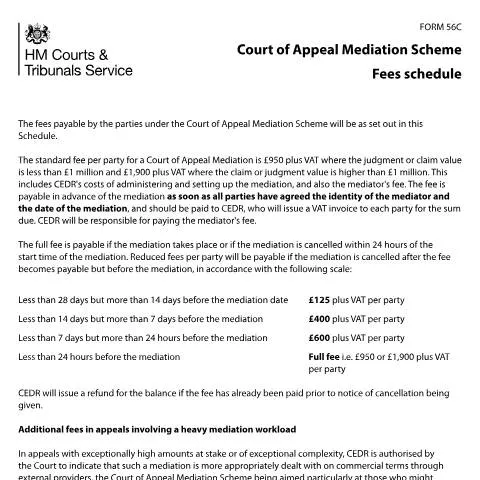
The financial aspect of mediation can be daunting for many parties involved. The fee structure under the Court of Appeal Mediation Scheme is designed to be transparent, allowing parties to understand their financial commitments before proceeding. Below is a detailed breakdown of fees applicable based on the value of the claim or judgment:
| Claim/Judgment Value | Standard Fee per Party (Excl. VAT) |
|---|---|
| Less than £1 million | £950 |
| £1 million or more | £1,900 |
These fees cover not only the mediator’s costs but also the administrative expenses incurred by the Centre for Effective Dispute Resolution (CEDR). It is crucial to note that fees are payable in advance, and a VAT invoice will be issued upon payment. The timing of cancellations further influences the financial implications:
- More than 28 days before mediation: No cancellation fees.
- 14 to 28 days before mediation: £125 plus VAT per party.
- 7 to 14 days before mediation: £400 plus VAT per party.
- Less than 7 days before mediation: £600 plus VAT per party.
- Less than 24 hours' notice: Full fee applies.
Who Should Submit Form 56C?
Form 56C is primarily relevant for parties involved in civil appeals at the Court of Appeal. This includes individuals, businesses, and other entities looking to resolve disputes without proceeding to a full trial. The form is typically submitted by the parties who wish to initiate mediation, and submitting it indicates their willingness to engage in this alternative dispute resolution method.
It's essential to understand that certain profiles may have specific considerations:
- Individuals: Those representing themselves (litigants in person) should be prepared to complete the form accurately, ensuring all personal details and claims are correctly stated.
- Legal Representatives: Solicitors may submit the form on behalf of their clients, and they should ensure all parties are in agreement regarding the selection of the mediator.
- Large Corporations: These entities may have internal legal teams or external counsel handling mediation processes, and they must consider additional complexities associated with commercial disputes.
Chronological Flow: From Submission to Resolution
Understanding the timeline associated with Form 56C can help parties navigate their mediation journey effectively. Here’s a step-by-step guide:
- Agreement to Mediate: All parties must agree to mediation before submitting Form 56C.
- Submission of Form 56C: Fill out and submit the form, along with the required fees.
- Appointment of a Mediator: Upon acceptance, CEDR will facilitate the selection of a mediator.
- Mediation Date Confirmation: All parties must agree on the date, and payment of fees must be completed.
- Mediation Session: Engage in the mediation, which typically lasts a day, depending on the complexity of the issues.
- Outcome: Reach a resolution, which can be formalised in a settlement agreement.
- Follow-Up: If mediation is unsuccessful, parties may proceed with their appeal in the court system.
The Nuances of Completing Form 56C
Completing Form 56C accurately is crucial for a smooth mediation process. Each section of the form requires careful attention to detail to avoid delays or complications. Below is a breakdown of critical sections to focus on:
Personal Details Section
This section requires the names, contact information, and roles of each party involved in the mediation. Ensure that:
- All names are spelled correctly.
- Contact details are current and reliable.
Details of the Dispute
In this section, summarise the nature of the dispute succinctly. Highlight key facts without unnecessary detail, ensuring clarity. Avoid jargon to facilitate understanding by the mediator.
Agreement to Mediate
This part of the form confirms all parties' agreement to participate in the mediation process. All signatures must be collected here, and it’s crucial to ensure that everyone involved has consented before the submission.
Payment Details
Clearly outline how the fees will be paid, ensuring that all parties understand their financial obligations. Miscommunication here can lead to significant delays.
What Happens If Issues Arise?
In the event of any complications—be it errors in the form, disputes over mediation terms, or issues with fee payments—parties have specific pathways to address these issues:
- Refusal of Mediation: If one party refuses to engage in mediation, this must be documented. The Court may need to be notified, and the case may proceed to court without mediation.
- Errors or Omissions: If errors are identified after submission, parties should contact CEDR immediately to rectify the situation.
- Cancellation and Refunds: If a mediation session needs to be cancelled, follow the fee schedule provided to understand any potential refunds or additional charges.
Variations and Exceptional Circumstances
Certain situations may require additional considerations when using Form 56C. For instance:
- Foreign Parties: If one or more parties are based outside the UK, ensure compliance with international mediation regulations and consider potential currency conversion implications for fees.
- Minors: When minors are involved, legal guardians must submit the form on their behalf, ensuring all legal requirements are met.
- Urgent Cases: In cases where time is of the essence, parties may seek expedited mediation scheduling through appropriate channels.
The Historical Context of Mediation in the Court of Appeal
The introduction of mediation into the judicial system has roots in the desire to provide alternative dispute resolution methods that are less adversarial and more cost-effective than traditional court proceedings. The Court of Appeal Mediation Scheme is grounded in this vision, aiming to enhance access to justice while alleviating the burden on the court system. Understanding the historical context informs users of the form about the broader objectives of mediation:
- Access to Justice: Mediation is designed to provide fair resolutions for all parties, particularly those who may struggle to afford lengthy court battles.
- Efficiency: The process aims to reduce the backlog in courts, allowing for faster resolutions.
- Flexibility: Unlike court proceedings, mediation offers flexibility in terms of resolutions and procedural rules.
For individuals or entities engaged in disputes that may potentially end up in the Court of Appeal, understanding the nuances and implications of Form 56C ultimately plays a crucial role in navigating the mediation landscape effectively. By being well-informed and prepared, parties can enhance their chances of reaching a satisfactory resolution through mediation.
Understanding the Mediation Process in the Court of Appeal
The Court of Appeal offers a mediation scheme designed to help parties resolve their disputes more efficiently and cost-effectively than through litigation. Mediation is a voluntary process where an independent mediator facilitates discussions between the parties to help them reach a mutually acceptable agreement. It can be particularly advantageous in cases where the relationship between the parties needs to be preserved or where the costs of a full trial may be prohibitively high.
In the context of the Court of Appeal, mediation is available for civil cases and is an optional step that litigants can choose to engage in before proceeding to a full hearing. The mediation service is managed by the HM Courts & Tribunals Service, and it is important to understand both the benefits and the obligations that come with this process.
Key Benefits of Mediation in the Court of Appeal:
Cost Efficiency: Engaging in mediation can significantly lower the overall expenses related to legal disputes. The fees associated with mediation sessions are often less than the costs incurred during court proceedings. This is particularly valuable for parties who may find themselves in lengthy and expensive litigation.
Time-Saving: Mediation sessions can be scheduled more swiftly than court dates. Parties may find that resolutions can be achieved in a matter of days or weeks, as opposed to the months or years that litigation can entail.
Confidentiality: Unlike court proceedings, which are public, mediation is a private process. This confidentiality can encourage open communication, allowing parties to express their views without the fear of their statements being used against them in court.
Control Over the Outcome: In mediation, the parties have control over the resolution of their dispute. Unlike a court judgment, where a judge makes the final decision, mediation encourages collaborative problem-solving, which often leads to more satisfactory outcomes for all involved.
The Role of the Mediator:
The mediator plays a crucial role in the mediation process. They do not make decisions or impose solutions but instead facilitate discussions and help clarify issues. They assist the parties in identifying their interests and exploring possible solutions. It is essential that mediators maintain neutrality and create an environment conducive to productive dialogue.
Who Can Access Mediation Services?
Any party involved in a civil matter scheduled for the Court of Appeal can opt for mediation. It is particularly beneficial for individuals and organisations that aim to resolve disputes without the adversarial nature of court proceedings. This process is also open to legal representatives of the parties, who can participate actively in discussions to advocate for their clients' interests.
Fees Structure for Mediation under Form 56C
When it comes to engaging in mediation within the Court of Appeal, understanding the fees involved is crucial for effective financial planning. The fees are structured to reflect the nature of the mediation services and are designed to be accessible to all parties involved.
Breakdown of Mediation Fees:
Initial Application Fee: There may be a nominal fee for submitting an application for mediation. This fee can vary depending on the specifics of the case and whether legal aid is being applied for by the parties involved.
Session Fees: Mediation sessions typically incur fees based on the duration of the session. For example, shorter sessions (1-2 hours) may have a lower flat fee, while longer sessions could be charged on an hourly basis. It is essential for parties to confirm the exact fees with the mediation service upon scheduling their session.
Fill in your form directly online
No printing: type your details into the boxes of the official form, tick, then download the PDF ready to send.
- 1Type into the form boxes
- 2Tick in one click
- 3Save and download the PDF
Additional Costs: In cases where additional mediation sessions are necessary, parties should be aware that further fees may apply. It is advisable to discuss the potential need for multiple sessions in advance and inquire about any possible discounts for booking multiple sessions upfront.
Payment Options: Payment for mediation services can usually be made through several methods, including credit cards or bank transfers. It is advisable to confirm payment details during the initial scheduling of the mediation session.
Fee Waivers and Reductions:
For parties experiencing financial hardship, there may be options to apply for fee waivers or reductions. This process often involves providing evidence of income and other financial details to the court or mediation service. Understanding the criteria for these waivers is important for parties to ensure they do not avoid necessary mediation due to cost concerns.
Importance of Early Engagement:
Engaging in mediation early in the appeal process can not only save costs but also lead to quicker resolutions. By proactively discussing the potential for mediation with legal representatives and opposing parties, individuals can navigate their appeals more effectively, potentially leading to settlements before the need for extensive court hearings.
Preparing for Mediation: Best Practices for Parties Involved
Effective preparation is essential for successful mediation outcomes in the Court of Appeal. Parties entering mediation should take specific steps to ensure they are adequately prepared to engage in meaningful discussions.
Steps to Prepare for Mediation:
Gather Relevant Documentation: Before entering mediation, parties should collect all pertinent documents, including legal correspondence, evidence, and any previous court rulings relevant to the case. Having these documents readily available can help clarify issues and support discussions.
Define Goals and Interests: It is vital for parties to identify and articulate their goals and underlying interests. Understanding what they wish to achieve from the mediation process allows parties to negotiate effectively and work towards a resolution that meets their needs.
Consider Possible Solutions: Prior to the mediation session, parties should brainstorm potential solutions and compromises. This proactive approach can facilitate constructive negotiation and demonstrate a willingness to resolve disputes amicably.
Prepare for Open Communication: Mediation relies heavily on effective communication. Parties should approach the mediation session with a mindset ready for dialogue, being open to hearing the other party's perspective and exploring collaborative solutions.
Consult Legal Representatives: Engaging one's solicitor or legal representative in the preparation process is crucial. Legal professionals can provide insights into legal frameworks, potential implications of various outcomes, and strategies for negotiation.
During the Mediation Session:
- Stay Calm and Focused: It is important to remain composed and concentrate on the issues at hand. Emotional reactions can derail productive discussions.
- Listen Actively: Listening to the other party’s perspectives can foster a better understanding and lead to effective resolutions.
- Remain Flexible: Parties should be prepared to adapt their positions based on discussions during the mediation process.
Post-Mediation Considerations:
Following the mediation session, it is essential to evaluate the outcomes and any agreements reached. If a resolution is achieved, parties should ensure that the agreement is documented clearly and signed by all parties involved. If mediation does not result in a resolution, parties must be prepared to proceed with the court process, having gained insights that may facilitate future negotiations.
By investing time and effort into understanding the mediation process and preparing adequately, parties can enhance their chances of achieving a positive outcome within the Court of Appeal’s mediation scheme under Form 56C.