When Legal Representation Becomes Mandatory: Understanding Court-Appointed Solicitor Claims
In the complex machinery of criminal justice, certain circumstances arise where the court must appoint legal representation for vulnerable defendants, regardless of their usual eligibility for legal aid. These situations—ranging from young offenders requiring adult guidance to defendants with severe mental health conditions—create a unique category of legal work that operates outside standard legal aid parameters. The Court Appointee (CA1) claim form serves as the gateway for solicitors to recover costs when they've been formally appointed by magistrates' courts or Crown Courts under specific statutory provisions.
Unlike conventional legal aid claims processed through the usual channels, court-appointed work carries distinct procedural requirements and payment structures. Solicitors undertaking this work must navigate a specialised claims process that demands precise documentation, specific formatting requirements, and adherence to strict submission protocols. The stakes are particularly high because rejected claims can result in significant financial losses for firms that have already invested substantial time and resources in complex cases.
The Legal Aid Agency's handling of CA1 claims reflects the exceptional nature of court-appointed work, where judicial orders override standard means testing and the usual gatekeeping mechanisms that govern legal aid provision. This creates both opportunities and obligations for legal practitioners who find themselves appointed to represent clients in circumstances where the court has determined that justice cannot be served without professional legal assistance.
Statutory Framework and Judicial Powers Behind Court Appointments
Court appointments typically arise under specific legislative provisions that empower judges to ensure fair proceedings when defendants cannot adequately represent themselves. The most common scenario involves Section 38 of the Youth Justice and Criminal Evidence Act 1999, which requires courts to appoint legal representation for defendants when special measures directions are being considered for vulnerable witnesses.
This statutory intervention becomes necessary when the court determines that cross-examination by an unrepresented defendant could cause additional distress to vulnerable witnesses, particularly in cases involving allegations of sexual offences or domestic violence. The judicial appointment is not discretionary in these circumstances—it's a legal requirement that overrides any previous decisions about legal aid eligibility or the defendant's expressed preferences about representation.
Other appointment scenarios include cases where defendants lack mental capacity to conduct their own defence, situations involving complex legal arguments that require professional expertise, or proceedings where the interests of justice demand representation despite the defendant's financial circumstances. Each appointment must be formally documented through a court order, which becomes an essential supporting document for any subsequent CA1 claim.
The appointed solicitor assumes full professional responsibilities towards their client, despite the involuntary nature of the appointment. This includes conducting investigations, preparing defence strategies, instructing counsel where appropriate, and ensuring the defendant understands the proceedings and their implications.
Digital Claims Architecture: Navigating the CA1 Electronic System
The CA1 form operates as a sophisticated digital document designed to capture the complexity of court-appointed work while maintaining the precise record-keeping required for public fund accountability. Each claim must begin with a fresh download from the gov.uk website, as the Legal Aid Agency regularly updates the form's underlying architecture to incorporate policy changes and technical improvements.
The electronic format includes embedded calculations, dropdown menus, and validation checks that help prevent common submission errors. However, this sophistication demands careful handling—overtyping existing forms or using outdated versions can corrupt the document's functionality and result in automatic rejection. The recommended file naming convention follows the format "Defendant's name followed by case number," which assists the Legal Aid Agency's case management systems in processing claims efficiently.
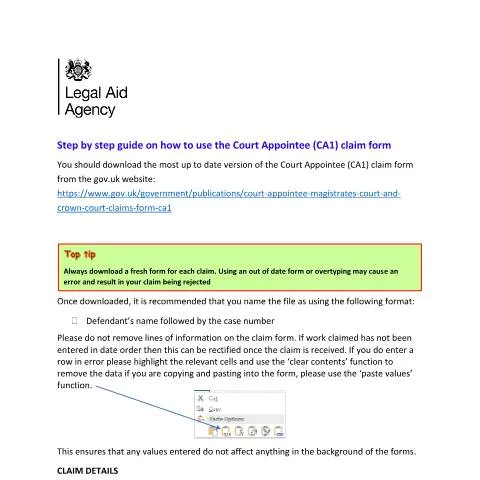
Critical to successful submission is understanding the form's data integrity requirements. When copying information into cells, practitioners must use the 'paste values' function rather than standard paste operations, which can import unwanted formatting that interferes with the form's background calculations. If errors occur during data entry, the 'clear contents' function should be used rather than simply deleting text, ensuring the cell's underlying properties remain intact.
| Submission Method | File Size Limit | Required Documents | Return Policy |
|---|---|---|---|
| Email (primary) | 10MB total | CA1 form, Section 38 order, supporting papers | Electronic documents not returned |
| Secure file exchange | No stated limit | Large supporting documents | Contact CCU for arrangements |
| Post (exceptional) | N/A | Paper files only after email submission | Returned within 14 days of determination |
Fee Structures and Rate Determination: Understanding Court-Appointed Work Compensation
Court-appointed work operates under the Supreme Court Costs Office (SCCO) guideline hourly rates, which vary significantly based on geographic location and the grade of fee earner conducting the work. These rates recognise the specialist nature of court-appointed cases while maintaining consistency with broader legal aid remuneration structures.
The CA1 form requires solicitors to specify their applicable rate using dropdown menus that correspond to official rate bands. However, practitioners can claim rates exceeding SCCO guidelines where the complexity or urgency of the case justifies enhanced remuneration. Such claims must include detailed justification explaining why standard rates are insufficient to reflect the work undertaken.
Fee earner grading follows established legal aid categories, from trainee solicitors through to senior partners, with each grade carrying different hourly rates. Claims based on previous experience or specialist expertise require supporting documentation, as case managers will otherwise default to lower rates based solely on formal qualifications.
The DUNS (Data Universal Numbering System) number represents a critical component of payment processing. This unique nine-digit identifier links claims to specific business locations and is mandatory for all payments. Solicitors without existing DUNS numbers must register through the official Dun & Bradstreet system before submitting their first CA1 claim, as the Legal Aid Agency cannot process payments without this identifier.
Time Recording and Digital Conversion Requirements
Accurate time recording presents particular challenges in the CA1 system, which requires digital time entry rather than conventional hours and minutes notation. The conversion follows decimal principles—1 hour 18 minutes becomes 1.3 hours, 2 hours 45 minutes becomes 2.75 hours, and so forth. The form includes a built-in decimal time converter to assist practitioners, but errors in time formatting can result in significant underpayment of claims.
Time entries must reflect actual work undertaken rather than estimated or rounded figures. Case managers scrutinise time records for reasonableness, particularly where substantial preparation time is claimed or where multiple fee earners have worked on the same case elements.
Essential Documentation Matrix: Building Bulletproof Claims
The CA1 claims process demands comprehensive supporting documentation that demonstrates both the legal basis for the court appointment and the work undertaken on the client's behalf. The Section 38 order represents the foundational document, providing legal authority for the appointment and establishing the solicitor's entitlement to remuneration from public funds.
Attendance notes must follow chronological order and provide sufficient detail for case managers to understand the work's necessity and complexity. These notes should capture not only face-to-face meetings with clients but also telephone consultations, correspondence review, legal research, and preparation activities. The Legal Aid Agency expects professional standards of record-keeping that would satisfy Law Society requirements for client file management.
Expert reports, where obtained, require careful documentation of their necessity and relevance to the case. The appointment of experts in court-appointed cases follows the same principles as privately funded work, meaning solicitors must justify both the need for expert evidence and the selection of particular specialists.
- Counsel's fee notes and work logs become mandatory where barristers are instructed, even when they're employed by the solicitor's firm
- Indictments or charge sheets provide essential context for understanding case complexity and the scope of work required
- Case summaries help case managers quickly grasp the issues involved and assess the reasonableness of work claimed
- Invoices and receipts support disbursement claims, particularly for items exceeding £20
Where essential documents cannot be provided, the CA1 form demands explicit explanations for their absence. Generic statements about missing paperwork will result in claim delays or reductions, so practitioners must provide specific reasons linked to the particular circumstances of their case.
Routine Correspondence and Disbursement Protocols
The CA1 system treats routine correspondence separately from substantive legal work, recognising that court-appointed cases often generate significant administrative communication that requires appropriate remuneration. Routine correspondence is claimed by item count rather than time spent, with different rates applying to different grades of fee earner who handle the correspondence.
This approach acknowledges that brief letters, emails, and telephone calls form an essential part of case management but don't justify detailed time recording. However, substantial correspondence that involves legal analysis or strategic decision-making should be claimed as preparation work rather than routine communication.
Travel expenses occupy a unique position in CA1 claims, being treated as disbursements when they involve actual out-of-pocket expenditure (such as public transport costs or parking fees) but as work claimed when they represent time spent travelling to court or client meetings. This distinction affects both the documentation required and the rate of remuneration applied.
Fill in your form directly online
No printing: type your details into the boxes of the official form, tick, then download the PDF ready to send.
- 1Type into the form boxes
- 2Tick in one click
- 3Save and download the PDF
Disbursement claims exceeding £20 must be supported by original invoices or receipts, reflecting the Legal Aid Agency's accountability requirements for public fund expenditure. Common disbursements in court-appointed cases include expert fees, interpretation services, medical reports, and specialist research materials.
Quality Control Mechanisms and Common Pitfalls
The CA1 form incorporates sophisticated validation systems designed to catch errors before submission, but these mechanisms can also create unexpected complications for practitioners unfamiliar with their operation. The summary of claim section will not populate until all mandatory fields are completed correctly, serving as a built-in quality check that prevents incomplete submissions.
Case managers apply rigorous scrutiny to CA1 claims, reflecting their role as guardians of public funds and their responsibility to ensure value for money in court-appointed work. Claims lacking proper justification for exceptional rates or extensive time commitments face detailed questioning and potential reduction.
The declaration requirement carries legal significance beyond mere form-filling. By selecting 'yes' to complete the declaration, solicitors make legally binding statements about the accuracy of their claim and their compliance with professional obligations. Unsigned claims face automatic rejection, regardless of their substantive merits.
Technical Troubleshooting and Form Management
When summary calculations fail to appear correctly, practitioners should systematically check several potential causes. Fresh form downloads resolve many technical issues, as cached or modified versions often contain corrupted elements that prevent proper operation. All mandatory fields marked with asterisks must contain appropriate data, and hourly rates must be specified for every category of work claimed.
Forms with insufficient lines for complex claims require special handling through partial submission procedures. Practitioners should email their incomplete forms with clear explanations of additional space requirements, allowing the Legal Aid Agency to extend the form appropriately before final submission.
Strategic Considerations for Sustainable Court-Appointed Practice
Successful CA1 practice requires understanding the broader context within which court appointments operate. Solicitors cannot refuse court appointments once made, creating potential cash flow implications for firms that must fund complex cases pending claim determination. This reality demands careful financial planning and robust case management systems.
The email submission process to [email protected] represents the primary route for claim processing, but practitioners must ensure their email systems can handle the technical requirements for successful transmission. Large file attachments may require splitting across multiple emails or use of the secure file exchange system, adding complexity to the submission process.
Building expertise in court-appointed work creates opportunities for firms willing to invest in understanding the specialised requirements and developing efficient systems for managing these cases. However, the combination of complex procedural requirements and detailed scrutiny of claims means that occasional practitioners may struggle to achieve cost-effective outcomes.
The Legal Aid Agency's emphasis on electronic submission and digital record-keeping reflects broader modernisation efforts across the justice system. Firms that adapt successfully to these requirements position themselves advantageously for future developments in legal aid administration and court-appointed work management.