When Tribunal Proceedings Take an Unexpected Turn: Understanding Form SEND8
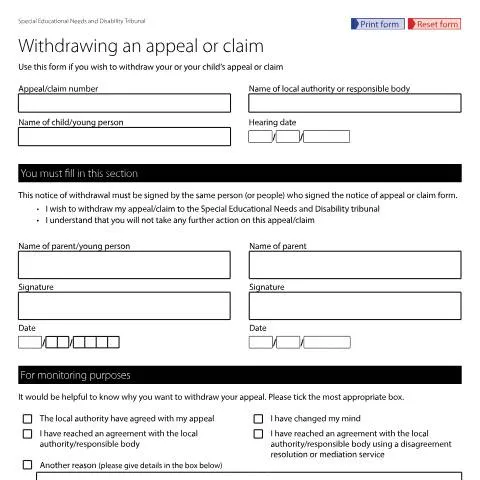
The journey through the Special Educational Needs and Disability (SEND) tribunal system can be emotionally draining and complex. Parents and young people who initially felt compelled to challenge a local authority's decision sometimes find themselves in a position where continuing with their appeal no longer serves their best interests. Whether it's because the local authority has had a change of heart, an agreement has been reached outside the formal hearing process, or circumstances have simply evolved, Form SEND8 provides the official route to step back from tribunal proceedings.
This withdrawal notice represents more than just administrative paperwork—it marks a significant decision point in what is often a deeply personal struggle for appropriate educational support. The Special Educational Needs and Disability Tribunal, operating under HM Courts & Tribunals Service, processes thousands of appeals annually, and a substantial proportion are resolved before reaching a full hearing through various forms of early resolution.
The Critical Timing Element: When Withdrawal Makes Strategic Sense
Understanding when to withdraw an appeal requires careful consideration of both procedural timing and strategic positioning. The tribunal system operates on strict timescales, but withdrawal can occur at virtually any stage of proceedings—from shortly after lodging the initial appeal right up until the hearing itself.
Many successful withdrawals occur during the case management phase, typically 6-12 weeks after the initial appeal submission. This period often sees intensive discussions between parties as the local authority reviews its position in light of the formal challenge. The prospect of a public hearing frequently motivates authorities to engage more constructively with families' concerns.
However, timing considerations extend beyond mere procedural convenience. Withdrawing too early might signal weakness in your position, potentially undermining future negotiations. Conversely, leaving withdrawal until the eve of a hearing could strain relationships with the local authority and limit opportunities for collaborative solutions moving forward.
| Timing of Withdrawal | Typical Scenario | Strategic Considerations |
|---|---|---|
| Within 4 weeks of appeal | Quick local authority concession | May indicate strong initial case |
| During case management | Negotiated settlement reached | Balanced approach preserving relationships |
| Pre-hearing (1-2 weeks before) | Last-minute agreement | Can create implementation pressures |
Navigating the Signature Requirements and Parental Authority
The signature provisions on Form SEND8 reflect the tribunal's careful approach to ensuring legitimate withdrawal requests. The requirement that "the same person (or people) who signed the notice of appeal or claim form" must sign the withdrawal notice prevents unauthorised abandonment of proceedings.
For appeals involving children under 16, this typically means both parents must sign if they jointly submitted the original appeal. Where parents have separated or divorced since the initial appeal, this requirement can create complications. The parent with primary responsibility for educational decisions may find themselves needing to locate and obtain consent from an estranged partner.
Young people aged 16 and over who lodged their own appeals hold exclusive authority over withdrawal decisions. Even where parents strongly disagree with the withdrawal, the young person's signature alone suffices. This reflects the tribunal's recognition of developing autonomy in educational decision-making as young people approach adulthood.
Complex Family Situations and Signature Challenges
When original appellants cannot be contacted or refuse to cooperate with withdrawal, the situation becomes significantly more complex. The tribunal does not provide mechanisms for unilateral withdrawal by one parent where joint signatures were originally required. In such circumstances, continuing with the appeal may be the only viable option, even where one parent has reached agreement with the local authority.
Special guardians, adoptive parents, and those with parental responsibility orders face particular scrutiny regarding their authority to withdraw appeals. The tribunal may request evidence of legal standing, particularly where the withdrawal request comes from someone other than the child's birth parents.
Decoding the Motivation Categories: Strategic Implications Beyond Administration
The monitoring section of Form SEND8 requires appellants to indicate their reason for withdrawal, and these categories reveal important insights into how tribunal proceedings influence local authority behaviour. Far from being merely administrative, this information helps the tribunal service understand systemic patterns in SEND dispute resolution.
Selecting "The local authority have agreed with my appeal" represents the most straightforward victory scenario. This outcome suggests the mere threat of tribunal scrutiny prompted the authority to reconsider its position. Such withdrawals often occur rapidly, sometimes within weeks of the initial appeal submission.
Choosing "I have reached an agreement with the local authority/responsible body" indicates a more nuanced resolution where compromise has been achieved. These agreements might involve partial concessions from both sides—perhaps securing some additional support while accepting that other requested provisions remain unavailable.
The Role of Mediation and Disagreement Resolution Services
The specific category for agreements reached "using a disagreement resolution or mediation service" highlights the tribunal's support for alternative dispute resolution. These services, often provided by voluntary sector organisations, can facilitate discussions between families and local authorities in less adversarial settings than formal hearings.
Mediation agreements leading to withdrawal frequently prove more durable than those imposed through tribunal decisions, as both parties have actively participated in crafting the resolution. However, such agreements may lack the enforceability of formal tribunal orders, potentially creating future compliance challenges.
Processing Pathways and Administrative Consequences
Once completed, Form SEND8 must reach the Special Educational Needs and Disability Tribunal at their Darlington processing centre. The tribunal operates a centralised system for SEND appeals across England, with all correspondence directed to the Parkgate facility regardless of the appellant's geographical location.
Upon receipt, the tribunal's case management team processes withdrawal requests typically within 5-10 working days. The appellant receives written confirmation that their case has been closed, and all parties—including the local authority or responsible body—are notified of the withdrawal.
This administrative closure carries significant implications. Once withdrawn, appeals cannot be reinstated if circumstances change or agreements break down. Families seeking to challenge the same decision again would need to submit an entirely fresh appeal, subject to the usual time limits and procedural requirements.
Impact on Future Proceedings and Legal Standing
Withdrawn appeals create no legal precedent and establish no binding obligations on local authorities beyond any separate agreements reached. This differs markedly from tribunal decisions, which create enforceable orders with ongoing monitoring and compliance mechanisms.
The withdrawal also affects the family's position regarding future appeals. While there's no formal prohibition on subsequent challenges, tribunals may scrutinise patterns of withdrawal where families repeatedly initiate then abandon proceedings without clear resolution.
Alternative Resolution Mechanisms and Their Relationship to Withdrawal
Form SEND8 exists within a broader ecosystem of dispute resolution mechanisms, and understanding these alternatives often influences withdrawal timing and strategy. Many families discover that formal tribunal proceedings, while stressful, provide leverage for productive negotiations that might not otherwise occur.
Local authorities often maintain dedicated SEND tribunal response teams who possess greater authority to authorise additional support than front-line officers. The formal appeal process typically elevates discussions to senior decision-makers with broader discretion over resource allocation.
Disagreement resolution services, available in most local authority areas, offer structured dialogue processes that can run parallel to tribunal proceedings. Successful resolution through these channels frequently leads to Form SEND8 submissions, as families achieve their objectives without requiring a formal hearing.
The Strategic Value of Maintained Pressure
Experienced SEND advocates often recommend maintaining tribunal proceedings even during productive negotiations, only withdrawing once concrete agreements are finalised. This approach prevents local authorities from using negotiation processes to run down appeal timescales without delivering substantive outcomes.
The psychological impact of impending hearings should not be underestimated. Local authority legal teams and senior officers typically prefer negotiated settlements to the unpredictability and public scrutiny of formal tribunal proceedings, creating incentives for meaningful compromise.
Data Protection Considerations and Information Management
Form SEND8 includes explicit reference to data protection obligations under the Data Protection Act 2018 and UK GDPR, reflecting the sensitive personal information involved in SEND tribunal proceedings. The Ministry of Justice's privacy charter, accessible through gov.uk, details how personal information submitted through tribunal processes is handled, stored, and eventually disposed of.
Families completing withdrawal forms should understand that their personal information remains within tribunal systems for defined retention periods, typically aligned with broader court record-keeping requirements. This information may be accessed for statistical analysis, quality assurance, and service improvement purposes, though individual identification is removed for such uses.
The monitoring data collected through Form SEND8 contributes to annual tribunal statistics and policy development within the Department for Education and Ministry of Justice. Understanding withdrawal patterns helps identify systemic issues in SEND provision and informs guidance to local authorities about effective dispute resolution approaches.
Regional Variations and Practical Implementation Challenges
While Form SEND8 provides a standardised withdrawal mechanism across England, practical implementation varies considerably between regions and local authority areas. Some authorities maintain proactive approaches to early resolution, with dedicated officers monitoring tribunal submissions and initiating contact with families shortly after appeals are lodged.
Other local authorities adopt more defensive stances, preparing for hearings without significant attempts at pre-hearing resolution. These different approaches significantly influence withdrawal patterns and timing, with proactive authorities seeing higher withdrawal rates during early case management phases.
The geographical centralisation of tribunal processing in Darlington creates particular challenges for families in remote areas or those with limited postal access. While electronic submission isn't currently available for Form SEND8, the tribunal service accepts submissions by post, and urgent cases may be handled through telephone contact with the registry.
Understanding these practical realities helps families make informed decisions about withdrawal timing and ensures they can effectively navigate the administrative requirements while focusing on achieving the best possible outcomes for their children's educational needs.
Understanding the Legal Implications of Withdrawal
When you withdraw an appeal or claim using Form SEND8, you're making a significant legal decision that carries binding consequences under UK administrative law. The withdrawal is generally considered final and irrevocable once processed by the tribunal, meaning you cannot simply change your mind and reinstate your case without meeting strict exceptional circumstances criteria.
The legal finality principle applies differently depending on the stage of proceedings. If you withdraw before the First-tier Tribunal has made any substantive case management directions, you may retain some flexibility to submit a fresh appeal within the original time limits, provided the underlying statutory deadline hasn't expired. However, once case management has begun—such as after directions for evidence submission or hearing scheduling—withdrawal typically bars you from raising the same legal challenge again unless new evidence emerges or there's been a material change in circumstances.
Fill in your form directly online
No printing: type your details into the boxes of the official form, tick, then download the PDF ready to send.
- 1Type into the form boxes
- 2Tick in one click
- 3Save and download the PDF
For SEND appeals specifically, the legal framework under the Children and Families Act 2014 provides some protection. If you withdraw an appeal about an Education, Health and Care (EHC) plan, the local authority cannot simply ignore the underlying concerns. They remain under their statutory duty to keep the plan under review and must still consider any representations you make outside the tribunal process. However, you lose the tribunal's independent oversight and the legal leverage that comes with active proceedings.
In disability discrimination cases, withdrawal can be particularly consequential. Under the Equality Act 2010, you generally have six months from the date of the alleged discrimination to bring a claim. If you withdraw and later discover additional evidence or face continued discrimination, you may struggle to bring a new claim unless you can demonstrate that the time limit should be extended due to exceptional circumstances. The tribunal has discretion to extend time limits, but this requires showing that it would be just and equitable to do so—a high threshold to meet.
Settlement negotiations often run parallel to tribunal proceedings, and understanding your legal position is crucial. If you're considering withdrawal because the other party has made settlement overtures, ensure any agreement is properly documented before submitting Form SEND8. Verbal promises or informal arrangements carry little legal weight, and withdrawing your appeal removes your strongest bargaining position. The tribunal cannot enforce settlement agreements, so any withdrawal should only occur after you've received written confirmation of agreed terms and, ideally, after taking independent legal advice.
Strategic Considerations and Alternative Options
Before completing Form SEND8, it's worth exploring whether withdrawal is truly the best strategy or if alternative approaches might better serve your interests. The tribunal system offers several procedural options that might address your concerns without the finality of withdrawal.
Postponement requests represent one valuable alternative. If your circumstances have changed temporarily—such as a house move, family illness, or new employment—you can apply to postpone hearings rather than withdraw entirely. The tribunal has broad discretion to grant postponements for good reasons, and this preserves your appeal while giving you time to address immediate concerns. For SEND cases, postponements can be particularly useful if you're awaiting new professional assessments or if your child is transitioning between educational settings.
Case management powers also offer flexibility. Tribunal judges can vary directions, extend deadlines for evidence submission, or even stay proceedings temporarily if there are ongoing discussions with the local authority or other respondent. These powers are designed to facilitate resolution while maintaining the tribunal's oversight. If you're struggling to meet procedural requirements, speaking with tribunal staff about extensions or variations might be more productive than withdrawal.
The mediation pathway deserves serious consideration, particularly for SEND disputes. While mediation is voluntary and non-binding, it can provide a structured forum for discussion without the adversarial nature of tribunal proceedings. Importantly, engaging in mediation doesn't require withdrawing your appeal—you can pursue both tracks simultaneously. Many local authorities are more willing to make meaningful concessions in mediation when they know a tribunal hearing remains scheduled as a backstop.
For some appellants, a partial withdrawal strategy might be appropriate. If your appeal covers multiple grounds or seeks various remedies, you might withdraw specific elements while maintaining others. For instance, in an EHC plan appeal, you might withdraw challenges to Section B (special educational needs description) while maintaining your appeal against Section F (educational provision). This requires careful consideration of how different sections interrelate, but it can streamline proceedings while preserving your strongest arguments.
Professional representation considerations also influence strategic decisions. If you've been representing yourself but now have access to legal support—whether through legal aid, pro bono assistance, or private funding—it might be worth continuing rather than withdrawing. Conversely, if you're facing mounting legal costs in a complex case with uncertain prospects, strategic withdrawal might limit financial exposure while preserving options for future challenge if circumstances improve.
Post-Withdrawal Rights and Future Options
Understanding your position after submitting Form SEND8 is crucial for planning future action. Withdrawal doesn't necessarily end your relationship with the tribunal system or eliminate all avenues for addressing your concerns, but it does significantly alter your legal landscape.
The 'fresh appeal' pathway remains available in specific circumstances, though the criteria are stringent. For SEND appeals, you can submit a new appeal if the local authority makes a fresh decision that adversely affects you—such as amending an EHC plan in a way that reduces provision or changes placement against your wishes. However, you cannot simply re-argue the same points that formed the basis of your withdrawn appeal unless there's genuinely new evidence or a material change in circumstances.
Administrative review processes often remain available after withdrawal. Many public bodies have internal review mechanisms that operate independently of tribunal proceedings. For SEND cases, this might involve requesting that the local authority's SEND team reconsider their position, potentially with input from senior officers or elected members. While these reviews lack the independence and legal power of tribunals, they can sometimes achieve practical outcomes, particularly where local authorities recognise they may face renewed legal challenge.
Ombudsman services provide another avenue for post-withdrawal recourse. The Local Government and Social Care Ombudsman can investigate complaints about local authority SEND services, focusing on maladministration rather than the merits of professional judgments. While ombudsman investigations can take many months and cannot order specific educational provision, they can result in apologies, compensation, and recommendations for service improvement that might benefit your child indirectly.
Judicial review represents the most formal post-withdrawal option, though it's subject to strict time limits and high legal thresholds. If you believe the original decision-making process was fundamentally flawed—through failure to consider relevant evidence, taking account of irrelevant factors, or procedural unfairness—judicial review might be possible. However, this requires permission from the Administrative Court, involves substantial costs risks, and focuses on the decision-making process rather than the merits of the decision itself.
Monitoring and review obligations continue after withdrawal. For EHC plans, local authorities must conduct annual reviews regardless of whether tribunal proceedings are active. These reviews provide opportunities to raise concerns, present new evidence, and request amendments. While you lose the tribunal's oversight, engaged participation in review processes can sometimes achieve changes that address your original concerns. The key is maintaining detailed records of your child's progress and any difficulties with current provision.
Future complaint rights also merit consideration. If services deteriorate after withdrawal, or if new issues arise, you retain the right to make fresh complaints through appropriate channels. For education matters, this might involve the school's complaint procedure, local authority complaint processes, or ultimately the Secretary of State complaint system. While these mechanisms lack the tribunal's legal powers, they can prompt investigations and recommendations that influence future decisions.