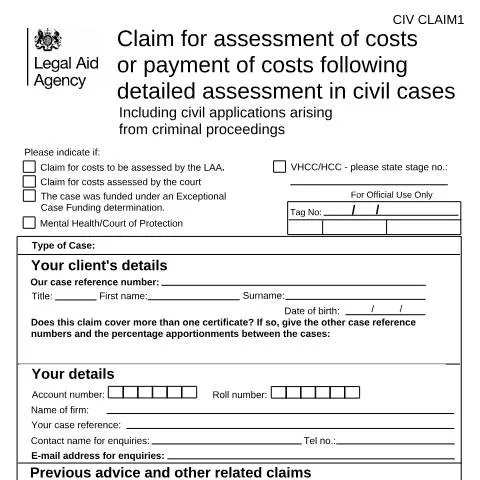
When Civil Litigation Meets Legal Aid: Understanding the CIV CLAIM1 Assessment Process
Legal aid solicitors handling civil cases face a critical juncture when their publicly funded work concludes: securing proper remuneration through the Legal Aid Agency's assessment system. The CIV CLAIM1 form serves as the gateway to this process, determining whether months of complex legal work receive appropriate compensation or fall victim to administrative oversights that can cost practices thousands of pounds.
This comprehensive claims form captures everything from initial client advice through to final court hearings, requiring solicitors to demonstrate not only the work undertaken but its necessity and proportionality. Unlike standard commercial billing, legal aid claims must satisfy stringent public funding criteria whilst navigating the tension between access to justice and taxpayer value.
The Dual Assessment Pathway: Court vs LAA Determination
The CIV CLAIM1 form accommodates two distinct assessment routes, each with fundamentally different implications for practitioners. Understanding which pathway applies determines both the documentation required and the likely timeline for payment.
Court-Assessed Claims: The Traditional Route
When costs are assessed by the court, typically following detailed assessment proceedings, the CIV CLAIM1 serves primarily as a notification document. The court has already scrutinised the work undertaken, determined appropriate hourly rates, and established the recoverable sum. Here, solicitors complete the form to claim payment of an already-determined amount, attaching the court's assessment certificate as definitive proof.
This route often applies in cases where:
- Costs were disputed by an opposing party
- The case involved substantial expenditure requiring judicial oversight
- Complex questions of proportionality arose during proceedings
- Multiple parties with conflicting interests were involved
LAA Assessment: Direct Agency Evaluation
The alternative pathway sees the Legal Aid Agency itself assessing both the quantum and reasonableness of costs claimed. This direct assessment route requires significantly more detailed justification, with solicitors effectively making their case to LAA case workers who lack the court's intimate knowledge of the proceedings.
LAA assessment typically occurs when:
- Cases conclude without contested costs proceedings
- Settlement agreements don't address legal costs specifically
- The matter falls below thresholds triggering automatic court assessment
- Procedural requirements haven't necessitated judicial cost determination
Deconstructing Client and Case Fundamentals
The form's opening sections establish the foundational elements that will influence every subsequent assessment decision. These seemingly straightforward fields contain numerous pitfalls that can derail claims months later.
Certificate Coverage and Apportionment Complexities
Where a single CIV CLAIM1 covers multiple legal aid certificates, practitioners must specify percentage apportionments between cases. This requirement recognises that solicitors often handle related matters under separate certificates, requiring careful allocation of time and costs. Failure to provide clear apportionment percentages can trigger assessment delays whilst the LAA seeks clarification.
The "final bill" designation carries particular significance. Marking a claim as final triggers automatic certificate closure, preventing submission of additional claims. Solicitors discovering omitted work or unexpected disbursements after submitting a "final" claim face complex reopening procedures that may not always succeed.
Prior Legal Help Integration
The form specifically addresses cases where clients received initial assistance under Legal Help, Family Help (Lower), or Help with Family Mediation before certificate funding commenced. This integration requirement reflects the LAA's need to understand the complete funding picture, particularly where pre-certificate advice influenced subsequent proceedings.
For cases beginning before 1st October 2007, solicitors must confirm total costs reported including VAT. Post-October 2007 cases require confirmation of amounts received excluding settlement fees but including VAT. This temporal distinction reflects significant changes to legal aid funding structures that continue to influence assessment approaches.
Temporal Boundaries and Procedural Milestones
Legal aid assessment operates within strict temporal frameworks that significantly impact both claim validity and payment prospects. The CIV CLAIM1 captures these critical dates whilst establishing the procedural context essential for accurate assessment.
| Date Category | Significance | Assessment Impact |
|---|---|---|
| Emergency certificate issue | Establishes funding commencement for urgent work | Determines eligible work periods and hourly rates |
| Substantive certificate issue | Confirms full representation authority | May trigger different assessment criteria |
| Proceedings issue date | Formal litigation commencement | Affects preparation vs hearing time allocation |
| Final work completion | Excludes bill preparation time | Defines claimable work boundaries |
Late Submission Implications
For pre-1st October 2007 certificates assessed by the LAA, late submission provisions apply where claims arrive beyond the three-month deadline. The form requires solicitors to identify the date from which this period runs and provide detailed explanations for any delay. The LAA maintains discretion to accept late claims, but explanations must demonstrate exceptional circumstances rather than administrative convenience.
Outcome Documentation and Recovery Obligations
The case outcome section serves dual purposes: establishing the proceedings' conclusion for assessment purposes and triggering additional obligations where property, damages, or costs were recovered. This section's completion directly influences both the assessment approach and potential statutory charge implications.
Certificate Outcomes Checklist Integration
Practitioners must utilise specific codes from the Certificate Outcomes Checklist when describing case conclusions. This standardisation enables consistent LAA data collection whilst ensuring assessment officers understand precisely how matters concluded. The five key outcome questions address:
- Case termination stage - whether resolution occurred pre-proceedings, during litigation, or post-trial
- Conclusion method - settlement, judgment, abandonment, or other resolution
- Result achieved - success level and benefit realisation for the client
- ADR utilisation - whether alternative dispute resolution was proposed or employed
- Public benefit achievement - broader societal advantages beyond individual client benefit
Recovery Implications and Statutory Charge Obligations
Where property, damages, or costs were awarded, solicitors must complete additional sections detailing recoveries. Property recovery or preservation triggers CIVADMIN 1 form submission requirements unless statutory charge decisions have already been made. This integration reflects the LAA's need to assess whether recovered amounts should contribute towards legal aid costs through the statutory charge mechanism.
Wasted costs orders require particular attention, with practitioners obliged to attach copies and complete dedicated sections. Such orders can significantly impact assessment approaches and may trigger enhanced scrutiny of the work claimed.
Time Recording Precision and Enhancement Justifications
The detailed work schedule represents the CIV CLAIM1's most critical component, requiring comprehensive chronological documentation of all chargeable activity. This section determines whether practitioners receive full compensation for their efforts or face significant reductions through assessment.
Activity Classification and Rate Determination
Work must be categorised across five distinct columns: preparation, attendance/conference, document examination/drafting, hearings, and travel/waiting time. Each category may attract different assessment approaches, with hearing attendance typically receiving more generous treatment than preparatory work. The chronological requirement ensures assessment officers can follow case development whilst identifying potential duplication or inefficiency.
Fee earner details must include initials, enabling verification against certificate authority letters and ensuring only authorised personnel conducted claimed work. Rate claims require careful consideration, as the LAA maintains detailed guidance on appropriate hourly rates for different practitioner grades and geographical areas.
Enhancement and Uplift Justification
Claims for enhanced rates or percentage uplifts demand full justification demonstrating exceptional case complexity, urgency, or practitioner expertise. The form specifically accommodates members of recognised accreditation schemes including:
- Resolution Specialist Accreditation Scheme
- Law Society's Family Law Advanced Accreditation Scheme
- Law Society's Children Law Accreditation Scheme
Panel member solicitors must sign dedicated declarations confirming their accreditation status. Where multiple panel members worked on the case, all must provide signed declarations or risk enhancement claims being rejected.
Counsel Integration and Payment Reconciliation
The CIV CLAIM1's counsel section addresses the complex relationship between solicitor claims and barrister payments, particularly where counsel operated under the Family Graduated Fee Scheme or Family Advocacy Scheme. This integration prevents double-payment whilst ensuring comprehensive case cost capture.
Outstanding Counsel Claims Verification
Practitioners must confirm whether all outstanding counsel claims have been paid by the LAA, providing detailed payment information including account numbers, dates of work, and total payments including VAT. This verification enables the LAA to cross-reference payments against their records whilst identifying any outstanding liabilities.
For court-assessed claims, summary information suffices provided payments are clearly identifiable on the assessed bill. However, LAA-assessed claims typically require more detailed breakdown enabling assessment officers to understand the complete cost structure.
Expert and Disbursement Documentation
Expert fees and other disbursements require separate documentation with detailed invoice breakdowns showing work undertaken and rates charged. Disbursement vouchers must contain sufficient detail enabling assessment officers to evaluate both necessity and reasonableness of expenditure.
The form distinguishes between preparation work and court attendance for experts, recognising these activities may attract different assessment approaches. Practitioners should ensure expert invoices clearly separate these elements to maximise recovery prospects.
Submission Strategy and Assessment Expectations
Successful CIV CLAIM1 submission requires strategic consideration of timing, documentation, and presentation to maximise payment prospects whilst minimising assessment delays. Understanding LAA processing approaches enables practitioners to structure claims optimally.
File Production and Reject Guidance
The form explicitly states that files "will not be required other than where provided in the published reject guidance." This represents a significant shift from historical practices where routine file production was expected. However, practitioners should maintain comprehensive records as the LAA retains discretion to request files where claims raise specific concerns or fall within reject guidance parameters.
The published reject guidance identifies circumstances triggering automatic file requests, including claims exceeding certain thresholds, cases involving unusual expenditure patterns, or matters where assessment officers identify potential concerns from the submitted documentation.
Processing Timelines and Payment Expectations
Assessment timelines vary significantly between court-assessed and LAA-assessed claims. Court-assessed claims typically process more rapidly as the judicial determination provides clear assessment parameters. LAA assessments require more detailed evaluation and may trigger requests for additional information or clarification.
Practitioners should anticipate potential queries from assessment officers, particularly regarding time allocation, enhancement claims, or unusual case features. Prompt response to such queries prevents processing delays that can extend payment timelines significantly.
The CIV CLAIM1 ultimately serves as both a technical document and a professional narrative, requiring practitioners to demonstrate not only what work was undertaken but why it was necessary and proportionate. Success depends on understanding both the form's technical requirements and the assessment philosophy underlying legal aid funding in civil cases.
Understanding the Court Fee Structure for CIV CLAIM1 Applications
The financial implications of submitting a CIV CLAIM1 form extend far beyond the initial court fee, requiring careful consideration of your claim's monetary value and potential additional costs. Unlike fixed-fee proceedings, civil claims processed through this form operate on a sliding scale that directly correlates with the amount you're seeking in damages or compensation.
For claims valued between £300 and £500, the court fee stands at £35, whilst claims ranging from £500.01 to £1,000 incur a £60 fee. As your claim value increases, so does the associated cost: claims between £1,000.01 and £1,500 require a £70 fee, and those from £1,500.01 to £3,000 carry an £80 charge. The fee structure becomes more substantial for higher-value claims, with amounts between £3,000.01 and £5,000 requiring a £115 fee, and claims from £5,000.01 to £10,000 incurring a £205 charge.
For significant claims exceeding £10,000, the fee calculation becomes more complex, typically representing a percentage of the total claim value. Claims between £10,000.01 and £200,000 generally incur a fee of 5% of the claim value, whilst those exceeding £200,000 may require specialist calculation or fall under different procedural tracks entirely.
Beyond the initial filing fee, successful claimants may recover certain costs from the losing party, though this isn't guaranteed. Consider potential expenses such as witness fees, expert testimony costs, and legal representation charges when evaluating the financial viability of your claim. The court may also impose additional charges for specific procedural steps, such as enforcement actions if the defendant fails to comply with a judgment.
Fee remission schemes exist for individuals experiencing financial hardship, potentially reducing or eliminating court fees entirely. Eligibility typically depends on your income, savings, and whether you receive certain means-tested benefits. The Help with Fees (HwF) scheme requires completion of form EX160, alongside supporting documentation proving your financial circumstances.
Navigating Response Procedures and Defendant Communications
Once you've submitted your CIV CLAIM1 form, the court initiates a formal process that requires the defendant to respond within specified timeframes, typically 14 days from service of the claim. Understanding this response mechanism proves crucial for managing expectations and preparing for various scenarios that may unfold during your case progression.
The defendant has several response options available, each triggering different procedural pathways. They may acknowledge service using form N9, effectively requesting additional time to prepare a full defence whilst avoiding default judgment. This acknowledgement extends their response deadline to 28 days from the original service date, providing breathing space for complex cases requiring detailed investigation or legal consultation.
Alternatively, the defendant might submit a full defence using form N11, challenging either the factual basis of your claim, the legal principles applied, or the quantum of damages sought. A well-constructed defence will address each allegation systematically, potentially introducing counterclaims that could complicate proceedings and extend resolution timelines significantly.
In some instances, defendants may admit liability whilst disputing the compensation amount, leading to quantum-only proceedings focused solely on determining appropriate damages. This scenario often accelerates resolution whilst maintaining the adversarial nature of determining fair compensation levels.
Default judgment becomes available when defendants fail to respond within prescribed timeframes, though obtaining such judgment requires careful attention to service requirements and procedural compliance. You must demonstrate proper service occurred and allow sufficient time for response before requesting default judgment through appropriate court channels.
Part admissions represent another common response, where defendants accept responsibility for some aspects of your claim whilst disputing others. These situations require careful evaluation of settlement opportunities versus continued litigation risks, often involving detailed negotiations around specific liability percentages and damage calculations.
The court's case management approach varies depending on claim complexity and defendant response type. Simple debt recovery cases with clear documentation may proceed through streamlined processes, whilst complex disputes involving multiple parties or technical evidence may require allocation to specific case management tracks with enhanced judicial oversight.
Evidence Compilation and Supporting Documentation Requirements
The strength of your CIV CLAIM1 application fundamentally depends on the quality and comprehensiveness of supporting evidence you compile and present to the court. This evidence must not only substantiate your factual allegations but also demonstrate the legal basis for your claim and justify the compensation amount sought.
Documentary evidence forms the backbone of most civil claims, requiring systematic organisation and strategic presentation. Contracts, correspondence, receipts, photographs, and official records must be chronologically arranged and clearly referenced within your particulars of claim. Each document should serve a specific purpose in advancing your case narrative, whether establishing the defendant's obligations, demonstrating breach of duty, or quantifying resulting damages.
Witness statements provide crucial first-hand accounts of relevant events, though their preparation requires careful attention to format and content requirements. Statements must be factual rather than argumentative, focusing on what witnesses personally observed or experienced rather than opinions or hearsay evidence. The Civil Procedure Rules specify particular formatting requirements, including numbered paragraphs, statement of truth declarations, and proper identification of document exhibits.
Expert evidence becomes necessary when technical or specialist knowledge exceeds ordinary experience, such as in professional negligence cases, construction disputes, or medical negligence claims. However, expert witnesses carry significant cost implications and require court permission in many circumstances. The expert's duty lies primarily with the court rather than the instructing party, demanding impartial analysis and clear explanation of technical concepts for judicial understanding.
Photographic evidence requires careful consideration of authenticity, relevance, and presentation standards. Images should be taken promptly after relevant incidents, properly dated, and accompanied by witness statements explaining their significance and context. Digital photography raises additional considerations around metadata preservation and potential manipulation concerns.
Financial documentation proves essential for damages quantification, requiring detailed records of losses incurred and expenses resulting from the defendant's actions or omissions. This might include medical bills, repair estimates, lost income calculations, or alternative accommodation costs. Each financial claim must be supported by appropriate receipts, invoices, or professional assessments demonstrating both the necessity and reasonableness of expenses claimed.
The disclosure process may require sharing relevant documents with opposing parties, even when potentially damaging to your case. Understanding disclosure obligations prevents procedural sanctions whilst ensuring compliance with overriding objectives of dealing with cases justly and proportionately.
Electronic evidence increasingly features in modern civil litigation, encompassing emails, social media communications, and digital records. Such evidence requires careful preservation to prevent allegations of tampering whilst ensuring proper authentication through appropriate technical procedures and expert testimony when necessary.