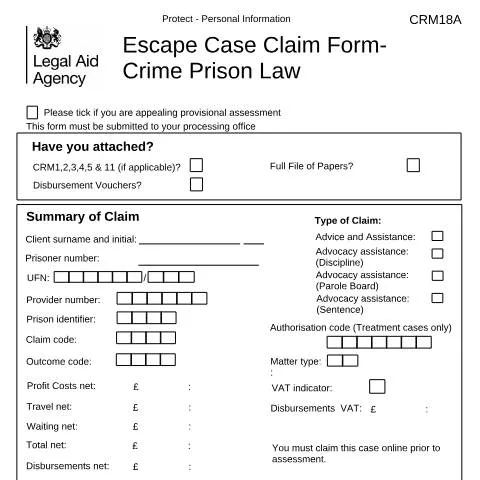
Understanding the CRM18A: Escape Fee Case Claim Form (Crime Prison Law)
The CRM18A form is an official document issued by the Legal Aid Agency in the United Kingdom, specifically designed for claiming fees related to legal assistance in cases involving crime prison law. This guide provides an overview of the purpose, scope, and key components of the CRM18A, helping legal practitioners and authorized providers understand its significance and how to properly complete and submit it.
Purpose and Application of the CRM18A
The primary objective of the CRM18A is to facilitate the claiming process for legal providers who have delivered advocacy or legal assistance services in prison law cases. These cases may involve various aspects of crime prison law, such as prison discipline, parole hearings, or sentence management. The form ensures that providers can accurately document the work undertaken, the associated costs, and justify disbursements, thereby enabling the Legal Aid Agency to process payments efficiently.
It is important to note that the CRM18A must be submitted following the completion of work, and prior to assessment, for cases eligible under the legal aid scheme. This process supports transparency and accountability in public funding for criminal legal aid services.
Scope and Key Features of the CRM18A
The form is structured to capture comprehensive details about the case, the work carried out, and the costs incurred. It is divided into several sections, each serving a specific function:
- Provider Details: Includes the name, contact information, provider number, and account details of the legal service provider.
- Case Summary: Encompasses client surname and initial, prison identifier, claim code, and outcome code. It also records the date when the work was completed and the total net costs claimed.
- Work Breakdown: Details the hours spent on various activities such as travel, waiting, attendance, preparation, phone calls, and correspondence. This is crucial for transparent fee calculation and audit purposes.
- Disbursements and VAT: Allows for claiming additional costs like disbursements, with specific fields for VAT and net amounts, ensuring compliance with regulatory requirements.
- Case-specific Information: Provides space for relevant case details that might influence payment or expedite processing, including any factors exceeding the Exceptional Case threshold.
Completing and Submitting the CRM18A
Legal practitioners must complete the CRM18A meticulously, ensuring all time entries and disbursements are recorded in chronological order. The form requires detailed logging of hours for each activity, with clear indication of initialers and dates, to maintain transparency and facilitate audit trails.
Before submission, providers should verify that all attached documents, such as vouchers or supporting papers, are included. The form must be submitted to the designated processing office, either physically or electronically, as specified by the Legal Aid Agency's protocols.
It is mandatory to claim this case online prior to assessment, aligning with the digital procedures established for legal aid claims. Providers should ensure their provider number and case identifiers are correctly entered to avoid delays.
Implications for Legal Providers and Clients
The CRM18A form streamlines the process of claiming fees for legal aid work in prison law cases, ensuring timely and accurate reimbursement. For legal providers, understanding the detailed requirements of the form helps prevent errors that could delay payment.
For clients, the use of this form supports the integrity of publicly funded legal services, maintaining accountability and transparency in the allocation of resources. It also ensures that providers are remunerated fairly for the work performed, encouraging continued access to legal aid in complex prison law cases.
Final Remarks
In summary, the CRM18A is a vital administrative tool within the UK's legal aid framework for prison law cases involving criminal matters. Proper completion and submission of this form are essential for the effective operation of legal aid services, safeguarding both taxpayer interests and the rights of individuals involved in the criminal justice system.