Navigating the Process: Understanding Form N258A's Role in Legal Aid
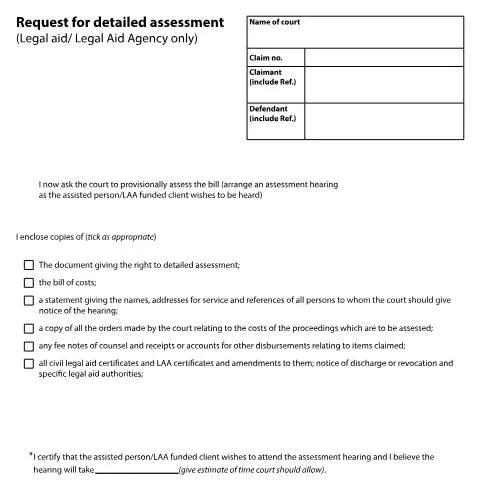
In the complex landscape of legal aid within the UK, Form N258A stands out as a crucial document for those seeking a detailed assessment of costs. When an individual or their solicitor believes that the legal expenses incurred during proceedings, funded by the Legal Aid Agency (LAA), need evaluation, this form becomes essential. It triggers the process of assessing the accuracy and appropriateness of the claimed costs, ensuring that all parties are treated fairly and justly under the law.
A Closer Look at the N258A: Key Components of the Form
Form N258A is structured to gather specific information necessary for a thorough assessment. Understanding each section can significantly influence the success of your application. Here’s a breakdown of the critical components:
Claim Details
- Name of Court: Clearly indicate the court where the case was heard. This is essential for proper processing.
- Claim Number: Ensure accuracy; any discrepancies could delay the assessment.
- Claimant and Defendant Information: Include comprehensive details, including references. This information is vital for the court to communicate effectively with all involved parties.
Enclosures: The Supporting Documents
The success of your submission hinges on the completeness of the enclosures. The form requests multiple documents, including:
- The document granting the right to a detailed assessment.
- The bill of costs, outlining the expenses incurred.
- A statement detailing the names and addresses of individuals to notify regarding the hearing.
- Copies of all court orders related to the costs that are under assessment.
- Fee notes or receipts for disbursements related to the claims.
- All relevant civil legal aid certificates, including any amendments.
Why Details Matter: Consequences of Incomplete Submissions
Submitting Form N258A with missing or incorrect information can derail the assessment process. The court may return the application, leading to delays that could frustrate your legal journey. To mitigate risks, ensure:
- Every document is current and correctly referenced.
- Enclosures are clearly marked and complete.
- The request for assessment is explicitly articulated, to avoid ambiguity.
The Legal Framework: Understanding the Regulation Behind Form N258A
The necessity for Form N258A arises from the regulations governing legal aid in the UK, primarily outlined in the Legal Aid, Sentencing and Punishment of Offenders Act 2012. This legislation mandates that costs incurred under legal aid be scrutinized to ensure they are reasonable and proportionate to the case. Understanding this legal backdrop is crucial for applicants, as it provides context to the assessment process.
Distinguishing Between Forms: N258A vs. Similar Documents
While there are several forms associated with legal aid and costs assessment, Form N258A serves a unique purpose. For instance:
| Form | Purpose | Notable Differences |
|---|---|---|
| N258A | Request for detailed assessment of legal aid costs. | Specific to legal aid-funded cases. |
| Form N260 | Summary costs assessment for cases not funded by legal aid. | Used for private clients and does not involve the LAA. |
| Form N252 | Application for costs in public law cases. | Focused on public law rather than general legal aid assessments. |
Completing the Form: Expert Tips for a Smooth Submission
Completing Form N258A accurately is key to ensuring a smooth assessment process. Here are several expert tips that can help:
Accuracy is Paramount
Double-check all information before submission. Any errors, particularly in names or references, could lead to delays.
Be Comprehensive in Your Documentation
Attach all required documents. Incomplete submissions are one of the top reasons for delays during processing.
Provide an Estimated Duration for the Hearing
Your estimate regarding the time required for the hearing helps the court to allocate resources appropriately. Be realistic; underestimating could lead to complications later.
The Court's Response: What Comes After Submission?
Once Form N258A is submitted, the court will review the application and enclosures. Here’s what typically happens next:
- Acknowledgment: The court will acknowledge receipt of your application.
- Assessment Hearing: If everything is in order, the court will schedule an assessment hearing. During this hearing, both parties can present their arguments regarding the costs.
- Decision: After reviewing the hearing details, the court will issue a decision on the validity of the costs claimed.
Making the Most of the Assessment Hearing
The assessment hearing is your opportunity to advocate for your position regarding the claimed costs. Here are some strategies to ensure effective participation:
- Prepare Your Arguments: Gather all necessary documents and prepare clear arguments about why the claimed costs are justified.
- Consult Legal Expertise: If possible, speak to a solicitor or legal advisor to bolster your case.
- Practice Clarity: Be concise and clear in your presentation, highlighting key points that support your claim.
Conclusion: Embracing the Process
Form N258A is more than just a piece of paperwork; it is a vital step in the journey towards justifying legal costs under the legal aid scheme. Understanding its components, the necessary documentation, and the overall framework ensures that applicants are well-equipped to navigate the assessment landscape. By embracing the process and preparing thoroughly, individuals can advocate effectively for their claims, paving the way for a fair resolution.
Understanding the Legal Aid Eligibility Criteria
When considering a detailed assessment for legal aid, it’s essential to understand the various eligibility criteria that the Legal Aid Agency (LAA) examines. The core aspects include financial eligibility, the type of case, and the merits of the application.
Financial eligibility is assessed based on your income and capital. If you’re applying for civil legal aid, your gross income must not exceed £2,657 per month if you have no dependents. For those with dependents, a different threshold applies, which may be higher based on the number of dependents you have. The LAA considers your disposable income after necessary expenses, and you might need to provide payslips, bank statements, and a detailed breakdown of your financial situation in the N258A application.
Capital assets are also scrutinised; you’re usually not eligible if your capital exceeds £8,000, excluding your primary residence and certain personal items. For cases involving family law, the threshold can be more flexible, particularly in domestic violence situations, where immediate support may be granted despite capital thresholds.
Moreover, the type of case plays a significant role in the approval process. Legal aid is available for a variety of cases, including family law, housing issues, and certain criminal cases. However, legal aid isn’t available for every type of case — for instance, applications related to commercial disputes are generally outside the scope of the LAA’s funding.
Finally, the merits test evaluates whether your case has sufficient legal grounds to pursue. This often involves an initial assessment by a legal representative who can ensure that pursuing legal action will likely result in a successful outcome. This merits assessment is particularly vital in complex fields like asylum and immigration law, where the nuances can significantly affect the likelihood of success.
In summary, being well-informed about these eligibility criteria will enhance your chances of successfully obtaining a detailed assessment for legal aid through the N258A form and ensure that your circumstances are presented thoroughly and accurately.
Completing Form N258A: Step-by-Step Guidance
When you take on the task of completing Form N258A for your detailed assessment of legal aid, following a structured approach can mitigate the chances of errors and delays. Here’s a step-by-step breakdown to guide you through the process effectively.
Step 1: Gather Necessary Documents Before starting the form, collect all required documentation. This includes proof of income, bank statements, proof of any capital assets, and documentation related to your legal matter. Having these at hand will streamline the filling process and help you provide accurate information.
Step 2: Fill Out Personal Information Begin by entering your personal details accurately. This includes your full name, address, date of birth, and National Insurance number. Ensure that all information is current and corresponds with your identification documents, as discrepancies can lead to rejection of your application.
Step 3: Detail Your Financial Situation The financial section of Form N258A will require detailed disclosures about your income and expenses. Be meticulous here — list all sources of income, including wages, benefits, and any other financial support. When detailing your expenses, include rent/mortgage, utility bills, and any other regular payments. The LAA uses this information to establish your disposable income and to determine if you meet the financial threshold for legal aid.
Step 4: Describe Your Legal Issue In this section, concisely describe the nature of your legal issue. Stick to factual information and avoid unnecessary details that do not pertain to your case. Clearly articulate the circumstances surrounding your situation, and include any prior attempts you’ve made to resolve the issue. This helps the LAA understand the context of your application.
Fill in your form directly online
No printing: type your details into the boxes of the official form, tick, then download the PDF ready to send.
- 1Type into the form boxes
- 2Tick in one click
- 3Save and download the PDF
Step 5: Review and Confirm Declaration Before submission, review the entire form for accuracy. Ensure that all fields are filled out completely and double-check mathematical calculations, particularly in the income and expenses sections. The final declaration statement is crucial, as by signing it, you affirm that the information provided is true to the best of your knowledge.
Step 6: Submit the Form Once you have filled out and reviewed Form N258A, submit it to the appropriate legal aid office. Ensure that you keep a copy of the submitted form for your records. Depending on your local LAA office, you may need to provide additional documentation, so check their specific requirements before submission.
Completing Form N258A does not have to be overwhelming. By preparing your documentation and following these steps diligently, you can navigate the legal aid assessment process more smoothly, thus increasing your chances of receiving necessary support.
Post-Application Process: What to Expect After Submission
After submitting your N258A form to the Legal Aid Agency, there are several key stages in the post-application process that you should be aware of. Understanding these can help manage expectations and ensure that you follow up appropriately.
Stage 1: Acknowledgment of Receipt Once your application is submitted, the LAA will send you an acknowledgment confirming that they have received your N258A form. This is typically sent by post or email, depending on your indicated preference. It’s wise to keep this acknowledgment for your records, as it serves as proof of submission.
Stage 2: Initial Review Your application will go through an initial review by LAA staff who will assess the completeness of your submission, including verifying that all required documentation is included. If there are any missing documents or information, they may contact you for clarification or additional details. Prompt response to any such requests is crucial to avoid delays.
Stage 3: Detailed Assessment Once the initial review is completed, a detailed assessment will be conducted. This involves a thorough evaluation of your financial situation and the merits of your case. The LAA may consult with legal professionals if necessary, especially for complex cases. During this phase, patience is important, as the time taken can vary significantly depending on the caseload and the complexity of your legal matter.
Stage 4: Decision Notification Upon completion of the assessment, you will receive a written notification outlining the decision regarding your legal aid application. If approved, the notice will detail the scope of the legal aid you are eligible for, including any limitations or conditions. In the case of denial, you’ll receive an explanation of the reasons for the decision, which may include insufficient financial resources or a determination that the case does not meet the necessary merits test.
Stage 5: Right to Appeal If your application is denied, you have the right to appeal the decision. The notification will include instructions on how to initiate an appeal, which typically involves submitting a request for reconsideration along with any additional evidence or information that may strengthen your case. Pay attention to any deadlines indicated in the notification, as delays in submitting an appeal can forfeit your right to contest the decision.
Stage 6: Reapplication or Alternative Options If your appeal is unsuccessful, or if you choose not to appeal, the LAA provides guidance on alternative options. This may involve considering other forms of assistance or adjusting your circumstances to meet eligibility criteria in the future. It’s crucial to remain proactive in seeking legal support, whether through private means or community resources.
Overall, understanding the post-application process can help alleviate some of the anxiety associated with applying for legal aid and ensure you are prepared for each subsequent step.