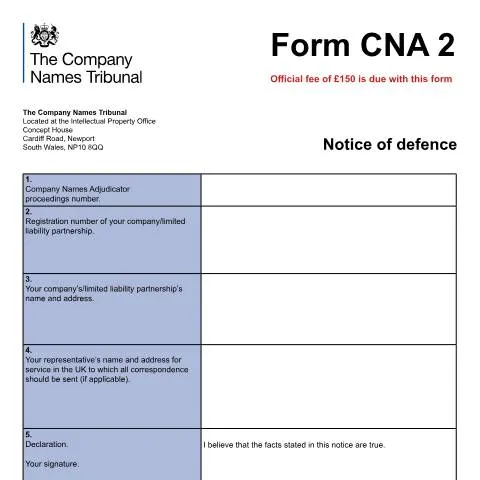
When Your Company Name Faces Challenge: Understanding the Defence Mechanism
Receiving an objection notice regarding your company name through the Company Names Tribunal can feel unsettling, particularly when you've operated under that name for months or years. The CNA 2: Notice of defence represents your formal opportunity to contest such challenges, providing a structured framework to present your case before the Company Names Adjudicator. This document becomes essential when another party claims your registered company name infringes their established rights or creates confusion in the marketplace.
The tribunal system, administered through the Intellectual Property Office in Newport, handles disputes where established businesses argue that newer registrations cause passing off or unfair competition. Understanding how to navigate this defence notice effectively can determine whether you retain your chosen trading identity or face costly rebranding.
The Strategic Landscape of Name Disputes
Company name conflicts typically arise when established businesses discover newer registrations that mirror their trading names, potentially causing consumer confusion. The Company Names Tribunal operates under specific statutory provisions, examining whether a registered name constitutes an opportunistic registration designed to exploit existing goodwill or genuinely reflects legitimate business intentions.
The defence process involves more than simply stating your position. You must demonstrate clear grounds for retaining your registration, whether through prior use, good faith adoption, or evidence that your activities don't materially affect the challenger's interests. The tribunal considers factors including:
- Chronological sequence of name adoption versus challenger's established usage
- Geographical overlap between business operations
- Similarity of goods or services offered
- Evidence of actual consumer confusion
- Commercial motivations behind the original registration
The £150 fee requirement reflects the tribunal's commitment to preventing frivolous defences while ensuring legitimate businesses can protect their interests. This cost consideration often influences strategic decisions about whether to contest or negotiate alternative solutions.
Decoding the Four Primary Defence Categories
The CNA 2 form presents four distinct defence grounds, each addressing different scenarios where name retention might be justified. Understanding these categories helps determine your strongest argumentative position.
Temporal Priority Defence
The prior registration defence applies when your company name was registered before the challenger established their claimed goodwill or reputation. This temporal argument requires careful documentation of registration dates against evidence of the applicant's commercial activities. Success depends on proving their business operations commenced after your formal registration, not merely their incorporation date.
This defence becomes particularly relevant in rapidly expanding markets where multiple businesses might adopt similar names independently. Digital businesses especially benefit from this approach, as online presence can be documented through archived web pages, social media accounts, and domain registration records.
Company Formation Business Defence
The formation business defence addresses situations where professional company formation services register names speculatively, then offer them for sale on standard commercial terms. This defence acknowledges legitimate business models while preventing abuse of the registration system.
To succeed with this approach, you must demonstrate:
- Operation of a genuine company formation business
- Standard pricing and terms applied consistently
- Willingness to transfer the name to the challenger on normal commercial terms
- Absence of specific targeting of the challenger's business
Good Faith Adoption
The good faith defence covers scenarios where names were chosen independently without knowledge of existing users. This requires evidence of genuine business reasons for the name selection, such as geographical references, descriptive terms, or personal connections.
Supporting evidence might include business planning documents, marketing materials, or correspondence showing the reasoning behind name selection. The defence becomes stronger when combined with evidence of substantial business development under the name.
Minimal Adverse Impact
The limited impact defence argues that your use doesn't significantly harm the challenger's interests. This approach suits situations where businesses operate in different geographical areas, serve distinct customer bases, or offer unrelated products and services.
Quantifying "significant extent" requires careful analysis of market overlap, customer demographics, and actual evidence of confusion or lost business. Trading statements, customer feedback, and market research can support this position.
Navigating the Opportunistic Registration Trap
The form includes a crucial warning about opportunistic registration, which can nullify the first two defence categories. If the tribunal determines your primary motivation was extracting payment from the challenger or preventing their registration, your defence options become severely limited.
Evidence suggesting opportunistic behaviour includes:
| Suspicious Indicators | Legitimate Business Markers |
|---|---|
| Immediate contact seeking payment after registration | Ongoing business operations under the name |
| Multiple similar registrations targeting one business | Consistent business development activities |
| No genuine trading activities | Investment in branding and marketing |
| Registration immediately after challenger's publicity | Independent name selection process |
Avoiding this classification requires demonstrating genuine business intentions through trading records, business plans, marketing expenditure, and operational activities. The tribunal examines the totality of circumstances rather than isolated factors.
Procedural Considerations and Strategic Responses
The defence notice requires systematic responses to the challenger's allegations, demanding careful analysis of their statement of grounds. Your response strategy should address three distinct elements: admitted facts, denied allegations, and claims requiring proof.
Admission and Denial Strategy
Selective admission of undisputed facts can strengthen your credibility while focusing attention on contested issues. For example, acknowledging your registration date while disputing claims about your business motivations or market impact creates a more targeted defence.
Denial should be specific and supported by evidence. Generic rejections appear weak compared to detailed rebuttals addressing particular factual claims. Where you lack sufficient information to respond definitively, requiring the applicant to prove their assertions shifts the evidential burden appropriately.
Supporting Documentation
The defence succeeds or fails based on supporting evidence quality. Relevant documentation might include:
- Corporate records: incorporation certificates, annual returns, business registrations
- Trading evidence: invoices, contracts, customer correspondence, trading statements
- Marketing materials: websites, advertisements, brochures, social media presence
- Temporal evidence: domain registrations, trademark applications, business planning documents
- Market analysis: customer surveys, competitor analysis, geographical trading patterns
Professional presentation of evidence enhances credibility, with clear chronological organisation and cross-referencing to specific defence grounds.
Cost Implications and Financial Strategy
The tribunal's cost award powers create significant financial stakes beyond the £150 filing fee. Unsuccessful parties may face substantial cost orders covering the opponent's legal fees, expert witness costs, and administrative expenses.
The form's cost claiming section requires strategic consideration. Claiming costs signals confidence in your position but may escalate the overall dispute value. Consider factors including:
- Strength of your defence evidence
- Challenger's apparent resources and determination
- Potential settlement opportunities
- Your own legal representation costs
Small businesses facing well-resourced challengers might prioritise quick resolution over cost recovery, while established businesses with strong positions may pursue full cost recovery to deter future challenges.
Representative Appointment and Professional Support
The form accommodates professional representation through dedicated address sections, acknowledging that name disputes often require specialist legal expertise. Intellectual property solicitors familiar with tribunal procedures can navigate complex evidential requirements and procedural deadlines more effectively than unrepresented parties.
Representative selection should consider tribunal experience specifically, as general commercial lawyers may lack familiarity with company names legislation and tribunal procedures. The address for service becomes crucial for receiving time-sensitive correspondence, with missed deadlines potentially compromising your defence.
Professional representation costs must be weighed against potential outcomes, considering both the value of retaining your chosen name and the risks of adverse cost orders. Some businesses opt for limited professional assistance with form completion while handling representation directly.
Payment Mechanics and Administrative Processing
The tribunal's payment system offers multiple options reflecting diverse business preferences and capabilities. Online card payments through the secure IPO portal provide immediate confirmation and processing, while traditional methods accommodate businesses preferring established payment channels.
The 16-digit reference number from online payments becomes crucial for linking payment to your defence submission. Recording this reference accurately prevents processing delays that might affect filing deadlines. Bank transfer options suit businesses with established IPO relationships or international operations requiring SWIFT transfers.
Deposit account facilities benefit frequent users of intellectual property services, providing streamlined payment processing and consolidated billing. However, maintaining adequate account balances requires forward planning, particularly for unexpected tribunal proceedings.
Processing typically commences upon receipt of both completed forms and confirmed payment, with incomplete submissions returned unprocessed. This administrative requirement emphasises the importance of thorough completion and payment verification before submission.
Strategic Considerations When Drafting Your Defence
The quality and comprehensiveness of your defence can significantly influence the trajectory of your case. Courts expect defendants to engage meaningfully with the claimant's allegations rather than simply denying everything without substance. A well-structured defence demonstrates that you understand the legal issues and have genuine grounds for contesting the claim.
When addressing each paragraph of the particulars of claim, consider whether you can admit certain uncontroversial facts whilst disputing the key allegations. For instance, in a contract dispute, you might admit that you entered into an agreement on a specific date but deny that you breached its terms. This approach can help narrow the issues in dispute and may reduce costs if the court later makes a costs order.
Pay particular attention to causation and quantum issues. Even if you accept that some breach or wrongdoing occurred, you might legitimately dispute whether it caused the claimant's losses or challenge the amount claimed. In personal injury cases, for example, you might accept liability for an accident but contest the severity of injuries claimed or argue that pre-existing conditions contributed to the claimant's condition.
Consider whether you have any counterclaims against the claimant. If the claimant owes you money or has themselves breached obligations, you can include these as counterclaims in your defence. This strategy can be particularly effective in commercial disputes where there are often cross-obligations between the parties. However, ensure any counterclaim is genuinely connected to the subject matter of the claim or arises from substantially the same facts.
The timing of your defence preparation is crucial. Whilst you have 14 or 28 days to file your defence, starting early allows time to gather supporting documents and consider your position carefully. If you're likely to need an extension, it's better to seek agreement from the claimant's solicitors before the deadline expires rather than risk a default judgment.
Common Pitfalls and How to Avoid Them
Many defendants undermine their cases through avoidable errors in their defence. One frequent mistake is making bare denials without explaining your version of events. Simply stating "denied" to each allegation may technically constitute a defence, but it provides no insight into your case and may prompt the court to order you to provide further information.
Another common error is raising defences that are legally insufficient or inappropriate to the type of claim. For example, in debt claims, defendants sometimes argue that they cannot afford to pay or that the creditor has treated them unfairly. Whilst these might be relevant to enforcement proceedings, they don't constitute valid defences to the underlying debt unless they point to specific legal issues such as unfair contract terms or procedural failures.
Be cautious about making allegations you cannot substantiate. If you claim the claimant has acted fraudulently or dishonestly, you must be prepared to prove these serious allegations. Courts take a dim view of unsubstantiated allegations of fraud, and you may face adverse costs consequences if you cannot support such claims.
Avoid the temptation to include irrelevant background information or emotional responses to the claim. Whilst you may feel aggrieved by the claimant's conduct, focus on legally relevant facts and defences. Personal grievances or lengthy explanations of your circumstances are generally unhelpful and may distract from your core legal arguments.
Document preservation is critical once proceedings commence. Ensure you maintain all relevant documents, emails, and records that might support your defence. The court may later order disclosure of documents, and you could face sanctions if relevant materials have been destroyed or lost after litigation began.
Consider the interplay between your defence and any insurance coverage you might have. If you have professional indemnity, public liability, or other relevant insurance, notify your insurers promptly. Many policies require immediate notification of potential claims, and delayed notification might prejudice your coverage. However, don't assume your insurers will automatically handle the defence – they may decline coverage or seek to avoid the policy.
Alternative Dispute Resolution and Settlement Considerations
Filing a defence doesn't preclude settlement discussions or alternative dispute resolution (ADR). Indeed, the court actively encourages parties to consider ADR throughout proceedings, and unreasonable refusal to engage in mediation or other ADR processes can lead to adverse costs orders even if you ultimately win the case.
Early engagement in settlement discussions can often resolve disputes more cost-effectively than proceeding to trial. Even if initial settlement attempts fail, they can help clarify the issues and may lead to resolution at a later stage. When engaging in settlement discussions, ensure any offers are marked "without prejudice" to prevent them being disclosed to the court if negotiations fail.
Part 36 offers represent a formal settlement mechanism with significant costs consequences. Either party can make a Part 36 offer at any stage of proceedings. If a defendant's Part 36 offer is not accepted and the claimant fails to obtain a judgment more advantageous than the offer, the claimant may be liable for the defendant's costs from the relevant date, even if they win the case overall.
Mediation can be particularly effective in commercial disputes, professional negligence claims, and cases involving ongoing relationships. The process is confidential, and parties retain control over the outcome, unlike court proceedings where a judge imposes a decision. Many courts now routinely stay proceedings to allow for mediation, particularly in cases where the parties haven't previously attempted ADR.
Consider whether expert determination might be appropriate for technical disputes. This process involves an independent expert making a binding decision on specific technical or valuation issues. It can be faster and less expensive than court proceedings for disputes that turn on expert evidence.
Early neutral evaluation offers another ADR option where an independent lawyer provides a non-binding assessment of the case's merits. This can help parties understand their positions realistically and may facilitate settlement discussions.
Remember that settlement discussions can continue even after filing your defence and throughout the court process. Many cases settle shortly before trial once the parties have a clearer understanding of the evidence and their respective positions. However, don't delay filing your defence in the hope that settlement negotiations will resolve the matter – you risk default judgment if you miss the deadline.