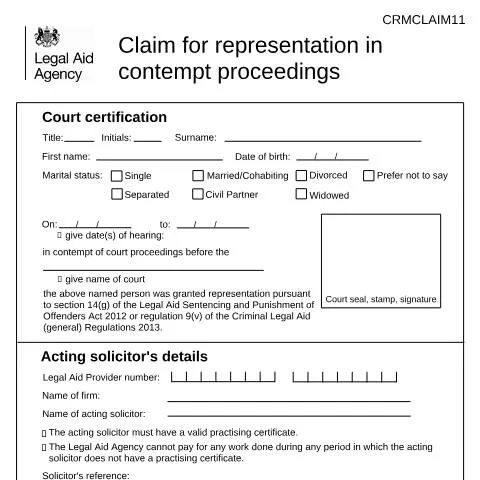
Understanding the CRMCLAIM11: A Critical Form for Representation in Contempt Proceedings
When individuals find themselves entangled in legal proceedings concerning contempt of court, the path can be fraught with complexity. One crucial document that aids legal representation in these situations is the CRMCLAIM11. Understanding the nuances and processes surrounding this form is essential for those seeking legal aid in the realm of contempt proceedings.
From Incident to Representation: The Lifecycle of the CRMCLAIM11
The CRMCLAIM11 is not merely a form; it embodies the journey of a legal case from its inception to the court's decision. This form is pivotal at a specific juncture — when a party involved in a contempt proceeding seeks representation. The process can be broken down into several key stages:
- Identification of Need: The need for legal representation arises when an individual faces allegations of contempt. This could be due to non-compliance with a court order or any action deemed obstructive to the judicial process.
- Engagement of Legal Counsel: Once the need is identified, engaging a solicitor with expertise in contempt proceedings is critical. The solicitor will guide the individual through the legal landscape.
- Filling Out the CRMCLAIM11: The next step involves completing the CRMCLAIM11. This stage requires careful attention to detail, as inaccuracies can delay the process.
- Submission for Approval: After filling out the form, it is submitted to the Legal Aid Agency for approval. The agency reviews the application to determine eligibility for legal aid.
- Representation in Court: Upon approval, the solicitor can represent the client in court, significantly increasing the chances of a favorable outcome.
Key Distinctions: CRMCLAIM11 versus Related Legal Aid Forms
It is essential to distinguish the CRMCLAIM11 from other forms within the Legal Aid framework. For instance, many may confuse it with the CRMCLAIM10, which is intended for general criminal legal aid claims. Here are some differentiating factors:
| Form Code | Purpose | Type of Proceedings | Eligibility Criteria |
|---|---|---|---|
| CRMCLAIM11 | Claim for representation in contempt proceedings | Contempt of Court | Depends on merits and financial eligibility |
| CRMCLAIM10 | Claim for general criminal legal aid | Criminal Proceedings | Merit-based assessment with distinct financial thresholds |
Understanding the distinct roles of these forms is vital to ensuring the right document is submitted, which directly impacts the ability to receive legal representation.
Navigating the CRMCLAIM11: Step-by-Step Completion Guide
Completing the CRMCLAIM11 requires precision. Here's a detailed overview of how to effectively fill out this critical document:
Personal Information
The initial sections request personal details of the claimant. This includes:
- Surname and First Name: Ensure that the names are spelled correctly, as they will be used throughout the legal proceedings.
- Date of Birth: Use the format dd/mm/yyyy to avoid confusion.
- Marital Status: This information may influence financial assessments and should reflect the current status accurately.
Details of Representation
Next, you must provide information regarding the acting solicitor and any counsel involved:
- Name of Firm and Solicitor: Clearly state the legal firm's name and the solicitor's name representing the claimant.
- Legal Aid Provider Number: This number is crucial as it verifies the solicitor's eligibility to handle legal aid cases.
- Contact Information: Accurate details here facilitate communication between parties involved in the case.
Financial Claims
One of the most critical sections pertains to financial claims for the legal representation:
- Standard Fees: This includes a breakdown of daily appearances and any additional costs incurred.
- Non-Standard Fees: If applicable, provide detailed narratives of the work done, including time spent and justification for the increased fees.
- Disbursements: Clearly outline any additional costs incurred during representation, such as travel expenses.
Crucial Deadlines and Follow-Up Actions
Time is of the essence when it comes to legal matters. The CRMCLAIM11 must be submitted in a timely manner to avoid jeopardizing one's legal standing. The following timeline is essential to remember:
- Submission Deadline: Claims for legal aid must be submitted as soon as the need is identified, ideally before the hearing date.
- Decision Notification: The Legal Aid Agency typically processes claims within 14 days, but it can vary. Stay alert for communication regarding the decision.
- Representation Timeline: Post-approval, the solicitor may proceed with representation in court, contingent on the timing of the approval.
Consequences of Incomplete Applications
Submitting an incomplete or inaccurate CRMCLAIM11 can have serious repercussions:
- Delayed Representation: Missing information can result in delays, leaving individuals vulnerable during court proceedings.
- Rejection of Claim: Inaccuracies may lead to outright rejection of the claim, requiring resubmission, which further complicates the timeline.
- Legal Penalties: In severe cases, providing false information could result in legal penalties or even criminal charges.
Thus, meticulous attention to detail is paramount when completing the CRMCLAIM11.
The Role of the Legal Aid Agency in the Process
The Legal Aid Agency (LAA) plays a significant role in the execution of the CRMCLAIM11. Their responsibilities include:
- Application Assessment: The LAA reviews submissions to ensure they meet financial and legal criteria for aid.
- Guidance Provision: They offer resources to help applicants understand their eligibility and the process surrounding legal aid claims.
- Ensuring Compliance: The LAA ensures that all legal practitioners involved meet the necessary qualifications and have valid practicing certificates.
Preparing for Court: What Comes Next?
After the CRMCLAIM11 is submitted and approved, the next phases include thorough preparation for the court hearings. Here’s what to expect:
- Strategy Sessions: The solicitor will conduct strategy sessions to outline the approach for the contempt proceedings.
- Gathering Evidence: It may be necessary to collect documents or testimony to substantiate the case.
- Court Appearance: The solicitor will represent the client during the proceedings, advocating on their behalf.
Each of these steps is crucial to building a strong defense or claim in contempt proceedings.
Long-Term Implications of Contempt Proceedings
Finally, it is important to consider the long-term implications that may arise from contempt proceedings:
- Reputation Damage: Being involved in contempt proceedings can impact an individual's reputation, particularly in business or public life.
- Legal Standing: Outcomes can affect future legal standing, particularly regarding compliance with court orders.
- Financial Consequences: Legal fees and potential penalties may lead to significant financial burdens.
Understanding these implications can help individuals approach their case with the seriousness it warrants.
Understanding Contempt Proceedings in the UK Legal System
Contempt proceedings can be complex, often arising from a breach of court orders or disruption of court proceedings. This section aims to demystify what contempt proceedings entail within the UK legal framework and their implications for involved parties.
There are two primary types of contempt: civil contempt and criminal contempt. Civil contempt typically revolves around the failure to comply with court orders, such as not attending court as ordered or disregarding a specific ruling. In contrast, criminal contempt involves actions that disrespect the court’s authority, such as behaving in a disorderly manner in the courtroom.
In the UK, contempt of court can lead to various consequences, including fines or imprisonment. The court may issue an injunction to compel compliance or impose sanctions to uphold the integrity of the judicial process. Understanding the nuances of contempt proceedings is crucial for anyone navigating the legal system, particularly when seeking representation through forms such as the CRMCLAIM11.
The Role of Legal Aid in Contempt Cases
Legal aid plays a significant role in ensuring that individuals facing contempt proceedings receive adequate representation, regardless of their financial situation. In the UK, Legal Aid Agency (LAA) provides funding for legal advice and representation, helping to ensure that justice is accessible to all.
Eligibility for legal aid in contempt cases depends on specific criteria, including the nature of the contempt, the applicant's financial circumstances, and the potential consequences of the proceedings. Applicants must complete a means test to assess their financial capability to pay for legal services. In cases involving civil contempt, legal aid may be more readily available if the case involves fundamental rights or significant public interest.
Moreover, understanding the procedure for applying for legal aid is vital. Those interested will typically need to fill out the appropriate forms, such as the CRMCLAIM11, and provide relevant documentation demonstrating their need for representation in contempt proceedings. It’s essential to ensure that applications are completed thoroughly, as incomplete submissions can cause delays in the provision of legal support.
Potential Outcomes and Appeals in Contempt Proceedings
Once contempt proceedings reach a conclusion, the outcomes can vary widely, and understanding these outcomes is critical for those involved. In instances where a party is found in contempt, the court may impose sanctions that could include fines, compensation orders, or, in severe cases, imprisonment.
However, if an individual believes that the court's decision was unjust or that their representation was inadequate, they have the right to appeal the ruling. The appeal process is governed by specific protocols, and it is advisable to seek the advice of a legal professional who can provide guidance tailored to the individual circumstances of the case.
Appealing a contempt ruling requires an understanding of the grounds for appeal, which typically include procedural errors made during the initial proceeding or new evidence that could impact the case's outcome. The appeal must be lodged within a specific timeframe, and the applicant may need to complete further paperwork, including potentially filing the necessary forms with the relevant court.
Additionally, it’s crucial to consider the implications of an appeal on the original sanction imposed. For instance, if the individual is subject to imprisonment, they may need to seek a stay of the sentence while the appeal is being considered, allowing them to remain free pending the outcome of the appeal.