Understanding the CIV CLAIM1A: Fixed Fee Public and Private Law Schemes
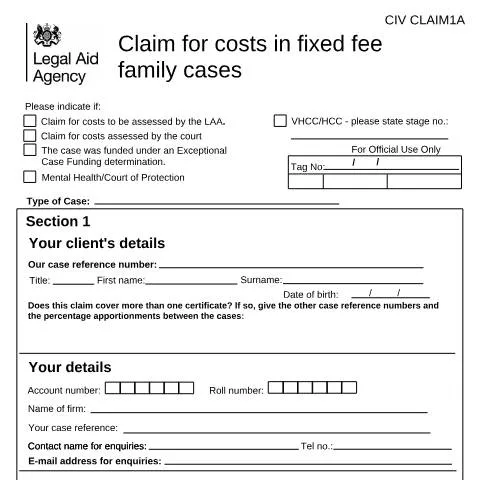
The CIV CLAIM1A is an official form used within the legal aid framework in the United Kingdom, specifically designed for claiming costs associated with legal aid-funded family law cases. Managed by the Legal Aid Agency (LAA), this form facilitates the process of claiming fixed fees for legal work carried out in family law proceedings, whether they are public or private law cases.
Scope and Purpose of the CIV CLAIM1A Form
The primary purpose of the CIV CLAIM1A is to enable legal practitioners to submit claims for costs incurred in family law cases that were supported through legal aid. This includes cases where legal advice, family help, or mediation assistance was provided. The form is applicable for both initial and final claims, and it can also be used when costs are to be assessed by the court or directly by the Legal Aid Agency.
It covers a broad spectrum of family law proceedings, including care and supervision cases, private law children cases, financial disputes, and domestic abuse cases. The form ensures transparency and accountability in the reimbursement process, aligning with the legal aid regulations and the legal framework governing personal data processing.
Who Should Use This Form?
The CIV CLAIM1A is intended for legal professionals acting on behalf of clients who received legal aid assistance in family law matters. This includes solicitors, legal representatives, and law firms involved in family law cases funded by legal aid. The form is applicable whether the case was funded under an exceptional funding determination or standard legal aid arrangements.
Legal practitioners must complete the form after the conclusion of a case or when submitting interim claims, ensuring that all costs are accurately documented and justified. The form also requires details of the case, the legal representative, and the client, including case references, client details, and the outcome of the proceedings.
Key Components and Information Required
- Case Details: Including the case reference number, type of case, and the stage at which the case ended.
- Client and Legal Representative Details: Names, contact information, and firm details.
- Costs and Disbursements: Actual costs incurred, broken down into solicitor and counsel advocacy, disbursements, and VAT.
- Outcome and Public Benefits: The final outcome of the case, whether alternative dispute resolution (ADR) was used, and if wider public benefits were achieved.
- Funding and Assessment: Whether the costs are to be assessed by the court or directly by the LAA, and details of any previous claims for payment on account.
Legal and Procedural Context
The form is governed by the legal aid regulations and the Data Protection Act 2018, including the UK GDPR, which ensure the confidentiality and proper handling of personal data. The completion and submission process requires careful attention to detail, especially regarding the costs incurred and the case's legal outcome.
Legal practitioners certify that the information provided is correct and that the work has not been claimed elsewhere. If costs are to be assessed by the LAA, a copy of the bill must be provided to the client, along with an explanation of their rights. The client must be given sufficient time (typically 21 days) to make any representations regarding the bill.
Conclusion
The CIV CLAIM1A form plays a vital role in the administration of legal aid costs in UK family law cases. It ensures that legal practitioners can claim appropriate fixed fees for their work, facilitating transparency and accountability in publicly funded legal services. Understanding the form's requirements and context is essential for legal professionals seeking to navigate the legal aid reimbursement process effectively.