When the Bailiffs Are at Your Door: Understanding the Last-Resort Defence of Form TE9
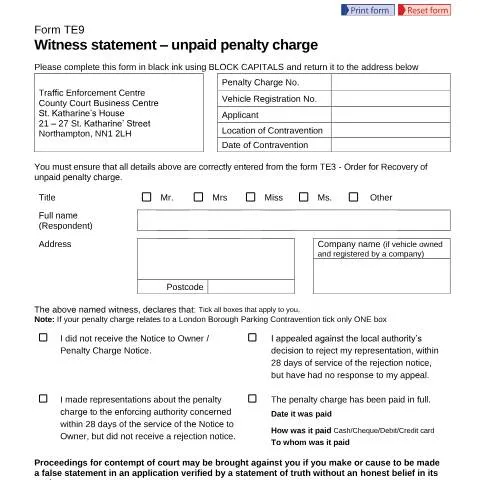
The brown envelope lands on your doormat with the unmistakable weight of official urgency. Inside, an Order for Recovery from the Traffic Enforcement Centre threatens bailiff action for an unpaid penalty charge that has spiralled from a modest fine into a substantial debt. For many motorists, this represents the final stage of enforcement action—but Form TE9 offers one last avenue to halt the proceedings and present your case to the court.
This witness statement form serves as your formal defence when enforcement proceedings have reached the county court level, typically months after the original parking contravention or traffic violation occurred. Unlike earlier stages in the process where you might correspond directly with the issuing authority, TE9 requires you to make a sworn statement to HM Courts & Tribunals Service, carrying all the legal weight and potential consequences that entails.
The form addresses a critical gap in the enforcement system: situations where genuine procedural failures or administrative errors have prevented you from exercising your statutory rights to challenge a penalty charge through normal channels. Whether you never received crucial notices, made timely representations that went unanswered, or have already settled the debt, TE9 provides the mechanism to present evidence that could halt or reverse enforcement action.
The Enforcement Journey: How Cases Reach the TE9 Stage
Understanding when and why you might need Form TE9 requires grasping the typical enforcement timeline that precedes it. The process begins with the initial penalty charge notice, whether issued on-street by a traffic warden or sent by post following detection by cameras or other automated systems.
For parking contraventions in London boroughs, the journey follows a distinct path under the Traffic Management Act 2004. After the initial penalty charge notice, vehicle keepers receive a Notice to Owner if the charge remains unpaid, typically within 28 days. This notice provides a fresh opportunity to pay the reduced penalty or make formal representations challenging the charge.
Outside London, local authorities follow similar procedures but with variations in timescales and processes. Some councils operate under civil parking enforcement powers, while others still use the older decriminalised parking enforcement systems. Regardless of the specific regime, all follow a broadly similar escalation pattern.
When representations are rejected or no response is received to the Notice to Owner, the case can progress to an independent adjudicator. For London boroughs, this means the London Tribunals (part of HM Courts & Tribunals Service), while other areas use the Traffic Penalty Tribunal. Failure to appeal at this stage, or an unsuccessful appeal, triggers the final enforcement phase.
The local authority then applies to the Traffic Enforcement Centre for an Order for Recovery, essentially converting the unpaid penalty charge into a county court debt. This order carries the full weight of a court judgment, enabling bailiff action, attachment of earnings, or charging orders against property. It is at this critical juncture that Form TE9 becomes relevant.
Four Grounds for Challenge: The Limited But Powerful Defences Available
Form TE9 restricts witness statements to four specific grounds, each addressing fundamental procedural failures that could have prevented you from exercising your statutory rights. The form makes a crucial distinction between London borough parking contraventions, where you may cite only one ground, and other traffic enforcement cases, where multiple grounds can apply simultaneously.
Non-Receipt of Critical Notices
The most commonly cited ground involves non-receipt of either the original Penalty Charge Notice or the subsequent Notice to Owner. This defence recognises that the entire enforcement system depends on proper service of notices, and failure to receive them fundamentally undermines the legitimacy of subsequent proceedings.
For postal notices, the law generally presumes service occurred if sent to the registered keeper's address as recorded with DVLA. However, this presumption can be rebutted with evidence such as prolonged absence from the address, postal disruption, or incorrect address details. The courts recognise that vehicle registration records may not reflect current addresses, particularly for leased vehicles or recent purchases.
Proving non-receipt requires more than simply asserting you didn't see the notice. Consider gathering supporting evidence such as mail redirection records, proof of absence during the relevant period, or witness statements from household members who would normally receive post.
The Unanswered Representation
This ground addresses situations where you made timely representations to the enforcing authority but received no response—specifically, no rejection notice. The system assumes that authorities will either accept representations (cancelling the charge) or issue a formal rejection notice explaining their decision and your right of appeal.
When authorities fail to respond within reasonable timeframes, you lose the opportunity to appeal to an independent adjudicator, as appeal rights typically expire 28 days after service of the rejection notice. Form TE9 allows you to bring this procedural failure to the court's attention.
Essential evidence includes copies of your original representations, proof of their timely submission (such as email delivery receipts or recorded delivery confirmations), and records showing no rejection notice was received. Some authorities acknowledge receipt of representations but then fail to issue decisions—this documentation becomes crucial evidence.
The Ignored Appeal
Similar to unanswered representations, this ground covers situations where you appealed the authority's rejection to the appropriate tribunal but received no response or acknowledgment. Independent adjudicators are required to process appeals within statutory timeframes and issue reasoned decisions.
This defence is less common but can occur during periods of high tribunal workload or administrative difficulties. The key requirement is demonstrating that your appeal was submitted within the 28-day deadline following receipt of the rejection notice, and that you received no subsequent communication from the tribunal.
Payment Already Made
Perhaps the most straightforward ground involves cases where you have already paid the penalty charge in full but enforcement action has continued due to administrative errors. This can occur when payments are processed incorrectly, allocated to wrong penalty charge numbers, or simply not recorded by the issuing authority's systems.
Form TE9 requires specific details about your payment: the exact date, method (cash, cheque, debit or credit card), and recipient. You must be prepared to provide proof of payment upon request, so gather bank statements, receipts, or other documentation before submitting your witness statement.
Payment-related defences often arise with online payment systems where technical glitches can prevent proper processing, or where vehicle registration numbers are entered incorrectly, causing payments to be allocated to wrong cases.
Navigating the London Borough Exception: Special Rules for Capital Parking
Form TE9 treats London borough parking contraventions differently from other traffic enforcement cases, reflecting the distinct legal framework governing parking in the capital. This differentiation stems from London's unique position under various Transport for London Acts and the special powers granted to London borough councils.
The critical restriction for London cases is that you may cite only one ground in your witness statement. This limitation requires careful consideration of which defence offers the strongest prospect of success. You cannot, for example, argue both that you never received the Notice to Owner and that your representations went unanswered—you must choose the single ground that best reflects your circumstances.
This restriction doesn't apply to traffic enforcement cases outside London, where multiple grounds can be cited simultaneously. A motorist challenging a bus lane penalty in Birmingham, for instance, could argue both non-receipt of notices and failure to respond to representations within the same TE9 statement.
The practical implication is that London borough cases require more strategic thinking. If you have potential grounds under multiple categories, consider which offers the strongest evidential foundation. Non-receipt of notices, while common, can be harder to prove definitively than documentary evidence of ignored representations or duplicate payments.
London's parking enforcement also operates under different appeal structures, with cases proceeding to London Tribunals rather than the Traffic Penalty Tribunal used elsewhere. This can affect the type of documentation available and the specific procedures that should have been followed.
Completing Form TE9: Technical Requirements and Common Pitfalls
Form TE9 demands meticulous attention to detail, beginning with the basic requirement to complete it in black ink using block capitals. This seemingly minor specification reflects the form's status as a court document that may be scanned, copied, and reviewed by multiple officials throughout the process.
The opening section requires you to transfer information precisely from your TE3 Order for Recovery, including the penalty charge number, vehicle registration, applicant details, contravention location, and date. These details must match exactly—any discrepancies could invalidate your witness statement or cause administrative delays while the court seeks clarification.
| Information Required | Source Document | Common Errors |
|---|---|---|
| Penalty Charge Number | TE3 Order for Recovery | Confusing with reference numbers from other correspondence |
| Vehicle Registration | TE3 Order for Recovery | Including spaces or hyphens where none exist in original |
| Contravention Location | TE3 Order for Recovery | Abbreviating or paraphrasing the official description |
| Contravention Date | TE3 Order for Recovery | Using different date format or misreading handwritten dates |
The personal details section accommodates various scenarios, including company-owned vehicles where the business name should be entered in the designated field. For individuals, ensure your full name matches that shown on the Order for Recovery, as variations could cause processing delays.
The checkbox section requires careful attention to the distinction between London borough cases (tick only one box) and other enforcement actions (tick all applicable boxes). Misunderstanding this requirement is a frequent source of confusion that can weaken otherwise valid challenges.
When completing the payment details section, be as specific as possible. Rather than simply stating "paid by card," specify whether it was a debit or credit card, and include partial card numbers if available. The recipient field should name the specific council, parking company, or payment processor—generic descriptions like "the council" may not provide sufficient clarity.
The Statement of Truth: Legal Consequences and Responsibilities
Form TE9 concludes with a statement of truth, elevating your witness statement to the level of evidence given under oath. The form explicitly warns that "Proceedings for contempt of court may be brought against you if you make or cause to be made a false statement in an application verified by a statement of truth without an honest belief in its truth."
This warning carries genuine legal weight. Contempt of court proceedings can result in fines, imprisonment, or both, making it essential to ensure every statement in your TE9 form is accurate and honestly believed to be true. The standard is not absolute certainty but rather an honest belief based on your knowledge and recollection of events.
The signature section accommodates various scenarios where someone other than the named respondent might sign the form. Company officers can sign on behalf of corporate vehicle owners, partners can sign for business partnerships, and litigation friends can act for protected parties under the Mental Capacity Act 2005. Each category has specific legal requirements about who qualifies and what authority they possess.
Submission Channels and Deadlines: Racing Against the Enforcement Clock
Form TE9 must be filed by the date specified on your Order for Recovery, typically allowing only 21 days from the date of the order. This tight deadline reflects the advanced stage of enforcement proceedings and the court's need to resolve matters promptly before bailiff action commences.
The Traffic Enforcement Centre accepts TE9 submissions through two primary channels: postal delivery to their Northampton address and email submission to [email protected]. Each method has distinct advantages and considerations that could influence your choice of submission route.
Postal submission provides a traditional paper trail with proof of posting available through recorded delivery services. However, it carries the risk of postal delays, particularly near the deadline. The Traffic Enforcement Centre processes significant volumes of correspondence, and postal submissions may take several days to be logged and acknowledged.
Email submission offers faster delivery and immediate confirmation of transmission, but requires careful attention to file formats and size limits. The court systems may not accept certain file types or very large attachments, potentially causing delays if resubmission becomes necessary.
Regardless of submission method, retain evidence of when and how you filed your TE9 form. Email confirmations, postal receipts, or delivery confirmations could become crucial if the court claims non-receipt or late submission. Given the serious consequences of missing the deadline—typically the immediate resumption of enforcement action—consider submitting well before the final date where possible.
After Submission: What Happens Next
Once the Traffic Enforcement Centre receives your TE9 witness statement, enforcement action should be suspended pending the court's consideration of your evidence. However, this suspension is not automatic, and you may need to contact bailiffs or enforcement agents directly if they continue pursuing collection action.
The court will review your witness statement and supporting evidence, potentially requesting additional documentation or clarification. In straightforward cases involving clear procedural failures or payment evidence, the court may set aside the Order for Recovery without further proceedings.
More complex cases might require a court hearing where you can present oral evidence and respond to questions from the district judge. The enforcing authority may also be represented, particularly in cases involving significant sums or disputed facts.
Successful TE9 applications typically result in the Order for Recovery being set aside, returning the case to its pre-enforcement status. This might mean the penalty charge is cancelled entirely, or that you regain the right to pursue appeals through the appropriate tribunal. The specific outcome depends on the grounds of your challenge and the court's assessment of what procedural stage the case should return to.
Strategic Considerations: When TE9 May Not Be Your Best Option
While Form TE9 provides a valuable last-resort mechanism for challenging enforcement action, it's not always the most appropriate or effective response to an Order for Recovery. Understanding its limitations and alternatives can help you make informed decisions about how to proceed.
TE9 witness statements are restricted to the four specific grounds outlined in the form. If your challenge to the penalty charge is based on other factors—such as disputed liability, defective signage, or procedural errors in the original investigation—TE9 may not provide an appropriate vehicle for your defence. These substantive challenges typically needed to be raised much earlier in the process through representations to the issuing authority or appeals to the relevant tribunal.
The form also requires you to demonstrate procedural failures in the enforcement process itself, rather than challenging the underlying merits of the penalty charge. If you received all notices correctly, made no representations, and failed to appeal within the statutory timeframes, TE9 is unlikely to provide a successful defence regardless of whether you believe the original penalty charge was justified.
Financial hardship, while a legitimate concern, is not grounds for a TE9 witness statement. If your primary issue is inability to pay rather than procedural failures in the enforcement process, you might be better served by contacting the Traffic Enforcement Centre directly to discuss payment arrangements or seeking debt advice from recognised agencies.
Consider also whether the effort and potential risks of submitting a TE9 form are proportionate to the penalty charge amount. While the principle of challenging unjust enforcement action is important, small penalty charges that have escalated through non-payment might be more practically resolved through payment, particularly if your grounds for challenge are weak or difficult to prove.
The statement of truth requirement means that unsuccessful TE9 applications carry potential consequences beyond simply losing the challenge. If the court determines that your witness statement was knowingly false or made without honest belief in its truth, you could face contempt proceedings in addition to the original enforcement action resuming.
Building Your Evidence Base
Successful TE9 applications typically depend on documentary evidence that supports your witness statement. Before completing the form, gather all relevant documentation and assess whether it provides sufficient support for your chosen ground of challenge.
For non-receipt claims, consider evidence such as mail redirection records, proof of absence from your registered address, medical records showing hospitalisation during the relevant period, or witness statements from household members. Simply asserting that you didn't receive notices is rarely sufficient without corroborating evidence.
Unanswered representation cases require copies of your original submission, proof of timely delivery, and records showing no rejection notice was received. Email systems provide detailed delivery logs, while postal submissions should be supported by recorded delivery receipts or similar proof of posting.
Payment-related defences need comprehensive financial records showing when, how, and to whom payment was made. Bank statements, credit card bills, online payment confirmations, or receipts from payment offices all strengthen your case. Be prepared to provide additional financial information if the court requests verification.
The Traffic Enforcement Centre may request additional evidence after reviewing your initial TE9 submission. Gather supporting documentation before submitting your witness statement, but be prepared to provide further details or clarification if requested. The court's willingness to set aside enforcement orders often depends on the strength and credibility of the evidence presented.