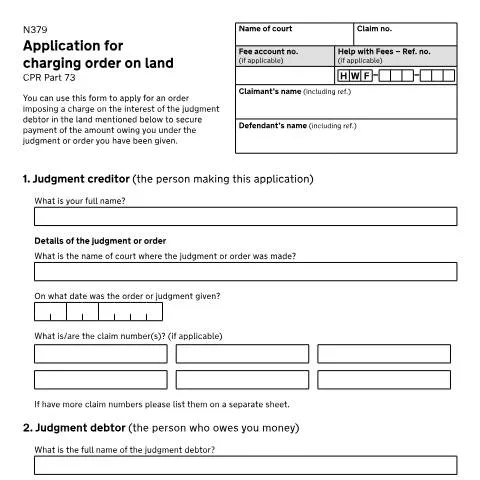
When Court Judgments Meet Property Assets: The Strategic Role of Form N379
Securing payment from a judgment debtor who owns property requires a sophisticated legal mechanism that bridges civil enforcement with property law. Form N379 serves as the gateway to obtaining a charging order on land or property, transforming an unsecured court judgment into a secured interest that follows the debtor's real estate assets. This enforcement tool becomes particularly valuable when traditional debt recovery methods prove insufficient, especially where debtors possess substantial property wealth but limited liquid assets.
The charging order process represents one of the most powerful enforcement mechanisms available through HM Courts & Tribunals Service, effectively creating a legal charge similar to a mortgage over the judgment debtor's property interest. Unlike other enforcement methods that require immediate asset seizure, a charging order provides long-term security that can ultimately lead to forced sale proceedings if the debt remains unpaid.
Eligible Judgment Creditors and Qualifying Debt Scenarios
The N379 application process is reserved for specific categories of judgment creditors who meet stringent qualifying criteria. Primary applicants include individuals, companies, and organisations who have obtained a money judgment from any court within England and Wales, provided the judgment debtor owns or holds an interest in land or property.
Standard Judgment Debt Requirements
For conventional court judgments, applicants must demonstrate that their judgment or order requires the debtor to pay a specific monetary amount. The form accommodates various judgment scenarios:
- Immediate payment judgments where no instalment provision was made
- Post-October 2012 judgments that benefit from streamlined enforcement procedures
- Pre-October 2012 judgments where instalment payments have fallen into arrears
Crucially, there is no minimum debt threshold for standard judgment debts, though practical considerations suggest that charging order applications are most cost-effective for substantial sums given the court fees and legal complexities involved.
Council Tax Liability Order Enforcement
A distinct pathway exists for local authority creditors seeking to enforce council tax debts through magistrates' court liability orders. These applications require a minimum outstanding debt of £1,000 and must include comprehensive evidence of the debt's validity. This threshold reflects the serious nature of converting council tax arrears into property charges and prevents disproportionate enforcement action.
Local authorities pursuing this route must attach detailed evidence demonstrating the liability order's validity, the calculation of outstanding amounts including any statutory interest, and confirmation that standard recovery methods have been exhausted or deemed inappropriate.
Identifying and Verifying the Judgment Debtor's Property Interest
The success of any charging order application hinges on accurately identifying and legally establishing the judgment debtor's interest in specific land or property. This process requires meticulous investigation and proper documentary evidence to satisfy court requirements.
Registered Land Documentation
For properties with registered titles at HM Land Registry, applicants must obtain and attach current office copies of the relevant Land Register entries. These documents provide definitive proof of ownership structures and any existing charges or restrictions. The title number must be specified precisely, and where multiple titles are involved, separate office copies for each title are required.
The Land Registry documentation reveals crucial information about the nature of the debtor's interest, including:
| Ownership Type | Documentation Required | Enforcement Implications |
|---|---|---|
| Sole ownership | Single proprietor entry | Full charging order available |
| Joint ownership | Multiple proprietor entries | Charge limited to debtor's share |
| Beneficial interest | Trust documentation | Complex valuation required |
| Partnership property | Partnership agreements | Business asset complications |
Unregistered Land Challenges
Unregistered land presents significantly greater evidentiary challenges, requiring alternative documentation to establish the debtor's interest. Acceptable evidence may include title deeds, conveyances, probate documents, or statutory declarations. The court scrutinises such evidence more carefully given the absence of Land Registry confirmation.
Navigating Complex Ownership Structures and Third-Party Interests
Property ownership rarely exists in isolation, and Form N379 requires comprehensive disclosure of all parties who may hold interests in the target property. This requirement serves both procedural fairness and practical enforcement purposes, ensuring all affected parties receive proper notice and can participate in proceedings.
Identifying Co-owners and Beneficiaries
Where property is jointly owned, whether as joint tenants or tenants in common, all co-owners must be identified and served with the charging order application. This includes spouses, civil partners, family members, or business associates who appear on the title or hold beneficial interests behind a trust structure.
Trust arrangements require particular care, as the charging order may affect both legal owners (trustees) and beneficial owners. The application must specify whether the judgment was obtained against the debtor in their personal capacity or as a trustee, as this fundamentally affects the scope of any charging order granted.
Occupational Rights and Restrictions
Beyond ownership interests, the form requires disclosure of persons with occupational rights, including:
- Tenants under residential or commercial leases
- Family members with rights of occupation under family law
- Persons claiming adverse possession or proprietary estoppel
- Mortgagees and other secured creditors
Failure to identify and serve relevant parties can result in the charging order being set aside or enforcement complications arising later in the process.
Competing Creditor Considerations and Priority Disputes
The N379 application requires honest disclosure of the applicant's knowledge regarding other creditors of the judgment debtor. This transparency serves multiple functions: it assists the court in assessing the proportionality of granting a charging order, helps establish priority between competing creditors, and may influence subsequent enforcement strategies.
Secured vs Unsecured Creditor Dynamics
Existing secured creditors, particularly mortgage lenders, typically take priority over charging orders in any eventual sale proceeds distribution. The application must acknowledge known mortgages, second charges, or other security interests that would rank ahead of the proposed charging order.
Where multiple unsecured creditors exist, charging orders generally rank according to the date of the court order rather than the underlying debt. This creates strategic timing considerations for creditors aware of competing enforcement action by other parties.
Insolvency Risk Assessment
Courts consider the broader creditor picture when evaluating charging order applications, particularly where the debtor faces multiple enforcement actions that might trigger insolvency proceedings. A charging order granted shortly before bankruptcy may face challenges from insolvency practitioners, especially if it appears to prefer one creditor over others unfairly.
Court Submission Procedures and Documentary Requirements
The N379 application follows strict procedural requirements that must be satisfied for the court to consider the application. Incomplete submissions are routinely returned, causing delays and potential prejudice to the applicant's position.
Essential Supporting Documentation
Every N379 application must include specific supporting documents tailored to the case circumstances:
- Certified copy of the original judgment or order establishing the debt
- Current Land Registry office copies for registered land or equivalent proof for unregistered property
- Evidence of service of statutory demands where applicable
- Liability order documentation for council tax enforcement cases
- Up-to-date debt calculation including interest accrued to the application date
For liability order enforcement, additional documentation must demonstrate the £1,000 minimum threshold and provide detailed evidence of the debt's composition and validity.
Court Fee Structure and Payment Methods
Charging order applications attract standard court fees, though the exact amount varies depending on the debt value and court location. Applicants may qualify for fee remission under the Help with Fees scheme, requiring completion of form EX160 and provision of financial evidence demonstrating eligibility.
Fee account holders can reference their account details on the form, while other applicants must include payment by cheque, postal order, or arrange telephone payment where facilities exist.
The Two-Stage Court Process and Interim Protection
Unlike many court applications that result in immediate final orders, charging order applications follow a distinctive two-stage process designed to balance creditor rights with debtor protection and third-party interests.
Interim Charging Order Stage
Upon initial consideration, courts typically grant an interim charging order if the basic requirements appear satisfied. This interim order provides immediate protection by preventing the debtor from disposing of the property without court permission, while allowing time for proper notice to all interested parties.
The interim order triggers a notice period during which the judgment debtor, property co-owners, and other interested parties can object to the charging order being made final. Common objection grounds include disputes over the debt's validity, challenges to the debtor's property interest, or arguments that the charging order would cause exceptional hardship.
Final Charging Order Determination
Following the notice period, the court conducts a final hearing where objections are considered and the proportionality of granting a final charging order is assessed. The court examines factors including:
- The debt's size relative to the property value
- The debtor's personal circumstances and ability to pay
- The impact on co-owners and family members
- Whether alternative enforcement methods might be more appropriate
- The creditor's conduct and the debt's origins
Courts possess discretionary powers to refuse charging orders even where technical requirements are met, particularly where granting the order would be disproportionate or unfair in the circumstances.
Post-Order Enforcement Pathways and Strategic Considerations
A final charging order represents a significant milestone rather than the conclusion of the enforcement process. The charging order secures the debt against the property but does not automatically provide payment, requiring additional strategic decisions about ultimate enforcement methods.
Order for Sale Applications
Where the charging order alone fails to prompt voluntary payment, creditors may apply for an order for sale under section 14 of the Trusts of Land and Appointment of Trustees Act 1996. These applications require separate proceedings and involve complex considerations balancing creditor rights against occupier interests, particularly where family homes are involved.
Courts approach sale applications cautiously, especially regarding residential properties occupied by the debtor's family. Factors including children's welfare, alternative accommodation availability, and the proportionality between debt and property value all influence the court's decision.
Registration and Priority Protection
Final charging orders should be registered at HM Land Registry as soon as possible to protect the creditor's priority against subsequent purchasers and creditors. Registration creates a public record of the charge and prevents the debtor from selling the property without addressing the secured debt.
The charging order remains in place until the debt is satisfied in full, the property is sold with proceeds applied to the debt, or the order is successfully challenged and set aside. This creates long-term security that can prove valuable even where immediate enforcement is impractical, particularly in cases involving property with development potential or expected appreciation.
Understanding the Court's Assessment Process for Charging Orders
When you submit Form N379, the court undertakes a structured assessment process that weighs multiple factors before granting a charging order. Understanding this evaluation framework can significantly improve your application's prospects and help you prepare for potential challenges.
The court's primary consideration centres on proportionality—whether securing the debt against property represents a reasonable response given the circumstances. For debts under £1,000, courts typically scrutinise applications more rigorously, requiring compelling evidence that other enforcement methods have been exhausted or would prove futile.
Property value plays a crucial role in the assessment. If your judgment debt represents less than 10% of the property's estimated value, the court may question whether a charging order provides adequate protection for other creditors or family members with interests in the property. Conversely, where the debt constitutes a substantial portion of the property's worth, courts generally view charging orders more favourably.
The debtor's personal circumstances receive careful scrutiny, particularly where the property serves as their primary residence. Courts consider factors such as dependent children, elderly relatives, or disabled family members who might face hardship if the property were ultimately sold. However, the presence of vulnerable occupants doesn't automatically preclude a charging order—rather, it influences the court's approach to any subsequent application for an order for sale.
Your conduct as a creditor also affects the court's decision. Evidence of reasonable attempts to negotiate payment arrangements, appropriate use of other enforcement methods, or fair dealing in the underlying transaction strengthens your position. Conversely, aggressive tactics, failure to respond to reasonable payment proposals, or attempts to bypass normal enforcement procedures may prejudice your application.
The court examines whether granting the charging order might unfairly prejudice other creditors. If the debtor faces multiple claims, securing one debt against property could disadvantage unsecured creditors in any subsequent insolvency proceedings. This consideration becomes particularly relevant where the debtor's financial position appears precarious.
Fill in your form directly online
No printing: type your details into the boxes of the official form, tick, then download the PDF ready to send.
- 1Type into the form boxes
- 2Tick in one click
- 3Save and download the PDF
Timing considerations influence the court's assessment. Applications made shortly after obtaining judgment, particularly where the underlying debt remains relatively fresh, typically receive more favourable consideration than those pursued after extended periods of inactivity. However, valid reasons for delay—such as awaiting the outcome of appeal proceedings or attempting alternative recovery methods—may excuse apparent tardiness.
Practical Enforcement Scenarios and Strategic Considerations
Different enforcement scenarios require tailored approaches to maximise your charging order application's effectiveness. Understanding these variations helps you present the strongest possible case while avoiding common pitfalls that can undermine your position.
For commercial judgment debts arising from business transactions, courts generally adopt a more straightforward approach to charging order applications. The commercial context typically removes concerns about residential security for families, though the court still considers proportionality and the debtor's overall financial position. When targeting commercial property, ensure your application clearly identifies the property's business use and any existing commercial mortgages or charges that might affect your priority ranking.
Consumer debt scenarios present more complex considerations. Where the underlying judgment stems from consumer credit agreements, hire purchase arrangements, or similar transactions, courts scrutinise the original agreement's fairness and your compliance with relevant consumer protection legislation. The Consumer Credit Act 1974 and subsequent regulations may impact your enforcement rights, particularly for older agreements or those involving vulnerable borrowers.
Joint property ownership creates additional complications requiring careful navigation. Where property is held as joint tenants, your charging order will affect the debtor's beneficial interest, but may not provide immediate security against the entire property value. Tenants in common arrangements require detailed investigation to establish the debtor's precise share and any agreements affecting their interest.
Family property situations demand particular sensitivity. Where the judgment debtor shares property with a spouse, civil partner, or cohabiting partner who isn't liable for the debt, the court considers the non-debtor's rights and interests. The Trusts of Land and Appointment of Trustees Act 1996 provides protection for family members, particularly where children are involved. Your application should acknowledge these interests while demonstrating why your charging order remains appropriate.
Properties subject to existing mortgages or charges require careful priority analysis. Your charging order will rank behind existing legal charges, potentially limiting its practical value. However, where substantial equity remains after accounting for prior charges, a charging order can still provide valuable security. Include property valuation evidence and details of existing charges to demonstrate the available equity securing your debt.
Leasehold properties present unique challenges, as your charging order secures the debtor's leasehold interest rather than the freehold title. Consider the lease's remaining term, any restrictions on assignment or charging, and ground rent or service charge obligations that might affect the property's value. Short remaining lease terms may significantly impact your security's worth, particularly where lease extension costs are substantial.
Multiple properties owned by the same debtor offer strategic choices. While you can potentially seek charging orders against several properties, courts prefer focused applications targeting property most likely to yield recovery. Consider factors such as property values, existing charges, occupancy status, and practical enforceability when selecting your target property.
Post-Order Procedures and Long-term Enforcement Strategy
Obtaining a charging order represents an important milestone, but effective enforcement often requires additional steps to convert your security into actual debt recovery. Understanding the post-order landscape helps you develop a comprehensive enforcement strategy aligned with your commercial objectives.
Once granted, your charging order must be registered at HM Land Registry to perfect your security interest. This registration protects your charge against subsequent purchasers and ensures your priority position against later creditors. The registration process typically takes 10-20 working days, during which you should monitor for any objections or complications that might affect your charge's validity.
Monitoring the debtor's ongoing financial position becomes crucial after securing your charging order. Regular credit checks, property searches, and business intelligence gathering help you identify optimal enforcement opportunities. Signs of financial recovery might indicate appropriate timing for negotiating settlement, while deteriorating circumstances could suggest urgent action to protect your position.
An order for sale represents the ultimate enforcement remedy, requiring a separate court application under section 14 of the Trusts of Land and Appointment of Trustees Act 1996. This application faces higher evidential thresholds and more complex considerations, particularly where family homes are involved. Courts balance your legitimate interest in debt recovery against the property occupiers' rights, considering factors such as the debt's age and size, property value, family circumstances, and alternative accommodation availability.
The timing of sale applications significantly affects success prospects. Courts generally require evidence that you've explored alternative recovery methods and given the debtor reasonable opportunity to arrange payment or refinancing. However, where the debtor's financial position continues deteriorating or they're actively dissipating assets, earlier applications may succeed.
Settlement negotiations often intensify following charging order registration, as debtors recognise the serious threat to their property security. Your negotiating position strengthens considerably, though maintaining reasonable expectations remains important. Consider factors such as the property's marketability, forced sale costs, and potential delays in reaching realistic settlement terms.
Partial satisfaction scenarios require careful documentation and Land Registry procedures. Where the debtor makes part payments reducing the secured debt, you must file appropriate notices updating the charge amount. Complete satisfaction requires formal discharge procedures removing your charge from the property register.
Third-party interests may emerge after your charging order registration, requiring protective action to maintain your priority position. Subsequent mortgages, family arrangement claims, or insolvency proceedings could affect your charge's value or enforceability. Regular property searches and debtor monitoring help identify these developments promptly.
Professional advice becomes increasingly valuable as enforcement progresses beyond the initial charging order stage. Property valuations, legal opinions on complex priority disputes, and tactical guidance on settlement negotiations often justify their costs through improved recovery prospects or reduced enforcement risks.
Alternative exit strategies merit consideration where direct enforcement proves challenging or uneconomic. Assignment of your charged debt to specialist enforcement agencies, participation in creditor arrangements, or strategic forbearance pending improved market conditions might better serve your commercial interests than forced sale proceedings.