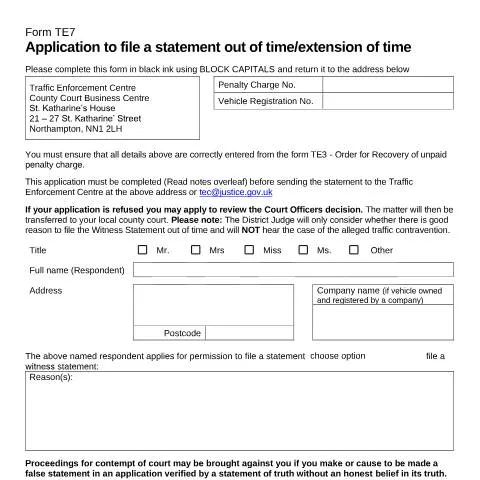
When Traffic Penalty Deadlines Slip Away: Understanding the TE7 Extension Process
Missing the deadline to challenge a traffic penalty can feel like watching your last train depart from the platform. Yet for countless motorists across England and Wales, this scenario unfolds daily when the 28-day window to file a witness statement closes without action. The TE7 form serves as a lifeline in these circumstances, offering a formal route to request additional time or permission to file a statement after the original deadline has passed.
This application sits within the broader traffic enforcement framework administered by HM Courts & Tribunals Service, specifically designed for situations where the standard challenge period has elapsed. Whether you've missed the deadline entirely or realise you need more time before it expires, the TE7 represents your opportunity to re-enter the legal process—though success depends entirely on demonstrating compelling reasons for the delay.
The Administrative Cascade: From Penalty to Court Enforcement
To understand when the TE7 becomes relevant, it's essential to grasp the sequential nature of traffic penalty enforcement. The process typically begins with a Penalty Charge Notice issued by a local authority or private parking company. If unpaid within the prescribed period, this escalates to a Notice to Owner, offering a final opportunity to pay the reduced penalty or make representations.
When these earlier stages fail to resolve the matter, enforcement authorities can apply for a Traffic Enforcement Order through the Traffic Enforcement Centre in Northampton. This is where the TE3 form—the Order for Recovery of unpaid penalty charge—enters the picture. The TE3 grants the authority to enforce the penalty as if it were a court judgment, but crucially, it also provides recipients with a final 21-day window to file a witness statement challenging the penalty.
The critical juncture arrives when this 21-day period expires unused. Once past this deadline, the standard route for challenging the penalty closes, and the TE7 becomes the only mechanism to re-open proceedings. The form essentially asks the court to exercise its discretion in allowing a late challenge, acknowledging that circumstances sometimes prevent timely responses to legal deadlines.
Dual Pathways: Extensions Versus Late Applications
The TE7 serves two distinct purposes, and understanding this distinction proves crucial for completing the application correctly. The form accommodates both prospective requests for additional time and retrospective applications to file statements after deadlines have passed.
Extension of Time Applications
When you're still within the 21-day deadline specified on your TE3 order but recognise you cannot meet it, the TE7 allows you to request an extension. Common scenarios include waiting for legal advice, gathering evidence, or dealing with personal circumstances that prevent immediate action. The key advantage of this approach lies in making the application before the deadline expires, demonstrating proactive engagement with the process.
Out of Time Applications
More commonly, the TE7 addresses situations where the deadline has already passed. These applications face stricter scrutiny because they ask the court to excuse non-compliance with a legal deadline. The court officer reviewing your application will expect detailed explanations for the delay, supported by evidence where appropriate.
| Application Type | Timing | Court Approach | Success Factors |
|---|---|---|---|
| Extension Request | Before deadline expires | More lenient consideration | Reasonable need for additional time |
| Out of Time | After deadline passed | Stricter scrutiny required | Compelling reasons for delay |
Crafting Compelling Reasons: What Courts Actually Accept
The success or failure of your TE7 application hinges entirely on the reasons you provide for missing the deadline. The form explicitly states that these should not be the reasons for disputing the original penalty charge—that argument belongs in your witness statement, not the extension application.
Acceptable reasons typically fall into several categories. Medical emergencies or serious illness that prevented you from dealing with correspondence often carry weight, particularly when supported by medical evidence. Postal problems can justify late applications, especially if you can demonstrate the TE3 order was delayed or misdirected. Extended travel abroad for business or family reasons may excuse delays, provided you can show you were genuinely unable to respond.
Administrative confusion sometimes succeeds, particularly where multiple penalty notices or enforcement actions create genuine uncertainty about deadlines. Family bereavements or crises receive sympathetic consideration, especially when they coincide closely with the deadline period.
Reasons Courts Typically Reject
Certain explanations rarely succeed with court officers. Simple forgetfulness or being "too busy" generally fails to meet the threshold for excusing legal non-compliance. Disagreement with the penalty itself doesn't justify missing deadlines—that's precisely what the witness statement process addresses. Financial difficulties preventing payment of the penalty don't excuse failure to challenge its validity within the prescribed timeframe.
Claiming you never received the TE3 order requires substantial evidence, as the Traffic Enforcement Centre maintains detailed postal records. Similarly, stating you didn't understand the deadline typically fails unless you can demonstrate specific circumstances that prevented comprehension, such as language barriers or learning difficulties.
Procedural Requirements and Documentary Evidence
The TE7 demands meticulous attention to administrative detail. The penalty charge number and vehicle registration must match exactly those shown on your TE3 order—any discrepancy can lead to automatic rejection. The form requires completion in black ink using block capitals, reflecting the court system's need for clear, legible documentation.
When applying out of time, you must attach your completed witness statement on form TE9. This creates a practical challenge: you're simultaneously asking for permission to file a statement while actually filing it. The court officer needs to see your substantive challenge to assess whether granting the extension serves the interests of justice.
Statement of Truth Requirements
The TE7 incorporates a statement of truth, carrying the same legal weight as sworn testimony. The warning about contempt of court proceedings isn't mere formality—making false statements in court applications can result in criminal prosecution. This particularly applies to claims about when you received documents or your circumstances during the relevant period.
Corporate applications require careful consideration of who can sign on behalf of the company. Only designated officers can bind the organisation, and the form must clearly identify their capacity. Partnership applications need signing by an actual partner, not merely an employee or agent.
Special Circumstances: Protected Parties and Litigation Friends
The TE7 acknowledges that some respondents lack capacity to conduct legal proceedings independently. Under the Mental Capacity Act 2005, individuals with cognitive impairments, learning difficulties, or certain mental health conditions may require a litigation friend to act on their behalf.
A litigation friend assumes significant responsibilities, effectively stepping into the shoes of the protected party for all legal purposes. They must act in the person's best interests while having no conflicting interests of their own. The court expects litigation friends to understand both the traffic penalty process and their broader duties under Part 21 of the Civil Procedure Rules.
Appointing a litigation friend isn't automatic—it requires formal application to the court, supported by evidence of the person's incapacity. This process can significantly extend timescales, making early identification of capacity issues crucial for anyone supporting vulnerable motorists through penalty challenges.
The Court Officer's Decision-Making Process
TE7 applications receive consideration from court officers without hearings, operating as a paper-based assessment. This administrative approach keeps costs down but places enormous emphasis on the quality of your written submissions. Court officers apply established criteria, balancing the interests of justice against the need to maintain deadline discipline within the enforcement system.
The decision-making process considers several factors beyond your stated reasons for delay. The court examines the length of the delay—applications made days after the deadline receive more favourable treatment than those submitted months later. The apparent strength of your underlying challenge matters too; court officers are more likely to grant extensions where the witness statement reveals genuinely arguable defences.
Review Rights and Local Court Transfer
Refused TE7 applications don't represent the end of the road. You can request review of the court officer's decision, triggering transfer to your local county court for consideration by a District Judge. This escalation transforms your application from an administrative process into a judicial one, though it also increases complexity and potential costs.
District Judges approach these reviews with fresh eyes, unconstrained by the original court officer's reasoning. However, they focus solely on whether good reason exists to file the witness statement out of time—they won't hear your substantive challenge to the traffic penalty. Success at review stage merely reopens the window for your main challenge; it doesn't resolve the underlying penalty dispute.
Navigating the Northampton Hub and Digital Alternatives
The Traffic Enforcement Centre in Northampton serves as the administrative heart of England and Wales' traffic penalty system. This centralised approach streamlines processing but can create practical challenges for motorists unfamiliar with the system. The centre's address at St. Katharine's House has become familiar to countless drivers navigating penalty disputes.
While postal submission remains the traditional route, the TE7 guidance acknowledges digital alternatives through the [email protected] email address. However, electronic submission requires careful attention to file formats and size limits. The court system's IT infrastructure may not accommodate all document types, making PDF conversion and compression sometimes necessary.
Timing considerations apply equally to both submission methods. Posted applications depend on Royal Mail's delivery schedules, while emails face potential server delays or filtering systems. Neither method guarantees instant processing, and the court cannot accept responsibility for technical failures beyond its control.
The centralised system means all TE7 applications, regardless of where the original penalty was issued, flow through Northampton. This creates consistency in decision-making but can disconnect the process from local circumstances that might influence a penalty challenge. Court officers in Northampton may lack intimate knowledge of specific local authority practices or traffic management schemes that feature in your case.
Strategic Timing and Long-term Enforcement Implications
Successfully obtaining a TE7 extension merely restarts the challenge process—it doesn't resolve your penalty dispute. This distinction carries important implications for your overall strategy and the potential long-term consequences of different outcomes.
If your extension succeeds but your subsequent witness statement fails, you'll face the original penalty plus additional enforcement costs accumulated during the extended proceedings. These can include court fees, bailiff charges, and interest, potentially doubling or tripling your financial exposure. The TE7 process essentially represents a calculated risk: the chance to avoid an unjustified penalty weighed against increased costs if your challenge ultimately fails.
The enforcement machinery doesn't pause during TE7 consideration. While your application is pending, the original penalty debt continues to exist, and enforcement agents may still attempt collection unless you've secured a formal stay. This creates practical pressure to resolve applications quickly, particularly where bailiff action threatens.
Successful TE7 applications reset the procedural clock but don't erase the compliance history that led to enforcement action. Future penalty notices from the same authority may receive less sympathetic treatment if they reveal a pattern of delayed responses or missed deadlines. Traffic enforcement systems increasingly use algorithmic assessments that flag persistent late payers for expedited enforcement.
Understanding the Legal Framework Behind TE7 Applications
The TE7 form operates within a complex legal framework that varies significantly depending on your location within England and Wales. For traffic enforcement orders issued outside London boroughs, the process falls under the Traffic Management Act 2004, which grants local authorities civil enforcement powers previously held by police forces. This legislative shift means that parking contraventions and moving traffic violations are now handled as civil matters rather than criminal offences, fundamentally changing how appeals and time extension requests are processed.
Within London boroughs, the system operates under different statutory provisions, primarily governed by the London Local Authorities and Transport for London Act 2003, alongside various Transport for London regulations. This creates a dual-tier system where identical contraventions may follow different procedural routes depending on whether they occurred within the Greater London Authority boundary or in other English and Welsh local authority areas.
The statutory framework establishes strict timelines that Form TE7 seeks to extend. Under normal circumstances, you have 28 days from the date of service of a Notice to Owner to make formal representations against a Penalty Charge Notice. If those representations are rejected, you then have 28 days to appeal to an independent adjudicator. The TE7 form specifically addresses situations where these statutory deadlines have passed, but exceptional circumstances may justify accepting a late application.
Adjudicators operating under this framework include the Traffic Penalty Tribunal for England and Wales (covering areas outside London) and London Tribunals (for London borough cases). These bodies maintain judicial independence from the issuing authorities, ensuring that TE7 applications receive impartial consideration. The legal test they apply focuses on whether there are exceptional circumstances that prevented timely compliance with statutory deadlines, rather than simply reviewing the merits of the underlying contravention.
Data protection considerations also play a crucial role in TE7 applications. Under the Data Protection Act 2018 and UK GDPR, enforcement authorities must handle personal information lawfully when processing penalty charge notices and subsequent appeals. This includes ensuring that notices are properly served and that individuals receive adequate opportunity to exercise their appeal rights. Where data protection failures contribute to missed deadlines, this may strengthen a TE7 application by demonstrating that late submission resulted from the authority's own procedural shortcomings.
Strategic Timing and Procedural Considerations for TE7 Submissions
The timing of your TE7 submission can significantly impact its likelihood of success, with several strategic considerations that extend beyond simply meeting the absolute deadline. While there's no statutory time limit for submitting Form TE7, tribunals generally expect applications to be made as soon as reasonably practicable after the original deadline passed or after the exceptional circumstances preventing timely submission ceased to apply.
Applications submitted within three months of the missed deadline typically receive more favourable consideration than those submitted after longer delays. However, this isn't an absolute rule, and compelling circumstances can justify acceptance of applications submitted after considerably longer periods. For instance, cases involving serious illness, family bereavement, or postal service failures may warrant acceptance even after extended delays, provided the applicant can demonstrate they acted promptly once the impediment was removed.
The procedural route your TE7 application follows depends on the specific stage at which the original deadline was missed. If you missed the initial 28-day deadline for making representations to the enforcement authority, your TE7 application typically goes directly to the tribunal, bypassing the authority's internal review process. Conversely, if you made timely representations but missed the subsequent appeal deadline after rejection, the TE7 application may require initial consideration by the enforcement authority before proceeding to tribunal review.
Documentation requirements vary depending on how long after the deadline you submit your application. Recent applications may require minimal supporting evidence if the exceptional circumstances are straightforward and verifiable. However, applications submitted after extended delays typically need comprehensive documentation demonstrating both the nature of the exceptional circumstances and evidence that the applicant acted reasonably promptly once those circumstances were resolved.
Seasonal factors can also influence TE7 processing times and success rates. Applications submitted during peak periods, such as immediately after the Christmas postal disruption period or during summer holiday seasons, may experience longer processing times but may also benefit from tribunals' increased awareness of common causes of delay during these periods. Understanding these patterns can help inform decisions about when to submit applications and what supporting evidence to emphasise.
The format and presentation of TE7 applications can also impact their effectiveness. While the form itself is relatively straightforward, the quality and organisation of supporting evidence can significantly influence adjudicator decisions. Clear chronological presentation of events, with supporting documentation properly referenced and indexed, demonstrates the seriousness of your application and makes it easier for adjudicators to understand your circumstances.
Regional Variations and Authority-Specific Procedures
The implementation of TE7 procedures varies considerably across different local authorities and enforcement agencies, creating a patchwork of practices that can significantly impact your experience. London boroughs, despite operating under broadly similar legislative frameworks, maintain distinct procedural variations that reflect their individual enforcement policies and administrative capabilities. Some boroughs operate streamlined digital systems that can process TE7 applications within days, while others rely on paper-based systems that may require several weeks for initial assessment.
Transport for London operates its own sophisticated TE7 processing system for contraventions on the Transport for London Road Network, including major routes like the A4, A40, and key bridges across the Thames. Their procedures often involve additional verification steps, particularly for applications claiming postal service failures, given the high volume of penalty charge notices they issue and the corresponding frequency of TE7 applications they receive.
Outside London, county councils and unitary authorities demonstrate even greater variation in their TE7 handling procedures. Rural authorities with lower contravention volumes may process applications more quickly due to reduced caseloads, but they may also have less sophisticated systems for verifying exceptional circumstances claims. Urban authorities outside London, such as those in Manchester, Birmingham, or Leeds, often maintain processing standards comparable to London boroughs but may apply different evidential requirements or follow alternative procedural timelines.
Parking enforcement companies operating under contracts with local authorities add another layer of complexity to TE7 procedures. While the statutory framework remains consistent, contracted enforcement providers may interpret procedural requirements differently or maintain varying standards of record-keeping that can impact the supporting evidence available for TE7 applications. Understanding which organisation issued your penalty charge notice and their specific procedures can inform your approach to completing Form TE7.
Cross-border considerations also arise for contraventions occurring near authority boundaries or for individuals who have moved between authorities since receiving their penalty charge notice. Welsh authorities operate under the same basic legislative framework as English authorities but may follow slightly different procedural conventions, particularly regarding language requirements and communication preferences.
Some authorities maintain specialised units for processing TE7 applications, with dedicated staff trained in assessing exceptional circumstances claims. These units often develop institutional knowledge about common scenarios and may apply more consistent standards in their decision-making. Other authorities integrate TE7 processing within their general appeals handling functions, potentially leading to more variable outcomes depending on the experience and training of individual case officers.
Regional variations also extend to the types of exceptional circumstances most commonly accepted. Authorities in areas with known postal service reliability issues may be more receptive to claims based on mail delivery failures, while those in regions with frequent severe weather may show greater understanding of weather-related delays. Understanding your local authority's historical approach to similar TE7 applications can help inform your strategy for presenting your own circumstances most effectively.