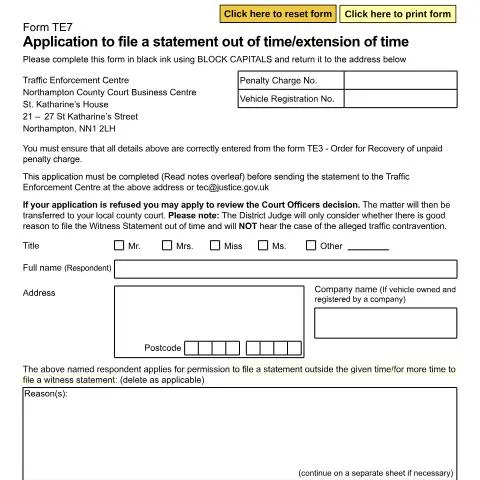
When Traffic Enforcement Orders Lead to Court Action: Understanding the TE7 Application
Receiving an Order for Recovery for an unpaid penalty charge can be a daunting experience, particularly when you believe you have grounds to challenge it but the statutory time limit has already expired. The TE7 form serves as your legal lifeline in these circumstances, allowing you to request additional time to file a witness statement through the Traffic Enforcement Centre at Northampton County Court Business Centre.
This court application becomes necessary when enforcement action has escalated beyond the initial penalty charge notice stage. Whether you're dealing with charges from Dart Charge crossings, the Mersey Gateway, or various clean air zones across England, the TE7 represents your formal request to the court system for permission to present your defence after the standard deadline has passed.
The form's significance lies in its role within the Traffic Enforcement Centre (TEC) system, which processes thousands of penalty charge recoveries annually. Once a local authority has obtained an Order for Recovery through form TE3, you typically have 21 days to respond with a witness statement using form TE9. However, life circumstances don't always align with legal deadlines, making the TE7 application a crucial procedural safeguard.
The Traffic Enforcement Escalation Process: Where TE7 Fits
Understanding when to use form TE7 requires knowledge of the enforcement timeline that precedes it. The process begins with a Penalty Charge Notice (PCN) issued by charging authorities such as Highways England for Dart Charge violations or local councils for clean air zone contraventions.
If the initial penalty remains unpaid and representations are unsuccessful, the charging authority may apply to the Traffic Enforcement Centre for an Order for Recovery. This court order transforms the penalty into a legally enforceable debt, accompanied by increased costs including a £8 court fee.
| Stage | Document | Response Time | Consequences of Inaction |
|---|---|---|---|
| Initial Notice | Penalty Charge Notice | 28 days (14 days for early payment) | Charge doubles after 28 days |
| Court Application | TE3 Order for Recovery | 21 days to file TE9 | Warrant of Control issued |
| Late Challenge | TE7 + TE9 forms | No statutory limit | Enforcement action continues |
The TE7 becomes relevant when you've missed the 21-day window to file your witness statement but still have legitimate grounds to challenge the original penalty. Crucially, this form doesn't suspend enforcement action automatically - warrant officers may continue collection attempts until the Traffic Enforcement Centre processes your application.
Eligible Circumstances and Valid Grounds for Late Applications
The Traffic Enforcement Centre exercises judicial discretion when considering TE7 applications, focusing specifically on whether you have "good reason" for filing late rather than the merits of your underlying traffic contravention case. This distinction is fundamental to understanding the form's purpose.
Acceptable reasons typically include circumstances beyond your reasonable control that prevented timely response to the Order for Recovery. Medical emergencies requiring hospitalisation, postal service failures with documented evidence, or extended periods abroad for work or family emergencies often constitute valid grounds.
Administrative errors by charging authorities can also justify late applications. For instance, if the Order for Recovery was sent to an outdated address despite your having properly notified the DVLA of address changes, or if you can demonstrate the authority failed to follow proper procedures in issuing the original penalty.
Unacceptable reasons generally include simple oversight, financial difficulties, or disagreement with the penalty itself. The court officer won't consider arguments like "I was parked legally" or "the signage was unclear" at this stage - such matters belong in your TE9 witness statement, not your TE7 application for extended time.
Remember: The TE7 addresses procedural timing issues, whilst the TE9 contains your substantive defence against the traffic contravention itself.
Corporate Respondents and Litigation Friends: Special Considerations
When the vehicle is registered to a company or organisation, the TE7 completion process involves additional complexities. The person signing must clearly identify themselves as an authorised representative, stating both their full name and position within the organisation alongside the company details.
Common corporate scenarios include fleet vehicles operated by delivery companies facing multiple clean air zone charges, or company cars used by employees who may have incurred Dart Charge penalties. The authorised signatory must be an officer of the company - typically a director, company secretary, or person with specific written authority to handle legal matters.
Partnership structures require similar careful attention, with the signatory identifying themselves as a partner of the firm. This becomes particularly relevant for taxi operators, haulage companies, or professional partnerships whose vehicles regularly traverse charging zones.
Litigation friends represent a specialised category under the Mental Capacity Act 2005. These appointed representatives can complete TE7 applications on behalf of protected parties who lack capacity to conduct legal proceedings themselves. Such situations require supporting documentation proving the litigation friend's authority and the respondent's protected status.
Documentation Requirements for Corporate Applications
- Company registration details matching DVLA records
- Clear identification of the authorised signatory's role
- Evidence of authority to act on the company's behalf
- Separate letterhead confirmation if the signatory's authority isn't obvious
Completing the TE7: Critical Details and Common Pitfalls
The TE7 form demands meticulous attention to detail, particularly regarding the penalty charge number and vehicle registration. These identifiers must match exactly with the information on your Order for Recovery (TE3), as the Traffic Enforcement Centre's computer systems cannot process applications with mismatched references.
The reasons section requires careful consideration of language and content. You must explain why you failed to meet the original 21-day deadline, not why you dispute the underlying penalty charge. Effective explanations are specific, chronological, and supported by evidence where possible.
For example, rather than writing "I was ill," provide details such as: "I was hospitalised from 15th March to 2nd April following emergency surgery, as confirmed by the enclosed discharge summary. The Order for Recovery was delivered during this period when I was unable to access post or respond to legal documents."
Essential Information for Your Application
- Penalty Charge Number: Exactly as shown on the TE3 Order for Recovery
- Vehicle Registration: Complete registration including any spaces or hyphens
- Personal Details: Full name and address matching DVLA records
- Chronological Explanation: Specific dates and circumstances preventing timely response
- Supporting Evidence: Medical certificates, postal service reports, travel documentation
The statement of truth carries serious legal weight - making false statements can result in contempt of court proceedings. Ensure every fact you state can be substantiated with evidence if required.
Submission Channels and Processing Expectations
The Traffic Enforcement Centre accepts TE7 applications through two primary channels: postal submission to the Northampton County Court Business Centre or email submission to [email protected]. Each method has distinct advantages and processing characteristics.
Postal applications should be sent to the St. Katharine's Street address using recorded delivery or signed-for services. This provides proof of delivery and helps establish timeline evidence if processing delays occur. Include all supporting documents as clear photocopies rather than originals, which may not be returned.
Email submissions offer faster delivery but require careful attention to file formats and size limitations. Scan documents at sufficient resolution for easy reading, typically 300 DPI for text documents. PDF format is generally preferred over image files for text-based evidence.
Processing Timeline Expectations
The Traffic Enforcement Centre typically processes TE7 applications within 10-15 working days, though complex cases or periods of high volume can extend this timeframe. During processing, enforcement action continues unless specifically suspended by the court.
If your application is refused, you retain the right to request a review, which transfers the matter to your local county court for consideration by a District Judge. This represents your final opportunity within the court system to secure permission for late filing.
Concurrent TE9 Preparation: Your Substantive Defence Strategy
While preparing your TE7 application, you must simultaneously complete form TE9 (Witness Statement), which contains your actual defence against the traffic contravention. The TE7 merely requests permission to file this defence late - without a properly completed TE9, your application lacks substance.
The TE9 form presents specific statutory grounds for challenging penalty charges, covering scenarios from vehicle theft and cloning to medical emergencies and administrative errors. You cannot modify these grounds or add custom defences - your circumstances must fit within the prescribed categories.
Payment-related defences require particularly detailed evidence. If claiming you paid the charge, you must specify the exact date, payment method, and recipient. Retain transaction references, bank statements, or receipts as the Traffic Enforcement Centre may request verification.
Strategic tip: Prepare your TE9 evidence gathering before completing the TE7, as this may reveal additional time-sensitive factors relevant to your late application.
Post-Decision Scenarios and Appeal Pathways
If the Traffic Enforcement Centre grants your TE7 application, they will process your accompanying TE9 witness statement according to standard procedures. The charging authority receives opportunity to respond to your defence, potentially leading to penalty cancellation or progression to a formal court hearing.
Should the court officer refuse your application, the refusal notice explains the reasoning and outlines your review rights. Reviews are conducted by District Judges at your local county court, representing a more formal judicial process than the initial administrative decision.
The review process focuses solely on whether good reason exists for late filing - the District Judge will not consider the merits of your traffic contravention defence at this stage. This procedural limitation means your review application must address timing issues convincingly, potentially with additional evidence not available during your original TE7 submission.
Throughout this process, enforcement action typically continues unless you successfully apply for a stay of execution or the charging authority agrees to suspend collection pending resolution. Understanding these procedural realities helps set appropriate expectations and informs strategic decisions about pursuing late challenges to traffic enforcement orders.
Understanding the Legal Framework Behind Traffic Enforcement Extensions
The statutory foundation for requesting additional time to challenge traffic enforcement orders stems from the Traffic Management Act 2004 and subsequent regulations, which establish clear procedural safeguards for motorists facing penalty charges. Form TE7 operates within this framework as part of the formal appeals process, ensuring that genuine cases of hardship or exceptional circumstances receive proper consideration.
Under the current legislation, adjudicators must apply specific legal tests when evaluating extension requests. The primary consideration centres on whether the applicant can demonstrate they were prevented from submitting their initial challenge within the standard timeframe through circumstances genuinely beyond their control. This goes beyond simple oversight or forgetfulness—the law requires evidence of material impediment to the normal appeals process.
The burden of proof rests entirely with the applicant, meaning you must provide compelling documentation to support your extension request. Courts and tribunals have established precedents indicating that medical emergencies, bereavement, postal service failures, and significant technical difficulties with online systems may constitute valid grounds. However, holiday absences, work pressures, or general inconvenience typically fall short of the legal threshold required.
Importantly, the adjudicator retains discretionary powers even when statutory grounds appear met. They may consider factors such as the strength of your underlying challenge, the length of delay involved, and whether granting an extension serves the interests of justice. This discretionary element means that borderline cases may succeed or fail based on the quality of evidence presented and the persuasiveness of your written submission.
The legal timeframes involved are strictly enforced, with the Traffic Penalty Tribunal and similar bodies operating under statutory deadlines that cannot be extended indefinitely. Generally, extension requests must be submitted within a reasonable period after the impediment preventing your original challenge has been resolved. Delays of several months without adequate explanation are unlikely to succeed, regardless of the underlying circumstances.
Strategic Considerations for Different Traffic Enforcement Scenarios
The approach to completing Form TE7 varies significantly depending on the specific type of enforcement action you're challenging. Dart Charge penalties often involve complex questions about account setup, payment timing, and vehicle registration details that may not be immediately apparent to occasional users of the crossing. If your extension request relates to Dart Charge issues, focus on documenting any technical difficulties with the online payment system, confusion over payment deadlines, or problems with automatic payment setup.
For Mersey Gateway Bridge penalties, similar payment system issues may arise, but you should also consider whether signage clarity or approach road conditions affected your ability to understand the charging requirements. The bridge's relatively recent introduction means that many drivers remain unfamiliar with the payment process, though this alone rarely constitutes grounds for extension unless combined with other compelling factors.
Clean Air Zone violations present unique challenges, as these schemes involve complex eligibility criteria based on vehicle specifications, emission standards, and exemption categories. Your extension request might succeed if you can demonstrate that determining your vehicle's compliance status required specialist knowledge or documentation that was not readily available within the original challenge timeframe. Similarly, if you needed to obtain retrofit certification or other technical assessments to mount an effective challenge, this could support your extension application.
Bus lane and parking enforcement cases often hinge on detailed examination of signage, road markings, and timing restrictions. If your challenge requires photographic evidence, witness statements, or technical surveys that could not be obtained within the standard timeframe, document these requirements thoroughly in your Form TE7 submission. Traffic light and speed camera violations may involve complex technical defences that require expert analysis or equipment calibration records—factors that could justify additional time if properly evidenced.
When dealing with multiple penalties from the same enforcement authority, consider whether a single comprehensive extension request might be more effective than multiple individual applications. Some circumstances that prevented timely challenge of one penalty may apply equally to related cases, allowing for more efficient case management while strengthening your overall position through consistent narrative and evidence.
Advanced Evidence Gathering and Documentation Strategies
Successful Form TE7 applications rely heavily on the quality and relevance of supporting documentation you provide alongside your extension request. Medical evidence requires particular attention to detail—generic sick notes or brief GP letters rarely suffice. Instead, obtain detailed medical reports that specifically explain how your condition prevented engagement with the appeals process during the relevant period. Mental health conditions, in particular, require careful documentation showing the direct impact on your ability to understand and respond to legal proceedings.
When citing postal service failures, simple claims about non-delivery prove insufficient without corroborating evidence. Royal Mail provides formal investigation services for undelivered items, and obtaining their official response can significantly strengthen your extension application. Similarly, if you claim technical difficulties with online submission systems, screenshot error messages, save browser cache files, and document your attempts to contact technical support services.
Employment-related impediments require careful handling, as work commitments alone rarely justify extensions. However, if your employment involved overseas deployment, emergency response duties, or other circumstances that genuinely prevented access to normal communication channels, obtain detailed confirmation from your employer. Military deployment orders, emergency service deployment records, or offshore work assignments may provide compelling evidence where general work pressure would not.
Family emergencies and bereavement situations demand sensitive documentation while maintaining legal relevance. Death certificates, hospital admission records, and care responsibility documentation can support extension requests, but ensure your evidence clearly links the family emergency to your inability to engage with the penalty charge process. Adjudicators distinguish between genuine incapacity due to family crisis and simple distraction or emotional upset that doesn't prevent basic administrative tasks.
Financial hardship arguments require particularly sophisticated presentation, as economic difficulties alone don't extend legal deadlines. However, if financial problems prevented access to legal advice, internet services, or postal systems necessary for mounting your challenge, document these specific impediments rather than general financial stress. Bank statements showing account suspensions, utility disconnection notices, or formal debt advice referrals may provide relevant context.
Technical evidence gathering becomes crucial when challenging the underlying enforcement action alongside requesting additional time. If your extension request succeeds, you'll need robust evidence for your substantive challenge. Begin collecting this evidence immediately—traffic flow data, weather condition reports, road maintenance records, or signage inspection reports may become crucial to your case but could prove difficult to obtain retrospectively.
Consider engaging professional assistance where the complexity of your case warrants expert input. Traffic law specialists, medical professionals, or technical consultants may provide reports that significantly strengthen both your extension request and underlying challenge. However, ensure any professional assistance is proportionate to the penalty amount involved and the likelihood of successful challenge.