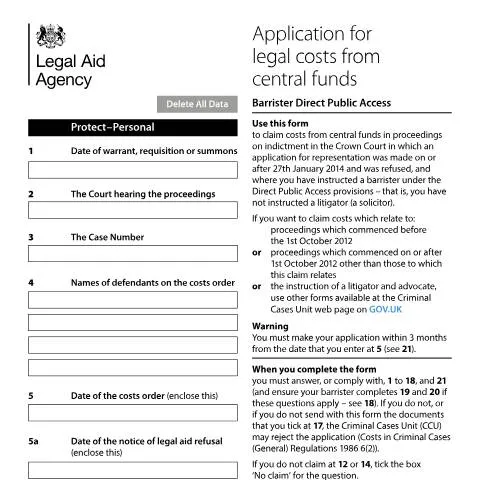
Understanding Form 5913A: Navigating the Costs Claim Process in Crown Court
When facing legal proceedings in the Crown Court, the financial implications can be daunting, particularly for those who have instructed a barrister via Direct Public Access. Form 5913A represents a critical step for individuals seeking to recover costs incurred from central funds, especially in instances where their application for legal representation has been refused. This article will delve into the intricacies of this form, offering guidance tailored to various user profiles and circumstances.
Who Should Consider Submitting Form 5913A?
The audience for Form 5913A primarily includes defendants in Crown Court proceedings who have opted not to engage a solicitor but instead have instructed a barrister directly. This form caters to those whose legal aid applications were declined post-27th January 2014. The following scenarios highlight when individuals might find themselves needing to submit this form:
- Direct Public Access Barristers: Individuals who wish to claim costs but have not worked through a litigator.
- Refusal of Legal Aid: Defendants who have faced a denial of financial assistance for their case and still seek reimbursement of costs.
- Cost Claims Related to Recent Proceedings: Claims connected to cases beginning after the specified date that were ineligible under prior provisions.
It's important to note that this form is not suitable for cases initiated before 1st October 2012 or for claims involving other legal representatives.
Preparation of Justificatory Documents: A Detailed Approach
Completing Form 5913A necessitates the submission of several supporting documents. These documents can vary depending on the specifics of the case, and ensuring they are prepared correctly is vital to the success of the claim. Here’s a breakdown of essential documents and their preparation:
1. Taxation Note from the Barrister
The instructed barrister must provide a taxation note, summarising the proceedings and detailing:
- The number of defendants involved.
- The nature of evidence presented during the prosecution.
- The complexities of the defence case that may have influenced the barrister’s fees.
2. Case Assessment and Schedule of Work
This schedule should include:
- A timeline of work done by the barrister, itemised with dates and actions taken.
- The total amounts claimed, clearly distinguishing between barrister fees and any applicable VAT.
3. Invoices for Disbursements
Any additional costs, such as expert reports or courier fees, should be substantiated with invoices. Specifying whether these costs are subject to VAT is crucial. The following documentation should be collated:
- Invoices for all disbursements claiming under Form 5913A.
- Details of any expert reports related to the case.
A Seamless Integration: Form 5913A in the Legal Aid Framework
Form 5913A is not an isolated document but rather a part of a broader legal framework designed to support defendants. Understanding its context within the legal aid system is essential. The following laws govern the submission and processing of costs claims:
- Prosecution of Offences Act 1985: Establishes the legal principles surrounding costs in criminal cases.
- Legal Aid, Sentencing and Punishment of Offenders Act 2012: Outlines the general provisions for legal aid and costs recovery.
- Costs in Criminal Cases (General) Regulations 1986: Provides specific guidance on how costs can be claimed and processed.
Timelines and Key Dates: Your Path with Form 5913A
Timing is of the essence when it comes to filing costs claims, and understanding the relevant timelines can significantly impact the success of your application. The following key dates are critical:
- Date of Warrant or Summons: This date should be entered accurately on the form, as it marks the beginning of the three-month window for submission.
- Submission Deadline: Claims must be submitted within three months from the date indicated in section 5 of Form 5913A. Failing to meet this deadline can result in rejection.
- Subsequent Processing: Once submitted, the Criminal Cases Unit (CCU) will review the application, which can take several weeks. Ensuring all documents are complete and correctly filled out is crucial to avoid delays.
What to Do When Facing Refusal or Missing Documentation
Receiving a refusal from the CCU can be disheartening, but it is important to understand the potential steps forward. Here’s how to navigate this situation:
1. Understanding the Refusal
If your application is rejected, a letter detailing the reasons will typically follow. Common reasons include:
- Incomplete documentation or missing signatures.
- Failure to adhere to the submission timeline.
- Ineligibility based on the nature of the case.
2. Addressing Missing Documents
Should you discover that certain documents are missing after submission, the CCU allows for a period in which you may rectify these issues:
- Submit any missing documents promptly while keeping a record of all correspondence.
- Consider seeking additional legal advice if the situation becomes complex or if you require further clarity on the refusal.
Estimating Your Costs: A Transparent Approach
Understanding how to accurately calculate the costs you are claiming is key to a successful application. The form requires transparency regarding barrister fees and disbursements:
| Type of Cost | Description | Max Amounts |
|---|---|---|
| Barrister’s Fees | Fees charged by the barrister for representation | Subject to the rates outlined in the 'Calculation of Legal Costs Document' |
| Disbursements | Costs incurred for third-party services (e.g., expert reports) | As per invoices submitted |
Providing a detailed breakdown of these costs aids the assessing officer’s decision-making process and can significantly influence the outcome of your claim.
Final Steps: Ensuring a Comprehensive Submission
To conclude your engagement with Form 5913A, double-check your application against the requirements set forth by the CCU:
- Completeness: Ensure all questions are answered, particularly 1 to 18 and 21, and check that your barrister has filled out sections 19 and 20 as applicable.
- Documentation: Attach all required documents as indicated in section 17 of the form.
- Submission Method: The form can be submitted by post or online as per the latest guidance. Verify that you are using the correct method as specified by the Legal Aid Agency.
By following these steps and ensuring thorough preparation, you can navigate the complexities of claiming costs from central funds in Crown Court effectively.
Understanding Eligibility for Costs from Central Funds
Before delving into the application process for costs from central funds under Direct Public Access for Crown Court cases, it's essential to understand who qualifies for such funding and under what circumstances. Generally, you may be eligible to apply for costs if you have been involved in a Crown Court proceeding and you were acquitted of the charges against you, or the prosecution was discontinued.
Additionally, costs can also be claimed in cases where the court deems that the prosecution was not justified, or if you have suffered undue hardship due to the legal proceedings. It's important to note that eligibility criteria may vary based on the nature of the case, the outcome, and whether you had legal representation.
Fill in your form directly online
No printing: type your details into the boxes of the official form, tick, then download the PDF ready to send.
- 1Type into the form boxes
- 2Tick in one click
- 3Save and download the PDF
If you were a defendant in a criminal trial and either were found not guilty or the case was dismissed, you should prepare to provide evidence supporting your claim. Documentation proving your financial situation, as well as proof of the court's decision, will be essential. Consider gathering:
- Official court transcripts or judgment documents.
- Evidence of any financial hardship experienced during the proceedings.
- Any relevant correspondence concerning the case.
Navigating the Application Process
The application process for claiming costs from central funds can be intricate, but with the correct approach, it can be manageable. To start, ensure you have the form 5913a readily available, as this is the primary document required. You can obtain this form from the Crown Court where your case was heard, or through the official government website.
Once you have the form, carefully read the instructions provided. It is worth noting that the form will require you to provide not only your personal details but also specifics about your court case, including:
- Case number
- Date of hearing
- Nature of the charges
- Outcomes of the court proceedings
Make sure to fill out the form accurately and completely; any missing information can lead to delays or even rejection of your application. In particular, be thorough in detailing the costs you are seeking to recover, which may include:
- Travel expenses to and from the court
- Cost of legal representation, if applicable
- Any other out-of-pocket expenses that were incurred as a direct result of the legal proceedings
Once the form is completed, you will need to submit it to the relevant Crown Court, ensuring you adhere to any specific submission guidelines they may have. Consider sending your application via recorded delivery to ensure it reaches the court securely.
What Happens After Submission?
Once you have submitted your application for costs from central funds, the waiting period begins. The processing time can vary, but you can typically expect a response within eight weeks. If your application is successful, the Crown Court will issue an order detailing the amount of costs approved and how they will be disbursed.
However, should your application be denied, you have the right to appeal the decision. The denial letter will typically provide information regarding the grounds for rejection and the timeframe within which you must submit your appeal. Here, clarity is key; make sure to gather any additional evidence required to support your appeal.
If you're uncertain about the implications of the court's decision, or if you feel your application was unjustly denied, it may be beneficial to seek advice from legal professionals who specialize in Crown Court proceedings. They can provide insights into the appeal process and help you navigate any complexities involved.