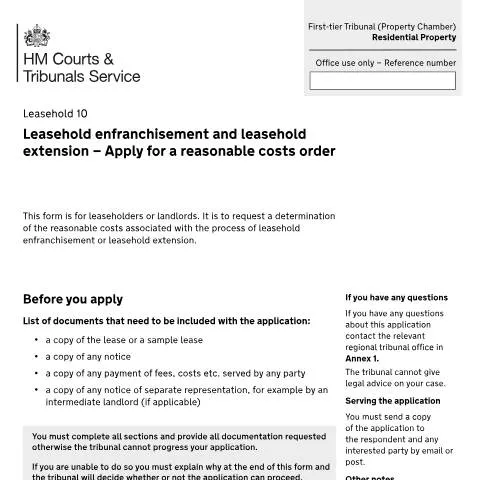
When Leasehold Costs Spiral: Understanding the Tribunal's Role in Determining Reasonable Expenses
Leasehold enfranchisement and lease extension proceedings can generate substantial legal and professional costs that often become contentious between landlords and leaseholders. When parties cannot agree on what constitutes reasonable costs following these statutory processes, the First-tier Tribunal (Property Chamber) steps in to make binding determinations through Form Leasehold 10. This specialised application addresses one of the most financially significant aspects of leasehold reform, where costs can range from hundreds to tens of thousands of pounds depending on the complexity and value of the property involved.
The tribunal's jurisdiction to determine reasonable costs stems from specific provisions within the Leasehold Reform, Housing and Urban Development Act 1993 and the Leasehold Reform Act 1967. These statutes establish clear liability frameworks but deliberately leave the assessment of reasonableness to judicial determination, recognising that costs vary enormously based on property values, legal complexity, and professional time invested.
Statutory Framework: Four Distinct Pathways to Cost Determination
Form Leasehold 10 serves four specific statutory scenarios, each governed by different legal provisions and cost-recovery principles. Understanding which pathway applies is crucial for framing the application correctly.
Collective Enfranchisement for Flats
Under Section 91(2)(d) of the 1993 Act, qualifying tenants seeking to purchase their building's freehold collectively must pay the landlord's reasonable costs under Section 33(1). These typically include valuation fees, legal costs for reviewing the notice of claim, and expenses related to deducing and investigating title. The tribunal frequently sees disputes where landlords claim substantial costs for multiple valuers or extensive legal work that tenants consider disproportionate.
Individual Lease Extensions for Flats
The same legislative section covers individual lease extensions, but costs are governed by Section 60(1). Here, reasonable costs often encompass surveyor fees, legal expenses for preparing the new lease, and Land Registry fees. Disputes commonly arise over whether landlords can recover costs for specialist leasehold counsel when straightforward precedent leases exist.
House Enfranchisement Applications
For houses, Section 21(1)(ba) of the 1967 Act governs cost determinations under Section 9(4). House enfranchisement typically involves simpler title investigations but can generate disputes over valuation costs, particularly where development value or marriage value calculations prove complex.
House Lease Extensions
Finally, house lease extensions fall under the same tribunal jurisdiction via Section 21(1)(ba), covering costs payable under Section 14(2). These cases often involve lower overall costs but can still generate significant disputes over proportionality.
| Property Type | Process | Legislative Basis | Common Cost Elements |
|---|---|---|---|
| Flats | Collective Enfranchisement | Section 91(2)(d) / Section 33(1) | Multiple valuations, title investigation, legal advice |
| Flats | Lease Extension | Section 91(2)(d) / Section 60(1) | Surveyor fees, lease drafting, Land Registry |
| Houses | Enfranchisement | Section 21(1)(ba) / Section 9(4) | Valuation, basic legal work, title checks |
| Houses | Lease Extension | Section 21(1)(ba) / Section 14(2) | Valuation, lease variation, registration |
Critical Documentation: Building Your Evidence Base
The tribunal cannot progress applications without complete documentation, making thorough preparation essential. The mandatory document list reflects the tribunal's need to understand the entire transaction context, not merely the disputed costs.
Essential Lease Documentation
A copy of the lease or sample lease allows the tribunal to assess the property's leasehold structure and any specific cost provisions. In collective enfranchisement cases involving multiple leases, a representative sample may suffice, but the tribunal expects explanation of any material variations between leases that might affect cost liability.
Notice Requirements and Service
Copies of all notices served during the statutory process provide crucial context for cost assessment. This includes initial notices of claim, counter-notices, notices of acceptance, and any withdrawal notices. The tribunal examines whether costs were reasonably incurred in responding to properly served notices or whether defective service rendered some expenses unnecessary.
Payment Records and Fee Documentation
Documentation of any payment of fees, costs etc. served by any party enables the tribunal to understand the cost dispute's scope. This encompasses invoices, fee notes, payment demands, and any correspondence about cost liability. Parties should include both disputed and undisputed cost elements to provide complete context.
Intermediate Landlord Considerations
Where applicable, notices of separate representation from intermediate landlords must be included. Complex leasehold structures often involve multiple landlord interests, each potentially entitled to separate representation and cost recovery. The tribunal needs to understand these arrangements to assess whether multiple sets of costs are justified.
Navigating the Application Process: From Submission to Service
Form Leasehold 10 applications follow strict procedural requirements that, if not observed, can delay or derail cost determinations. The tribunal emphasises that incomplete applications cannot progress, placing the burden on applicants to provide comprehensive documentation from the outset.
Completion Standards and Documentation Gaps
The tribunal requires all sections to be completed and all requested documentation provided. Where applicants cannot comply fully, they must explain the reasons at the form's end, allowing the tribunal to decide whether the application can proceed. Common reasons for incomplete documentation include missing historical records, unlocated parties, or ongoing negotiations affecting document availability.
Handwritten applications must be clearly legible, with additional sheets properly identified by the applicant's name. The tribunal frequently encounters applications where poor handwriting or inadequate space usage creates ambiguity about the parties' positions or the relief sought.
Service Requirements and Timing
Applicants must serve copies on all respondents and interested parties by email or post. This service requirement ensures all parties receive simultaneous notice of the application and can prepare responses accordingly. Failure to serve properly can lead to procedural challenges and potential application dismissal.
The tribunal distinguishes between respondents (parties against whom relief is sought) and interested parties (those with legitimate interests in the outcome but not directly liable). In collective enfranchisement cases, this might include intermediate landlords, mortgagees, or management companies with contractual interests.
Multi-Party Dynamics and Representative Arrangements
Leasehold cost disputes frequently involve multiple parties with varying interests and representation arrangements. Form Leasehold 10 accommodates these complexities through specific provisions for group applications and professional representation.
Collective Applications and Joint Representation
Cases with multiple applicants require separate documentation listing all parties' names, addresses, and email contacts where known. This commonly occurs in collective enfranchisement disputes where participating tenants jointly challenge landlord costs, or where multiple landlord interests dispute tenant cost liability.
The tribunal expects clear identification of each party's capacity—whether as leaseholder, landlord, or nominee purchaser. In collective cases, nominee purchasers often take lead responsibility for cost challenges, but individual tenants may retain separate representation for specific issues affecting their interests.
Professional Representation and Communication Protocols
Where parties appoint representatives, the tribunal office communicates exclusively with those representatives, not the underlying clients. This protocol prevents confusion and ensures consistent communication channels, but requires careful consideration of representation arrangements.
Professional representatives typically include solicitors, barristers, or specialist leasehold consultants. The tribunal accepts DX numbers for correspondence where regional offices support this service, though not all tribunal regions maintain DX facilities.
Property Identification and Jurisdictional Considerations
Accurate property identification ensures the tribunal's jurisdiction and prevents confusion in cases involving multiple properties or complex ownership structures.
The subject property address may differ from the applicant's address, particularly where landlords or nominee purchasers make applications, or where tenants live elsewhere. The tribunal needs precise identification to match applications with any existing case files and ensure proper geographical jurisdiction.
In collective enfranchisement cases, the subject property typically encompasses the entire building or development, while individual lease extension applications focus on specific flats or units. The tribunal's cost assessment may vary significantly based on whether disputes involve single properties or complex multi-unit developments.
Regional Tribunal Offices and Procedural Variations
The First-tier Tribunal (Property Chamber) operates through regional offices with varying administrative arrangements and local practices. Understanding these differences can affect application timing and communication preferences.
Regional offices maintain different DX arrangements, with some offices accepting DX correspondence while others rely exclusively on postal and electronic communication. Applicants should verify their regional office's preferences through Annex 1 of the form to ensure appropriate communication channels.
The tribunal cannot provide legal advice on individual cases, but regional offices can clarify procedural requirements and application processing timescales. This distinction is crucial for parties seeking guidance on cost liability principles versus administrative procedures.
Strategic Timing and Cost Recovery Implications
Form Leasehold 10 applications often arise months or years after the underlying enfranchisement or extension process concludes. This delay can complicate evidence gathering and affect the tribunal's cost assessment approach.
The tribunal expects parties to attempt cost resolution through negotiation before formal application. Evidence of such attempts—or explanations for their absence—can influence the tribunal's approach to cost awards and may affect decisions about application fees or further cost liability.
Successful applicants may recover their tribunal costs from unsuccessful parties, making strategic consideration of application timing and evidence preparation crucial for overall cost management. The tribunal's determination of reasonable costs in the underlying transaction may also influence its approach to application-related expenses.
Understanding these procedural requirements and strategic considerations enables parties to present effective applications that address the tribunal's analytical framework while protecting their financial interests throughout the cost determination process.
Understanding the Calculation Methods for Reasonable Costs Orders
The determination of what constitutes "reasonable costs" under a Form Leasehold 10 application follows established legal principles that tribunals apply consistently across England and Wales. These calculations aren't arbitrary—they're governed by specific methodologies that consider both the complexity of your case and the conduct of all parties involved.
Tribunals typically employ the "indemnity basis" as their starting point, which means you can potentially recover costs that were reasonably and necessarily incurred in pursuing or defending your case. However, this doesn't guarantee full recovery of every expense you've documented. The tribunal will scrutinise each cost element against the "proportionality test"—essentially asking whether the expense was proportionate to the importance of the matter, the complexity involved, and the amount at stake.
For legal representation costs, tribunals often reference guideline hourly rates published by the Senior Courts Costs Office, though these aren't binding in leasehold matters. A Grade A fee earner (typically a solicitor with over 8 years' post-qualification experience) might reasonably charge between £350-600 per hour depending on location and specialism, whilst a Grade D fee earner (trainee or paralegal) might charge £150-250 per hour. However, tribunals will reduce these rates if they consider them excessive for the work actually undertaken.
Fill in your form directly online
No printing: type your details into the boxes of the official form, tick, then download the PDF ready to send.
- 1Type into the form boxes
- 2Tick in one click
- 3Save and download the PDF
Expert witness fees present particular challenges in cost recovery applications. Whilst you might engage a chartered surveyor at £200-400 per hour, the tribunal will only allow recovery if their evidence was genuinely necessary and proportionate. If multiple experts covered similar ground, or if the expert's report contained excessive detail for a straightforward matter, expect significant reductions in any costs award.
Administrative costs—including tribunal fees, document production, and travel expenses—generally face less scrutiny, provided they're properly evidenced and directly related to your case. However, tribunals take a dim view of inflated mileage claims or unnecessary premium travel arrangements. Standard HMRC mileage rates (currently 45p per mile for the first 10,000 miles) typically represent the upper limit for recovery.
The "conduct factor" significantly influences cost calculations. If the tribunal determines that your opponent acted unreasonably—perhaps by refusing a reasonable settlement offer, failing to engage with pre-action protocols, or pursuing clearly unmeritorious arguments—this can justify an enhanced costs award. Conversely, if your own conduct contributed to unnecessary expense, expect proportionate reductions even where you've substantially succeeded.
Strategic Considerations for Timing Your Application
The timing of your Form Leasehold 10 application can dramatically impact both its likelihood of success and the quantum of any eventual award. Unlike standard civil litigation where costs typically "follow the event" at the conclusion of proceedings, leasehold tribunals operate under a more restrictive regime that requires careful strategic planning.
Most successful costs applications arise from applications made shortly after the substantive hearing, whilst the tribunal's findings remain fresh and the parties' conduct during proceedings is clearly documented in the tribunal's decision. However, you shouldn't assume that winning your substantive case automatically entitles you to costs—the tribunal must make a separate determination that the circumstances justify departing from the general rule that each party bears their own costs.
Consider the "Part 36 equivalent" strategy available in leasehold matters. Whilst formal Part 36 offers don't apply to tribunal proceedings, making a clear, time-limited settlement offer before or during proceedings can strengthen your costs application significantly. If you offered to settle for terms that the tribunal ultimately awards (or better), and your opponent unreasonably refused, this provides compelling evidence of unreasonable conduct justifying a costs order.
Pre-action conduct carries substantial weight in tribunals' cost decisions. The Pre-Action Protocol for Housing Conditions Claims encourages early disclosure of relevant information and genuine attempts at resolution before formal proceedings commence. If you can demonstrate compliance with these expectations whilst your opponent ignored them, this supports your application. Document all pre-action correspondence meticulously—emails showing unreasonable delays, refusal to provide essential information, or rejection of reasonable proposals without proper consideration all strengthen your position.
The "protective costs application" represents another strategic option where you face significant financial risk. You can apply for a costs capping order at any stage of proceedings, asking the tribunal to limit your potential liability for your opponent's costs should you lose. Whilst this doesn't guarantee you'll recover your own costs if successful, it provides valuable protection against excessive exposure.
Timing also affects the evidence available to support your application. Contemporaneous records of time spent, decisions made, and strategies adopted carry far more weight than reconstructed accounts prepared months after the event. Maintain detailed time records throughout your case, noting not just hours spent but the necessity for each task undertaken. This documentation becomes invaluable when justifying your costs to the tribunal.
Enforcement Procedures and Recovery Mechanisms
Obtaining a costs order represents only the first step in actually recovering your expenses—enforcement can prove equally challenging and requires understanding of the various mechanisms available under English law. Unlike tribunal decisions on substantive leasehold matters, costs orders don't automatically become enforceable judgments, requiring additional procedural steps to secure payment.
The tribunal's costs order itself must first be converted into an enforceable judgment through the county court system. This involves filing an application for registration of the tribunal order as a county court judgment, accompanied by the prescribed fee and evidence of service of the original order on the judgment debtor. The process typically takes 14-28 days, after which you possess the same enforcement powers available for any county court judgment.
Attachment of earnings orders provide an effective enforcement mechanism where the judgment debtor remains in employment. The court can order the debtor's employer to deduct specified amounts directly from wages or salary, though this requires knowledge of the employment details and only applies to employment income—not self-employment, benefits, or pension income. The Protected Earnings Rate ensures the debtor retains sufficient income for basic living expenses, potentially limiting recovery speed for larger awards.
Third party debt orders (formerly garnishee orders) allow you to intercept money owed to the judgment debtor by third parties, most commonly bank accounts. However, this requires specific knowledge of the debtor's banking arrangements and faces various exemptions—including protected benefits, joint accounts where the debtor isn't the primary account holder, and accounts held in trust. The interim order freezes the identified funds pending a final hearing where the debtor can raise objections.
Charging orders against property offer security for your judgment debt, though they don't provide immediate payment. The court can impose a charge against the debtor's beneficial interest in land or certain investments, ensuring you receive payment when the property is eventually sold. This proves particularly valuable in leasehold disputes where the debtor owns the freehold or other property interests, though obtaining a charging order absolute requires satisfying the court that it's appropriate in all circumstances.
Warrant of control (formerly warrant of execution) authorises court enforcement agents to seize and sell the debtor's goods to satisfy the judgment debt. However, various items enjoy statutory protection—including basic household necessities, tools of trade up to specified values, and items owned by third parties. The process also incurs additional costs that you must advance, though these become recoverable as part of the enforcement process if successful.
Insolvency proceedings represent the ultimate enforcement mechanism for substantial unpaid costs orders, though they require careful consideration of the debtor's overall financial position and the likelihood of recovery. A statutory demand serves as the formal precursor to bankruptcy proceedings for individuals or winding-up petitions for companies, though you must demonstrate that the debt exceeds the relevant threshold (currently £5,000 for statutory demands) and that the debtor appears unable to pay.
Alternative dispute resolution shouldn't be overlooked even post-judgment. Many debtors prefer negotiated payment arrangements to the uncertainty and additional costs of enforcement proceedings. Structured settlement agreements—perhaps involving monthly instalments secured by suspended enforcement action—often prove more effective than aggressive enforcement, particularly where the debtor faces genuine but temporary financial difficulties rather than willful non-payment.