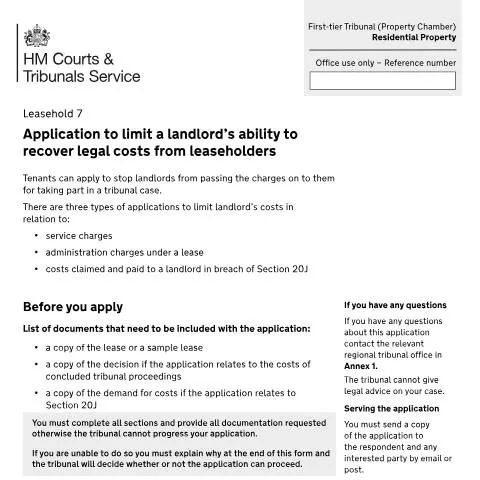
When Landlords' Legal Bills Land on Your Doorstep: Understanding Tribunal Cost Recovery Applications
The prospect of receiving a demand for legal costs from your landlord can transform what seemed like a straightforward leasehold dispute into a financial nightmare. Whether your landlord has just concluded tribunal proceedings about service charges, administration fees, or other lease-related matters, they may attempt to pass their legal expenses directly onto leaseholders through various contractual mechanisms. Form Leasehold 7 serves as your shield against these potentially devastating cost recovery attempts, offering three distinct pathways to challenge or reclaim money that landlords seek to extract from tenants who may have had little or no involvement in the original proceedings.
This tribunal application addresses a fundamental imbalance in leasehold relationships where landlords can initiate legal action, incur substantial professional fees, and then systematically distribute these costs among leaseholders through service charge accounts or administration charge provisions. The form recognises that tenants often find themselves financially penalised for disputes they neither started nor participated in, creating what Parliament identified as an inherently unfair burden-sharing arrangement.
Three Distinct Legal Remedies Under One Application Framework
Form Leasehold 7 consolidates three separate statutory remedies that address different aspects of landlord cost recovery, each targeting specific circumstances where tenants face unreasonable financial exposure.
Section 20C Applications: Blocking Service Charge Inclusion
The most commonly used provision operates under Section 20C of the Landlord and Tenant Act 1985, designed to prevent landlords from incorporating their tribunal-related legal costs into future service charge calculations. Many lease agreements contain clauses permitting landlords to treat legal expenses as recoverable costs through the annual service charge mechanism, effectively spreading their litigation bills across all leaseholders in a development.
Section 20C applications prove particularly valuable when landlords have pursued unsuccessful tribunal cases or where their conduct during proceedings was unreasonable. The tribunal considers factors including the landlord's behaviour, the outcome of the original case, and whether including legal costs in service charges would create disproportionate financial hardship for leaseholders. Crucially, you can apply for Section 20C protection even if you weren't involved in the original tribunal proceedings, provided you're liable for service charges that might include the disputed legal costs.
Administration Charge Limitations Under the 2002 Act
The second remedy addresses Paragraph 5A of Schedule 11 to the Commonhold and Leasehold Reform Act 2002, targeting administration charges specifically related to litigation costs. Unlike service charges which cover general building management expenses, administration charges typically arise from specific tenant actions or requests, such as consent applications, lease variations, or breach proceedings.
Many leases contain provisions allowing landlords to charge tenants for legal costs incurred in connection with lease enforcement or property management disputes. These contractual litigation cost clauses can create substantial individual liability, particularly where landlords engage expensive legal representation for relatively minor matters. The tribunal can reduce or eliminate these charges where they're deemed unreasonable in amount or circumstance.
Section 20K Recovery for Non-Participating Tenants
The third and most complex remedy operates under Section 20K of the Landlord and Tenant Act 1985, specifically protecting tenants who weren't involved in original tribunal proceedings but subsequently face cost recovery demands. This provision recognises that landlords sometimes attempt to reclaim legal expenses from tenants who had no opportunity to participate in or influence the conduct of the original case.
Section 20K applications require demonstrating that you've already paid prohibited amounts to your landlord and seeking their return. This remedy proves essential where landlords have already extracted legal costs through service charge demands or administration charges before tenants realised they could challenge these payments. The tribunal can order full or partial refunds where landlords have breached the statutory restrictions on cost recovery.
Identifying Your Eligibility and Strategic Positioning
Determining which remedy applies to your situation requires careful analysis of your lease terms, the nature of any tribunal proceedings, and your involvement or lack thereof in the original case. The tribunal's approach varies significantly depending on whether you participated in the original proceedings, the outcome of those proceedings, and the specific cost recovery mechanism your landlord is attempting to use.
| Your Situation | Relevant Remedy | Key Considerations |
|---|---|---|
| Landlord won tribunal case, seeking service charge inclusion | Section 20C | Success depends on landlord's conduct and reasonableness |
| Landlord lost tribunal case, still claiming costs | Section 20C | Strong prospects for cost protection order |
| Direct administration charge for legal costs | Paragraph 5A Schedule 11 | Focus on proportionality and lease provisions |
| Already paid costs, weren't involved in case | Section 20K | Must prove non-participation and payment |
| Multiple cost recovery methods attempted | Combination application | Address each mechanism separately |
Leaseholders often discover cost recovery attempts months or years after the original tribunal proceedings concluded, particularly where landlords incorporate legal expenses into annual service charge accounts without clear identification. Time limits vary depending on the remedy sought, making early identification and action crucial for preserving your rights.
Essential Documentation and Evidence Gathering
The tribunal requires specific documentation to process your application, with missing papers frequently causing delays or rejection. Your evidence package must demonstrate both the legal basis for your application and the factual circumstances supporting your case.
Core Documentary Requirements
Every application must include a copy of your lease or sample lease where multiple identical leases exist within a development. The tribunal needs to examine the specific clauses governing cost recovery, service charge provisions, and administration charge mechanisms. Pay particular attention to sections dealing with legal costs, tribunal proceedings, and landlord expenses, as these clauses determine the scope of potential cost recovery.
Where your application relates to concluded tribunal proceedings, you must provide a complete copy of the tribunal's decision, including any directions or orders made during the case. This documentation helps the tribunal understand the context of the original dispute, the parties' conduct, and the ultimate outcome that led to the cost recovery attempt.
For Section 20K applications involving breach of statutory restrictions, include copies of any cost demands you've received from your landlord. These demands should clearly show the amounts claimed, the legal basis for recovery, and any payments you've already made. Service charge accounts, administration charge invoices, and correspondence regarding legal costs all serve as crucial evidence.
Supporting Evidence Strategy
Beyond mandatory documentation, your case strength often depends on additional evidence demonstrating unreasonable landlord conduct, disproportionate cost recovery, or procedural irregularities. Correspondence between you and your landlord, particularly regarding the original dispute or subsequent cost demands, can reveal important contextual information.
Financial evidence proving hardship or disproportionate impact strengthens applications significantly, particularly where legal costs represent a substantial percentage of your annual service charge liability or where multiple cost recovery attempts create cumulative financial pressure.
Navigating the Application Process and Tribunal Procedures
Form Leasehold 7 follows a structured format requiring precise completion across multiple sections, with the tribunal unable to progress incomplete applications. Each section serves a specific purpose in establishing jurisdiction, identifying parties, and framing the legal issues for determination.
Section Breakdown and Completion Strategy
Section 1 requires selecting the appropriate legal remedy or combination of remedies, with many applicants benefiting from multiple selections where landlords have attempted various cost recovery methods. The tribunal treats each selected remedy as a separate legal application, requiring distinct evidence and legal arguments for each claim.
Sections 2 and 4 identify applicants and respondents, with particular complexity arising in multi-unit developments where numerous leaseholders may wish to join the application. The form accommodates multiple applicants through additional documentation, requiring signed consent from each participating tenant along with their contact details and lease information.
Section 3 addresses property details, crucial for establishing tribunal jurisdiction and identifying the relevant lease arrangements. Where applications cover multiple properties within a development, provide comprehensive descriptions highlighting any variations in lease terms or cost allocation mechanisms.
Service Requirements and Respondent Notification
The tribunal mandates that you serve copies of your completed application on all respondents and interested parties, typically including your landlord, managing agent, and any other parties involved in the original tribunal proceedings. Service must occur by email or post, with proof of service potentially required if respondents dispute receiving notification.
Interested parties may include other leaseholders who could be affected by the tribunal's decision, particularly where cost protection orders might redirect financial liability or where collective service charge arrangements create shared interests in the outcome.
Tactical Considerations and Timing Strategies
The timing of your Leasehold 7 application can significantly impact both procedural requirements and substantive outcomes, with different strategic considerations applying depending on whether cost recovery attempts have already commenced or remain prospective.
Pre-emptive Applications During Ongoing Proceedings
Where tribunal proceedings are still ongoing, submitting Section 20C applications during the original case often proves more efficient than separate subsequent proceedings. Many tribunals encourage parties to raise cost protection issues during substantive hearings, allowing comprehensive consideration of both the underlying dispute and potential cost consequences.
Early applications also prevent landlords from incurring additional legal costs in the knowledge that recovery may be restricted, potentially encouraging more reasonable conduct and settlement discussions. However, premature applications where the original case outcome remains uncertain may receive less favourable consideration from tribunals preferring to assess cost recovery requests in light of final determinations.
Fill in your form directly online
No printing: type your details into the boxes of the official form, tick, then download the PDF ready to send.
- 1Type into the form boxes
- 2Tick in one click
- 3Save and download the PDF
Post-Decision Applications and Limitation Periods
Applications following concluded tribunal proceedings must navigate various limitation periods and procedural requirements, with different time limits applying to each remedy type. Section 20C applications generally require submission within reasonable periods following conclusion of the original case, though the tribunal retains discretion where exceptional circumstances justify delays.
Section 20K recovery applications face more stringent timing requirements, particularly where landlords have already extracted prohibited costs through service charge or administration charge mechanisms. Delay in challenging cost recovery can significantly weaken your position, particularly where you've continued making payments without protest after becoming aware of potential statutory breaches.
Understanding Tribunal Decision-Making and Outcome Scenarios
Tribunal determinations on cost protection applications involve balancing multiple factors including landlord conduct, case outcomes, tenant involvement, and proportionality considerations. The tribunal's approach varies significantly depending on the specific remedy sought and the factual circumstances surrounding both the original dispute and subsequent cost recovery attempts.
Section 20C Decision Factors
For Section 20C applications, tribunals typically consider whether the landlord's pursuit of the original case was reasonable, their conduct during proceedings, and the ultimate outcome achieved. Landlords who lose tribunal cases or achieve only marginal success often face cost protection orders, particularly where their legal expenditure appears disproportionate to the issues in dispute.
The tribunal also examines whether including legal costs in service charges would create unfair financial consequences for leaseholders, considering factors such as the number of units sharing costs, individual financial circumstances, and whether tenants had opportunities to influence the landlord's legal strategy.
Administration Charge Assessments
Paragraph 5A applications focus on reasonableness and proportionality, with tribunals examining whether contractual litigation cost clauses create excessive financial exposure relative to the underlying lease obligations. The assessment considers both the amount of costs claimed and the circumstances giving rise to legal expenditure.
Tribunals frequently reduce administration charges where landlords have engaged unnecessarily expensive legal representation, pursued disproportionate enforcement action, or failed to explore alternative dispute resolution before commencing formal proceedings. The key test involves whether the costs represent a reasonable response to the tenant's conduct or lease breach.
Preparing for Hearings and Presenting Effective Arguments
Most Leasehold 7 applications proceed to substantive hearings where both parties can present evidence and legal arguments, with tribunal decisions significantly influenced by the quality of preparation and presentation demonstrated by each side.
Your hearing preparation should address both the legal framework governing cost recovery and the specific factual circumstances of your case. Tribunals appreciate clear chronological presentations highlighting key events, decisions, and correspondence that led to the current cost recovery dispute.
Effective arguments often focus on procedural fairness, particularly where landlords failed to notify tenants about potential cost consequences before commencing legal action or where cost recovery attempts emerged unexpectedly through service charge accounts without prior warning or consultation.
Financial impact evidence proves particularly compelling, especially where legal cost recovery would create genuine hardship or where the amounts claimed appear grossly disproportionate to your individual benefit from any successful landlord action. Tribunals retain broad discretion in fashioning appropriate remedies, including partial cost protection orders where complete exemption would be inappropriate.
The tribunal's ultimate decision will establish binding precedent for your ongoing landlord relationship, making thorough preparation and professional presentation essential for achieving optimal outcomes that protect your long-term financial interests while maintaining constructive property management relationships.