When Landlords Need to Prove Lease Breach: Understanding the Leasehold 6 Application Process
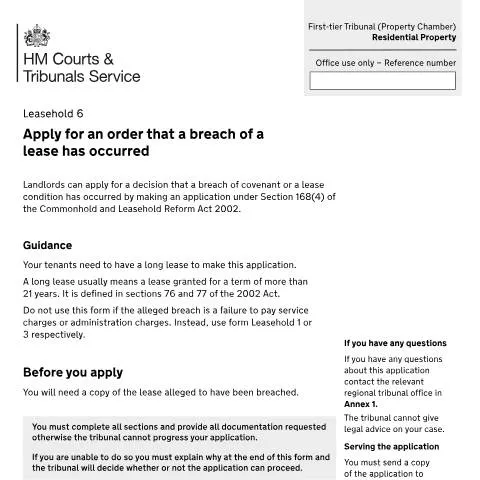
For landlords managing long leases, proving that a tenant has breached their lease obligations can be legally complex. The Leasehold 6 form serves as the gateway to obtaining a formal determination from the First-tier Tribunal (Property Chamber) that a breach of covenant or lease condition has indeed occurred. This application, made under Section 168(4) of the Commonhold and Leasehold Reform Act 2002, creates a crucial legal foundation that may be required before pursuing further enforcement action.
The process isn't simply about registering a complaint. The tribunal determination establishes an official record that specific lease terms have been violated, which can prove essential for subsequent legal proceedings. However, this route has specific limitations and requirements that landlords must understand before submitting their application.
The Legal Framework: Section 168(4) and Long Lease Requirements
The Commonhold and Leasehold Reform Act 2002 introduced significant protections for long leaseholders, including the requirement for landlords to obtain a tribunal determination before pursuing certain enforcement actions. Section 168(4) specifically allows landlords to apply for an order confirming that a breach has occurred, but only in carefully defined circumstances.
The definition of a long lease is crucial here. According to sections 76 and 77 of the 2002 Act, this typically means leases granted for terms exceeding 21 years. However, the legal definition encompasses various scenarios and extensions, so landlords should verify their lease qualifies before proceeding.
Importantly, the Leasehold 6 form cannot be used for breaches involving failure to pay service charges or administration charges. These specific financial disputes require different applications: Leasehold 1 for service charge disputes and Leasehold 3 for administration charge matters. This distinction reflects the specialised procedures Parliament established for different types of leasehold disputes.
Excluded Breach Types and Alternative Routes
The exclusion of service charge and administration charge breaches from the Leasehold 6 process reflects the comprehensive framework Parliament created for leasehold dispute resolution. Service charge disputes often involve complex questions about reasonableness, consultation requirements, and detailed expenditure analysis that require specialised tribunal procedures.
Similarly, administration charge disputes typically concern the landlord's right to recover costs for various administrative functions, which involves different legal tests and evidence requirements than general covenant breaches.
Dissecting the Application: Key Sections and Evidence Requirements
The Leasehold 6 form demands comprehensive information across five main sections, each serving specific evidential purposes. Understanding what the tribunal needs at each stage can significantly impact the application's success.
Applicant and Representative Details
Section 1 captures not just basic contact information but establishes the legal capacity of the applicant. The form specifically notes that capacity would typically be "landlord", but this can encompass various entities including freeholders, head lessees, or management companies with relevant rights under the lease structure.
For multiple applicants, the tribunal requires separate documentation signed by each party or individual emails confirming participation. This requirement prevents disputes later about who authorised the application and ensures all relevant landlord entities are properly represented.
The representative provisions allow landlords to appoint someone to handle tribunal correspondence. Crucially, once a representative is appointed, the tribunal will only correspond with that representative, not the landlord directly. This can streamline communication but requires careful consideration of who should receive important updates and decisions.
Property Information and Description Requirements
Section 2 requires more than just an address. The tribunal needs context about the property type, building structure, and estimated age. This information helps tribunals understand the lease framework and potential issues that might arise in different property types.
For example, a Victorian conversion flat might face different covenant interpretation issues than a purpose-built modern development. Similarly, the number of flats in a block can affect how certain lease obligations operate in practice.
Respondent Identification and Service
Properly identifying the respondent in Section 3 is crucial for valid service of the application. The form allows for multiple respondents, reflecting situations where lease obligations might affect several leaseholders or where breaches involve multiple parties.
The tribunal requires applicants to serve a copy of the application on respondents and any interested parties by email or post. This service requirement ensures procedural fairness and gives respondents proper notice to prepare their response.
The Critical Section 4: Specifying Breach Details and Legal Analysis
Section 4 represents the heart of the application, requiring landlords to specify exactly which covenant has been breached and provide detailed evidence of the breach's nature. This section demands both legal precision and factual thoroughness.
Identifying the Specific Covenant
Landlords must reference the exact lease clause allegedly breached. Vague references to "general obligations" or "tenant duties" won't suffice. The tribunal needs to see the precise wording of the covenant and understand how the tenant's actions or omissions constitute a breach.
Common covenant breaches might include:
- Unauthorised alterations or improvements without required consent
- Use of premises contrary to permitted use clauses
- Failure to maintain the property in required condition
- Breach of insurance obligations or cooperation requirements
- Violation of nuisance or annoyance provisions
- Subletting without consent where prohibited
Evidencing the Breach
The tribunal expects comprehensive details about how the breach occurred, when it started, whether it's continuing, and what evidence supports the landlord's position. Photographic evidence, correspondence with the tenant, witness statements, and expert reports may all be relevant depending on the breach type.
For alterations breaches, landlords might need building plans, photographs showing unauthorised work, and evidence that proper consent procedures weren't followed. For use breaches, evidence might include observations of unauthorised activities, complaints from other residents, or business registrations at residential addresses.
Tenant Admissions and Communications
Section 4.2 specifically asks whether the tenant has admitted any aspect of the alleged breach. Such admissions can significantly strengthen the landlord's case, but the tribunal needs full context including when admissions were made, in what circumstances, and whether the tenant has since disputed their previous position.
Partial admissions require careful handling. A tenant might admit to undertaking certain works while disputing that those works constitute a breach, or might admit a breach while claiming it's been remedied or that consent was implied.
Strategic Considerations: Timing and Parallel Proceedings
Section 5 addresses other related applications or proceedings, reflecting the complex web of potential disputes in leasehold relationships. The tribunal needs to understand the broader context to avoid conflicting decisions and ensure efficient case management.
Related Management Disputes
Leasehold disputes rarely exist in isolation. A breach of repair covenants might coincide with service charge disputes about maintenance standards. Unauthorised alterations might trigger both breach proceedings and applications about consent procedures. The tribunal must coordinate these various elements to provide coherent resolution.
Landlords should disclose any pending applications about property management, service charges, or other lease interpretation issues. This transparency helps the tribunal identify potential conflicts and may enable consolidation of related cases for more efficient resolution.
Ongoing Tenant and Landlord Relationships
Where the same parties have previous tribunal history, this context can affect how the current application is approached. Patterns of dispute, previous determinations about lease interpretation, or ongoing compliance issues all provide relevant background for the tribunal's consideration.
Documentation Requirements and Supporting Evidence
The tribunal's ability to determine breach applications depends entirely on the quality and completeness of supporting documentation. The form emphasises that all sections must be completed and all requested documentation provided, or the application cannot progress unless compelling reasons for omissions are explained.
| Essential Documents | Purpose | Timing Requirements |
|---|---|---|
| Copy of the lease | Establishes covenant terms and breach definition | Must accompany application |
| Evidence of breach | Demonstrates violation occurred | Should cover breach period comprehensively |
| Correspondence with tenant | Shows attempts at resolution and tenant response | Include all relevant communications |
| Supporting witness statements | Provides independent verification | Should be contemporaneous where possible |
The Lease Document Requirement
A complete copy of the lease alleged to have been breached is mandatory. This must include all schedules, plans, and amendments that might affect the interpretation of relevant covenants. Where leases have been varied or supplemented, all relevant documentation must be provided to give the tribunal the complete legal picture.
The tribunal needs to see not just the specific covenant allegedly breached, but the broader lease context that might affect interpretation. Service charge provisions, insurance clauses, and management arrangements can all influence how specific covenants operate in practice.
Quality and Presentation of Evidence
While the form can be completed by hand if written clearly, the complexity of lease breach applications often benefits from typed submissions with well-organised supporting documentation. Additional pages are permitted where space is insufficient, but must include the applicant's name at the top of each page.
Photographic evidence should be clearly dated and annotated to explain what they demonstrate. Plans and technical documents need sufficient context for tribunal members who may not have specialist knowledge in particular areas.
Submission Process and Regional Tribunal Offices
The First-tier Tribunal (Property Chamber) operates through regional offices across England, each handling applications for their geographical area. Annex 1 of the form provides contact details for relevant regional offices, and applicants must identify the correct office based on the property location.
Service Requirements and Procedural Compliance
Beyond submitting the application to the tribunal, landlords must serve copies on all respondents and interested parties. This service can be by email or post, but must be properly documented to demonstrate compliance with procedural requirements.
Interested parties might include other leaseholders affected by the breach, management companies, or superior landlords with relevant interests. Identifying all necessary parties prevents delays and ensures comprehensive resolution of the dispute.
DX Service and Professional Representation
Some regional tribunal offices accept DX (Document Exchange) service, particularly useful for legal representatives handling multiple applications. However, not all offices participate in DX services, so representatives must verify availability for their specific regional office.
The tribunal cannot provide legal advice on applications, emphasising the importance of proper preparation or professional assistance where lease interpretation involves complex legal issues.
Post-Application Procedures and Tribunal Determination
Once properly submitted, the Leasehold 6 application triggers a formal tribunal process that can result in various outcomes depending on the evidence presented and the respondent's position.
The tribunal may determine that a breach has occurred, find no breach has been established, or identify that remedial action by the tenant has resolved the situation. These determinations carry significant legal weight and can influence subsequent enforcement proceedings or lease forfeiture actions.
For landlords, a successful breach determination provides crucial legal foundation for further action, while an unsuccessful application might indicate weaknesses in their interpretation of lease obligations or evidence gathering. Either outcome provides clarity that can guide future landlord-tenant relationships and dispute resolution strategies.
The Leasehold 6 process represents Parliament's attempt to balance landlord enforcement rights with leaseholder protection, ensuring that breach allegations receive proper scrutiny before potentially serious consequences follow. Understanding this balance helps both landlords and tenants navigate the complex world of long lease relationships more effectively.
Fill in your form directly online
No printing: type your details into the boxes of the official form, tick, then download the PDF ready to send.
- 1Type into the form boxes
- 2Tick in one click
- 3Save and download the PDF
Common Types of Lease Breaches That Warrant Form Leasehold 6 Applications
Understanding which specific breaches justify a Form Leasehold 6 application helps leaseholders build stronger cases before the First-tier Tribunal (Property Chamber). The most frequently encountered breaches fall into several distinct categories, each requiring different evidence and approaches.
Service charge disputes represent the largest category of lease breach applications. These typically involve landlords failing to provide adequate breakdown of costs, charging for services not actually provided, or including unreasonable management fees without proper justification. For instance, if your lease specifies that service charges must be "reasonably incurred" but you're being charged £500 monthly for cleaning a communal area that receives minimal use, this could constitute a breach. The key evidence includes comparing charges to market rates, photographing the actual condition of services, and obtaining quotes from alternative providers.
Repair and maintenance obligations form another significant category. Landlords who fail to maintain common areas, ignore structural repairs, or neglect safety systems breach their lease obligations. A typical scenario involves water damage from faulty communal pipes that the landlord refuses to address despite multiple requests. Document such breaches through dated photographs, correspondence records, and professional reports where structural issues are concerned. Remember that minor cosmetic issues rarely warrant tribunal action, but health and safety concerns or substantial property damage typically do.
Insurance-related breaches occur when landlords fail to maintain adequate buildings insurance, refuse to provide policy details, or inappropriately recover insurance costs. Your lease should specify the landlord's insurance obligations – if they're charging you for insurance but cannot provide evidence of coverage, or if the policy doesn't adequately protect the building, these constitute potential breaches.
Information and consultation breaches arise under Section 20 of the Landlord and Tenant Act 1985, where landlords proceed with major works costing over £250 per leaseholder without proper consultation. This includes failing to obtain multiple quotes, not allowing sufficient response time, or ignoring leaseholder objections without proper consideration.
Strategic Considerations Before Filing Your Application
Before submitting Form Leasehold 6, several strategic factors can significantly impact your case's success rate and overall outcome. The timing of your application, the strength of your evidence base, and your approach to pre-tribunal resolution all influence whether the tribunal will find in your favour.
Timing considerations extend beyond simple limitation periods. While most lease breach claims must be brought within six years, the practical timing of your application matters enormously. Filing immediately after a breach occurs might seem logical, but tribunals often expect evidence that the breach is ongoing or has caused substantial detriment. Conversely, waiting too long can weaken your position, particularly if you've continued paying disputed charges without formal protest. The optimal timing typically falls between three to twelve months after initial breach identification, allowing time to gather evidence and attempt resolution while demonstrating the breach's continuing impact.
Evidence quality assessment requires honest evaluation of your documentation before proceeding. Strong cases typically include contemporaneous written records, independent expert opinions where technical issues arise, and clear financial quantification of losses. Weak cases rely heavily on verbal agreements, lack supporting documentation, or involve subjective complaints about service quality without objective standards. Consider whether your evidence would convince an impartial observer – if you're relying primarily on your own testimony against professional property managers, additional corroborating evidence becomes essential.
Alternative dispute resolution potential should be thoroughly explored before tribunal proceedings. Many lease breaches result from communication failures or misunderstandings rather than deliberate non-compliance. The Property Ombudsman scheme covers many managing agents, providing free dispute resolution for service charge and management issues. Similarly, professional body complaint procedures (such as ARMA or RICS) can resolve disputes more quickly and cost-effectively than tribunal proceedings. However, be aware that some landlords use offers to engage in alternative dispute resolution as delay tactics – set clear deadlines for resolution attempts.
Cost-benefit analysis becomes crucial given the potential financial implications. While the First-tier Tribunal doesn't automatically award costs to successful parties, unsuccessful applicants can face liability for the other side's legal expenses in complex cases. Calculate not just your potential recovery (such as service charge refunds) but also the time investment required, potential relationship damage with your landlord, and the possibility of retaliatory action within legal bounds.
Collective action possibilities often strengthen individual cases while reducing costs. If multiple leaseholders face similar breaches, coordinating applications or appointing a representative can improve your negotiating position and share legal expenses. However, ensure all participants understand their individual liability and commitment levels before proceeding collectively.
Post-Application Process and Enforcement Mechanisms
Successfully obtaining a tribunal determination that a lease breach has occurred represents only the beginning of the enforcement process. Understanding how tribunal decisions are implemented and what happens when landlords fail to comply ensures you can effectively utilize any favourable ruling.
Tribunal decision implementation varies significantly depending on the specific breach type and remedy awarded. Financial remedies, such as service charge refunds or compensation payments, create enforceable debts that can be pursued through county court proceedings if necessary. However, the tribunal cannot directly compel payment – you must take separate enforcement action for monetary awards. Keep detailed records of any payments made or withheld following the tribunal decision, as these may be relevant for subsequent enforcement proceedings.
Specific performance orders require landlords to take particular actions, such as completing repairs or providing information. These decisions include clear deadlines and specific requirements, but enforcement can prove challenging if landlords remain non-compliant. The tribunal cannot hold landlords in contempt, but persistent non-compliance may justify applications for mandatory injunctions through the High Court, though this involves significantly higher costs and complexity.
Service charge withholding rights often arise from successful breach applications, but must be exercised carefully to avoid creating your own breach of lease obligations. Following a tribunal determination that service charges are unreasonable or improperly levied, you typically gain the right to withhold future payments until proper procedures are followed. However, continue paying undisputed portions and maintain clear records demonstrating which specific charges you're withholding and why.
Ongoing monitoring requirements become essential after successful applications, as landlords may initially comply but gradually revert to previous practices. Establish systems for tracking whether ordered remedies are being maintained – for instance, if the tribunal ordered improved cleaning standards, document the actual service quality over subsequent months. This evidence proves invaluable if further applications become necessary.
Relationship management considerations require careful balance between asserting your rights and maintaining workable relationships. While tribunals protect leaseholders from retaliatory action, landlords retain significant control over day-to-day management decisions. Consider whether ongoing disputes justify the potential for deteriorated relationships, particularly in smaller developments where cooperation benefits all parties.
Follow-up application scenarios may arise if new breaches occur or if landlords fail to implement tribunal decisions effectively. The tribunal system allows for multiple applications, but repeated applications about similar issues may face increased scrutiny regarding whether previous remedies were given adequate opportunity to work. Document how you've attempted to resolve new issues before filing subsequent applications, demonstrating that tribunal intervention remains necessary.
Appeals against tribunal decisions are possible but strictly limited to points of law rather than factual disagreements. The Upper Tribunal (Lands Chamber) hears such appeals, but permission is required and costs risks are substantially higher. Most unsuccessful parties are better served by addressing the specific deficiencies identified in the tribunal decision rather than appealing, particularly where the decision provides clear guidance for future compliance.