When Motor Trade Businesses Need Their First Set of Trade Plates
The motor trade industry operates under specific regulatory frameworks that distinguish legitimate business activities from private vehicle use. For any business dealing in vehicles—whether selling, repairing, manufacturing, or testing—trade licence plates represent the legal gateway to conducting road-based operations without the administrative burden of registering every vehicle individually.
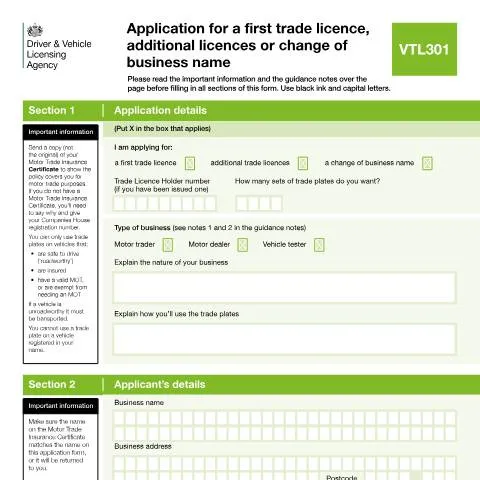
Form VTL301 serves as the primary application mechanism for businesses seeking their initial trade licence from the Driver and Vehicle Licensing Agency. This document establishes the legal foundation for using trade plates, which allow motor traders to move unregistered or customer vehicles on public roads for specific business purposes. The application process involves demonstrating legitimate motor trade operations, securing appropriate insurance coverage, and committing to strict usage limitations.
The significance extends beyond mere convenience. Trade plates enable businesses to test drive vehicles with potential customers, transport vehicles between locations, and conduct road trials without the prohibitive cost and administrative complexity of individual vehicle registration. However, this privilege comes with stringent responsibilities and legal obligations that the VTL301 application process helps establish and monitor.
Defining the Motor Trade Landscape: Who Qualifies for Trade Licences
The DVLA recognises three distinct categories of eligible businesses, each with specific operational characteristics that justify trade plate usage. Understanding these categories helps determine not only eligibility but also the appropriate scope of trade plate activities.
| Business Type | Core Activities | Trade Plate Usage Rights |
|---|---|---|
| Motor Dealer | Vehicle sales, showroom operations | Customer test drives, delivery to buyers |
| Motor Trader | Manufacturing, repairs, modifications | Road testing, quality assurance drives |
| Vehicle Tester | Independent testing services | Performance evaluation, compliance testing |
Motor dealers typically operate retail environments where customers examine and purchase vehicles. Their trade plate requirements often focus on enabling potential buyers to experience vehicles under real driving conditions, facilitating the sales process whilst maintaining legal compliance for unregistered stock.
Motor traders encompass a broader range of activities including vehicle manufacturing, substantial repairs, and modifications. These businesses frequently need to conduct extensive road testing to verify work quality, assess performance modifications, or demonstrate restored vehicles to potential buyers.
Vehicle testers provide specialised services to other businesses or individuals, requiring road access to evaluate vehicle performance, conduct compliance assessments, or provide independent verification of vehicle condition.
Collection and Delivery Operations
Businesses exclusively engaged in vehicle collection and delivery services qualify for trade licences under specific conditions. The activity must either represent the sole business function or operate alongside manufacturing or repair services. Pure logistics operations without manufacturing or repair elements face more restrictive eligibility criteria.
Navigating the VTL301 Application Structure
The form divides into four principal sections, each addressing distinct aspects of the trade licence application. This structure reflects the DVLA's systematic approach to verifying business legitimacy, insurance adequacy, and operational compliance.
Section 1: Application Scope and Business Classification
Applicants must clearly identify whether they seek a first trade licence, additional licences, or a business name change. This distinction affects processing procedures and required documentation. First-time applicants undergo more comprehensive verification, whilst existing licence holders requesting additional plates benefit from streamlined processing based on established business relationships.
The business type classification—motor trader, dealer, or tester—determines permissible trade plate activities. Applicants must articulate their business nature clearly and specify intended trade plate usage. Vague descriptions often result in application delays or rejections, emphasising the importance of precise, comprehensive explanations.
Section 2: Business Identity and Contact Information
Business name consistency across all documentation represents a critical compliance requirement. The name appearing on the VTL301 must exactly match the name on the Motor Trade Insurance Certificate. Discrepancies trigger automatic application returns, causing significant delays.
Contact information serves operational purposes beyond mere administration. The DVLA uses provided telephone numbers and email addresses for application status updates, delivery notifications, and ongoing compliance communications. Mobile phone numbers enable Royal Mail delivery tracking services, providing real-time updates about trade plate dispatch.
Section 3: Trade Licence History and Usage Patterns
This section examines the applicant's history with trade plates, including previous holdings at the current business location, other business names, and alternative business addresses. Such information helps the DVLA identify patterns of compliance or non-compliance, influencing application assessment.
Plate type selection—all vehicle types, vehicles plus bicycles, or bicycles only—determines the physical plates received. Standard applications receive front and rear plates for motor vehicles, whilst comprehensive applications include additional bicycle plates for businesses dealing in powered two-wheelers.
Section 4: Financial Obligations and Legal Declarations
Payment processing requires cheques or postal orders payable to 'DVLA Swansea'. Cash payments and personal cheques to individuals are not accepted. Damaged or altered cheques trigger application returns, emphasising the importance of careful payment preparation.
The declaration section carries legal weight, with false statements constituting criminal offences. Signatories must hold appropriate authority within the business structure—directors for limited companies, partners for partnerships, or sole proprietors for individual businesses.
Insurance Requirements: The Motor Trade Certificate Foundation
Motor Trade Insurance represents the cornerstone of trade licence eligibility, serving as proof that the business operates legitimately within the motor trade sector. Unlike standard vehicle insurance, Motor Trade Insurance covers business-specific activities including customer test drives, vehicle movement between locations, and road testing of unregistered vehicles.
The insurance certificate must explicitly state coverage for 'motor trade purposes', distinguishing it from general commercial vehicle insurance. Standard business insurance policies typically exclude motor trade activities, making specialised coverage essential for trade licence applications.
Certificate Submission Requirements
Applicants must submit photocopies of their Motor Trade Insurance Certificate, retaining originals for their records. The DVLA specifically requests copies to prevent loss of essential business documentation whilst enabling thorough verification of coverage details.
Certificate validity periods must extend beyond the requested trade licence start date. Expired or soon-to-expire certificates require renewal before application submission, as the DVLA cannot issue trade licences without current insurance coverage verification.
Alternative Documentation for Specific Business Types
Businesses lacking Motor Trade Insurance Certificates must provide Companies House registration numbers along with detailed explanations for the absence of standard motor trade coverage. This alternative applies primarily to manufacturers or specialised businesses whose insurance arrangements differ from conventional motor trade policies.
Operational Limitations and Compliance Obligations
Trade plates operate under strict usage limitations designed to prevent abuse whilst enabling legitimate business activities. These restrictions form part of the legal framework governing trade licence privileges and carry significant penalties for violations.
Vehicle Eligibility Criteria
Trade plates may only be used on vehicles meeting specific safety and legal requirements:
- Roadworthiness: Vehicles must be mechanically safe for road use, regardless of registration status
- Insurance coverage: Motor Trade Insurance must extend to the specific vehicle being driven
- MOT compliance: Valid MOT certificates or statutory exemptions must apply
Unroadworthy vehicles require transportation rather than driven movement, even with trade plates attached. This distinction protects public safety whilst acknowledging that motor trade businesses often deal with vehicles requiring repair or restoration.
Ownership Restrictions
A fundamental limitation prohibits using trade plates on vehicles registered in the licence holder's name. This prevents businesses from avoiding standard vehicle excise duty on personally-owned vehicles whilst maintaining clear distinctions between business and private vehicle use.
Purpose-Specific Usage
Trade plates must be used exclusively for purposes declared in the VTL301 application. Businesses stating plates will facilitate customer test drives cannot subsequently use them for general business transportation or personal journeys. Purpose modifications require formal notification to the DVLA through appropriate channels.
Processing Timelines and Administrative Procedures
The DVLA operates specific processing timelines for trade licence applications, balancing thorough verification requirements with business operational needs. Understanding these timelines helps businesses plan effectively and avoid operational disruptions.
Application Submission Timing
Applications should not be submitted more than ten days before the desired licence start date. Earlier submissions may be delayed or returned, as the DVLA systems are configured to process applications within this timeframe. This requirement reflects the administrative reality of coordinating insurance verification, payment processing, and plate manufacture.
The specified start date must fall on the first day of a calendar month, aligning with the DVLA's monthly licensing cycles. Mid-month start dates are not accommodated, requiring businesses to plan accordingly when timing their applications.
Documentation Verification Process
The DVLA conducts systematic verification of submitted documentation, including insurance certificate validation, business registration checks, and payment processing. This verification typically requires several working days, depending on the complexity of the business structure and clarity of submitted information.
Incomplete applications trigger automatic returns with explanatory documentation, requiring resubmission with corrected or additional information. Such returns significantly extend processing times, emphasising the importance of comprehensive initial submissions.
Trade Plate Dispatch and Delivery
Approved applications result in trade plate manufacture and dispatch via Royal Mail services. Delivery tracking information is available to applicants who provide mobile phone numbers and consent to Royal Mail communications during the application process.
Trade plates are posted to the business address specified in the VTL301 application. Alternative delivery arrangements require separate correspondence with the DVLA, as standard processing assumes delivery to the registered business location.
Financial Considerations and Fee Structure
Trade licence fees reflect the administrative costs of processing applications, manufacturing plates, and maintaining licensing systems. The fee structure varies based on licence duration and plate quantity, with businesses able to select arrangements matching their operational requirements.
Payment Methods and Processing
The DVLA accepts cheques and postal orders exclusively, made payable to 'DVLA Swansea'. Personal cheques require careful attention to payee details, as incorrect payee information triggers payment rejection and application delays.
Cheque validity periods must extend beyond application processing times. Post-dated cheques are not accepted, requiring businesses to ensure funds availability when submitting applications rather than at projected processing completion dates.
Refund Entitlements for Business Changes
Businesses changing names whilst holding valid trade licences may qualify for refunds covering unused licence periods. The refund calculation operates on full calendar months remaining after the DVLA receives the change application, encouraging prompt notification of business structure modifications.
Existing trade plates must be returned when requesting name changes, with replacement plates issued bearing the updated business name. This exchange process ensures accurate records whilst preventing unauthorised plate retention under previous business identities.
Integration with Broader Motor Trade Regulations
Trade licence applications operate within the broader regulatory framework governing the UK motor trade industry. Understanding these connections helps businesses ensure comprehensive compliance whilst maximising the operational benefits of trade plate access.
The relationship between trade licences and vehicle excise duty creates specific obligations for businesses. Trade plates do not eliminate excise duty requirements for registered vehicles but provide alternatives for unregistered vehicles undergoing sale, repair, or testing processes.
Consumer protection regulations intersect with trade plate usage, particularly regarding customer test drives and vehicle demonstrations. Businesses must ensure adequate insurance coverage extends to customers driving vehicles under trade plates, maintaining protection for both business and consumer interests.
Data protection obligations under the UK GDPR apply to customer information collected during trade plate activities. Businesses using trade plates for customer demonstrations must implement appropriate data handling procedures, ensuring customer privacy whilst maintaining necessary business records.
Understanding Different Trade Licence Categories and Their Specific Requirements
The VTL301 application process varies significantly depending on the specific type of trade licence you're seeking. Motor traders must distinguish between several distinct categories, each carrying unique obligations and documentation requirements that can substantially impact your application timeline and success rate.
A motor dealer licence primarily covers businesses buying and selling vehicles as their main commercial activity. This category requires comprehensive evidence of your trading premises, including photographs of the site, detailed floor plans showing customer access areas, and proof of appropriate business insurance covering public liability. DVLA expects to see established customer-facing facilities, adequate vehicle storage capacity, and clear segregation between trade and private areas.
For vehicle dismantler licences, environmental compliance becomes paramount. You'll need an Environmental Permit from the Environment Agency or equivalent regulatory body, demonstrating your facility meets waste management standards. Documentation must include details of your depollution procedures, evidence of authorised treatment facility status, and proof of appropriate waste carrier registration. The application requires specific technical information about your dismantling processes and environmental impact mitigation measures.
Motor auction houses face additional scrutiny regarding their operational procedures and customer verification systems. Your VTL301 submission must detail your auction scheduling, bidder registration processes, and vehicle authentication procedures. DVLA particularly examines your systems for preventing stolen vehicle sales and ensuring proper documentation transfer between sellers and buyers.
Businesses operating as vehicle rental companies must provide extensive fleet management documentation. This includes maintenance schedules, driver verification procedures, and comprehensive insurance arrangements covering both vehicles and third-party liability. Your application should demonstrate robust systems for tracking vehicle location, condition monitoring, and customer identity verification.
The vehicle recovery and storage category requires evidence of secure storage facilities, proper vehicle handling equipment, and appropriate staff training certifications. Documentation must show compliance with Health and Safety Executive guidelines for lifting operations and demonstrate adequate security measures preventing unauthorised access to stored vehicles.
Each category also carries different fee structures and renewal requirements. Motor dealers typically face standard annual renewal processes, whilst dismantlers may require more frequent environmental compliance reviews. Understanding these distinctions before submitting your VTL301 prevents costly delays and ensures you provide appropriate supporting evidence from the outset.
Managing Multi-Site Operations and Complex Business Structures
Businesses operating across multiple locations or with complex corporate structures face particular challenges when completing the VTL301 application. DVLA's assessment process becomes significantly more intricate when evaluating companies with subsidiary relationships, franchise arrangements, or geographically dispersed operations.
For multi-site operations, each trading location typically requires separate licence consideration, even under unified corporate ownership. Your VTL301 application must clearly identify all premises where trade activities will occur, providing individual site assessments for each location. This includes separate documentation packages covering premises suitability, local authority compliance, and site-specific insurance arrangements.
When preparing multi-site applications, establish a clear hierarchy showing which locations serve as primary trading bases versus auxiliary storage or display facilities. DVLA distinguishes between sites used for customer transactions and those serving purely operational functions. Customer-facing locations require more comprehensive documentation, including accessibility compliance, adequate parking facilities, and appropriate signage arrangements.
Companies with franchise or partnership arrangements must carefully delineate operational responsibilities and legal obligations. Your VTL301 submission should clearly identify which entity holds ultimate responsibility for trade activities, vehicle ownership, and regulatory compliance. Documentation must demonstrate clear lines of authority and show how franchise agreements align with DVLA licensing requirements.
For businesses operating under group company structures, particular attention must be paid to cross-company vehicle transfers and shared operational resources. DVLA examines whether vehicles move between related companies under trade plate authority and how administrative systems handle these transfers. Your application should detail inter-company agreements and demonstrate that all entities maintain appropriate licensing coverage.
Complex ownership structures involving multiple shareholders, holding companies, or overseas parent entities require additional transparency measures. The VTL301 application must identify all beneficial owners holding significant stakes and demonstrate their suitability under DVLA's fit and proper person criteria. This becomes particularly relevant when overseas entities hold controlling interests, as additional verification procedures may apply.
Businesses planning expansion or restructuring should consider how future changes might affect their licensing status. DVLA typically requires notification of significant operational changes, including new premises, ownership transfers, or substantial business model modifications. Planning these considerations during your initial VTL301 application can prevent future compliance complications and licensing interruptions.
Compliance Monitoring and Ongoing Regulatory Obligations
Securing your initial trade licence through the VTL301 process represents just the beginning of ongoing regulatory obligations that continue throughout your licence validity period. DVLA maintains active monitoring systems and expects licence holders to demonstrate continuous compliance with all applicable standards and requirements.
Record-keeping obligations extend far beyond simple transaction logs. Licensed traders must maintain comprehensive documentation covering all vehicle acquisitions, disposals, and movements under trade plate authority. These records must include detailed vehicle identification information, acquisition sources, disposal methods, and complete audit trails for all commercial activities. DVLA inspectors expect to see systematic record-keeping that enables rapid verification of any vehicle's history within your business operations.
Your documentation systems must accommodate digital record requirements whilst maintaining appropriate backup and recovery procedures. Many traders find that purely paper-based systems become inadequate as business volumes increase, particularly when dealing with online sales platforms or electronic auction houses. However, any digital systems must ensure data integrity and provide reliable access during potential DVLA inspections.
Trade plate usage carries specific obligations that many new licence holders underestimate. Every journey under trade plate authority must have legitimate business purposes, with clear documentation supporting the necessity for each trip. This includes movements between your premises, customer deliveries, test drives, and transportation to auction venues or other trading locations. Misuse of trade plates represents a serious compliance breach that can result in licence suspension or revocation.
Regular premises inspections form part of DVLA's ongoing monitoring regime, though these typically occur without advance notice. Licence holders must ensure their facilities continuously meet the standards demonstrated in their original VTL301 application. This includes maintaining appropriate security measures, ensuring adequate vehicle storage capacity, and preserving customer access arrangements that comply with accessibility legislation.
Insurance compliance requires continuous attention, as coverage gaps can invalidate your trading authority. Your insurance arrangements must cover all aspects of your licensed activities, including public liability, vehicle storage, and trade plate usage. Many policies include specific exclusions for commercial trading activities, making it essential to work with insurers experienced in motor trade requirements.
Changes to your business operations, ownership structure, or premises arrangements typically require formal notification to DVLA within specified timeframes. This includes modifications to your trading activities, additional premises acquisitions, significant ownership changes, or alterations to your business structure. Failure to notify relevant changes can result in licensing complications and potential penalties.
The annual renewal process provides DVLA with opportunities to reassess your continued suitability and compliance record. Renewal applications examine any enforcement actions, insurance claims, or operational changes that occurred during the preceding licence period. Maintaining comprehensive compliance documentation throughout your licence term significantly streamlines renewal procedures and demonstrates your commitment to regulatory standards.
Understanding these ongoing obligations before submitting your initial VTL301 application enables better preparation and helps establish appropriate operational systems from the outset. Many compliance issues arise from inadequate preparation rather than deliberate violations, making early planning essential for long-term licensing success.