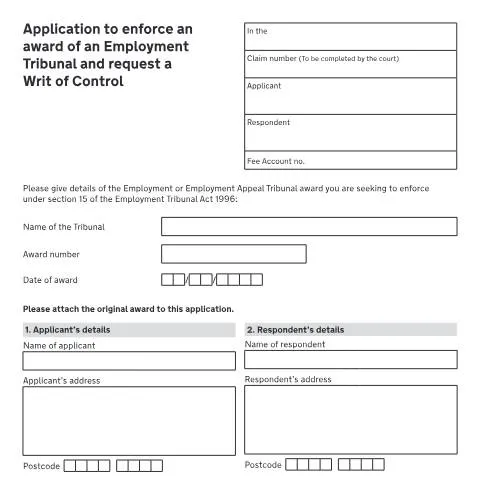
The Significance of Form N471 in Employment Tribunal Awards
When a worker wins a case at an Employment Tribunal, the tribunal issues an award. However, having an award is merely the beginning of the process; enforcing it can often be a complex journey. Form N471, known as the Application to enforce an award of an Employment Tribunal and request a Writ of Control, plays a crucial role in making the award actionable. This form is not just a bureaucratic requirement; it outlines the pathway for applicants to ensure that their rights are upheld and that they receive the compensation awarded to them.
Understanding the Context: Employment Awards and Enforcements
The backdrop for Form N471 is rooted in the legislative framework established by the Employment Tribunal Act 1996. This act empowers individuals who have been wronged in their workplace to seek justice through employment tribunals. However, the effectiveness of such awards hinges on the ability to enforce them. When a respondent fails to make the payments as ordered, this form becomes the mechanism through which the award can be enforced through the courts.
Key Elements of the Employment Tribunal’s Award
- Award Amount: The total sum owed as determined by the tribunal.
- Costs Incurred: Any legal costs that have been awarded by the tribunal.
- Interest Calculation: The ability to claim interest on the amount owed, which must be accurately calculated and documented.
The applicant must ensure that they provide complete and accurate information to facilitate effective enforcement.
Who Must Submit Form N471?
Primarily, it is the responsibility of the applicant—typically the person who received the award from the tribunal—to ensure that Form N471 is submitted. The form can also be filled out by a legal representative acting on behalf of the applicant. This is an important aspect since it allows individuals to seek professional guidance, especially when navigating the complexities of court procedures.
Eligibility and Conditions for Filing
Before filing the form, the applicant must confirm that the award has not been fully paid. If a portion of the award remains unpaid, the applicant is entitled to pursue enforcement. Here are some scenarios where the filing is applicable:
- The respondent has made no payment towards the awarded amount.
- The respondent has partially paid but still owes a significant balance.
- The respondent has ignored requests for payment.
Completing Form N471: A Step-by-Step Guide
Filling out Form N471 requires careful attention to detail. The form comprises several sections, each demanding specific information:
1. Applicant and Respondent Details
It is imperative to accurately fill in the names, addresses, and contact information for both the applicant and the respondent. Any discrepancies may lead to delays in processing the form.
2. Award Details
In this section, applicants must include crucial information about the award:
- Name of the Tribunal where the award was issued.
- Award number, which identifies the specific case.
- Date of the award.
3. Calculating the Amount Owing
This is one of the most critical sections of Form N471. Applicants must clearly state:
- The total amount owed.
- Details on any interest calculations, including the applicable percentage and the dates concerning the interest.
- Legal costs incurred during the tribunal proceedings.
Failure to accurately calculate these amounts can lead to complications or a dismissal of the enforcement application.
4. Requesting a Writ of Control
This section requests that the court issue a Writ of Control, allowing enforcement officers to collect the awarded amounts. Applicants must specify that they intend to enforce through execution against goods, which underscores the serious nature of the claim.
Where to Submit Your Application: Channels for Filing
Form N471 can be submitted through various channels, but the method chosen can impact processing times and ease of communication. Here are the available options:
1. Online Submission
Submitting Form N471 online through the relevant court service can be faster and offers immediate confirmation of receipt. However, applicants must have a digital signature and ensure all details are entered correctly.
2. Postal Submission
Alternatively, applicants can print the form and send it by post to the appropriate court. This method may take longer but could be preferable for those who wish to retain a physical copy of their submission.
3. In-person Submission
Visiting the court in person to submit the form can facilitate immediate queries and clarifications. Applicants can also ensure that their documentation is complete, which may be beneficial in complex cases.
After Submission: Monitoring Your Application
Once Form N471 has been submitted, it is crucial to track the progress of the application. The applicant can:
- Contact the court directly to inquire about the status of the enforcement.
- Be aware of any notifications or requests from the court for additional information or clarification.
- Monitor deadlines associated with the enforcement process to ensure timely follow-ups if necessary.
Understanding the Court’s Role
The court will review the application for completeness and correctness. If all requirements are met, a Writ of Control will be issued. However, if any issues arise, applicants may be required to amend their submission.
Timeframes to Keep in Mind
Timing is critical in the enforcement process. Applicants should be aware of the following timeframes:
1. Filing Deadline
There are no strict deadlines for filing Form N471 post-award; however, it’s advisable to act promptly once the award is not being honoured. Delays can complicate matters and may affect the enforceability of the award.
2. Court Processing Times
Processing times vary by court and can depend on current workload and the complexity of the case. It is advisable to follow up if there are delays beyond a few weeks.
3. Enforcement Actions
Once a Writ of Control is issued, enforcement officers may act quickly, but logistical factors could influence timing; applicants should remain prepared for any eventuality.
Special Circumstances and Considerations
Certain situations may require additional considerations when filling out Form N471:
1. Foreign Respondents
If the respondent resides outside the UK, the enforcement may involve international law and additional legal complexities. It’s important to seek specialist legal advice in such cases.
2. Vulnerable Parties
For applicants who are minors or protected parties, a litigation friend must sign the form. Ensuring the right individual is designated as a litigation friend is imperative to uphold the application’s validity.
3. Urgent Situations
In cases where immediate enforcement is critical, applicants should communicate with the court to expedite processing, although this is granted on a case-by-case basis.
Preparing Supporting Documentation
Form N471 requires the attachment of the original award document. However, additional documents may enhance the application:
- Proof of Communication: Any correspondence regarding payment requests can support the case.
- Proof of Costs: Invoices or receipts for legal costs incurred during the tribunal process.
- Interest Calculations: Detailed calculations should be provided if claiming interest.
Applicants must ensure that all attachments are clearly labelled and referenced within the form to avoid confusion.
Conclusion: Navigating the Enforcement Landscape
Successfully enforcing an Employment Tribunal award using Form N471 can be a daunting process, but it is essential for ensuring that justice is served. By understanding the requirements, procedures, and options available, applicants can navigate this landscape more effectively. As always, seeking legal advice can provide invaluable guidance tailored to the specific circumstances, ensuring that all aspects are addressed properly.
Fill in your form directly online
No printing: type your details into the boxes of the official form, tick, then download the PDF ready to send.
- 1Type into the form boxes
- 2Tick in one click
- 3Save and download the PDF
Understanding the Enforcement Process for Employment Tribunal Awards
Enforcing a decision made by an Employment Tribunal can sometimes be as complex as the tribunal proceedings themselves. Once an Employment Tribunal issues a judgment in favour of a claimant, it is essential for the claimant to understand the steps required to enforce this award effectively. The process primarily revolves around the completion and submission of Form N471, which is used to apply for a Writ of Control to enforce the award.
To initiate this process, the claimant must first determine if the respondent (the party ordered to pay) has failed to comply with the tribunal's decision. If the employer has not paid the awarded amount within the stipulated time frame, typically stated in the tribunal's order, the claimant can seek enforcement. It’s important to note that before filling out Form N471, claimants should ensure that they have a copy of the tribunal's judgment or order, as this will be necessary for the application.
Once the claimant confirms the non-compliance, they must complete Form N471 with accurate information regarding the tribunal's decision, including the date of judgment, the amount owed, and details of the parties involved. The form can be submitted to the High Court or the County Court, depending on the amount of the award. For awards exceeding £600, the High Court is typically the appropriate venue.
Upon submission, the court will review the application. If satisfied, it issues a Writ of Control, which authorizes enforcement officers to take control of the debtor's goods to recover the owed amount. It’s crucial for the claimant to understand that while a Writ of Control allows for the seizure of goods, it does not guarantee immediate payment. The enforcement officers must follow specific legal procedures when executing the writ.
Potential Complications During Enforcement
While the process of applying for a Writ of Control via Form N471 seems straightforward, several complications can arise that may hinder the enforcement of an Employment Tribunal award.
Firstly, the respondent may dispute the enforcement action, claiming that the tribunal's decision was incorrect or that they have already complied. In such cases, the claimant may need to provide additional evidence to counter these arguments, which may involve resorting back to the Employment Tribunal or even appealing the matter in a higher court.
Another complication could arise from issues related to the respondent's ability to pay the awarded amount. If the respondent is facing financial difficulties or insolvency, the claimant may find it challenging to recover the awarded sum. In these scenarios, the claimant may have to consider alternative options such as negotiating a payment plan or pursuing other assets that the respondent may own.
Additionally, enforcing a tribunal award across different jurisdictions can complicate matters further. If a respondent operates in multiple regions or countries, the claimant must follow the enforcement procedures relevant to those jurisdictions, which may differ significantly from UK laws. This situation often requires legal advice to navigate effectively.
Costs Associated with the Application Process
When applying for a Writ of Control through Form N471, it’s important for the claimant to be aware of the potential costs associated with the enforcement process. While the initial application may have a low fee, there are various other expenses to consider that can accumulate throughout the enforcement journey.
Firstly, court fees apply when submitting Form N471. As of the latest guidelines, this fee is based on the value of the claim and can vary. Additionally, fees may be incurred for further legal actions if disputes arise or if the claimant needs to seek further court orders to enforce the tribunal’s award.
Moreover, if enforcement officers are required to seize assets, there may be additional costs related to their services. These fees typically cover the officer's attendance, transportation, and any administrative costs involved in inventorying and disposing of seized goods.
Claimants should also consider the potential need for legal assistance throughout the enforcement process. Engaging a solicitor can enhance the chances of successful enforcement but will introduce further legal costs. Claimants must weigh these costs against the amount awarded by the tribunal to determine whether proceeding with enforcement is financially viable.
In conclusion, while the process to enforce an Employment Tribunal award via Form N471 is an essential tool for claimants, it is fraught with potential complications and costs that require careful consideration. Being well-informed and prepared can make a significant difference in the successful enforcement of a tribunal award.