When Your Judgment Debt is Paid: Understanding the Certificate of Satisfaction Process
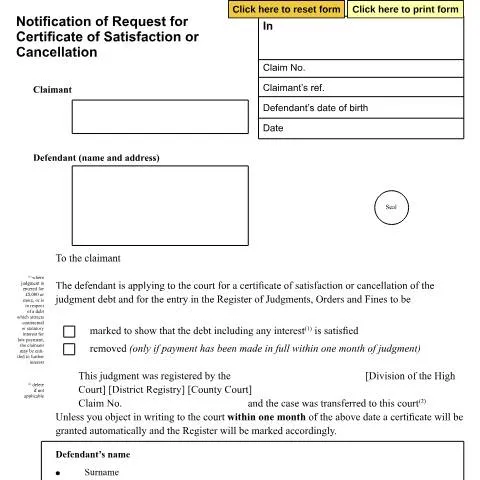
After successfully pursuing a civil claim through the courts and securing a judgment against a debtor, the story doesn't end with the court's decision. When that judgment debt is eventually paid—whether in full or through agreed instalments—the legal record needs updating to reflect this satisfaction. This is where Form N441, the Notification of Request for Certificate of Satisfaction or Cancellation, plays a crucial role in the English civil justice system.
This notification marks a pivotal moment for both creditors and debtors. For the judgment debtor, it represents the opportunity to clear their name from the Register of Judgments, Orders and Fines—a public record that can significantly impact their credit rating and financial standing. For creditors, it signals the formal conclusion of their debt recovery process and triggers important administrative obligations.
The Legal Framework Behind Certificate Applications
The certificate of satisfaction system operates under the Civil Procedure Rules, specifically designed to maintain the integrity of the Register of Judgments, Orders and Fines. When a debtor fulfills their judgment obligations, they gain the legal right to request formal recognition of this payment through HM Courts & Tribunals Service.
The process involves two distinct outcomes depending on the timing of payment:
- Certificate of Satisfaction: Issued when payment is made more than one month after judgment, marking the debt as satisfied but leaving the original entry visible on the register
- Certificate of Cancellation: Granted when full payment occurs within one month of judgment, completely removing the entry from the register as if the judgment never existed
This distinction carries profound implications for the debtor's credit history. While satisfaction certificates acknowledge payment, they don't erase the fact that court action was necessary. Cancellation certificates, however, offer complete rehabilitation by eliminating any trace of the judgment from public records.
Jurisdictional Considerations Across Court Systems
Form N441 operates across the entire court hierarchy, from County Courts handling smaller claims to High Court divisions managing substantial commercial disputes. The notification may originate from the court that initially entered judgment or from a court to which the case has been transferred for enforcement purposes.
Transfer scenarios commonly arise when enforcement action moves from the original court to one closer to the debtor's assets or residence. The N441 form accommodates these complexities by clearly identifying both the originating court and the current administrative court, ensuring proper jurisdictional handling of the certificate request.
Creditor Rights and Response Obligations
Upon receiving Form N441, creditors face a critical one-month window to raise any objections to the proposed certificate. This timeframe reflects the court's preference for expediting debt closure while protecting creditor interests.
The automatic approval mechanism serves judicial efficiency—unless creditors actively object within the specified period, courts will grant certificates without further hearing or investigation. This places the burden on creditors to monitor their judgment portfolio and respond promptly to satisfaction requests.
Grounds for Creditor Objection
| Objection Category | Typical Circumstances | Required Evidence |
|---|---|---|
| Payment Disputes | Incorrect payment amounts or dates claimed by debtor | Payment records, bank statements, correspondence |
| Interest Entitlement | Ongoing statutory or contractual interest on judgments £5,000+ | Interest calculations, contract terms, statutory provisions |
| Partial Payments | Debtor claiming full satisfaction despite outstanding balance | Account statements, payment schedules, court orders |
| Enforcement Costs | Unpaid bailiff fees, legal costs, or court charges | Cost orders, enforcement agent invoices, court fee receipts |
Creditors must understand that silence constitutes consent in this process. The court interprets non-response as acceptance of the debtor's payment claims, making subsequent challenges significantly more difficult.
Interest Complications in High-Value Judgments
Judgments exceeding £5,000 or those involving contractual interest present particular complexity. The N441 form specifically highlights that creditors "may be entitled to further interest" in these circumstances. This acknowledgment protects creditor rights while alerting them to potential ongoing obligations.
Interest continues accruing on substantial judgments until full payment, and creditors must carefully calculate whether proposed satisfaction amounts include all accumulated interest. The form's footnote serves as a crucial reminder to review interest entitlements before the objection deadline expires.
Register Impact and Credit Reporting Implications
The Register of Judgments, Orders and Fines serves as England and Wales' central repository for civil judgment information, directly feeding credit reference agencies and influencing individual and commercial credit ratings. Form N441 notifications trigger immediate register updates with far-reaching consequences for judgment debtors.
Understanding register mechanics helps both parties appreciate the certificate's significance. Satisfaction entries remain visible for six years from the original judgment date, clearly marked to show debt resolution. This transparency allows future creditors to assess both the debtor's past difficulties and their ultimate compliance with court orders.
Cancellation certificates offer more dramatic relief by completely expunging judgment records. This option, available only for prompt payment within one month, recognizes that swift resolution suggests minimal credit risk and deserves complete rehabilitation.
Commercial Implications for Business Debtors
For commercial entities, judgment satisfaction certificates carry particular weight in supplier relationships, banking arrangements, and contract negotiations. Business credit files extensively reference court judgment history, making certificate timing and type crucial for maintaining commercial viability.
Companies facing temporary cash flow difficulties often prioritize rapid judgment settlement to secure cancellation certificates, even when this requires accessing expensive short-term finance. The long-term credit benefits frequently justify immediate financial strain, particularly for businesses dependent on trade credit or banking facilities.
Administrative Process and Documentation Requirements
The N441 notification system operates through established court administrative channels, with specific requirements for documentation and verification. Courts must balance efficient processing with accuracy safeguards, creating standardized procedures for certificate applications.
Debtors initiating certificate requests must provide comprehensive payment evidence, including dates, amounts, and payment methods. The form captures essential details including defendant identification, judgment specifics, and payment chronology to enable proper verification.
Court Processing Procedures
Upon receiving debtor applications, court staff generate N441 notifications containing all relevant case information extracted from court records. This automated approach minimizes transcription errors while ensuring creditors receive accurate judgment details for verification purposes.
The notification process operates independently of ongoing enforcement activities, meaning certificate requests can proceed even while other collection efforts continue. This parallel processing recognizes that payment and enforcement often overlap, particularly in complex commercial disputes.
Court staff verify debtor identity through multiple data points including name variations, address history, and date of birth records to prevent fraudulent certificate applications.
Strategic Considerations for Debt Recovery Practitioners
Legal practitioners managing debt recovery portfolios must develop systematic approaches to N441 notifications, balancing client interests with administrative efficiency. The one-month response window demands prompt evaluation procedures and clear client communication protocols.
Successful practitioners maintain detailed judgment registers tracking payment status, interest calculations, and enforcement costs to enable rapid response to certificate notifications. This preparation proves essential when multiple notifications arrive simultaneously or complex interest calculations require verification.
Client Communication Protocols
Effective client management requires immediate notification forwarding combined with clear explanation of response options and deadlines. Clients unfamiliar with court procedures may not appreciate the automatic approval mechanism or understand their objection rights.
Practitioners should establish standard procedures for:
- Immediate notification forwarding with response deadline highlighting
- Payment verification against client records and court files
- Interest calculation review for qualifying judgments
- Cost assessment including enforcement expenses and legal fees
- Strategic advice on objection merits and potential consequences
Common Complications and Resolution Strategies
Certificate applications frequently encounter complications requiring careful navigation of court procedures and creditor-debtor negotiations. Understanding typical problem scenarios enables proactive resolution strategies that serve all parties' interests.
Payment timing disputes represent the most frequent complication, particularly regarding the critical one-month cancellation deadline. Debtors may claim earlier payment dates than creditors recorded, creating factual disputes requiring documentary evidence from both sides.
Addressing Payment Date Discrepancies
When creditors dispute claimed payment dates—especially for cancellation applications—they must provide compelling evidence within the objection period. Courts generally accept bank transfer records, cleared cheque dates, and cash receipt documentation as definitive payment proof.
The form specifically notes that payment dates represent "that given by the defendant," alerting creditors to verify accuracy. This disclaimer protects courts from liability while emphasizing creditor responsibility for challenging incorrect information.
Resolution strategies include requesting debtor payment evidence, reviewing internal accounting records, and consulting bank statements for transaction verification. Early engagement often resolves disputes without formal court involvement, particularly when good faith disagreements arise from administrative errors.
Partial Payment Scenarios
Complex situations arise when debtors claim full satisfaction despite creditor records showing outstanding balances. These scenarios require careful analysis of payment allocations, particularly in cases involving multiple judgments or ongoing interest accrual.
Creditors must distinguish between principal debt satisfaction and total judgment obligations, including costs, interest, and enforcement expenses. The certificate system addresses debt satisfaction rather than complete case closure, creating potential confusion for inexperienced parties.
Future Implications and System Evolution
The certificate of satisfaction system continues evolving to meet changing commercial and technological demands. Digital payment systems create new verification challenges while increasing payment speed and documentation quality.
Court digitization initiatives aim to streamline certificate processing while maintaining accuracy safeguards. Electronic notifications and automated register updates promise faster resolution times and reduced administrative burdens for all parties.
These developments particularly benefit high-volume creditors managing extensive judgment portfolios. Automated monitoring systems can flag certificate applications requiring attention while routine cases proceed without manual intervention.
The system's fundamental principles—protecting creditor rights while enabling debtor rehabilitation—remain constant despite technological advancement. Form N441 represents this balance, providing structured notification procedures that serve justice system efficiency while maintaining procedural fairness for all participants in civil debt recovery proceedings.
Understanding Different Types of Satisfaction and Cancellation Scenarios
Form N441 covers various distinct scenarios where legal obligations have been fulfilled or where court orders require modification. Understanding which category applies to your situation is crucial for completing the application correctly and providing the appropriate supporting evidence.
The most straightforward scenario involves full satisfaction of a judgment debt. This occurs when a debtor has paid the entire amount owed, including any accrued interest and court costs. In such cases, the creditor typically initiates the N441 application, though debtors can apply if the creditor fails to do so within a reasonable timeframe after payment. The court requires clear evidence of payment, such as bank statements, receipts, or written acknowledgment from the creditor.
Partial satisfaction presents a more complex situation. When a debtor has paid only part of the judgment debt, the court record can be updated to reflect the reduced outstanding amount. This requires precise calculations and documentation of exactly how much has been paid and when. The remaining balance continues to appear on the Register of Judgments, Orders and Fines, but the updated amount provides a more accurate picture for credit reference purposes.
Cancellation scenarios differ fundamentally from satisfaction cases. A judgment might be cancelled if it was entered in error, if the underlying claim has been settled through alternative means, or if subsequent legal proceedings have rendered the original judgment void. For instance, if parties reach a settlement agreement after judgment but before enforcement, they may seek cancellation rather than satisfaction. This distinction matters because cancellation removes the judgment entirely from public records, while satisfaction merely marks it as paid.
Fill in your form directly online
No printing: type your details into the boxes of the official form, tick, then download the PDF ready to send.
- 1Type into the form boxes
- 2Tick in one click
- 3Save and download the PDF
Set-aside situations require particular attention to timing and legal grounds. When a defendant successfully applies to set aside a default judgment, the original judgment becomes void. However, the administrative process of updating court records requires a separate N441 application to ensure the Register of Judgments reflects the changed status. This prevents the set-aside judgment from continuing to affect the defendant's credit rating.
Enforcement-related cancellations occur when attachment of earnings orders, charging orders, or third-party debt orders are discharged. Each type of enforcement carries specific requirements for demonstrating that cancellation is appropriate. For charging orders, applicants must show either that the underlying debt has been satisfied or that the charged property has been sold with proceeds applied to the debt.
Navigating Complex Multi-Party and Commercial Applications
Commercial disputes and multi-party cases introduce additional layers of complexity to N441 applications. When multiple defendants are involved in a single judgment, partial satisfaction by one party doesn't automatically affect the liability of others. The application must specify precisely which parties have satisfied their obligations and which remain liable.
In cases involving joint and several liability, particular care is needed when applying for partial satisfaction. If one defendant pays the full judgment amount, this satisfies the entire debt, but the paying party may retain rights of contribution against co-defendants. The N441 application should clearly state whether the payment represents full satisfaction of the judgment or merely one party's contribution, with ongoing liability for others.
Corporate restructuring scenarios present unique challenges. When a company subject to a judgment undergoes merger, acquisition, or liquidation, the status of existing court orders may require clarification. Successor companies might seek cancellation of orders against predecessor entities, while liquidators may apply for satisfaction certificates to demonstrate that debts have been paid from available assets.
Partnership dissolutions create similar complications. When a partnership judgment exists but the partnership has been dissolved, former partners may need individual satisfaction or cancellation certificates to protect their personal credit standings. The application must address whether the partnership debt has been assumed by a continuing entity or satisfied through partnership assets.
Cross-border enforcement issues arise when judgments involve parties or assets in different jurisdictions. While Form N441 deals with English and Welsh court records, applicants may need to consider parallel proceedings in Scotland, Northern Ireland, or overseas jurisdictions. Evidence of satisfaction in one jurisdiction doesn't automatically update records in another, requiring coordinated applications across multiple legal systems.
Group litigation presents particular documentation challenges. When numerous claimants obtain judgment against a single defendant, bulk satisfaction requires careful coordination. Some courts may accept a single N441 application covering multiple related judgments, provided each case is clearly identified and appropriate evidence is provided for all claims.
Insolvency proceedings significantly impact N441 applications. When a judgment debtor enters administration, liquidation, or individual voluntary arrangement, the treatment of existing judgments follows specific statutory procedures. Creditors may need to prove their debts in the insolvency proceedings before seeking satisfaction certificates, while some judgments may be stayed pending the outcome of insolvency processes.
Strategic Considerations and Long-term Implications
The decision to pursue a certificate of satisfaction or cancellation carries significant long-term implications that extend beyond immediate legal requirements. Understanding these broader consequences helps applicants make informed decisions about timing, scope, and approach to their N441 applications.
Credit rating implications represent perhaps the most significant consideration for individual judgment debtors. Satisfied judgments remain visible on credit reports for six years from the judgment date, but their impact on creditworthiness differs markedly from unsatisfied judgments. Lenders typically view satisfied judgments more favourably, particularly if satisfaction occurred promptly after the judgment was entered. However, the timing of satisfaction matters: paying immediately may demonstrate financial responsibility, while delayed payment might suggest ongoing financial difficulties.
The strategic timing of satisfaction applications can influence negotiation dynamics in ongoing commercial relationships. A creditor's willingness to delay filing Form N441 might provide leverage in related disputes or future business negotiations. Conversely, prompt satisfaction demonstrates good faith and may facilitate ongoing commercial relationships despite past disputes.
For businesses, the public nature of court records means that unsatisfied judgments can impact reputation and commercial relationships. Suppliers, customers, and potential partners routinely conduct due diligence searches that reveal court judgments. Obtaining satisfaction certificates promptly helps maintain commercial credibility and may be essential for securing future credit facilities or major contracts.
Enforcement prevention represents another crucial consideration. Once a judgment is satisfied and properly recorded, creditors lose the right to pursue enforcement action for that debt. This provides important protection for debtors who have fulfilled their obligations but fear continued enforcement activity. However, partial satisfaction certificates don't prevent enforcement for the remaining balance, making complete payment often preferable to partial settlements.
Tax implications may arise in certain satisfaction scenarios. When debts are settled for less than the full amount owed, the forgiven portion might constitute taxable income for the debtor. Professional advice becomes essential in significant commercial settlements to ensure compliance with HMRC requirements and proper tax planning.
The precedential value of satisfaction certificates shouldn't be overlooked in related litigation. Evidence that similar disputes have been resolved through payment can strengthen positions in ongoing cases or negotiations. Conversely, patterns of multiple judgments, even if satisfied, might indicate systemic issues that could influence future legal proceedings.
International enforcement considerations become relevant for parties with assets or business interests overseas. While UK satisfaction certificates don't automatically prevent enforcement in other jurisdictions, they provide important evidence of debt discharge that can be presented to foreign courts. Some international treaties and conventions recognise UK court orders, making proper documentation through Form N441 potentially valuable for preventing duplicate enforcement abroad.
Insurance implications may arise where professional indemnity or commercial insurance policies respond to judgment debts. Insurers typically require proper documentation of claim resolution, making satisfaction certificates essential for closing insurance claims and potentially affecting future premium calculations.
The administrative burden of ongoing compliance with court orders ends once proper satisfaction or cancellation certificates are obtained. This includes reporting requirements, restriction on disposal of assets, and other ongoing obligations that may flow from certain types of judgment. Clear documentation through Form N441 provides certainty that these obligations have been discharged.