Navigating the Certificate of Cancellation of a Registration: A Practical Guide
Imagine you’ve successfully closed a chapter in your agricultural business. Perhaps you’ve paid off a debt tied to an Agricultural Charge, and now, it’s time to get that registration cancelled. Enter the Certificate of Cancellation of a Registration application, also known as form AC4. This essential document from HM Land Registry not only marks the end of a financial obligation but also holds significant value in future dealings. Let’s delve into everything you need to know about obtaining this certificate, its validity, and how it fits into the broader picture of land and agricultural finance in the UK.
Understanding the Scope: When is AC4 Required?
The Certificate of Cancellation of a Registration is particularly relevant for farmers and agricultural societies looking to formally annul registrations of Agricultural Charges. These charges often serve as security for loans, meaning once you've settled your debts, it’s crucial to cancel the corresponding registration to avoid any lingering financial ties or complications.
Why You Need This Certificate
- Legal Clarity: It provides proof that the charge has been cancelled in the eyes of the law.
- Future Financing: This certification can facilitate future loans or financial dealings without the burden of prior encumbrances.
- Peace of Mind: Knowing that your obligations are officially resolved can help ease any lingering doubts about your financial landscape.
The Application Process: Step-by-Step Breakdown
Applying for the AC4 certificate is straightforward, but precision is key. Below are the steps involved in the application process.
Collecting Necessary Information
Before commencing the application, gather the following details:- Name of the Applicant: Your name or the name of your organisation.
- Date of Registration: The date when the Agricultural Charge was registered.
- Reference Number: The unique identifier assigned to your initial registration.
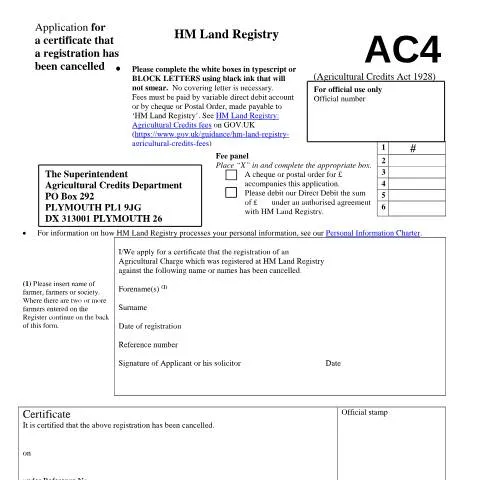
Filling Out the Form AC4
The AC4 form must be completed in BLOCK LETTERS using black ink. Here is a brief overview of the sections you will encounter:
- Applicant's Name and Address: This is where you provide your contact details, including postcode.
- Details of Registration: You will need to input the names associated with the Agricultural Charge.
- Signature: Ensure the application is signed, either by you or your solicitor.
- Payment Information: Decide whether you will pay via cheque or direct debit.
Submitting the Application
Once your application is complete, it can be sent directly to the Agricultural Credits Department at HM Land Registry. The address is:
Superintendent
Agricultural Credits Department
PO Box 292
PLYMOUTH PL1 9JG
Payment of Fees
Fees for processing the AC4 application vary. Currently, they may be paid via direct debit or cheque, made payable to ‘HM Land Registry’. To verify the current fee structure, always refer to the official HM Land Registry website.
Who Can Apply? Eligibility Criteria
In order to submit an application for the AC4 certificate, the applicant must meet specific criteria. This section clarifies who is eligible to apply:
- Individuals: Farmers or private landowners who have registered an Agricultural Charge.
- Organisations: Agricultural societies or companies that hold such a registration.
Conditions for Application
It is important to note that the application must be made only if:
- The Agricultural Charge has been fully paid off.
- No further financial obligations remain connected to the registration.
What Happens After Submission?
Upon successful submission of your application and payment of the requisite fee, you can expect the following:
Processing Time
While processing times can vary, HM Land Registry typically undertakes to process applications within a set timeframe. However, during peak periods or if additional information is needed, it may take longer.
Receiving the Certificate
Once processed, the certificate will be sent to the address provided in your application form. Ensure that the address is accurate to avoid any delays.
Handling Errors or Controversies
What if there’s an error in your application, or perhaps you’ve misplaced your certificate? Here’s how to navigate these situations:
In Case of Errors in the Application
- Contact HM Land Registry: Reach out to them directly as soon as you discover an error.
- Provide Correct Information: Be prepared to supply the correct details promptly to facilitate a quick resolution.
Lost or Misplaced Certificates
If your certificate has been lost, follow these steps to obtain a replacement:
- Submit a Replacement Request: Contact HM Land Registry to request a new certificate.
- Provide Identification: Verification may require you to confirm your identity or provide additional documentation.
Real-World Applications: When and Where is the Certificate Useful?
The value of the AC4 certificate extends beyond mere administrative necessity. Understanding its practical applications can help you decode its importance in your agricultural dealings.
Financing Options
Financial institutions often require proof of cleared debts to ensure their loan portfolios are secure. The AC4 certificate acts as a critical document when:
- Applying for new loans or credit facilities.
- Negotiating terms with potential investors or buyers.
Legal Transactions
When transferring land ownership, having an up-to-date registration status is essential. Buyers will appreciate assurance that no outstanding charges exist against the land they intend to purchase.
Duration of Validity and Renewal Considerations
Unlike many other types of certificates, the AC4 does not require renewal; its importance lies in the moment it is issued. However, understanding how long the cancellation remains effective in the eyes of the law is vital:
Certificate Validity
The AC4 certificate is valid indefinitely once issued, confirming that the Agricultural Charge is no longer applicable. However, keep a copy for your records, as it may be necessary in future transactions or dealings.
Fill in your form directly online
No printing: type your details into the boxes of the official form, tick, then download the PDF ready to send.
- 1Type into the form boxes
- 2Tick in one click
- 3Save and download the PDF
Renewal Contexts
While the AC4 itself does not need renewal, if you secure new financing or undertake additional charges, examine whether different documentation might be necessary.
Final Thoughts: The Importance of Compliance and Accurate Record-Keeping
In an era where financial stability is paramount, understanding the intricacies of forms like the AC4 is crucial. Whether you are a long-standing farmer or an emerging agricultural business, being proactive about your registrations can make all the difference in navigating financial landscapes.
By ensuring that you complete your application accurately and maintain open lines of communication with HM Land Registry, you not only safeguard your interests but also pave the way for future opportunities and growth.
Understanding the Certificate of Cancellation of Registration (AC4)
The Certificate of Cancellation of Registration (AC4) is a vital document in the UK administrative landscape, primarily involving the registration of certain transactions and entities. It's crucial for individuals and businesses to understand the circumstances under which one might need to apply for this certificate, as well as the implications of having a registration cancelled. In essence, the AC4 serves to formalise the cancellation of a registration, which could be due to a variety of reasons such as voluntary deregistration, dissolution, or legal requirements that necessitate the cancellation.
When considering an application for an AC4, it's essential to be aware of the relevant governing bodies. For instance, cancellations related to company registrations fall under the jurisdiction of Companies House, while vehicle registrations would involve the Driver and Vehicle Licensing Agency (DVLA). Each authority has its own specific criteria and processes for issuing a Certificate of Cancellation, and understanding these nuances can significantly streamline your application process.
Moreover, it’s important to note that the AC4 can have various implications depending on the type of registration being cancelled. For businesses, the cancellation could affect their operational capabilities, tax obligations, and overall legal standing. Therefore, individuals and entities should conduct thorough research and, if necessary, seek professional advice to fully comprehend the ramifications before proceeding with an application.
Step-by-Step Guide to Applying for AC4
Applying for a Certificate of Cancellation of Registration requires a systematic approach to ensure that all necessary information and documents are accurately provided. Here’s a step-by-step guide:
- Determine Eligibility: Check if you meet the eligibility criteria for the cancellation of your specific registration. This varies depending on whether it’s a business registration, vehicle registration, or another type.
- Gather Required Documentation: Collect all relevant documents that support your application. This could include proof of identity, original registration documents, and any correspondence related to your cancellation request.
- Complete the Application Form: Fill out the appropriate application form (for instance, the AC4 form). Ensure that all sections are completed accurately to prevent delays in processing.
- Submit Your Application: Follow the submission guidelines provided by the relevant authority. This could involve online submission, mailing physical documents, or visiting a local office.
- Await Confirmation: After submission, monitor your application status. The authorities typically provide an estimated processing time, but it can vary based on workload and the complexity of your request.
- Receive Your Certificate: If your application is approved, you will receive your Certificate of Cancellation of Registration (AC4) in the post or electronically, depending on how you submitted your application.
Throughout this process, it’s also beneficial to maintain copies of all documents submitted and correspondence with the authority. This not only serves as a record for your reference but can also aid in case there are follow-up questions or issues regarding your application.
Common Pitfalls and How to Avoid Them
When applying for a Certificate of Cancellation of Registration (AC4), applicants often encounter several common pitfalls that can delay the process or lead to rejection. Being aware of these potential issues can significantly enhance your chances of a successful application.
- Incomplete Applications: One of the primary reasons applications are rejected is due to incomplete information. Ensure that you double-check all sections of the AC4 form and provide all necessary documentation. It may help to create a checklist based on the requirements outlined by the relevant authority.
- Failure to Meet Deadlines: Each authority has specific deadlines for submitting cancellation requests. Familiarise yourself with these dates to avoid missing deadlines that could complicate your cancellation process.
- Incorrect Fees: Some applications may require a fee for processing. Make sure you are aware of any associated costs and submit the correct payment. If unsure, contact the agency beforehand for clarification.
- Poor Communication: If you are required to correspond with the agency, ensure your communication is clear and concise. Provide all relevant details in your letters or emails to avoid confusion, and always include your reference number if applicable.
- Not Seeking Professional Advice: If your case involves complications—such as financial implications or legal concerns—consulting with an expert can be beneficial. This could be a solicitor, accountant, or a professional knowledgeable in administrative processes.
By proactively addressing these common pitfalls, applicants can navigate the application process with greater confidence and efficiency, resulting in a smooth cancellation experience.