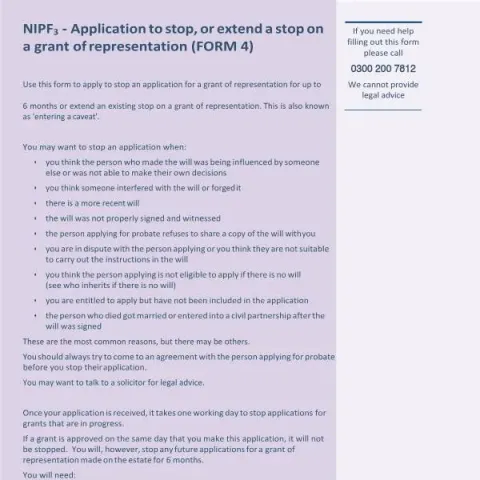
Understanding the NIPF3 Form: Application to Stop or Extend a Stop on a Grant of Representation
The NIPF3 form, issued by the Northern Ireland Executive via nidirect, is an essential legal document designed for individuals who wish to challenge or delay the granting of probate or administration of a deceased person's estate. This form, officially titled Application to stop, or extend a stop on a grant of representation (FORM 4), serves as a tool for those who believe there are grounds to prevent the probate process from proceeding or to extend existing restrictions.
Purpose and When to Use the NIPF3 Form
The primary objective of the NIPF3 form is to enable interested parties to apply for a temporary halt—up to six months—on the issuance of a grant of representation. This process is also known as 'entering a caveat.' It is particularly relevant in situations where there are concerns about the validity of the will, the mental capacity of the deceased, or potential interference or forgery.
Common reasons for submitting this application include:
- Suspicion that the will was influenced or not made freely by the deceased.
- Concerns about interference, forgery, or improper signing of the will.
- The existence of a more recent will that might supersede the current one.
- Disputes over the contents or validity of the will.
- Refusal of the applicant to receive a copy of the will from the person applying for probate.
- Ineligibility of the person applying for probate, especially if they are not the rightful beneficiary.
- Post-will marriage or civil partnership of the deceased, which might affect inheritance rights.
Preparing and Submitting the Application
Before completing the NIPF3 form, applicants should gather key details including:
- An address in Northern Ireland where official correspondence can be sent.
- The full name and address of the deceased, including any aliases.
- The exact date of death.
It is advisable to consult a solicitor for legal advice to ensure the application is correctly prepared. Once ready, the application can be submitted either online or via paper, accompanied by the appropriate fee.
Fees and Payment Methods
The current fee for applying to stop a grant of representation for up to six months is £98. If the applicant wishes to extend this stop for an additional six months, a further fee of £65 applies. Payments can be made by cheque or Postal Order payable to NICTS. Legal professionals can include their ICOS account number for streamlined processing. Alternatively, payment can be made in person at designated courts in Belfast or Derry/Londonderry, or over the phone if paying by card.
Processing and Next Steps
Upon receipt of the application, the authorities aim to process it within one working day. If the application is successful and a grant is in progress, the stop will be enacted immediately. However, if a grant is approved on the same day as the application, the stop will not affect that particular grant but will prevent any future applications for six months.
Applicants will receive a notification confirming receipt, along with a reference number for future correspondence or to request an extension. If an extension is sought, the application must be submitted within one month of the current stop's expiry, providing the existing case reference and expiry date.
Fill in your form directly online
No printing: type your details into the boxes of the official form, tick, then download the PDF ready to send.
- 1Type into the form boxes
- 2Tick in one click
- 3Save and download the PDF
Additional Support and Contact Information
If assistance is needed in completing the form, applicants can contact the dedicated helpline at 0300 200 7812. It is important to note that the authorities cannot provide legal advice, and applicants should seek professional legal counsel if necessary.
Important Considerations
Applicants should always attempt to resolve disputes amicably before submitting an application to stop a grant. The legal process can be complex, and understanding the grounds for challenging a will or probate application is crucial. This form provides a formal mechanism to protect one's interests during the probate process, ensuring fairness and transparency in estate management.