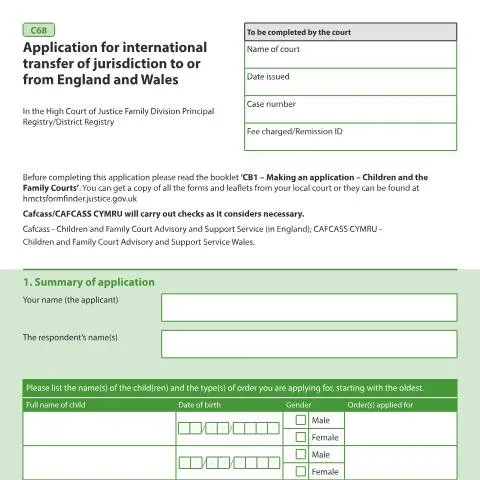
Navigating the Complexities of Form C68: A Guide for Applicants
When it comes to legal proceedings involving children, the process can be fraught with challenges, particularly when jurisdiction is in question. The Application for International Transfer of Jurisdiction to or from England and Wales, commonly referred to as Form C68, plays a crucial role in facilitating these complex legal transitions. Understanding the nuances of this form is essential for those embarking on this journey.
Understanding the Role of Form C68 in International Jurisdiction
Form C68 serves to initiate the transfer of legal jurisdiction from one country to another, particularly in matters regarding child welfare and custody. This application is typically lodged when there are existing court orders that need to be transferred to England and Wales, or vice versa. It’s an important document ensuring that the welfare of the child remains a priority, as different countries have varying laws and regulations regarding family matters.
Key objectives of Form C68 include:
- Facilitating legal communication between jurisdictions.
- Ensuring that the courts in England and Wales are aware of any existing proceedings in other countries.
- Streamlining the transfer process to prevent legal limbo for families involved.
Who Typically Files Form C68?
The applicants for Form C68 are usually parents or guardians who are involved in ongoing family court proceedings. It may also be filed by their solicitors if legal representation is in place. Specific situations that might prompt the need for this form include:
- A parent relocating to England and needing custody arrangements addressed.
- International disputes arising due to abduction or custody conflicts.
- Existing orders from another jurisdiction that require enforcement or modification in England and Wales.
Breaking Down the Sections of Form C68
Completing Form C68 can seem daunting due to the range of information required. Below is a detailed breakdown of each section, highlighting what information is necessary and common pitfalls to avoid.
Section 1: Summary of Application
This section requires the applicant to provide essential details including their name, the respondent's name, and the names of any children involved. Be precise when listing names and the orders you are applying for. Remember, inaccuracies here can delay processing.
- Checklist:
- Ensure names are spelled correctly.
- List children in chronological order by age.
- Specify the type of orders clearly.
Section 2: About You (The Applicant)
In this section, the applicant must provide personal information. If safety is a concern, you may wish to complete the Confidential Contact Details Form C8, which can be obtained from local court offices or the HMCTS website.
- Considerations:
- Double-check your place of birth and nationality.
- Provide all previous addresses if applicable, as failing to do so can lead to complications.
Section 3: The Child(ren)
This section focuses on the child or children involved in the proceedings. Detail each child’s full name, date of birth, gender, and nationality. If there are more than four children, a separate sheet may be required.
- Important:
- Ensure gender and nationality are accurately recorded.
- Consider any current addresses if they differ from yours for relevant parties.
Justifications and Supporting Documents
When submitting Form C68, you need to provide a rationale for the application. This could include evidence of existing proceedings in other jurisdictions or issues under the Human Rights Act 1998. Here’s what to prepare:
Types of Justifications
- Details of current or past court cases involving the child.
- Documentation proving the connection of the child to the countries involved in the jurisdiction transfer.
- Any evidence supporting the need for the transfer, such as issues of safety or ongoing legal conflicts.
Organising Your Supporting Documents
When preparing your supporting documents, categorise them based on relevance. This will streamline the review process:
| Type of Document | Details Required | Importance |
|---|---|---|
| Current Court Orders | Must be copies of all relevant orders from previous cases. | Critical for establishing existing legal frameworks. |
| Evidence of Mediation Attempts | Documentation showing efforts taken to mediate disputes. | Supports the applicant's commitment to resolving matters amicably. |
| Proof of Child’s Connection | Documents showing the child’s residency, schooling, etc. | Important for establishing jurisdictional ties. |
How to Submit Form C68: A Step-by-Step Process
Submitting Form C68 doesn’t merely involve completing it; the submission process is equally crucial. Here’s how to navigate it effectively:
Step 1: Review Your Completed Form
Before submission, ensure that every section has been completed accurately. A thorough review helps prevent delays.
Step 2: Gather All Supporting Documents
Collect all necessary documents that support your application. Ensure they are in the correct order and clearly labelled.
Step 3: Submit to the Appropriate Court
The completed Form C68 and your supporting documents should be lodged either at the High Court of Justice Family Division or the appropriate District Registry. While mailing is an option, in-person submission is recommended to receive immediate confirmation.
Post-Submission: What to Expect Next
Once Form C68 has been submitted, it’s essential to understand the next steps and how to track the progress of your application.
How Applications are Processed
The processing of Form C68 involves several administrative steps:
- The court will evaluate the application based on the information provided.
- Cafcass or CAFCASS CYMRU may perform checks and assessments as deemed necessary.
- You may receive requests for additional documents or clarification on certain points.
Tracking Your Application
To stay updated, you might consider the following:
- Contact the court directly to inquire about the status of your application.
- Keep records of all communications with the court for future reference.
Potential Challenges and How to Overcome Them
Filing Form C68 may present certain challenges, particularly concerning international laws and jurisdictional discrepancies.
Common Obstacles
- Jurisdictional Conflicts: Different countries have varying family laws. It’s advisable to consult with a solicitor specialized in international family law.
- Delays in Processing: Be prepared to respond promptly to any requests for additional information from the court.
Seeking Legal Assistance
If you encounter obstacles, consider reaching out to professionals. Legal experts can provide invaluable guidance and ensure that your application is robust and well-supported.
The Impact of Form C68 on Family Dynamics
Completing and submitting Form C68 is not merely a procedural step; it can significantly impact family dynamics, especially where children are concerned. Understanding this impact is vital for all involved.
Emotional Considerations
The transfer of jurisdiction can create uncertainty for the children involved. Consider engaging with family mediation services to smoothen the transition and ensure the best outcomes for all parties.
Legal Repercussions
Failure to file Form C68 properly can lead to complications such as jurisdiction disputes and enforcement issues, particularly if a parent does not comply with existing orders from another jurisdiction.
Practical Tips for a Successful Submission
To navigate the complexities surrounding Form C68 successfully, consider the following practical advice:
Maintain Clear Communication
Keep all communications open with your solicitor, the court, and any involved parties. Clear communication ensures that everyone is on the same page and can minimize misunderstandings.
Stay Informed About Legal Changes
Family law can evolve, and staying abreast of changes can provide a significant advantage. Regularly consult legal resources or your solicitor for updates.
Document Everything
Maintain detailed records of your application process, including all correspondence and submitted documents. This can be invaluable for tracking progress and addressing any future concerns.
By understanding the intricacies of Form C68 and adhering to the guidelines outlined, applicants can navigate the complexities of international jurisdiction transfer more effectively, ensuring that the best interests of the children involved remain the priority.
Understanding the Grounds for Transfer of Jurisdiction
In the context of international law, the application for the transfer of jurisdiction to or from England and Wales using Form C68 involves specific grounds that must be substantiated. It's vital to recognize that not all cases will qualify for such a transfer. The key grounds for transfer can include:
Habitual Residence: Demonstrating that the individual or the family has established their primary home in the respective jurisdiction is often a strong argument for transferring the case. Habitual residence typically considers where a person has lived regularly and is often evaluated over the past year.
Best Interests of the Child: In cases involving children, the court prioritizes their welfare. If residing in a different jurisdiction serves the best interests of the child, this factor may sway the decision. Evidence might include schooling arrangements, family support systems, and stability offered by the new jurisdiction.
Safety Concerns: If there are substantial concerns regarding safety in the current jurisdiction—such as domestic violence or abuse—this can also provide a compelling reason for transfer. Adequate documentation, such as police reports or court orders, will bolster this argument.
Fair Trial Considerations: If transferring the jurisdiction would ensure a fair trial—such as avoiding significant legal or practical disadvantages in the current jurisdiction—this could further justify the application. This includes considerations such as legal representation, language barriers, and cultural nuances that may impact the case.
Connection to the New Jurisdiction: Establishing a substantive connection to the new jurisdiction—such as family ties, employment, or community involvement—can support the argument for transfer. This connection helps illustrate why the case should be handled in the requested jurisdiction.
When making an application, it is essential to document these grounds thoroughly and present them clearly in Form C68. The evidence provided will play a crucial role in persuading the presiding family court to grant the transfer.
Fill in your form directly online
No printing: type your details into the boxes of the official form, tick, then download the PDF ready to send.
- 1Type into the form boxes
- 2Tick in one click
- 3Save and download the PDF
Completing Form C68: Key Sections and Common Challenges
Filling out Form C68 requires meticulous attention to detail, as each section of the form serves a specific purpose in the overall application. Understanding the key sections of the application can help alleviate common challenges faced by applicants. Here are the significant sections you’ll encounter:
Applicant Information: This section requires detailed personal information about the applicant, including full name, address, and National Insurance number. It is crucial to ensure that all information is accurate and up to date, as discrepancies can delay processing.
Respondent Information: Similar to the applicant section, the form requires comprehensive details about the respondent. If the respondent resides in a different jurisdiction, additional information about their location and contact details must be provided.
Case Details: This part of the form asks for a summary of the existing case, including the court that currently has jurisdiction and the nature of the proceedings (e.g., child custody, financial arrangements). Be concise yet thorough, as this section will help the court understand the context of your request.
Reasons for Transfer: This is arguably the most critical section, where you must outline the grounds for requesting a jurisdiction transfer. Here, applicants often struggle. It is advisable to clearly state your reasons and support them with any relevant evidence. Use bullet points or short paragraphs to enhance readability.
Supporting Evidence: This section allows you to list and attach any documentation that supports your claim. This can include previous court orders, affidavits, or any other relevant information that reinforces your request. Ensure that all evidence is appropriately referenced in the form.
Required Signatures: Make sure to sign and date the application. Unsigned forms are a frequent source of delays, as they cannot be processed until they are duly signed.
Common challenges when filling out Form C68 include misunderstandings about what constitutes supporting evidence and how to present it effectively. It is advisable to consult with legal assistance if there is uncertainty, especially if the circumstances surrounding the case are complex.
Post-Submission Process: What to Expect After Filing Form C68
Once Form C68 has been submitted to the relevant family court, applicants should be prepared for various procedural steps that follow. Understanding the post-submission process can help manage expectations and ensure that necessary actions are taken promptly.
Acknowledgement of Receipt: After filing, applicants typically receive an acknowledgment from the court confirming receipt of the application. This can take anywhere from a few days to a couple of weeks, depending on the court’s workload. Keep this document in your records.
Review Period: The court will enter a review period where a judge will assess the merits of the application. This period can vary significantly based on the complexity of the case and the current demand on court resources. Patience is essential during this stage, as cases are prioritized based on urgency and significance.
Court Hearing: In many instances, a court hearing may be scheduled where both parties can present their cases. The applicant must be prepared to explain their reasons for the transfer and answer any questions from the judge. It is advisable to engage legal representation during this stage to ensure that arguments are framed effectively and that procedural rules are followed.
Decision Notification: After deliberation, the court will issue a decision regarding the application. Applicants will receive a formal notification outlining whether the transfer has been granted or denied. If the application is denied, the notification will typically include reasons for the decision, which can be crucial for any potential appeals.
Next Steps: If the transfer is granted, the applicant must follow the necessary steps to comply with the new jurisdiction's requirements. This may include notifying relevant authorities in both jurisdictions and ensuring that any ongoing proceedings are transitioned smoothly.
Appeal Process: In the event of a denial, there may be an opportunity to appeal the decision. Applicants must adhere to specific procedures and timelines for submitting an appeal, which will typically be outlined in the decision notification.
Being informed about these steps can significantly enhance an applicant's confidence and preparedness as they navigate the complexities associated with transferring jurisdiction.