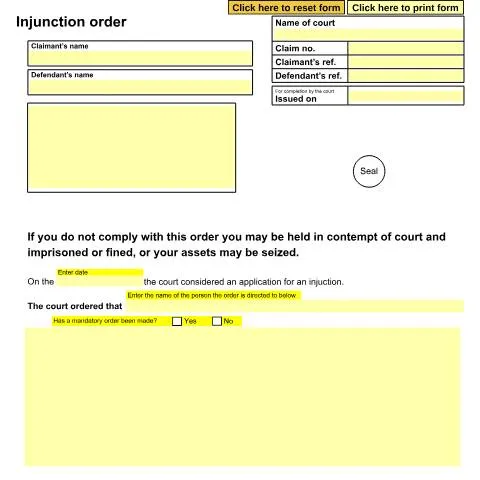
Understanding the N16 Injunction Order: A Comprehensive Legal Instrument
When urgent legal circumstances demand immediate court intervention to prevent irreparable harm, the Form N16 serves as the definitive court document that transforms judicial decisions into enforceable legal orders. This general form of injunction, whether issued through interim applications or originating applications, represents one of the most powerful tools within the civil justice system of England and Wales, administered by HM Courts & Tribunals Service.
The N16 form encapsulates the court's authority to compel or restrain specific actions, creating legally binding obligations that carry serious consequences for non-compliance. Unlike standard civil claims that seek monetary compensation, injunctions address situations where money cannot adequately remedy the harm – making this document particularly significant for disputes involving ongoing breaches, threatened damage, or circumstances requiring immediate judicial intervention.
The Dual Nature of N16 Applications: Interim Versus Originating Proceedings
The N16 form accommodates two distinct procedural pathways, each serving different strategic purposes within civil litigation. Understanding this distinction proves crucial for legal practitioners and litigants navigating the complexities of injunctive relief.
Interim Applications: Emergency Response Mechanisms
Interim injunctions through Form N16 typically arise during existing proceedings when circumstances change dramatically or when immediate protection becomes necessary. These applications often emerge in commercial disputes where one party threatens to breach contractual obligations, intellectual property cases involving ongoing infringement, or neighbour disputes where continuing actions cause substantial harm.
The interim process demands urgent consideration by the court, frequently requiring applications to be made on notice or even without notice in extreme circumstances. Courts maintain strict office hours between 10 am and 4 pm, Monday to Friday, but emergency applications outside these hours may be accommodated through designated out-of-hours procedures for genuinely urgent matters.
Originating Applications: Standalone Injunctive Proceedings
When injunctive relief constitutes the primary or sole remedy sought, practitioners initiate proceedings directly through the N16 as an originating application. This approach proves particularly effective in cases involving:
- Restrictive covenant enforcement between property owners
- Professional regulatory breaches requiring immediate cessation
- Environmental nuisances demanding urgent intervention
- Intellectual property disputes where continuing infringement threatens irreparable damage
Originating applications establish entirely new proceedings, with the N16 serving as both the initiating document and the eventual order format, streamlining the process for cases where monetary damages remain inappropriate or insufficient.
Critical Components and Completion Requirements
The N16 form contains several mandatory sections that courts complete with meticulous attention to detail, ensuring enforceability and clarity for all parties involved.
Essential Identification Elements
Each N16 must specify the exact court office handling the matter, complete with the designated claim number that becomes the permanent reference for all subsequent correspondence. The form requires both claimant and defendant reference numbers, facilitating efficient case management within busy court systems.
| Field | Purpose | Completion Authority |
|---|---|---|
| Court Name | Establishes jurisdiction and enforcement authority | Court Administration |
| Claim Number | Unique identifier for case tracking | Court Administration |
| Issue Date | Determines when obligations commence | Judicial Officer |
| Court Seal | Provides official authentication | Court Administration |
Party Identification and Service Requirements
Precise identification of both claimant and defendant proves essential for subsequent enforcement proceedings. Courts require full legal names rather than trading names or abbreviations, ensuring that any breach can be properly attributed and enforcement action effectively pursued.
The issued date holds particular significance as it establishes when the injunctive obligations take effect. Courts typically issue N16 orders on the same day as the hearing, though complex cases may require reserved judgments with later issue dates.
Navigating Court Procedures and Administrative Requirements
Successfully obtaining an N16 injunction requires careful attention to procedural requirements that vary depending on the urgency and nature of the application.
Standard Application Procedures
Most N16 applications follow established civil procedure rules requiring formal application notices, supporting evidence, and appropriate fees. Applicants must demonstrate both a serious question to be tried and that the balance of convenience favours granting the injunction.
Courts expect comprehensive evidence addressing the likelihood of success on the merits, the adequacy of damages as an alternative remedy, and the respective hardships that granting or refusing the injunction might cause to each party.
Urgent and Emergency Procedures
When circumstances demand immediate intervention, courts accommodate urgent applications through abbreviated procedures. These may include telephone applications to duty judges, expedited hearings with minimal notice periods, or even ex parte applications where giving notice would defeat the purpose of seeking relief.
Emergency applications outside standard court hours require contact with designated emergency numbers, though courts maintain strict criteria for determining what constitutes genuine urgency warranting out-of-hours intervention.
Enforcement Mechanisms and Compliance Obligations
Once issued, the N16 creates legally binding obligations backed by the full authority of the court system. Understanding enforcement mechanisms proves crucial for both parties subject to injunctive orders.
Immediate Compliance Requirements
Injunctions typically take effect immediately upon service on the defendant, regardless of whether an appeal is contemplated. This immediate effect distinguishes injunctions from monetary judgments, which may be stayed pending appeal proceedings.
Recipients of N16 orders must ensure that their employees, agents, and representatives understand the scope of the injunction, as corporate defendants remain liable for breaches committed by their staff acting within their employment.
Consequences of Non-Compliance
Breach of an N16 injunction constitutes contempt of court, carrying serious consequences including:
- Unlimited fines proportionate to the seriousness of the breach
- Imprisonment for up to two years for individuals
- Sequestration of assets for corporate defendants
- Director disqualification in appropriate cases
Courts take particular care to ensure that injunction terms are sufficiently clear and precise that defendants understand exactly what actions are prohibited or required, preventing inadvertent breaches that could trigger contempt proceedings.
Variations, Discharge Applications, and Ongoing Case Management
The dynamic nature of civil disputes often necessitates modifications to original N16 orders as circumstances evolve or new evidence emerges.
Variation Applications
Either party may seek variation of an existing N16 order when changed circumstances justify modification of the original terms. Common grounds include:
- Material changes in the underlying factual situation
- Discovery of evidence not available at the original hearing
- Practical difficulties in complying with overly broad injunctive terms
- Changes in law affecting the enforceability of specific provisions
Variation applications require formal application procedures similar to the original injunction application, including supporting evidence and appropriate fees.
Discharge Proceedings
Defendants may seek complete discharge of N16 orders by demonstrating that the original grounds for granting the injunction no longer exist or that the injunction causes disproportionate hardship compared to the benefit it provides to the claimant.
Successful discharge applications often rely on showing that the threat of harm that justified the original injunction has permanently ceased, or that adequate alternative remedies have become available that render the injunction unnecessary.
Strategic Considerations for Different Categories of Applicants
The effectiveness of N16 applications varies significantly depending on the applicant's circumstances, the nature of the dispute, and the specific relief sought.
Commercial and Business Applications
Commercial entities frequently utilise N16 forms in disputes involving breach of restrictive covenants, protection of confidential information, or prevention of unfair competition. These applications often involve complex factual scenarios requiring extensive documentary evidence and expert testimony.
Business applicants must carefully consider the commercial relationships that injunctive relief might affect, particularly where ongoing contractual relationships exist between the parties that could be damaged by adversarial proceedings.
Individual and Personal Applications
Private individuals seeking N16 relief often face different challenges, particularly regarding the financial resources required for comprehensive legal representation and the emotional stress of ongoing litigation.
Personal applicants frequently benefit from exploring alternative dispute resolution mechanisms before pursuing injunctive relief, as these approaches may preserve relationships while achieving the desired outcome more cost-effectively.
Administrative Processing and Court Communication Protocols
Effective interaction with court administration significantly influences the efficiency and success of N16 applications.
Correspondence and Documentation Standards
All communications with the court must be addressed to the Court Manager and include the designated claim number for proper file management. Courts maintain strict documentation standards, requiring legible copies of all supporting materials and compliance with prescribed formatting requirements.
The crown copyright notice on Form N16 reflects its status as an official court document, requiring careful handling and appropriate reproduction standards when multiple copies are needed for service or court bundles.
Monitoring and Follow-Up Procedures
Given the limited court office hours of 10 am to 4 pm on weekdays, parties must plan their communications and applications accordingly. Courts do not guarantee same-day processing of routine applications, though urgent matters receive expedited attention when circumstances justify immediate intervention.
Regular monitoring of case progress through appropriate channels ensures that parties remain informed of developments and can respond promptly to court requirements or opponent applications that might affect their interests.
Strategic Considerations for Interim vs Final Relief Applications
When completing Form N16, applicants must carefully consider whether they are seeking interim relief pending a full trial or pursuing a final injunction as their primary remedy. This distinction fundamentally shapes how you approach the form and what evidence you must provide.
Fill in your form directly online
No printing: type your details into the boxes of the official form, tick, then download the PDF ready to send.
- 1Type into the form boxes
- 2Tick in one click
- 3Save and download the PDF
For interim applications, the court applies the well-established American Cyanamid test, which requires you to demonstrate: firstly, that there is a serious question to be tried (not a frivolous or vexatious claim); secondly, that damages would not be an adequate remedy if the injunction is refused; and thirdly, that the balance of convenience favours granting the injunction. When completing section 3 of Form N16, you should explicitly address each limb of this test with specific reference to your circumstances.
The adequacy of damages criterion often proves decisive. If you're a small business seeking to prevent a former employee from breaching restrictive covenants, you might argue that the loss of confidential client relationships cannot be adequately compensated in monetary terms. Conversely, if you're a large corporation with easily quantifiable losses, the court may be more reluctant to grant interim relief.
For final relief applications, the evidential burden is significantly higher. You must prove your case on the balance of probabilities rather than merely showing an arguable case. This affects how you complete the witness statement sections and what supporting documentation you attach. Final applications typically require more extensive discovery, expert evidence where technical issues arise, and detailed financial disclosure if the injunction relates to commercial disputes.
The urgency factor also influences your approach. If seeking interim relief without notice (ex parte), you must provide compelling evidence of why giving notice to the respondent would defeat the purpose of the application. This might apply in cases of threatened destruction of evidence, imminent asset dissipation, or where notice would trigger the very conduct you seek to prevent. The court scrutinises such applications particularly carefully, and you bear a duty of full and frank disclosure of all material facts, including those that might favour the respondent.
Consider also the duration of relief sought. Interim injunctions typically last until trial or further order, while final injunctions may be permanent or time-limited. If seeking a permanent injunction, you should address in your application why lesser remedies (such as undertakings or limited duration orders) would be insufficient to protect your interests.
Cross-Undertakings in Damages and Financial Security Requirements
A critical aspect often overlooked by litigants in person is the cross-undertaking in damages that typically accompanies interim injunctions. When the court grants your application, you usually must undertake to compensate the respondent for any losses they suffer if the injunction is later found to have been wrongly granted. This undertaking can expose you to significant financial liability.
The court may require you to provide security for this cross-undertaking, particularly if you are not resident in England and Wales, have limited assets, or if the potential losses to the respondent could be substantial. Security might take the form of a payment into court, a bank guarantee, or other acceptable financial instruments. You should be prepared to address your financial position and ability to honour any cross-undertaking when completing Form N16.
In exceptional circumstances, the court may dispense with the requirement for a cross-undertaking. This typically applies where the applicant is impecunious and the case involves matters of public interest, or where statute provides specific protection (such as certain environmental or consumer protection cases). If you believe your case falls into this category, you should make specific representations in your application explaining why the usual rule should not apply.
The quantum of potential liability under a cross-undertaking can be significant. For instance, if you obtain an interim injunction preventing a company from launching a new product, and that injunction is later discharged, you might be liable for the company's lost profits during the period of the injunction. Courts have awarded damages running into millions of pounds on cross-undertakings, so this is not a commitment to enter into lightly.
When completing Form N16, you should include a realistic assessment of the potential losses the respondent might suffer if the injunction is granted. This demonstrates to the court that you understand the gravity of what you are seeking and have considered the implications for all parties. If the potential liability is substantial relative to your means, you might consider whether alternative remedies (such as seeking undertakings from the respondent) might be more appropriate.
Some applicants attempt to limit their exposure by seeking to cap the cross-undertaking at a specific sum. While courts occasionally agree to such arrangements, they are reluctant to do so unless there are compelling reasons, as it could leave respondents inadequately protected. If you wish to pursue this route, you must provide detailed evidence of your financial position and explain why a conventional unlimited cross-undertaking would be inappropriate.
Procedural Variations for Specific Types of Injunctive Relief
Different categories of injunctive relief carry distinct procedural requirements that affect how you complete Form N16 and what additional steps you must take. Understanding these variations is crucial for ensuring your application follows the correct procedural pathway.
Search orders (formerly Anton Piller orders) represent one of the most intrusive forms of relief available. If your application seeks permission to enter the respondent's premises to search for and preserve evidence, you must satisfy extremely strict criteria. The application must demonstrate a strong prima facie case, potential or actual serious damage to your interests, clear evidence that the respondent possesses crucial evidence, and a real possibility that evidence will be destroyed before disclosure can occur through normal channels. Such applications are invariably made without notice and require the attendance of an independent solicitor to supervise the search. When completing Form N16 for a search order, you must provide detailed proposals for how the search will be conducted, including arrangements for the independent solicitor and undertakings regarding the treatment of privileged or confidential material.
Freezing orders (formerly Mareva injunctions) prevent respondents from dissipating assets pending judgment. These applications require evidence of a good arguable case on the merits and a real risk of asset dissipation. The risk need not be evidenced by express threats; it may be inferred from the nature of the respondent's business, their conduct, or the structure of their affairs. When seeking a freezing order through Form N16, you must specify the maximum sum to be frozen (typically the value of your claim plus costs and interest) and provide details of the respondent's known assets. The court will typically require detailed financial disclosure from the respondent once the order is made.
Mandatory injunctions, which require positive action rather than mere restraint, face a higher threshold than prohibitory injunctions. Courts are more reluctant to make orders requiring ongoing supervision or compelling specific performance of complex obligations. If your Form N16 application seeks mandatory relief, you must demonstrate that the case is unusually strong and that prohibitory relief would be inadequate. You should also address how compliance with any order could be monitored and enforced.
Springboard injunctions prevent respondents from benefiting from past wrongdoing, even after the wrongdoing has ceased. These are particularly relevant in employment cases where former employees have misused confidential information. The injunction extends beyond the natural expiry of restrictive covenants to neutralise any ongoing advantage gained from the breach. When applying for springboard relief, you must identify the specific advantage gained and explain why conventional remedies would be insufficient to address the continuing effects of the wrongdoing.
Privacy injunctions, often sought to prevent publication of private information, must navigate the complex balance between Article 8 (privacy) and Article 10 (freedom of expression) rights under the Human Rights Act 1998. Such applications typically require immediate consideration due to the nature of media deadlines. If your Form N16 application relates to privacy or confidential information, you should specifically address the public interest in publication versus the claimant's legitimate expectation of privacy, applying the guidance established in cases such as Campbell v MGN Limited.
Group litigation or representative actions may require modified procedures when seeking injunctive relief affecting multiple parties. The court must consider whether all affected parties are adequately represented and whether the proposed injunction would bind non-parties. If your application affects a class of persons, you should address in Form N16 how notice will be given to affected parties and whether separate representation is required for different interest groups within the class.