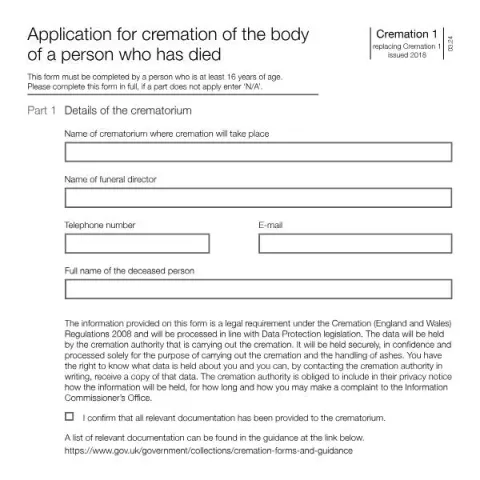
When Death Calls for Cremation: Understanding the Ministry of Justice Application Process
The death of a loved one brings an overwhelming cascade of decisions, and amongst the most pressing is determining how their remains will be handled. For families choosing cremation in England or Wales, the Cremation 1 form stands as the mandatory gateway through which all cremation arrangements must pass. This Ministry of Justice document, replacing its 2018 predecessor as of March 2024, represents far more than mere bureaucracy—it serves as a legal safeguard ensuring that cremations proceed only with proper authority and full awareness of all parties involved.
Unlike burial arrangements, which operate under different regulatory frameworks, cremation requires explicit written consent documented through this specific application. The process involves multiple stakeholders: the applicant (typically a family member), the crematorium authority, funeral directors, and medical practitioners who attended the deceased. Each plays a crucial role in ensuring the cremation proceeds lawfully and respectfully.
Establishing Your Right to Apply: The Hierarchy of Authority
Not everyone can simply decide to cremate a deceased person's remains. The Cremation (England and Wales) Regulations 2008 establish a clear hierarchy of authority that determines who holds the legal right to make this application. Understanding your position within this hierarchy proves essential before completing any paperwork.
Near relatives occupy the primary position of authority. The regulations define this category precisely: the widow, widower, or surviving civil partner of the deceased, parents, children, or any other relative who usually resided with the deceased person. The phrase "usually residing" carries legal weight—occasional visits or temporary stays don't qualify someone as a near relative under these regulations.
Executors named in a valid will hold equivalent authority to near relatives. However, complications arise when multiple executors exist, or when executor status remains disputed. The form requires confirmation of whether any near relative or executor has been left uninformed about the proposed cremation, acknowledging that family dynamics often complicate end-of-life decisions.
| Relationship Category | Automatic Right to Apply | Special Considerations |
|---|---|---|
| Spouse/Civil Partner | Yes | Must provide marriage/civil partnership certificate |
| Parents/Children | Yes | Birth certificates may be required |
| Cohabiting Relative | Yes | Proof of usual residence needed |
| Named Executor | Yes | Will must be available for inspection |
| Other Relatives | Conditional | Must explain absence of higher-priority applicants |
| Non-relatives | Exceptional | Detailed justification required |
When someone outside these primary categories seeks to apply, they must provide detailed explanations in Part 2 of the form. This might occur when no near relatives exist, when family members live abroad and cannot act quickly enough, or in cases involving estranged families. The cremation authority will scrutinise such applications carefully, potentially requesting additional documentation or witness statements.
Navigating Family Consent and Potential Objections
The form's most sensitive sections address family notification and potential objections to the proposed cremation. These requirements reflect the irreversible nature of cremation and the legal system's recognition that family members may hold strong religious, cultural, or personal views about body disposal methods.
Section 2 of Part 2 requires applicants to confirm whether all near relatives and executors have been informed about the cremation plans. This isn't merely a courtesy—it's a legal requirement designed to prevent cremations proceeding against the wishes of those with legitimate interests in the deceased's remains. The form demands specific names and reasons when family members haven't been contacted.
Common legitimate reasons for non-notification include: relatives living abroad without known contact details, estrangement predating the death by several years, or relatives who explicitly requested no contact regarding funeral arrangements. However, convenience or family disagreements about other matters don't constitute valid reasons for excluding relatives from notification.
Question 3 addresses direct objections to cremation. Any expressed objection from a near relative or executor must be detailed fully, including the objector's name and the nature of their concerns. Such objections don't automatically prevent cremation, but they trigger additional scrutiny from the cremation authority. Religious objections, concerns about the deceased's previously expressed wishes, or disputes over the applicant's authority commonly arise.
Practical tip: Document all attempts to contact family members, including dates, methods used (phone, email, post), and any responses received. This documentation becomes crucial if the cremation authority questions the notification process.
Medical Histories and Hazardous Implant Protocols
Part 3 of the form delves into medical details that directly impact cremation safety and procedures. The section requiring medical practitioner information isn't merely administrative—it ensures the cremation authority can verify death certificates and, if necessary, contact medical professionals who treated the deceased during their final illness.
The questions about hazardous implants represent a critical safety protocol. Modern medical devices pose genuine risks during cremation: pacemakers can explode due to battery expansion, radioactive implants may contaminate cremation chambers, and certain orthopaedic devices like the "Fixion" intramedullary nailing system can cause dangerous reactions at high temperatures.
Applicants often struggle with these medical questions, particularly when the deceased received treatment at multiple facilities or when medical records aren't immediately accessible. The form acknowledges this reality by including "Don't know" options, but selecting these triggers additional verification requirements.
When implants are identified, the form requires confirmation of their removal. This typically involves coordination between funeral directors and medical facilities. Some devices must be removed by qualified medical personnel before the body reaches the crematorium, whilst others can be handled by crematorium staff using appropriate safety protocols.
Common oversight: Dental work containing mercury amalgam fillings, whilst not strictly hazardous implants, should be mentioned to crematorium staff due to environmental regulations governing mercury emissions during cremation.
Ash Disposal Decisions: Understanding Your Long-Term Commitments
Part 4 confronts applicants with decisions that extend far beyond the cremation itself. The form's definition of "ashes" as "all the material left in the cremator after cremation, and following the removal of any metal, and any subsequent grinding or other process" underscores the comprehensive nature of what families will receive or must decide upon.
The three disposal options reflect different approaches to memorialisation and family involvement. Option 1—crematorium handling—suits families preferring professional management without ongoing responsibility. Many crematoria offer gardens of remembrance, memorial walls, or scattered areas where ashes receive dignified treatment according to established protocols.
Option 2—collection from the crematorium—places responsibility on families but offers maximum flexibility for private ceremonies, burial in family plots, or keeping ashes at home. However, this option requires someone to collect the ashes within reasonable timeframes, typically 4-6 weeks after cremation, though policies vary between cremation authorities.
Option 3—temporary holding—provides breathing space for families needing time to decide, but it's not indefinite storage. Most cremation authorities charge fees after initial holding periods, and some have legal obligations to dispose of unclaimed ashes after specified timeframes, usually 12-24 months.
The form emphasises that Options 1 and 2 can be changed before implementation, provided changes are confirmed in writing with signatures. This flexibility acknowledges that grief can cloud decision-making and families may reconsider their initial choices as they process their loss.
Metal Recovery Considerations
The cremation process inevitably recovers metals from dental work, joint replacements, and other medical devices. By default, cremation authorities dispose of these metals through established recycling programmes, often generating modest revenues for crematorium maintenance or charitable donations. However, families can request return of metals, either within the ashes or separately, though this choice should be made thoughtfully as metal fragments can be distressing to encounter unexpectedly.
Exceptional Circumstances: Early Pregnancy Loss and Recovery Challenges
Part 5 addresses one of the most sensitive aspects of cremation services: situations where no recoverable ashes result from the process. This occurs most commonly with early pregnancy losses but can also happen with bodies severely affected by certain medical conditions or treatment methods.
The form's acknowledgment of this possibility serves multiple purposes: it prepares families psychologically, establishes legal protections for cremation authorities, and ensures informed consent about potential outcomes. Cremation authorities must document their efforts to recover ashes, but physical laws govern what remains after high-temperature cremation processes.
When no ashes are recoverable, families face unexpected grief complications. The absence of physical remains to scatter, bury, or keep can intensify feelings of loss. Cremation authorities typically offer alternative memorial options—memorial entries in books of remembrance, plaques in gardens of remembrance, or participation in annual memorial services.
Submission Protocols and Processing Timelines
Completing the Cremation 1 form represents just the beginning of the cremation authorisation process. The form must accompany a comprehensive documentation package including death certificates, medical certificates, and any coroner's authorisations. The guidance referenced in the form—available through the government's cremation forms and guidance collection—provides detailed checklists of required supporting documents.
Processing timelines vary significantly based on circumstances surrounding the death. Straightforward cases with complete documentation and no family disputes typically process within 24-48 hours of submission. However, cases involving coroner investigations, disputed family authority, or missing documentation can extend processing for weeks.
The form must be completed by someone at least 16 years old, reflecting the legal system's recognition that cremation decisions carry adult responsibilities. This age requirement occasionally creates complications when young people are the only available relatives, requiring involvement of social services or legal guardians in some cases.
Data protection considerations embedded throughout the form reflect compliance with the Data Protection Act 2018 and UK GDPR requirements. Cremation authorities must maintain detailed privacy notices explaining how personal information is processed, stored, and eventually destroyed. Families retain rights to access their data and complaint mechanisms through the Information Commissioner's Office.
Professional Coordination and Authority Verification
The cremation application process involves careful coordination between multiple professional parties, each carrying specific legal obligations. Funeral directors often facilitate form completion, but legal responsibility rests with the applicant signing the document. This distinction becomes important if disputes arise or if information proves inaccurate.
Cremation authorities receiving completed applications must verify applicant identity and authority before proceeding. This verification process may involve requesting additional documentation, contacting other family members, or consulting with legal advisors when authority questions arise. The irreversible nature of cremation makes thorough verification essential, even when it delays proceedings.
Medical practitioner information serves verification purposes and potential investigation needs. If questions arise about the death circumstances or if additional medical information becomes necessary, cremation authorities need reliable contact details for treating physicians. This requirement occasionally reveals gaps in medical care documentation, particularly for elderly individuals with complex care arrangements involving multiple providers.
The form's emphasis on complete information reflects the cremation authority's legal liability for ensuring proper authorisation. Incomplete or inaccurate applications can result in delayed cremations, family distress, and potential legal complications. Taking time to gather complete, accurate information before submission ultimately serves everyone's interests in achieving dignified, legally compliant cremation services.
Special Circumstances and Complex Cases
Certain situations require additional documentation or modified procedures when completing your cremation application. Understanding these circumstances beforehand can prevent delays and ensure compliance with statutory requirements.
Deaths Under Investigation by HM Coroner
When a death falls under coroner jurisdiction, you cannot proceed with cremation until the coroner releases the body. The coroner's office will issue either Form 99 (coroner's certificate for cremation) or Form E (removal of body for cremation after post-mortem). These replace the standard medical certificates normally required. The cremation authority must receive the coroner's documentation before accepting your application.
Common scenarios requiring coroner involvement include sudden unexplained deaths, deaths in custody, industrial accidents, or cases where the deceased hadn't seen a doctor within 14 days before death. The coroner's investigation timeline varies significantly—from several days for straightforward cases to months for complex inquiries involving post-mortems or inquests.
Repatriation and International Cases
For bodies being repatriated to England or Wales for cremation, additional documentation proves essential. You'll need the original foreign death certificate with an official English translation if issued in another language. The Foreign, Commonwealth & Development Office may need to authenticate documents through apostille certification, depending on the country of death.
Conversely, when cremating in England or Wales before repatriating ashes internationally, research destination country requirements early. Some nations restrict ash importation or require specific cremation certificates. The crematorium can usually provide certified copies of cremation certificates, but obtaining these post-cremation may incur additional fees and delays.
Fill in your form directly online
No printing: type your details into the boxes of the official form, tick, then download the PDF ready to send.
- 1Type into the form boxes
- 2Tick in one click
- 3Save and download the PDF
Religious and Cultural Considerations
Different faith communities maintain varying requirements affecting cremation applications. Islamic and Orthodox Jewish traditions generally prohibit cremation, whilst Hindu, Sikh, and Buddhist practices often specify particular timing or ceremonial elements. Some crematoriums accommodate specific religious needs, such as allowing family members to initiate the cremation process or providing facilities for ritual washing.
Inform the crematorium of any religious requirements when submitting your application. This might influence scheduling, as some faiths require cremation within specific timeframes or on particular days. Certain crematoriums maintain dedicated areas or equipment for different religious practices, potentially affecting availability and booking arrangements.
Fees, Payment Methods, and Financial Assistance
Cremation costs encompass multiple components beyond the basic cremation fee, and understanding the full financial picture helps families plan accordingly.
Mandatory and Optional Charges
The crematorium charges a basic cremation fee covering the cremation process itself, typically including use of the chapel for a standard service duration (usually 30-45 minutes). Additional charges often apply for extended service times, weekend or bank holiday cremations, or use of specific facilities like organ accompaniment or audio-visual equipment.
Medical referee fees represent another mandatory cost—the appointed doctor who reviews cremation applications charges a statutory fee for examining the medical certificates and authorising cremation. This fee remains separate from crematorium charges and varies between different medical referees.
Optional services generating additional costs include memorial books, plaques, or garden of remembrance plots. Some crematoriums offer webcast services for remote attendees or digital tribute facilities, each carrying separate charges. Discuss all potential costs upfront to avoid unexpected expenses.
Payment Timing and Methods
Most crematoriums require payment before conducting the cremation, though payment timing varies between facilities. Some accept payment when booking, others on the day of service. Payment methods typically include bank transfers, cheques, or card payments, though cash acceptance varies by crematorium.
When using funeral directors, they often handle crematorium payments as part of their service, adding cremation fees to the overall funeral account. This arrangement can simplify payment logistics but may affect timing of when you receive cremation certificates or other documentation.
Financial Support Options
The Department for Work and Pensions provides Funeral Expenses Payment through the Social Fund for eligible claimants receiving certain benefits. This payment can cover cremation fees, though it may not cover the full cost depending on local crematorium charges and your circumstances.
Some local authorities maintain public health funeral provisions for cases where no suitable arrangements exist, though these typically involve basic services without family input on arrangements. Veterans' organisations sometimes provide financial assistance for ex-service personnel, whilst some employers offer bereavement support including financial help with funeral costs.
Post-Cremation Procedures and Documentation
Completing the cremation application represents just the beginning of a process that extends beyond the cremation ceremony itself, involving important administrative steps and decisions about cremated remains.
Cremation Certificate and Official Records
Following cremation, the crematorium issues a cremation certificate confirming the process has occurred according to statutory requirements. This document serves as official proof of cremation and may be required for various administrative purposes, including insurance claims, pension arrangements, or legal proceedings.
The cremation certificate includes details such as the deceased's name, date of cremation, crematorium location, and confirmation that cremation occurred in accordance with statutory provisions. Keep multiple certified copies, as various organisations may require original documentation rather than photocopies.
The crematorium maintains permanent records of all cremations, including details from your application and associated medical certificates. These records remain accessible for future reference, though accessing historical information may involve fees and formal application procedures.
Collection and Disposal of Cremated Remains
Crematoriums typically retain cremated remains for a specified period—commonly four weeks to three months—before requiring collection or disposal decisions. The person who signed the cremation application usually holds responsibility for collecting remains, though they may authorise others in writing to collect on their behalf.
When collecting remains, bring photographic identification and any documentation provided by the crematorium. Some facilities require advance notice for collection, particularly outside normal office hours or during busy periods.
If remains go uncollected within the specified timeframe, crematoriums follow their individual policies, which might include scattering in designated garden areas, interment in common graves, or extending the collection period with additional charges. Discuss collection arrangements clearly when submitting your application to avoid complications.
For remains being scattered or interred elsewhere, check whether destination locations require specific permissions or documentation. Private land scattering needs landowner consent, whilst some public locations maintain restrictions or require formal applications. Church graveyards, municipal cemeteries, or designated memorial gardens each operate under different regulatory frameworks affecting ash interment or scattering permissions.